Raised Floor for Semiconductor Market Insights
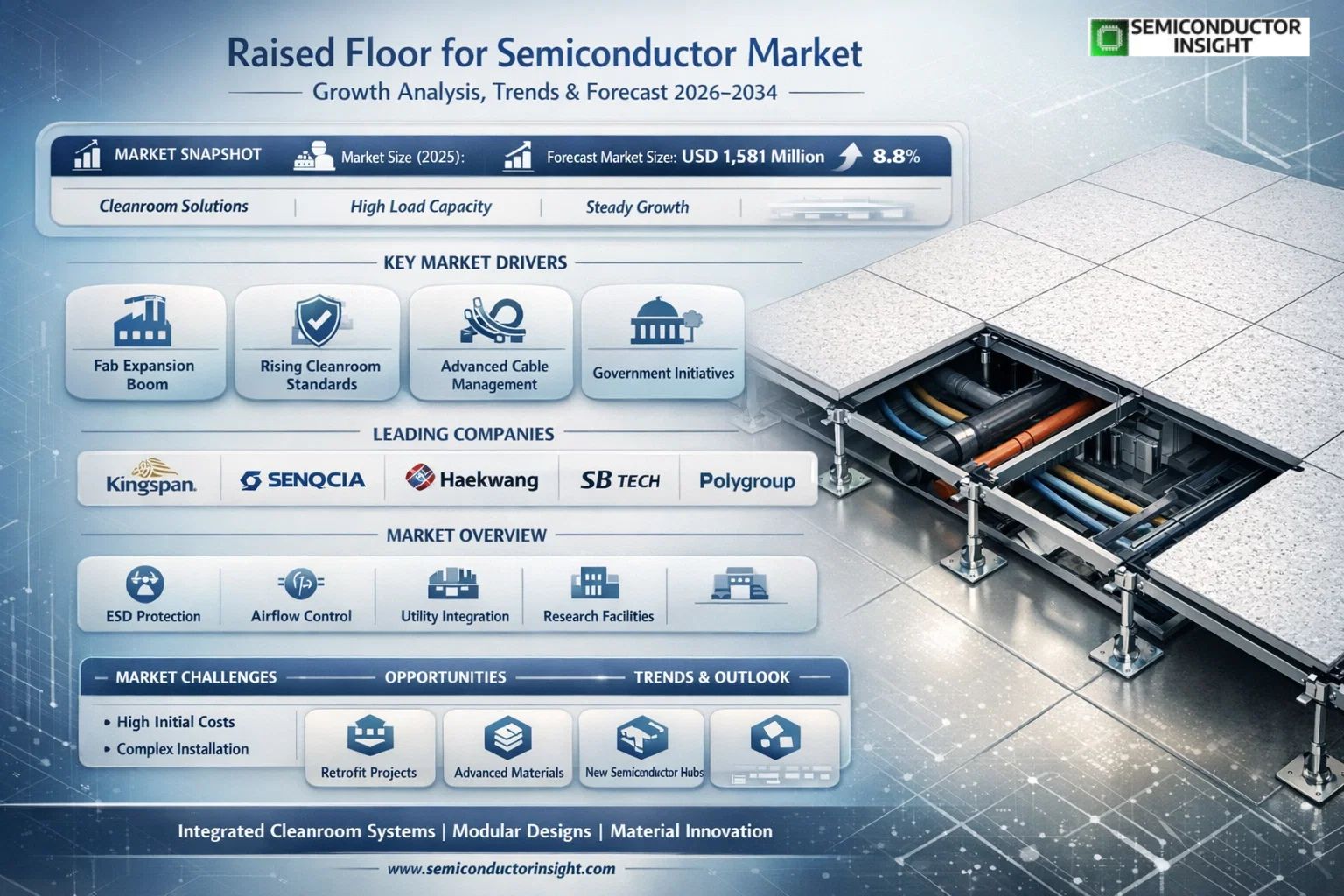
Global Raised Floor for Semiconductor market size was valued at USD 864 million in 2025. The market is projected to grow from USD 939 million in 2026 to USD 1,581 million by 2034, exhibiting a CAGR of 8.8% during the forecast period.
A raised floor for semiconductor manufacturing is a critical modular flooring system designed specifically for cleanroom environments in fabs and other advanced technology spaces. These systems create an elevated platform, typically with a surface resistance between 105 and 109 ohms, to provide essential electrostatic discharge (ESD) protection for sensitive microelectronic components and equipment. The void beneath the floor panels serves as a highly efficient plenum for routing critical utilities,including power cables, chilled water lines, and specialty gas pipelines,while also facilitating superior air circulation and filtration to maintain stringent ISO Class cleanroom standards.
The market growth is primarily driven by Global expansion of semiconductor fabrication capacity, particularly with major investments in new 300mm and leading-edge fabs. Government initiatives like the U.S. CHIPS Act and similar programs in Europe and Asia are catalyzing this construction boom. Furthermore, the increasing complexity of process tools demands more sophisticated underfloor management solutions for vibration control, higher load-bearing capacity (often exceeding 1,000 kg/m²), and enhanced fire resistance. Key players such as Kingspan Group and Changzhou Huatong Xinli Flooring collectively hold a significant portion of the market share, with continuous innovation focused on materials like high-grade aluminum alloys and advanced steel composites to meet evolving industry requirements.
MARKET DRIVERS
Rapid Expansion of Semiconductor Fabrication Facilities
Global surge in demand for semiconductors, driven by automotive electrification, AI infrastructure, and advanced consumer electronics, necessitates the construction of new fabs and expansion of existing ones. Each new facility requires extensive cleanroom environments where a precision Raised Floor for Semiconductor Market is a foundational component. This infrastructure supports stringent vibration control, cabling management, and ultra-clean airflow essential for nanoscale manufacturing. The capital expenditures in this sector, projected to reach tens of billions annually, directly propel demand for advanced access floor systems.
Increasing Stringency of Cleanroom and Vibration Standards
As semiconductor process nodes shrink to 3nm and below, tolerance for environmental contamination and micro-vibration approaches zero. Traditional flooring solutions are inadequate, creating a critical need for specialized anti-static, high-load-capacity raised access floors. These systems provide the necessary plenum for continuous laminar airflow and house sensitive utilities, ensuring operational integrity. This technical requirement is a primary driver for upgrading and specifying performance-oriented Raised Floor for Semiconductor Market solutions in both new builds and retrofits.
➤ The integration of smart facility management and IoT sensors directly into the raised floor plenum is becoming a baseline specification for new mega-fabs, driving value-added system sales.
Furthermore, the push towards sustainability and energy efficiency in fab operations incentivizes the adoption of raised floors designed to optimize airflow dynamics, reducing the energy consumption of HVAC systems by an estimated 15-20% in controlled environments.
MARKET CHALLENGES
High Initial Cost and Complex Integration
The deployment of a qualified Raised Floor for Semiconductor Market represents a significant portion of cleanroom capital expenditure. These are not commodity products but engineered systems requiring precise installation, certification for load-bearing and seismic stability, and integration with complex MEP (Mechanical, Electrical, Plumbing) services. This creates high upfront costs and lengthy installation timelines, which can be a barrier for smaller manufacturers or in regions with budget constraints, potentially slowing market penetration.
Other Challenges
Material Supply Chain and Geopolitical Factors
The production of high-grade steel, aluminum, and specialized cementitious cores used in panels can be affected by raw material price volatility and trade policies. Disruptions can delay fab construction schedules, which operate on tight timelines.
Technical Expertise and Maintenance Burden
Proper maintenance of the access floor system, including regular sealing of panel edges and plenum cleaning, is vital to prevent contamination. A shortage of specialized facility technicians familiar with semiconductor-grade requirements poses an ongoing operational challenge.
MARKET RESTRAINTS
Cyclical Nature of Semiconductor Capital Investment
Raised Floor for Semiconductor Market is intrinsically tied to the capital expenditure cycles of chip manufacturers. During industry downturns or periods of overcapacity, new fab construction and major upgrades are deferred or cancelled. This cyclicality creates significant demand volatility for raised floor suppliers, making long-term production planning and inventory management difficult. The market cannot easily decouple from these macroeconomic and industry-specific investment fluctuations.
Competition from Alternative Structural Platforms
For certain support spaces within a fab (e.g., sub-fab or utility areas), some developers may opt for grated walkways, solid concrete slabs with embedded conduits, or other non-access floor solutions to reduce cost. While these do not meet cleanroom standards, their use in non-critical zones can marginally restrain the total addressable market for raised flooring in a semiconductor facility project.
MARKET OPPORTUNITIES
Retrofit and Modernization of Aging Fabs
A significant installed base of semiconductor fabs, particularly those built over a decade ago, operate with outdated raised floor systems. These may not meet current standards for vibration control, load capacity, or contaminant containment. This creates a substantial aftermarket opportunity for system upgrades and replacements. As manufacturers seek to extend the life and improve the yield of existing assets without full rebuilds, demand for retrofit-compatible Raised Floor for Semiconductor Market solutions is growing.
Advent of Advanced Materials and Modular Designs
Innovation in lightweight, high-strength composite materials and smart, modular panel designs presents a key growth avenue. Floors with integrated power/data ports, real-time deflection monitoring, and enhanced fire resistance offer higher value. Furthermore, the development of faster-install, interlocking systems can reduce fab construction timelines, providing a competitive edge to suppliers and directly addressing the challenge of high integration complexity.
Geographic Expansion into New Semiconductor Hubs
Government initiatives like the CHIPS Act in the United States and similar policies in Europe, India, and Japan are catalyzing the establishment of new semiconductor manufacturing clusters outside traditional hubs. This geographic diversification of production presents fresh, long-term opportunities for raised floor system providers to establish partnerships with engineering procurement construction (EPC) firms and secure contracts in these emerging, high-growth regions.
Raised Floor for Semiconductor Market Trends
Integration with Advanced Cleanroom Systems
The trend towards tighter process nodes and larger wafer sizes is elevating the performance requirements for semiconductor fabrication environments. This drives demand for raised floor for semiconductor market solutions that are seamlessly integrated with advanced cleanroom HVAC and filtration systems. The design ensures laminar airflow to maintain the stringent Class 1 or ISO 3 cleanroom standards necessary for advanced chip manufacturing. This integration is critical for controlling particle contamination, which directly impacts die yield and product reliability in facilities producing memory and logic devices.
Other Trends
Material Innovation for Enhanced Performance
Manufacturers are developing specialized materials to meet the extreme demands of modern fabs. This includes the use of high-grade aluminum alloys and stainless steel with enhanced surface treatments to improve anti-static dissipation, achieving consistent electrical resistance between 10^5 to 10^9 ohms. These materials also offer superior corrosion resistance against the aggressive chemicals used in etching and cleaning processes, extending the lifecycle of Raised Floor for Semiconductor Market infrastructure and reducing total cost of ownership.
Modular and Scalable Infrastructure Design
A key trend is the shift towards modular, reconfigurable floor systems to accommodate rapid technological changes and fab expansions. This flexibility supports the management of increasingly dense cable trays, ultra-pure water lines, and specialty gas distribution systems required for tools like EUV lithography. The ability to quickly access and modify sub-floor utilities without major downtime is a significant operational advantage. This trend is closely linked to the geographic market concentration, where the Asia-Pacific region, as the largest consumer, is driving demand for scalable solutions to support its aggressive semiconductor capacity build-out.
COMPETITIVE LANDSCAPE
Key Industry Players
A Highly Fragmented Market Driven by Technical Expertise and Cleanroom Integration
Global market for semiconductor raised floors is characterized by intense competition among specialized manufacturers who offer critical solutions for fab and OSAT environments. The market is relatively fragmented, with the top two players, Kingspan and Changzhou Huatong Xinli Flooring, collectively holding approximately 20% of Global market share. Leadership is established through deep expertise in material science, particularly in developing aluminum alloy and stainless steel flooring systems that meet stringent requirements for electrostatic discharge (ESD) protection, structural load-bearing capacity, and fire resistance. These leading companies compete on their ability to provide fully integrated, certified cleanroom solutions, combining raised floors with advanced air circulation and cable management systems that are essential for semiconductor manufacturing yields and operational safety.
Beyond the top-tier global suppliers, a robust ecosystem of regional and niche players sustains the competitive dynamics. Companies such as SENQCIA CORPORATION, Exyte Technology, and Polygroup have carved out significant positions by focusing on high-purity material offerings and strong partnerships with semiconductor facility design and construction firms. In the Asia-Pacific region, which is the largest consumer market, local manufacturers like Jiangsu Tonglu Flooring, Haekwang, and SB TECH compete effectively by offering cost-competitive, customized solutions while meeting the rapid demand from new fab construction. The competitive edge for all players hinges on continuous R&D investment to enhance product durability, ease of maintenance, and compliance with evolving international cleanroom standards.
List of Key Raised Floor for Semiconductor Companies Profiled
- Kingspan
- SENQCIA CORPORATION
- Haekwang
- SB TECH
- Polygroup
- Gamma Industries
- Astra Group
- Exyte Technology
- Changzhou Huatong Xinli Flooring
- Jiangsu Tonglu Flooring
- YENI
- NAKA Corporation
- Ahresty
- TMC Vibration Control
- WONKWANG Technique Flooring System
Segment Analysis:
| Segment Category | Sub-Segments | Key Insights |
| By Type |
|
Aluminum Alloy Floor represents the leading segment, favored for its superior balance of properties essential for semiconductor fabrication.
|
| By Application |
|
Fab (Fabrication Facility) is the predominant and most demanding application, driving continuous innovation in raised floor specifications.
|
| By End User |
|
Foundries constitute a leading and highly influential end-user segment due to their scale and technological focus.
|
| By Core Function |
|
Static Control & Safety is the paramount functional requirement, fundamentally influencing material selection and system design.
|
| By Procurement & Specification Influence |
|
Facility Design & Construction Firms hold significant influence as they translate semiconductor makers’ process needs into physical building specifications.
|
Regional Analysis: Raised Floor for Semiconductor Market
Asia-Pacific
The dense cluster of leading-edge semiconductor fabs across Taiwan, South Korea, and increasingly China establishes a continuous, high-volume demand pipeline for Raised Floor for Semiconductor Market solutions. This ecosystem necessitates floors that meet the most rigorous specifications for cleanroom compatibility and equipment support, setting Global benchmark.
National policies and massive capital inflows aimed at securing semiconductor supply chains are directly accelerating fab construction. Each new facility requires a complete Raised Floor for Semiconductor Market installation, creating a strong, policy-backed growth driver unique to the Asia-Pacific region compared to other markets.
Demand is shaped by the need to support ever-larger, heavier, and more vibration-sensitive semiconductor manufacturing tools. The raised floor market here leads in adopting high-load-capacity panels, advanced seismic bracing, and specialized coatings for optimal static control and chemical resistance within fab environments.
Proximity to both end-users (fabs) and a mature network of component suppliers fosters rapid innovation and customization in Raised Floor for Semiconductor Market products. This localized ecosystem enables quicker response times for specialized requirements and integrated solutions, reinforcing the region’s leadership.
North America
The North American market for Raised Floor for Semiconductor Market is characterized by significant investment in domestic chip manufacturing capacity, led by initiatives like the U.S. CHIPS Act. This drives demand for new fabrication facilities, which require advanced raised floor systems for their support infrastructure, particularly in research & development and pilot production lines. The focus is on high-value, innovative solutions that integrate seamlessly with smart factory and Industry 4.0 concepts, emphasizing data connectivity and monitoring capabilities within the floor system itself. Additionally, the modernization and expansion of existing semiconductor research centers and design houses contribute to steady demand for retrofitting and upgrading older Raised Floor for Semiconductor Market installations with newer, more efficient technologies.
Europe
Europe’s Raised Floor for Semiconductor Market is propelled by the EU’s ambitious plans to double its global semiconductor market share. Strategic investments in mega-fabs across Germany, France, and Ireland are key demand drivers. The regional market emphasizes precision engineering, sustainability, and compliance with strict EU regulations regarding materials and energy efficiency. Raised floor solutions are sought for their ability to facilitate complex utility distribution and ultra-stable environments needed for EUV lithography and other precision processes. Collaboration between raised floor manufacturers and leading European semiconductor equipment suppliers is crucial to develop customized, high-performance systems that meet the specific technical standards of the region’s advanced manufacturing initiatives.
South America
The South American market for Raised Floor for Semiconductor Market is nascent but growing, primarily focused on supporting assembly, testing, and packaging (ATP) facilities rather than front-end wafer fabrication. Growth is linked to regional economic diversification efforts and the establishment of technology parks. Demand centers on cost-effective, durable raised floor solutions that provide reliable static control and basic underfloor service distribution for cleanroom and controlled environments. While not at the technological forefront, this market presents opportunities for standardized Raised Floor for Semiconductor Market products, with potential growth tied to larger regional economic stability and increasing foreign direct investment in the technology manufacturing sector.
Middle East & Africa
Raised Floor for Semiconductor Market in the Middle East & Africa region is in early development stages, largely driven by strategic national visions to move beyond hydrocarbon dependency into knowledge-based economies, including technology manufacturing. Initial projects may involve smaller-scale semiconductor research facilities or specialized production units. The market demand is for robust, reliable Raised Floor for Semiconductor Market systems that can perform well in varying climatic conditions while providing the necessary infrastructure for precision electronics work. Partnerships with global technology providers and turnkey project developers are key to market entry, focusing on establishing foundational infrastructure capable of supporting future, more advanced semiconductor manufacturing ambitions.
Report Scope
This market research report provides a comprehensive analysis of the Raised Floor for Semiconductor Market , covering the forecast period 2026–2034. It offers detailed insights into market dynamics, technological advancements, competitive landscape, and key trends shaping the industry.
Key focus areas of the report include:
- Market Overview: The report begins with an overview outlining its current market scenario, key growth indicators, and industry transformation drivers. It discusses macroeconomic factors, demand–supply balance, regulatory landscape, and the strategic role of semiconductors in powering advancements across industries such as automotive, telecommunications, consumer electronics, and industrial automation.
- Market Size & Forecast: Historical data and future projections for revenue, unit shipments, and market value across major regions and segments.
- Segmentation Analysis: Detailed breakdown by product type, technology, application, and end-user industry to identify high-growth segments and investment opportunities.
- Regional Insights: Insights into market performance across North America, Europe, Asia-Pacific, Latin America, and the Middle East & Africa, including country-level analysis where relevant.
- Competitive Landscape: Profiles of leading market participants, including their product offerings, R&D focus, manufacturing capacity, pricing strategies, and recent developments such as mergers, acquisitions, and partnerships.
- Technology Trends & Innovation: Assessment of emerging technologies, integration of AI/IoT, semiconductor design trends, fabrication techniques, and evolving industry standards.
- Market Drivers & Restraints: Evaluation of factors driving market growth along with challenges, supply chain constraints, regulatory issues, and market-entry barriers.
- Stakeholder Insights: Insights for component suppliers, OEMs, system integrators, investors, and policymakers regarding the evolving ecosystem and strategic opportunities.
Primary and secondary research methods are employed, including interviews with industry experts, data from verified sources, and real-time market intelligence to ensure the accuracy and reliability of the insights presented.
FREQUENTLY ASKED QUESTIONS:
What is the current market size and forecast of Raised Floor for Semiconductor Market?
-> Global Raised Floor for Semiconductor market was valued at USD 864 million in 2025 and is projected to reach USD 1581 million by 2034, at a CAGR of 8.8% during the forecast period.
Which key companies operate in Raised Floor for Semiconductor Market?
-> Key players include Kingspan, SENQCIA CORPORATION, Haekwang, SB TECH, Polygroup, Gamma Industries, Astra Group, ZIP ENC, Hemsco, Exyte Technology, Seo Ho, WONKWANG Technique Flooring System, TMC Vibration Control, Ahresty, NAKA Corporation, TitanFlor, Jiangsu Tonglu Flooring, Changzhou Huatong, Huilian, Huayi, YENI, and Vero Veria Corporation, among others.
What are the key growth drivers and advantages?
-> Key drivers and advantages include anti-static protection (resistance between 10^5 and 10^9 ohms), wear and corrosion resistance, cable and pipeline management, cleanroom air circulation and quality control, load-bearing capacity, and fire-proof performance.
Which region dominates the market?
-> Asia-Pacific is the world’s largest consumer market due to rapid urbanization and strong demand for IT infrastructure construction.
What are the primary applications and types in this market?
-> Main applications are Fab and OAST. Key product types include Aluminum Alloy Floor, Stainless Steel Floor, and Others.

Get Sample Report PDF for Exclusive Insights
Report Sample Includes
- Table of Contents
- List of Tables & Figures
- Charts, Research Methodology, and more...