MARKET INSIGHTS
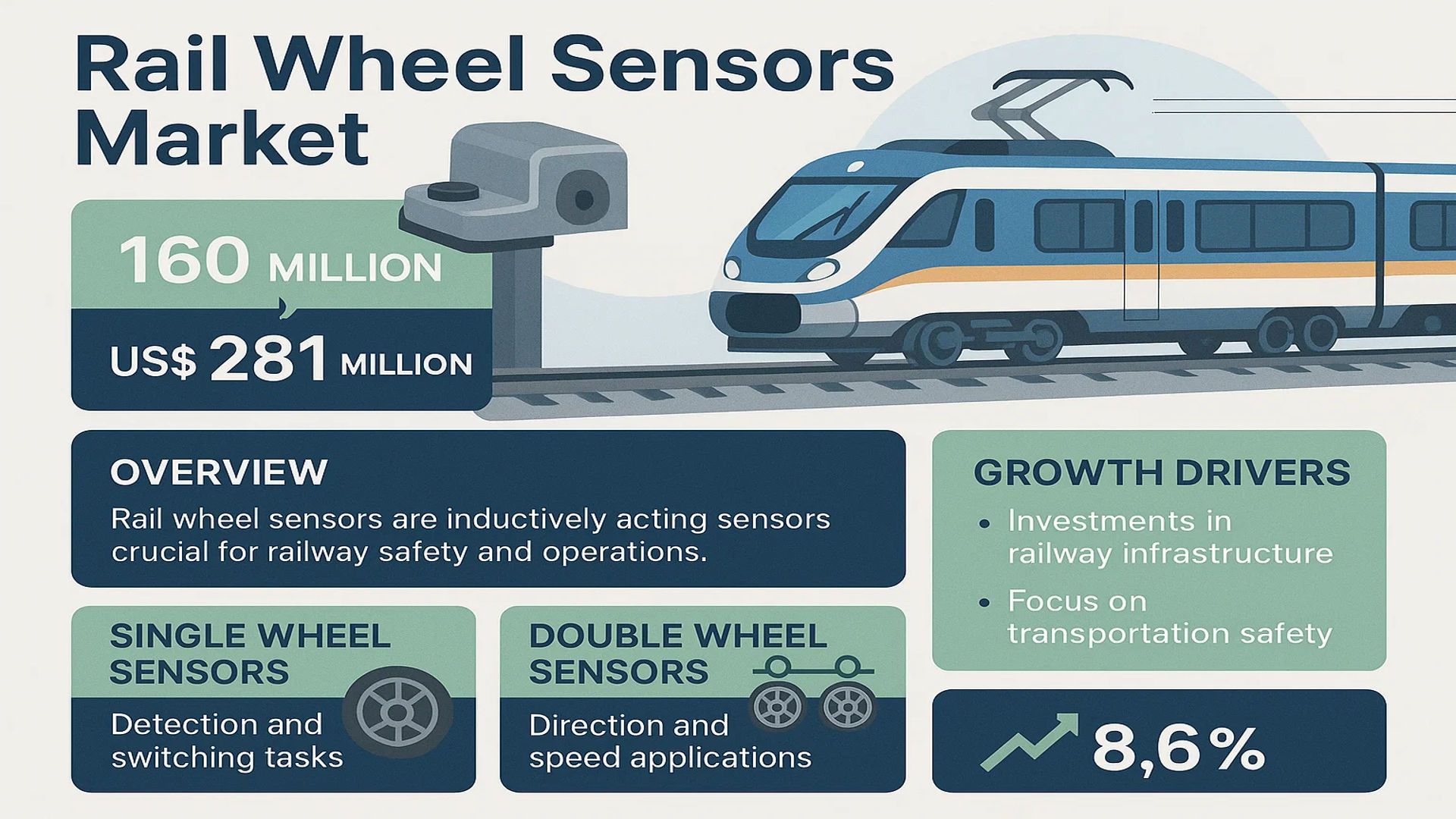
The global Rail Wheel Sensors Market was valued at 160 million in 2024 and is projected to reach US$ 281 million by 2032, at a CAGR of 8.6% during the forecast period.
Rail wheel sensors are inductively acting sensors crucial for railway safety and operations. These sensors detect the metal mass of a train’s wheel flange to generate precise electrical impulses, enabling critical functions such as rolling stock detection, axle counting, speed measurement, and direction identification. The market is segmented into Single Wheel Sensors, primarily used for detection and switching tasks, and Double Wheel Sensors, which are essential for advanced applications like direction detection and accurate speed calculation.
This market is experiencing robust growth driven by global investments in railway infrastructure modernization and the increasing emphasis on transportation safety and efficiency. Europe dominates the market, holding over 40% of the global share, due to its extensive and advanced rail networks. The Double Wheel Sensor segment is the largest product category, accounting for more than 60% of the market, as it is indispensable for complex signaling and control systems. Furthermore, the Rail Transport Line application is the largest end-use segment, followed closely by the rapidly expanding Urban Rail Transit sector, reflecting the ongoing global trend towards sustainable public transportation solutions.
MARKET DYNAMICS
MARKET DRIVERS
Global Expansion of Rail Infrastructure Projects to Accelerate Market Growth
The global rail network is undergoing substantial expansion, driven by increasing urbanization and the need for efficient mass transit systems. Investments in high-speed rail projects, metro expansions, and freight corridor developments are creating robust demand for rail wheel sensors. These sensors are critical for ensuring operational safety, optimizing traffic flow, and enabling predictive maintenance. For instance, over 15,000 kilometers of new high-speed rail lines are planned globally between 2024 and 2030, with significant projects underway in Asia and Europe. Such infrastructure growth necessitates advanced detection systems, including wheel sensors for axle counting, speed measurement, and train direction identification, directly propelling market expansion.
Stringent Safety Regulations and Adoption of Predictive Maintenance to Boost Demand
Railway authorities and operators worldwide are implementing stricter safety standards to prevent accidents and enhance operational reliability. Regulatory mandates increasingly require the integration of advanced sensor technologies for real-time monitoring and fault detection. Rail wheel sensors play a pivotal role in these systems by providing accurate data on wheel presence, direction, and speed, which is essential for signaling and train control systems. Additionally, the shift toward predictive maintenance—enabled by IoT and data analytics—is gaining traction. By 2030, predictive maintenance adoption in railways is expected to reduce downtime by up to 30%, driving investments in sensor technologies that support condition monitoring and early fault detection.
Technological Advancements in Sensor Design and Connectivity to Fuel Innovation
Recent technological innovations are significantly enhancing the functionality and reliability of rail wheel sensors. Developments in inductive sensing technology, improved resistance to environmental factors such as moisture and extreme temperatures, and the integration of wireless connectivity are making these sensors more efficient and easier to deploy. For example, the introduction of IP68-rated sensors ensures durability in harsh conditions, while wireless models simplify installation and reduce maintenance costs. Furthermore, the incorporation of these sensors into broader IoT ecosystems allows for seamless data exchange with central control systems, enabling smarter rail operations and contributing to market growth.
MARKET CHALLENGES
High Installation and Maintenance Costs to Impede Widespread Adoption
While rail wheel sensors are essential for modern rail systems, their high installation, calibration, and maintenance costs present significant challenges. The initial deployment of these sensors often requires specialized labor, custom infrastructure integration, and periodic recalibration to ensure accuracy. In regions with limited budgets or older rail networks, these expenses can delay upgrades and restrict market penetration. Additionally, lifecycle costs, including parts replacement and software updates, add to the total cost of ownership, making it difficult for smaller operators to justify investments. These financial barriers are particularly pronounced in developing economies, where funding for rail modernization is often constrained.
Other Challenges
Environmental and Operational Durability Issues
Rail wheel sensors are exposed to extreme conditions, including vibration, dust, moisture, and temperature fluctuations, which can affect their performance and lifespan. Ensuring consistent operation in such environments requires robust design and materials, increasing production costs. Sensor failures due to environmental factors can lead to false readings or system downtime, posing safety risks and necessitating frequent maintenance.
Compatibility with Legacy Systems
Integrating advanced wheel sensors with existing legacy rail infrastructure remains a complex challenge. Many older systems lack the connectivity or data processing capabilities needed to utilize modern sensors fully. Retrofitting these systems often involves additional hardware and software upgrades, further escalating costs and implementation timelines.
MARKET RESTRAINTS
Limited Standardization and Interoperability Issues to Hinder Market Growth
The lack of global standardization in rail wheel sensor specifications and communication protocols creates interoperability challenges, complicating integration across different rail networks and equipment brands. Variations in output signals, mounting mechanisms, and data formats can necessitate custom solutions, increasing development time and costs. This fragmentation also limits the scalability of sensor deployments, as operators must often rely on proprietary systems from specific manufacturers. Without widely accepted standards, the market faces slower adoption rates, especially in regions with multi-vendor rail environments.
Cybersecurity Concerns in Connected Rail Systems to Deter Investments
As rail wheel sensors become increasingly integrated with networked control and monitoring systems, cybersecurity vulnerabilities emerge as a significant restraint. Potential threats include data manipulation, unauthorized access, and system disruptions, which could compromise safety and operational integrity. Ensuring robust cybersecurity measures requires continuous investment in encryption, authentication, and monitoring technologies, adding complexity and cost to sensor deployments. These concerns are particularly acute in regions with heightened security regulations, where compliance adds another layer of challenge to market growth.
MARKET OPPORTUNITIES
Integration with AI and Big Data Analytics to Unlock New Revenue Streams
The convergence of rail wheel sensors with artificial intelligence and big data analytics presents transformative opportunities for the market. Sensor-generated data can be leveraged to optimize train scheduling, predict maintenance needs, and enhance energy efficiency. For example, AI algorithms analyzing wheel sensor data can identify patterns indicating wear or potential failures, enabling proactive interventions. This integration not only improves operational efficiency but also creates opportunities for value-added services, such as data-driven insights and consulting, opening new revenue channels for sensor manufacturers and rail operators.
Growing Emphasis on Urban Rail Transit and Smart City Initiatives to Drive Demand
Urbanization trends and smart city projects worldwide are accelerating the development of urban rail transit systems, including metros, trams, and light rail. These systems rely heavily on advanced sensing technologies for automation, safety, and efficiency. Rail wheel sensors are critical components in these environments, supporting functions like platform screen door synchronization, train tracking, and passenger counting. With over 200 cities globally planning or expanding urban rail networks by 2030, the demand for reliable and advanced wheel sensors is poised to surge, offering significant growth opportunities for market players.
RAIL WHEEL SENSORS MARKET TRENDS
Integration of IoT and Predictive Maintenance to Emerge as a Dominant Trend
The integration of Internet of Things (IoT) technology and predictive maintenance protocols is revolutionizing the rail wheel sensors market. These sensors are increasingly being embedded with connectivity features that allow for real-time data transmission to centralized monitoring systems. This enables railway operators to move from reactive maintenance schedules to predictive models, significantly reducing unplanned downtime and operational costs. For instance, the ability to monitor wheel flange wear, bearing temperatures, and axle integrity in real-time allows for maintenance to be scheduled precisely when needed, rather than based on fixed intervals. This trend is particularly strong in Europe and North America, where investments in smart railway infrastructure are substantial. The shift towards predictive analytics is not just about cost savings; it enhances safety by providing early warnings for potential failures, a critical factor given that a single undetected flaw can lead to catastrophic derailments. The market is responding with sensors that offer higher sampling rates, improved signal processing, and robust wireless communication protocols to thrive in the harsh railway environment.
Other Trends
Expansion and Modernization of Rail Networks
A global push for sustainable transportation is driving massive investment in rail infrastructure, both for long-distance freight and passenger lines and for urban transit systems. Governments worldwide are allocating significant funds to expand and modernize their rail networks, which directly fuels the demand for advanced detection and monitoring systems like rail wheel sensors. High-speed rail projects, in particular, require exceptionally reliable and precise sensor technology for axle counting, speed measurement, and train integrity monitoring at very high velocities. Urban rail transit, including metros and light rail systems, is experiencing rapid growth in densely populated regions, further accelerating the adoption of these sensors for traffic management and safety applications. This expansion is not limited to new tracks; it also encompasses the retrofitting of existing lines with modern signaling and control systems, creating a sustained demand for sensor upgrades and replacements.
Advancements in Sensor Technology and Material Science
Technological innovation is a key driver, with manufacturers focusing on developing sensors that are more durable, accurate, and easier to install and maintain. Recent advancements include the use of novel composite materials and hardened enclosures that offer greater resistance to extreme weather conditions, vibration, and electromagnetic interference. There is also a growing trend towards non-contact sensing technologies, such as optical and acoustic sensors, which are being developed to complement or even replace traditional inductive wheel sensors for specific applications. These technologies can offer benefits like reduced mechanical wear and the ability to gather different types of data. Furthermore, the miniaturization of electronics allows for more compact sensor designs without compromising on performance, enabling their deployment in space-constrained environments. The continuous R&D efforts by key market players are focused on enhancing product longevity and reducing the total cost of ownership, which is a critical purchasing factor for railway operators.
COMPETITIVE LANDSCAPE
Key Industry Players
Technological Innovation and Strategic Expansions Drive Market Leadership
The global Rail Wheel Sensors market exhibits a semi-consolidated structure, characterized by the presence of a few dominant international players and numerous specialized regional manufacturers. The market’s competitive intensity is high, driven by the critical need for reliability and precision in railway safety and traffic management systems. Frauscher Sensor Technology stands as a preeminent leader, commanding significant market share due to its pioneering advancements in axle counting and wheel detection technology. The company’s extensive global footprint, particularly its stronghold in the European market—which accounts for over 40% of global demand—cements its leadership position.
Siemens and Honeywell are also major forces, leveraging their vast industrial automation portfolios and deep integration capabilities within rail infrastructure projects worldwide. Their growth is heavily supported by continuous investment in research and development, focusing on enhancing sensor durability and data accuracy in diverse environmental conditions. Furthermore, these corporations benefit from long-standing relationships with national rail operators and government bodies, securing large-scale contracts for both new installations and modernization projects.
Growth strategies across the board are increasingly focused on geographical expansion and product portfolio diversification. Companies are actively targeting emerging markets in Asia, especially China, which represents over 30% of the global market alongside North America. Recent developments include the launch of next-generation, IoT-enabled sensors that facilitate predictive maintenance and real-time health monitoring of railway assets. These innovations are crucial for capturing value in the growing urban rail transit segment.
Meanwhile, established players like Pintsch Tiefenbach and Western-Cullen-Hayes are strengthening their positions through strategic partnerships and acquisitions to enhance their technological offerings and expand their service networks. Simultaneously, specialized manufacturers such as Fersil and Argenia Railway Technologies are competing effectively by offering cost-competitive, application-specific solutions, particularly in regional and freight rail applications. This dynamic ensures a robust and evolving competitive environment.
List of Key Rail Wheel Sensor Companies Profiled
- Frauscher Sensor Technology (Austria)
- Siemens AG (Germany)
- Honeywell International Inc. (U.S.)
- Pintsch Tiefenbach GmbH (Germany)
- Western-Cullen-Hayes, Inc. (U.S.)
- Fersil S.A. (Poland)
- Altpro LLC (Russia)
- Shenzhen Javs Technology Co., Ltd. (China)
- Argenia Railway Technologies Inc. (Canada)
- Anhui Landun Photoelectron Co., Ltd. (China)
- Beijing Railtechcn Technology Co., Ltd. (China)
- Senchuan (China)
Segment Analysis:
By Type
Double Wheel Sensor Segment Commands Market Leadership Due to Its Critical Role in Advanced Rail Operations
The market is segmented based on type into:
- Single Wheel Sensor
- Primarily utilized for rolling stock detection and switching tasks in rail yards and sidings.
- Double Wheel Sensor
- Essential for direction detection, precise axle counting, and accurate speed measurement on mainlines and high-traffic corridors.
By Application
Rail Transport Line Segment Holds the Largest Share Driven by Global Freight and Passenger Rail Network Expansion
The market is segmented based on application into:
- Rail Transport Line
- Includes mainline railways for long-distance freight and passenger transport, requiring robust sensing for safety and traffic management.
- Urban Rail Transit
- Encompasses metros, subways, trams, and light rail systems within cities, focusing on high-frequency operations and passenger safety.
By Technology
Inductive Sensor Technology Remains the Industry Standard Owing to Its Proven Reliability in Harsh Environments
The market is segmented based on technology into:
- Inductive Sensors
- Detect the metal mass of the wheel flange, generating electrical impulses; known for durability and resistance to environmental factors like dirt and moisture.
- Optical Sensors
- Employ light beams for detection; used in specific applications requiring non-contact measurement but can be susceptible to obstructions.
- Others
- Includes emerging and niche technologies such as acoustic or ultrasonic sensors.
By End User
Railway Infrastructure Operators are the Primary End Users Fueling Demand for Safety and Efficiency Upgrades
The market is segmented based on end user into:
- Railway Infrastructure Operators
- National rail networks and private track owners responsible for maintaining and upgrading signaling and detection systems.
- Rolling Stock Manufacturers
- Companies that build locomotives and wagons, integrating sensors for onboard diagnostics and control systems.
- Maintenance Service Providers
- Third-party firms specializing in the installation, calibration, and repair of rail infrastructure components.
Regional Analysis: Rail Wheel Sensors Market
Europe
Europe holds the dominant position in the global Rail Wheel Sensors market, accounting for over 40% of the total revenue share. This leadership is driven by the region’s extensive, mature rail networks and a strong regulatory emphasis on safety and operational efficiency. The European Union’s mandate for the progressive implementation of the European Rail Traffic Management System (ERTMS) is a primary catalyst, requiring advanced sensor technology for train control and signaling. Countries like Germany, France, and the UK are at the forefront of upgrading their infrastructure, creating sustained demand for high-precision double wheel sensors used in axle counting and speed measurement. Key European manufacturers, including Frauscher Sensor Technology, Siemens, and Pintsch Tiefenbach, benefit from this robust domestic demand while also exporting their technologically advanced products globally. The market is characterized by a focus on innovation, reliability, and compliance with stringent EU technical standards.
North America
North America represents a highly significant market, holding a share of over 30%. The market is propelled by substantial government investments in rail infrastructure modernization and a strong focus on freight logistics efficiency. The Infrastructure Investment and Jobs Act in the United States, which allocates billions to rail improvements, directly fuels demand for advanced detection systems. The region’s emphasis on Positive Train Control (PTC) systems necessitates reliable wheel sensors for accurate train positioning and movement authority, making double wheel sensors the preferred technology. Major players like Honeywell and Western-Cullen-Hayes have a strong foothold here, providing solutions that meet the rigorous safety and performance requirements set by entities like the Federal Railroad Administration (FRA). While the market is advanced, growth is steady, tied to specific infrastructure project rollouts and the replacement cycles of existing equipment.
Asia-Pacific
The Asia-Pacific region is the fastest-growing market for rail wheel sensors, with China alone commanding a significant portion of the global share. This explosive growth is fueled by unprecedented investments in both high-speed rail networks and urban metro systems across China, India, and Southeast Asian nations. The sheer volume of new rolling stock and track being laid creates massive demand for basic detection sensors. However, the market is notably bifurcated; while there is a high volume consumption of cost-effective single wheel sensors, there is a rapidly increasing adoption of more sophisticated double sensors for advanced applications in new metro and high-speed lines. Local manufacturers such as Shenzhen Javs Technology and Anhui Landun Photoelectron are becoming increasingly competitive, catering to domestic projects and often presenting a cost-sensitive alternative to Western suppliers.
South America
The South American market for rail wheel sensors is in a developing phase, characterized by gradual expansion rather than rapid transformation. Countries like Brazil and Argentina are undertaking efforts to revitalize and expand their freight and passenger rail corridors, which presents clear opportunities for sensor suppliers. However, market growth is tempered by persistent economic volatility and budgetary constraints that often delay large-scale infrastructure projects. The adoption of technology tends to be pragmatic, with a focus on proven, reliable solutions that offer value. This often means that newer, more advanced sensor technologies see slower uptake compared to established, cost-effective models. The market potential is recognized, but realization is closely tied to regional economic stability and sustained public investment.
Middle East & Africa
The Middle East and Africa region represents an emerging market with significant long-term potential, though it currently holds a smaller share of the global total. Development is concentrated in specific nations, particularly in the Gulf Cooperation Council (GCC) countries like Saudi Arabia and the UAE, where ambitious economic diversification plans include major rail and metro projects. These new, state-of-the-art installations often incorporate advanced sensor technology from the outset. In contrast, other parts of the region face challenges related to funding limitations and less developed rail infrastructure. The demand is primarily for durable and reliable sensors that can withstand harsh environmental conditions. While the current market size is modest, the pipeline of planned urban rail and intercity projects suggests a strong growth trajectory over the coming decade.
Report Scope
This market research report provides a comprehensive analysis of the global and regional Rail Wheel Sensors markets, covering the forecast period 2025–2032. It offers detailed insights into market dynamics, technological advancements, competitive landscape, and key trends shaping the industry.
Key focus areas of the report include:
- Market Size & Forecast: Historical data and future projections for revenue, unit shipments, and market value across major regions and segments.
- Segmentation Analysis: Detailed breakdown by product type, technology, application, and end-user industry to identify high-growth segments and investment opportunities.
- Regional Outlook: Insights into market performance across North America, Europe, Asia-Pacific, Latin America, and the Middle East & Africa, including country-level analysis where relevant.
- Competitive Landscape: Profiles of leading market participants, including their product offerings, R&D focus, manufacturing capacity, pricing strategies, and recent developments such as mergers, acquisitions, and partnerships.
- Technology Trends & Innovation: Assessment of emerging technologies, integration of AI/IoT, sensor design trends, fabrication techniques, and evolving industry standards.
- Market Drivers & Restraints: Evaluation of factors driving market growth along with challenges, supply chain constraints, regulatory issues, and market-entry barriers.
- Stakeholder Analysis: Insights for component suppliers, OEMs, system integrators, investors, and policymakers regarding the evolving ecosystem and strategic opportunities.
Primary and secondary research methods are employed, including interviews with industry experts, data from verified sources, and real-time market intelligence to ensure the accuracy and reliability of the insights presented.
FREQUENTLY ASKED QUESTIONS:
What is the current market size of Global Rail Wheel Sensors Market?
->Rail Wheel Sensors Market was valued at 160 million in 2024 and is projected to reach US$ 281 million by 2032, at a CAGR of 8.6% during the forecast period.
Which key companies operate in Global Rail Wheel Sensors Market?
-> Key players include Frauscher Sensor Technology, Siemens, Honeywell, Pintsch Tiefenbach, and Western-Cullen-Hayes, among others. The global top five manufacturers hold a combined market share of over 70%.
What are the key growth drivers?
-> Key growth drivers include global railway infrastructure modernization projects, increasing demand for rail safety and traffic management systems, and the expansion of urban rail transit networks worldwide.
Which region dominates the market?
-> Europe is the largest market, holding over 40% of the global share, followed by North America and China.
What are the emerging trends?
-> Emerging trends include the integration of IoT and predictive maintenance technologies, development of more robust and weather-resistant sensors, and increasing adoption of wireless sensor networks for enhanced rail operations.

Get Sample Report PDF for Exclusive Insights
Report Sample Includes
- Table of Contents
- List of Tables & Figures
- Charts, Research Methodology, and more...
 Download Sample Report PDF