Rad Hard Shift Registers Market Insights
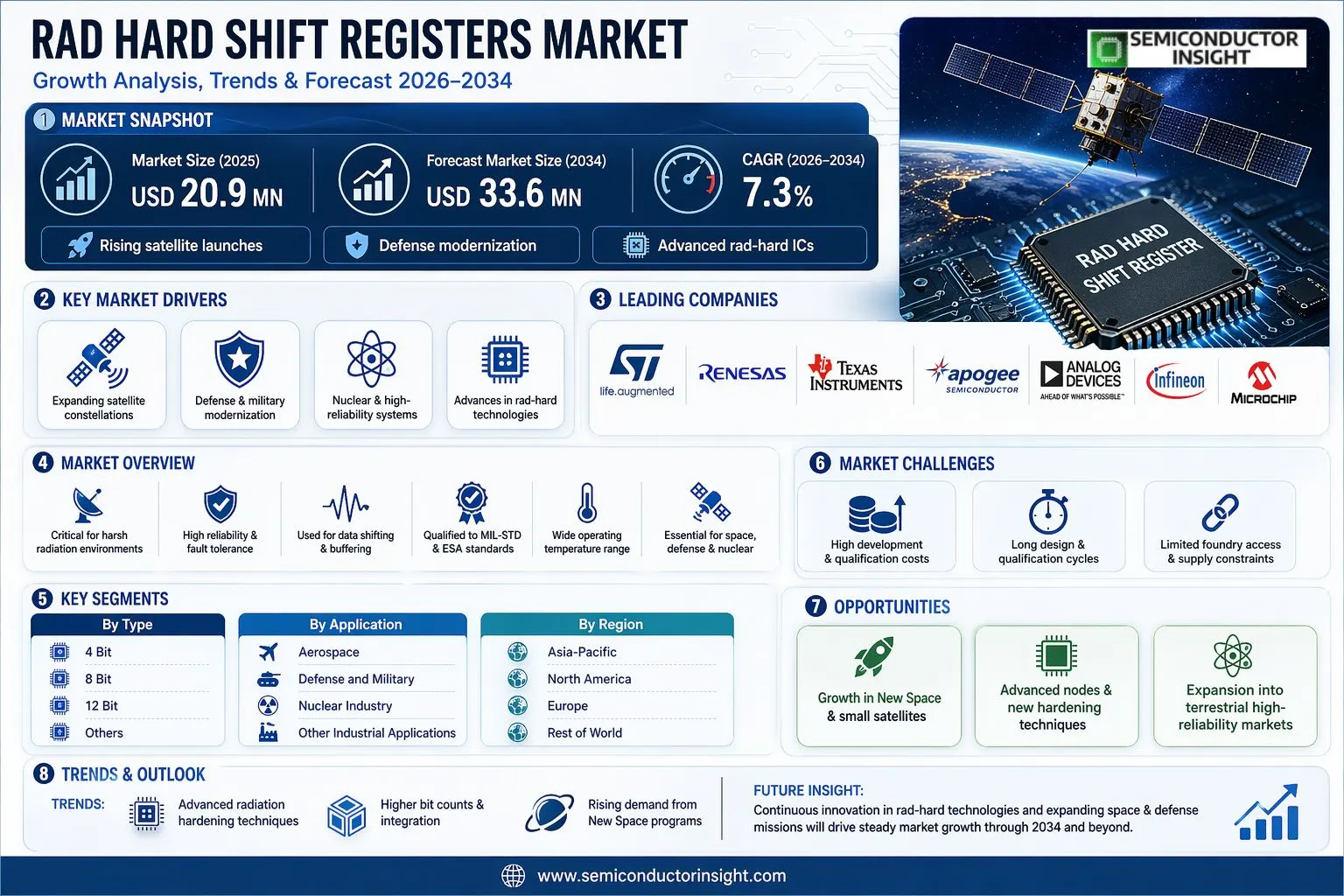
Global Rad Hard Shift Registers Market size was valued at USD 20.9 million in 2025. The market is projected to grow from USD 22.4 million in 2026 to USD 33.6 million by 2034, exhibiting a CAGR of 7.3% during the forecast period.
Radiation-hardened (Rad Hard) shift registers are specialized digital storage devices designed to operate reliably in high-radiation environments where standard electronics would fail. These components are based on cascaded flip-flops, typically D-type, which allow data to be transferred sequentially with each clock pulse, enabling critical data shifting and temporary storage functions. However, Rad Hard variants incorporate unique design techniques and manufacturing processes, such as silicon-on-insulator (SOI) technology or specific layout hardening, to mitigate the damaging effects of ionizing radiation, including single-event upsets (SEUs) and total ionizing dose (TID).
The market is experiencing steady growth driven by several key factors, primarily the increasing number of satellite launches for communication, Earth observation, and national security, alongside modernization programs in defense systems that require electronics capable of withstanding harsh nuclear or space environments. Furthermore, advancements in nuclear power plant instrumentation and particle accelerator technologies contribute to demand. Initiatives by leading semiconductor companies are also pivotal; for instance, manufacturers are continuously developing new product families with higher performance and radiation tolerance levels to meet stringent MIL-PRF-38535 or ESA QML-Y qualifications. STMicroelectronics, Renesas Electronics, Texas Instruments, and Apogee Semiconductor are some of the key players that operate in the market with a wide range of portfolios.
MARKET DRIVERS
Expanding Satellite Constellations and Deep-Space Exploration
The global surge in deploying commercial low-earth orbit (LEO) satellite constellations for communication, Earth observation, and internet services is a primary driver for Rad Hard Shift Registers Market. These components are critical for data handling and command systems in satellites, where they must reliably operate amidst intense radiation. Similarly, government-funded missions to the Moon, Mars, and beyond require electronics that can withstand prolonged exposure to cosmic rays and solar particle events, directly fueling demand for radiation-hardened shift registers and other integrated circuits.
Modernization of Defense and Nuclear Infrastructure
National security programs worldwide are modernizing strategic systems, including missile guidance, military satellites, and nuclear command and control networks. These applications demand the utmost reliability in harsh radiative environments, such as those found in high-altitude aviation or near nuclear sources. Rad Hard Shift Registers Market benefits from this trend, as these devices are essential for signal processing and temporary data storage in such critical systems, where failure is not an option.
➤ Stringent space qualification standards and long lifecycle requirements create a high barrier to entry, ensuring stable demand for certified, reliable Rad Hard components from established vendors.
Furthermore, the trend towards miniaturization and increased functionality in aerospace electronics pushes for more integrated, yet radiation-tolerant, solutions. This drives innovation Rad Hard Shift Registers Market, leading to devices with higher data rates, lower power consumption, and enhanced latch-up immunity to meet the evolving needs of next-generation spacecraft and defense platforms.
MARKET CHALLENGES
Extremely High Development and Certification Costs
The design, fabrication, and qualification of Rad Hard shift registers involve specialized semiconductor processes, extensive testing, and rigorous certification to standards like MIL-PRF-38535 or ESA’s space-grade approvals. These processes are tremendously costly and time-consuming, often requiring years from design to flight-ready status. This high cost structure limits the number of suppliers and can constrain innovation and price competitiveness withRad Hard Shift Registers Market.
Other Challenges
Technical Complexity and Long Design Cycles
The physics of hardening semiconductors against single-event effects (SEE) and total ionizing dose (TID) is inherently complex. Designing a Rad Hard shift register that balances performance, power, and radiation tolerance often results in larger die sizes and older technology nodes compared to commercial counterparts. This leads to longer design and production cycles, making it difficult for the market to keep pace with the rapid innovation seen in the commercial semiconductor sector.
Limited Foundry Access and Supply Chain Constraints
Production of Rad Hard integrated circuits depends on a limited number of specialized foundries with radiation-hardened-by-design (RHBD) or radiation-hardened-by-process (RHBP) capabilities. This creates a fragile supply chain vulnerable to bottlenecks. For Rad Hard Shift Registers Market, any disruption at these niche foundries can lead to significant delays for aerospace and defense contractors, impacting mission timelines.
MARKET RESTRAINTS
High Cost-Pressure from Commercial-Off-The-Shelf (COTS) Alternatives
For applications in lower-radiation environments or for less critical missions, system designers face significant pressure to use lower-cost commercial-off-the-shelf (COTS) or industrial-grade components. The premium price of dedicated Rad Hard shift registers, which can be orders of magnitude higher than commercial parts, acts as a major restraint. This cost sensitivity can limit market penetration in emerging commercial space ventures with tighter budget constraints, pushing them to adopt alternative risk-mitigation strategies instead of dedicated Rad Hard solutions.
Long Product Lifecycles and Slow Replacement Rates
Aerospace and defense systems are designed for decades-long service lives, and once a component like a Rad Hard shift register is qualified for a specific platform, it is rarely changed. This results in very slow replacement cycles and discourages frequent re-designs. Consequently, demand growth Rad Hard Shift Registers Market is often tied to the initiation of entirely new programs rather than the refresh of existing ones, limiting overall market velocity.
MARKET OPPORTUNITIES
Adoption of New Radiation-Hardening Techniques and Advanced Nodes
Significant opportunity exists in the development of Rad Hard shift registers using newer semiconductor technology nodes and advanced hardening techniques, such as Silicon-On-Insulator (SOI) and FinFET geometries. These technologies offer improved performance and power efficiency while maintaining or enhancing radiation tolerance. Companies that successfully commercialize Rad Hard IP on more advanced nodes can capture market share by offering smaller, faster, and more power-efficient solutions for next-generation satellite payloads and space probes.
Growth in New Space and Small Satellite Segments
The proliferation of small satellites (CubeSats, SmallSats) for commercial and scientific missions presents a substantial opportunity. While these platforms often have lower radiation tolerance requirements than deep-space missions, they still need reliable electronics. This creates a demand for cost-optimized Rad Hard or radiation-tolerant shift registers,components that offer a balance between assurance and affordability. Tailoring products for this high-volume segment is a key strategic growth avenue for Rad Hard Shift Registers Market.
Expansion into Terrestrial High-Reliability Applications
Beyond space, there is growing potential in terrestrial applications where radiation-induced errors are a concern, such as in high-altitude aircraft avionics, nuclear power plant control systems, and medical equipment like proton therapy machines. The proven reliability of Rad Hard shift registers makes them suitable for these niche, high-reliability industrial applications, offering a path for market diversification beyond the traditional aerospace and defense core.
Rad Hard Shift Registers Market Trends
Advancements in Radiation-Hardened Semiconductor Manufacturing
Primary industry trends are driven by continuous enhancements in semiconductor fabrication processes. For reliable operation in high-radiation environments found in space and defense systems, specialized hardening-by-design and the use of silicon-on-insulator substrates are increasingly adopted. Manufacturers are innovating to balance high tolerance to single-event effects with power efficiency and data throughput, which is critical for signal processing and data handling in satellites and nuclear applications. Companies like STMicroelectronics, Renesas Electronics, and Texas Instruments leverage their technological expertise to develop more robust and integrated solutions Rad Hard Shift Registers Market, ensuring product reliability and extended operational lifecycles for critical missions.
Other Trends
Increasing Demand for High-Bit Configurations
Within the product type segment, a growing demand is observed for shift registers with higher bit capacities, such as 8-bit and 12-bit configurations. This trend correlates with the need for more sophisticated data manipulation and longer serial data streams in modern electronic systems for aerospace platforms. As payloads and onboard computers require greater data handling capabilities, the versatility and integration offered by these advanced components are gaining importance in the market dynamics.
Geographic Expansion and Supply Chain Resilience
The market landscape is influenced by regional procurement strategies and the push for supply chain diversification. While established players dominate the competitive scene, strategic investments in research and manufacturing capacity are noted in key regions outside North America. This movement aims to meet the specific technical qualifications and stringent reliability standards of global defense and aerospace programs, thereby influencing long-term supply channels for Rad Hard Shift Registers.
Strategic Industry Collaboration and Specialization
A key trend involves deepening collaborations between component manufacturers, system integrators, and defense contractors. Specialized firms like Apogee Semiconductor are focusing on niche radiation-hardened solutions. This ecosystem is essential for tailoring components, including shift registers, to the exacting performance and environmental requirements of next-generation spacecraft, military communication systems, and avionics. Such partnerships are crucial for innovation and addressing the technical challenges within the industry’s supply chain.
COMPETITIVE LANDSCAPE
Key Industry Players
High-Reliability Requirements in Space, Defense, and Nuclear Sectors Define Market Dynamics
Global Rad Hard Shift Register market exhibits a consolidated structure dominated by a few major semiconductor corporations with specialized radiation-hardened product lines, holding a significant collective revenue share. The top five manufacturers, including industry stalwarts such as STMicroelectronics and Texas Instruments, command a formidable market position by leveraging their extensive R&D capabilities, proven space heritage, and expertise in designing integrated circuits for extreme environments. Competition revolves around technological innovation in hardening processes, product reliability assurance, and the ability to meet stringent MIL-STD and ESA/ESCC qualifications for aerospace, defense, and nuclear applications.
Beyond these established leaders, the competitive landscape includes dedicated niche players and aerospace-focused semiconductor companies that cater to specific, high-value segments. Companies like Apogee Semiconductor and other specialized suppliers compete by offering custom Rad Hard solutions, low-volume production runs for specialized missions, or focusing on particular bit-length configurations like 4-bit or 8-bit registers. This secondary tier adds important diversity to the supply chain, supporting a range of mission profiles and offering technological alternatives to programs with unique power, performance, or packaging requirements.
List of Key Rad Hard Shift Registers Companies Profiled
- STMicroelectronics
- Renesas Electronics
- Texas Instruments
- Apogee Semiconductor
- Analog Devices, Inc.
- Infineon Technologies AG
- Microchip Technology Inc.
- BAE Systems PLC
- Cobham Advanced Electronic Solutions
- Teledyne e2v
- Honeywell Aerospace
- VORAGO Technologies
- Solid State Devices, Inc. (SSDI)
- Data Device Corporation (DDC)
- White Electronic Designs
Segment Analysis:
| Segment Category | Sub-Segments | Key Insights |
| By Type |
|
4 Bit Registers are a foundational segment with sustained demand, underpinned by their critical balance between simplicity and robustness for mission-specific applications. Their design inherently offers high reliability against single-event upsets, making them ideal for targeted, less complex control and data buffering tasks. Furthermore, their well-established manufacturing process and validation history make them a trusted, cost-effective component for systems where extreme miniaturization is not the primary driver. The segment continues to see consistent adoption in legacy system upgrades and new designs requiring proven radiation-hardened logic elements. |
| By Application |
|
Defense and Military is the most demanding and innovation-driven application segment, characterized by an uncompromising need for reliability in harsh operational environments. These applications drive specifications for the highest radiation tolerance, extended temperature ranges, and long-term component availability for multi-decade platform lifecycles. The segment fuels development of highly integrated and multi-bit solutions for advanced radar, secure communications, and electronic warfare systems. Continuous geopolitical tensions and modernization programs ensure a steady pipeline of development projects requiring these specialized components, creating a highly specialized and quality-centric supply chain. |
| By End User |
|
Government & National Agencies represent the archetypal end-user, acting as the primary specifier and procurer for the most critical programs. Their procurement cycles are lengthy and governed by stringent qualification standards and detailed technical specifications. This user group prioritizes long-term supply chain security, traceability of components, and vendor pedigree over pure cost considerations. Agencies often drive standardization and fund joint development programs with trusted manufacturers to create next-generation hardened electronics, setting the technical benchmark that eventually filters down to commercial aerospace and high-reliability industrial applications, solidifying their central role in market direction. |
| By Technology Node |
|
Mature Rad-Hard Nodes constitute the workhorse of the market, offering the optimal blend of proven radiation performance, design maturity, and commercial availability. Nodes in the 90-150nm range have been extensively characterized for total ionizing dose and single-event effects across various foundry processes, giving designers a high degree of confidence. These technologies support the integration of moderate complexity, such as multi-bit registers with embedded control logic, without the prohibitive costs and unproven reliability risks associated with leading-edge commercial nodes. This segment is central to balancing performance demands with the industry’s paramount requirement for flight-proven, dependable solutions. |
| By Supply Chain Model |
|
Direct Manufacturer Sales is the dominant and strategically vital model for this high-assurance market, driven by the need for absolute quality control and technical collaboration. Given the low-volume, high-mix nature of production and the necessity for detailed lot traceability and specialized testing data, direct engagement is essential. This model facilitates close technical discussions for custom specifications, access to detailed radiation test reports, and secure long-term supply agreements. It builds the strong, trust-based relationships between major semiconductor firms, like STMicroelectronics or Texas Instruments, and their prime contractor clients, ensuring alignment on roadmaps and the management of complex product lifecycles. |
Regional Analysis: Global Rad Hard Shift Registers Market
North America
Rad Hard Shift Registers Market in North America demonstrates high market concentration. It is dominated by a small number of established, specialized semiconductor companies with decades of experience in radiation hardening. The competitive landscape is defined by technological partnerships and government contracts, making entry for new players exceptionally challenging without substantial investment and proven reliability.
Primary demand stems from flagship government and military satellite programs, scientific deep-space missions, and critical nuclear/particle physics research infrastructure. The shift towards smaller, more powerful satellites (CubeSats, SmallSats) is also creating a nuanced secondary market segment, pushing for miniaturized yet robust rad hard shift register solutions suitable for new satellite architectures.
This region is the epicenter for pioneering radiation-hardening-by-design (RHBD) and radiation-hardening-by-process (RHBP) techniques applied to shift registers. Continuous R&D focuses on achieving higher data rates, lower power consumption under harsh conditions, and enhanced single-event effect (SEE) immunity, ensuring components can withstand the demanding environments of space and specialized terrestrial applications.
North American regulatory bodies and leading aerospace primes are instrumental in defining global testing and qualification protocols for Rad Hard electronics. Specifications developed here for reliability, radiation tolerance levels, and lifetime performance often become de facto international benchmarks, influencing procurement and design choices for Global Rad Hard Shift Registers Market.
Europe
Europe is a significant and technologically advanced region Rad Hard Shift Registers Market, primarily driven by the collaborative space initiatives under the European Space Agency (ESA) and strong national programs in countries like France, Germany, and the United Kingdom. The market is supported by a sophisticated network of research institutions and aerospace corporations focused on scientific payloads and secure communication satellites, demanding high-reliability electronics. European efforts are characterized by a strong emphasis on sovereign capability and assured supply chains for critical space components. The region’s competitive strength lies in specialized niche applications and collaborative cross-border R&D projects, which foster innovation in specific areas of rad hard design, complementing rather than directly competing with North American dominance in certain high-volume defense applications.
Asia-Pacific
The Asia-Pacific region exhibits the most dynamic growth potential withRad Hard Shift Registers Market, fueled by ambitious national space programs in China, India, and Japan. Rapidly expanding satellite deployment for communication, Earth observation, and navigation is creating robust demand for radiation-tolerant components. This region is notable for its increasing investment in indigenous semiconductor manufacturing capabilities, including specialized foundries aiming to develop domestic sources for rad hard ICs to reduce import dependency. While currently building technological depth and qualification heritage, the Asia-Pacific market’s trajectory is marked by a strategic push towards self-reliance in critical space technologies, positioning it as a future focal point for both supply and demand in the global landscape.
South America
South America represents an emerging region with nascent but growing involvement Rad Hard Shift Registers Market. Key countries, notably Brazil and Argentina, have established space agencies focused on developing sovereign capabilities in satellite technology, particularly for remote sensing and environmental monitoring. Market activity is primarily driven by government-led academic collaborations and participation in international science missions, creating a small but steady demand for radiation-hardened components. While reliant on imports for advanced rad hard shift registers, regional investments in space infrastructure and human capital development are laying the groundwork for future, more integrated participation in the specialized electronics supply chain for space applications.
Middle East & Africa
The Middle East & Africa region is developing a strategic interest Rad Hard Shift Registers Market, aligned with national visions for economic diversification and technological advancement. Gulf Cooperation Council (GCC) nations are investing in space programs for communication, Earth observation, and establishing themselves as regional hubs for space science. This investment is generating initial demand for satellite subsystems requiring rad hard electronics. The market in this region is primarily defined by strategic procurement and partnerships with established international suppliers, serving as a new demand center. It is characterized by high-value, low-volume procurement linked to flagship national projects aimed at building long-term spacefaring capabilities and prestige.
Report Scope
This market research report provides a comprehensive analysis of the Rad Hard Shift Registers Market , covering the forecast period 2026–2034. It offers detailed insights into market dynamics, technological advancements, competitive landscape, and key trends shaping the industry.
Key focus areas of the report include:
- Market Overview: The report begins with an overview outlining its current market scenario, key growth indicators, and industry transformation drivers. It discusses macroeconomic factors, demand–supply balance, regulatory landscape, and the strategic role of semiconductors in powering advancements across industries such as automotive, telecommunications, consumer electronics, and industrial automation.
- Market Size & Forecast: Historical data and future projections for revenue, unit shipments, and market value across major regions and segments.
- Segmentation Analysis: Detailed breakdown by product type, technology, application, and end-user industry to identify high-growth segments and investment opportunities.
- Regional Insights: Insights into market performance across North America, Europe, Asia-Pacific, Latin America, and the Middle East & Africa, including country-level analysis where relevant.
- Competitive Landscape: Profiles of leading market participants, including their product offerings, R&D focus, manufacturing capacity, pricing strategies, and recent developments such as mergers, acquisitions, and partnerships.
- Technology Trends & Innovation: Assessment of emerging technologies, integration of AI/IoT, semiconductor design trends, fabrication techniques, and evolving industry standards.
- Market Drivers & Restraints: Evaluation of factors driving market growth along with challenges, supply chain constraints, regulatory issues, and market-entry barriers.
- Stakeholder Insights: Insights for component suppliers, OEMs, system integrators, investors, and policymakers regarding the evolving ecosystem and strategic opportunities.
Primary and secondary research methods are employed, including interviews with industry experts, data from verified sources, and real-time market intelligence to ensure the accuracy and reliability of the insights presented.
FREQUENTLY ASKED QUESTIONS:
What is the current market size of Rad Hard Shift Registers Market?
-> Global Rad Hard Shift Registers Market was valued at USD 20.9 million in 2025 and is projected to reach USD 33.6 million by 2034, growing at a CAGR of 7.3% during the forecast period.
Which key companies operate Rad Hard Shift Registers Market?
-> Key players include STMicroelectronics, Renesas Electronics, Texas Instruments, and Apogee Semiconductor, among others. In 2025, the global top five players held a significant revenue share.
What are the key growth drivers?
-> Key growth drivers include increasing demand from aerospace, defense and military, and nuclear industries, along with the critical need for radiation-hardened electronic components in harsh environments.
Which region dominates the market?
-> The U.S. represents a major market, with its size estimated at millions in 2025. China is also projected to reach a substantial market size, indicating significant regional activity in North America and Asia.
What are the emerging trends?
-> Emerging trends include advancements in radiation-hardened design technology, development of specialized shift registers for space applications, and integration into critical systems for enhanced reliability.

Get Sample Report PDF for Exclusive Insights
Report Sample Includes
- Table of Contents
- List of Tables & Figures
- Charts, Research Methodology, and more...
 Download Sample Report PDF