
Rad Hard Multiplexers Market Insights
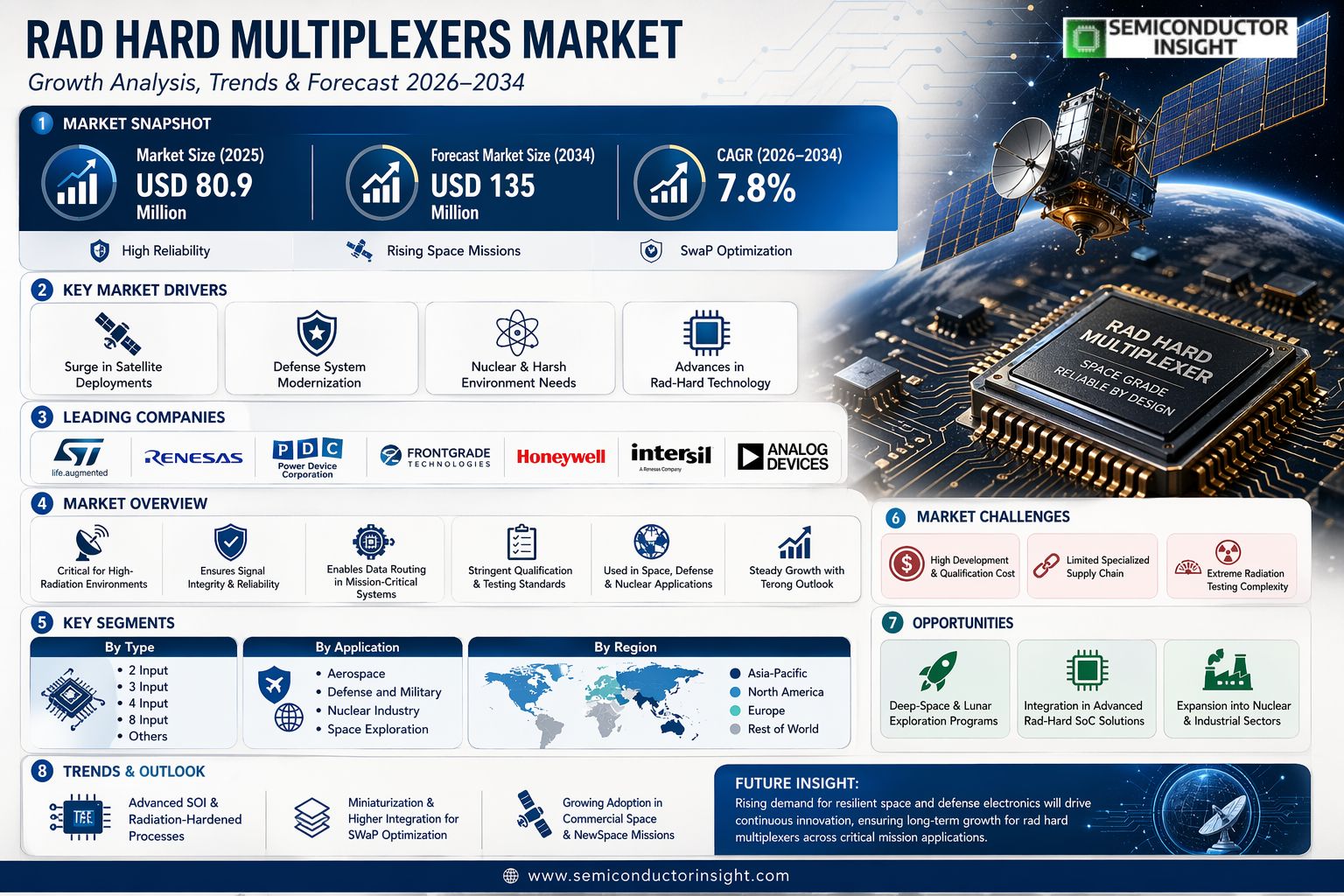
Global Rad Hard Multiplexers Market size was valued at USD 80.9 million in 2025. The market is projected to grow from USD 87.1 million in 2026 to reach USD 135 million by 2034, exhibiting a CAGR of 7.8% during the forecast period.
Radiation-hardened (Rad Hard) multiplexers are specialized electronic components engineered to maintain reliable operation in high-energy radiation environments, such as space, nuclear facilities, and certain military applications. These devices are designed using specific semiconductor processes and materials,like silicon-on-insulator (SOI) technology,to mitigate the damaging effects of ionizing radiation, including single-event upsets (SEUs) and total ionizing dose (TID) effects. Their primary function is to select one of several input signals and forward it to a single output line, a critical task for data routing and signal management in harsh conditions where standard electronics would fail.
The market growth is primarily driven by increasing satellite deployments for communication, Earth observation, and national security, alongside modernization programs in defense systems that require robust electronics. However, the market faces challenges due to the high cost of design, testing, and qualification for radiation hardness, which creates a significant barrier to entry. Recent developments focus on enhancing performance while reducing size, weight, and power (SWaP). For instance, key players like Analog Devices and STMicroelectronics continue to advance their rad-hard analog product lines to support new space missions. Other leading manufacturers operating in this niche but critical market include Renesas Electronics, Data Device Corporation (DDC), and Frontgrade Technologies, who supply components with guaranteed performance across specified radiation levels.
MARKET DRIVERS
Global Expansion of Space Exploration Initiatives
The primary driver for Rad Hard Multiplexers Market is the unprecedented surge in global space activity. Increased government and private sector investments in satellite constellations for communication, Earth observation, and navigation demand highly reliable electronic components capable of withstanding the harsh radiation environment of space. This directly escalates the procurement and integration of critical signal routing components like radiation-hardened multiplexers.
Modernization of Defense and Aerospace Systems
Military and aerospace platforms, including avionics, missile systems, and unmanned vehicles, are undergoing significant technological upgrades. These systems require electronics that guarantee performance and data integrity in high-radiation or nuclear-hardened environments. Rad Hard Multiplexers Market is propelled by the need for these components in next-generation secure and resilient defense infrastructure, ensuring reliable signal management where failure is not an option.
➤ The concurrent growth in commercial satellite deployment and national security modernization creates a sustained, high-reliability demand cycle for radiation-hardened integrated circuits, with multiplexers being a fundamental building block.
Advancements in semiconductor manufacturing for rad-hard applications themselves act as a catalyst. Improved processes enable higher performance, lower power consumption, and greater functional density in radiation-hardened multiplexers, making them more attractive for a wider range of critical missions within the overall market.
MARKET CHALLENGES
Extreme Cost and Complexity of Development and Certification
The most significant challenge Rad Hard Multiplexers Market is the immense cost and extended development timeline associated with designing, manufacturing, and qualifying components. The specialized materials, proprietary fabrication processes, and rigorous testing required to guarantee performance under radiation exposure result in unit costs orders of magnitude higher than commercial-grade equivalents, limiting market volume and supplier entry.
Other Challenges
Technological Obsolescence and Long Product Lifecycles
The lengthy design and qualification cycles for space and defense systems can lead to a mismatch with the faster pace of semiconductor innovation. Designing a Rad Hard Multiplexers Market product with a 15-20 year reliability horizon using older, proven process nodes creates challenges in balancing performance with long-term availability and support.
Supply Chain Constraints and Limited Foundry Access
Production is dependent on a very limited number of specialized semiconductor foundries equipped for rad-hard processes. This concentrated supply chain creates vulnerabilities, including capacity bottlenecks and geopolitical sensitivities, which can severely impact lead times and availability for critical programs.
MARKET RESTRAINTS
High Entry Barriers and Market Consolidation
Rad Hard Multiplexers Market is inherently restrained by formidable barriers to entry. The need for deep expertise in radiation effects, access to costly specialized manufacturing, and established relationships with defense and aerospace primes consolidates the market among a few key players. This limits competitive pressure and can slow the pace of innovation and cost reduction, potentially restraining overall market growth as program budgets face scrutiny.
Proliferation of Commercial-Off-The-Shelf (COTS) Alternatives for Less Critical Orbits
For missions in low-Earth orbit (LEO) or with shorter operational lifespans, system designers are increasingly evaluating high-reliability commercial components or those with inherent radiation tolerance. This trend towards “COTS-like” or “New Space” approaches for certain applications poses a restraint on the traditional, full mil-spec Rad Hard Multiplexers Market segment, as it introduces alternative, lower-cost solutions for non-geostationary or commercial constellations.
MARKET OPPORTUNITIES
Deep-Space Exploration and Lunar/Planetary Missions
The renewed focus on lunar gateways, Mars exploration, and deep-space probes presents a major opportunity. These missions encounter vastly more severe radiation environments, such as galactic cosmic rays and solar particle events, mandating the highest level of radiation hardening. Rad Hard Multiplexers Market is poised for growth from these flagship programs, which require components with proven reliability for multi-year missions beyond Earth’s protective magnetosphere.
Integration with Advanced Rad-Hard System-on-Chip (SoC) Designs
Opportunity exists in the development of more integrated, multifunctional rad-hard solutions. Embedding multiplexer functions into broader radiation-hardened signal chain or data processing SoCs can offer system designers reduced size, weight, power, and cost (SWaP-C). Companies Rad Hard Multiplexers Market that can offer such highly integrated, application-specific solutions will capture significant value in next-generation satellite and spacecraft architectures.
Expansion into New Critical Infrastructure Terrestrial Applications
Beyond space and aerospace, there is burgeoning potential in terrestrial applications where radiation-induced errors are unacceptable. This includes electronics for nuclear power plant control systems, high-altitude aviation, and medical equipment in radiation therapy environments. Adapting rad-hard multiplexer technology for these high-reliability industrial markets could open substantial new revenue streams for market players.
Rad Hard Multiplexers Market Trends
Dominant Aerospace and Defense Demand
The primary driver for Rad Hard Multiplexers Market continues to be the robust demand from the aerospace and defense sectors. These components are critical for satellite constellations, launch vehicles, and military-grade communication systems that must operate reliably in harsh radiation environments, such as space or high-altitude flight. The industry trend shows a consistent push for higher integration and miniaturization, allowing for more complex signal routing within the stringent size, weight, and power constraints of modern platforms. This demand is fostering continuous R&D into advanced semiconductor processes that enhance radiation tolerance without compromising performance.
Other Trends
Material and Process Innovation
A significant trend withRad Hard Multiplexers Market is the advancement in specialized materials and fabrication processes. Manufacturers are moving beyond traditional hardening techniques to employ silicon-on-insulator and other specialized substrate technologies. These innovations are crucial for improving the total ionizing dose tolerance and single-event effect immunity of multiplexers, directly addressing the challenges posed by more demanding missions and longer operational lifetimes in orbit.
Supply Chain Consolidation and Strategic Focus
The competitive landscape is characterized by a consolidation of expertise among a select group of specialized manufacturers, including STMicroelectronics, Renesas Electronics, and Honeywell. These key players are focusing on vertical integration and strategic partnerships to control the supply of rad-hardened components. The trend indicates a market where deep technical knowledge and proven reliability are paramount, creating high barriers to entry and emphasizing long-term supplier relationships for major defense and aerospace contractors.
Regional Investment and Program Alignment
Geographically, procurement and development trends Rad Hard Multiplexers Market are closely aligned with national space and defense programs. Significant government investments in new space infrastructure and modernized military assets in North America and Asia-Pacific are directly influencing production volumes and technological roadmaps. This alignment ensures that product development cycles are synchronized with major program milestones, from research phases to full-scale deployment, securing a pipeline of demand for qualified rad-hard multiplexers.
COMPETITIVE LANDSCAPE
Key Industry Players
A Market Defined by Specialized Expertise and Strategic Consolidation
Global Rad Hard Multiplexers Market is characterized by a concentrated and specialized competitive environment, where technological expertise in radiation-hardened semiconductor design is the primary barrier to entry. In 2025, Global top five manufacturers held a significant revenue share, underscoring the consolidated nature of this high-reliability segment. Market leadership is firmly held by established semiconductor and aerospace-defense corporations with deep-rooted capabilities in radiation-hardening technologies. STMicroelectronics and Renesas Electronics are pivotal players, leveraging their extensive semiconductor portfolios to serve critical aerospace and defense applications. The competitive advantage in this market is built on long-term reliability data, stringent qualification processes, and the ability to meet the exacting standards of agencies like NASA and major defense departments.
Beyond the top-tier leaders, a cadre of highly specialized firms addresses niche and demanding application segments. Companies such as Power Device Corporation and Data Device Corporation (DDC) focus intently on high-reliability components for space and military systems. Meanwhile, diversified industrial and defense conglomerates like Honeywell, Northrop Grumman, and Frontgrade (formerly part of Cobham) integrate Rad Hard multiplexers into their broader mission-critical subsystems and platforms, often utilizing in-house capabilities to secure supply chains. The market also sees significant activity from analog and mixed-signal specialists like Analog Devices, whose precision data conversion expertise is crucial for signal integrity in harsh environments. The competitive landscape is further shaped by strategic mergers and acquisitions, as larger entities seek to acquire specialized radiation-hardened intellectual property and manufacturing know-how.
List of Key Rad Hard Multiplexers Companies Profiled
- STMicroelectronics
- Renesas Electronics Corporation
- Power Device Corporation
- Frontgrade Technologies
- Intersil (a part of Renesas)
- Honeywell Aerospace
- Cobham Semiconductor Solutions
- Northrop Grumman Corporation
- Data Device Corporation (DDC)
- Analog Devices, Inc.
- Microchip Technology Inc.
- Texas Instruments Incorporated
- BAE Systems PLC
- Vorago Technologies
- Crane Aerospace & Electronics
Segment Analysis:
| Segment Category | Sub-Segments | Key Insights |
| By Type |
|
2 Input multiplexers are the established core of the market, prized for their fundamental role and reliability in critical signal routing. Their design simplicity often translates into superior radiation hardness and robust performance in extreme environments. This segment benefits from extensive legacy system integration and widespread availability from key manufacturers, fostering strong trust among engineers for mission-critical aerospace and defense applications where component failure is not an option. |
| By Application |
|
Defense and Military applications represent the primary driver, creating sustained and high-value demand for rad hard multiplexers. The operational necessity for electronic systems to function reliably in battlefield conditions, including potential exposure to radiation from nuclear events or specialized weaponry, mandates the use of these hardened components. This segment demands the highest standards of reliability, security of supply, and long-term product support, which shapes the entire market’s focus on ruggedness and stringent qualification processes. |
| By End User |
|
Defense System Integrators are the most influential end-user segment, acting as the crucial link between component manufacturers and final deployed platforms. These integrators drive specifications that emphasize not just performance but also long-term availability, traceability, and compliance with strict military standards. Their projects, ranging from spacecraft to ground-based radar and command systems, require multiplexers that can endure the lifecycle of the equipment, thereby favoring established suppliers with proven track records in radiation-hardened technology. |
| By Fabrication Technology |
|
Silicon-on-Insulator (SOI) based fabrication is the leading technological approach for achieving radiation hardness. SOI technology provides inherent isolation that significantly reduces susceptibility to single-event effects and latch-up, which are critical failure modes in radiation environments. This method allows designers to balance performance, power consumption, and hardening efficacy, making it the preferred foundation for many commercial rad hard components offered by leading semiconductor companies in this niche market. |
| By Certification Level |
|
Space-Qualified (EQML / Class V) components command the highest strategic value, tailored for the most demanding environments like satellites and deep-space probes. This segment involves exhaustive testing for total ionizing dose and single-event effects, ensuring functionality over multi-year missions without maintenance. The extreme reliability requirements and lengthy, costly qualification processes create high barriers to entry, consolidating demand among a select group of trusted manufacturers and making these components critical for national space and security infrastructure. |
Regional Analysis: Rad Hard Multiplexers Market
North America
The region’s market stability is heavily influenced by long-term defense contracts from the U.S. government and allied nations. These contracts provide predictable funding streams for programs requiring radiation-hardened electronics, from missile defense systems to strategic satellites. This procurement ecosystem incentivizes continual product refinement and qualification testing for rad hard multiplexers to meet evolving mission profiles and radiation tolerance specifications set forth by prime contractors across commercial aerospace.
The burgeoning commercial space and NewSpace sector in North America is becoming a significant secondary driver. While historically focused on defense, suppliers are now adapting their aerospace rad hard multiplexer designs for cost-sensitive yet reliability-critical commercial satellite constellations. This involves balancing the extreme performance needed for harsh radiation environments with commercial pressures for faster development cycles and scalable manufacturing.
The concentration of national laboratories, top-tier research universities, and specialized technology incubators fosters a powerful innovation pipeline for radiation-hardened electronics. Collaborative projects between academia, government agencies, and private firms accelerate the development of next-generation materials and designs essential for advancing the performance parameters of aerospace rad hard multiplexers, particularly for deep-space and high-altitude applications.
Market leadership is reinforced by strategic alliances between U.S. component manufacturers and global aerospace primes. However, the controlled nature of this rad hard multiplexers segment means that international trade is governed by stringent export regulations (ITAR). This creates a protected domestic supply chain but also necessitates careful navigation for firms seeking to engage in transnational partnerships and address global commercial aerospace demand.
Europe
The European market for rad hard multiplexers is characterized by a strong collective effort through multinational space agency collaborations, primarily led by the European Space Agency (ESA), and robust national programs in countries like France, Germany, and the United Kingdom. The region’s focus extends across a diverse mission portfolio including Earth observation, scientific deep-space probes, and secure governmental satellite communications. This drives demand for highly reliable and qualified aerospace radiation-hardened components. European suppliers emphasize rigorous design assurance, long-term reliability validation, and adherence to ECSS (European Cooperation for Space Standardization) protocols. The push for strategic autonomy in space capabilities and secure supply chains for critical space electronics is fostering increased R&D investment and public-private partnerships to develop indigenous capabilities withRad Hard Multiplexers Market, particularly for next-generation launchers and sovereign satellite constellations.
Asia-Pacific
The Asia-Pacific region represents the most dynamic and rapidly growing segment of Global Rad Hard Multiplexers Market, fueled by ambitious national space programs. China’s aggressive advancement in space exploration, satellite navigation (Beidou), and military space applications creates massive domestic demand for radiation-hardened electronics, fostering a self-reliant, state-driven aerospace supply chain. Japan and India also contribute significantly, with focused programs for scientific missions, lunar exploration, and regional satellite communication networks. This growth is driving local technological maturation in designing and qualifying aerospace rad hard multiplexers. While currently more inwardly focused, the expanding technological base and manufacturing scale in the region position it as a potential future hub for both supply and innovation within the broader commercial aerospace market for radiation-tolerant components.
South America
Participation Rad Hard Multiplexers Market from South America is nascent but emerging, primarily through collaborative international partnerships and regional space initiatives. Countries like Brazil and Argentina have established space agencies with focuses on remote sensing, environmental monitoring, and communication satellites. Their involvement typically entails procuring qualified subsystems and components, including aerospace radiation-hardened electronics, from established international suppliers for specific satellite projects. While not a primary development hub, the region’s engagement through partnerships with agencies like NASA and ESA provides a pathway for technology transfer and capacity building. The market presence is characterized by targeted procurement for specific missions rather than indigenous production, with growth tied to the expansion of national space budgets and regional cooperative agreements in commercial aerospace.
Middle East & Africa
Activity in the Middle East & Africa withRad Hard Multiplexers Market is selectively growing, driven by strategic investments in sovereign satellite capabilities, particularly in the Gulf Cooperation Council (GCC) nations. These countries are launching communication, Earth observation, and reconnaissance satellites to diversify economies and enhance security, creating demand for reliable aerospace electronic components that can withstand the space radiation environment. Procurement often involves turnkey contracts with international satellite manufacturers, which include specified rad hard multiplexers and other critical subsystems. Regional initiatives are more focused on downstream application and operation, with component-level development and manufacturing remaining outside the region. However, long-term vision documents aimed at building space science and technology ecosystems could gradually influence deeper engagement with the specialized supply chains for radiation-hardened electronics.
Report Scope
This market research report provides a comprehensive analysis of the Rad Hard Multiplexers Market , covering the forecast period 2026–2034. It offers detailed insights into market dynamics, technological advancements, competitive landscape, and key trends shaping the industry.
Key focus areas of the report include:
- Market Overview: The report begins with an overview outlining its current market scenario, key growth indicators, and industry transformation drivers. It discusses macroeconomic factors, demand–supply balance, regulatory landscape, and the strategic role of semiconductors in powering advancements across industries such as automotive, telecommunications, consumer electronics, and industrial automation.
- Market Size & Forecast: Historical data and future projections for revenue, unit shipments, and market value across major regions and segments.
- Segmentation Analysis: Detailed breakdown by product type, technology, application, and end-user industry to identify high-growth segments and investment opportunities.
- Regional Insights: Insights into market performance across North America, Europe, Asia-Pacific, Latin America, and the Middle East & Africa, including country-level analysis where relevant.
- Competitive Landscape: Profiles of leading market participants, including their product offerings, R&D focus, manufacturing capacity, pricing strategies, and recent developments such as mergers, acquisitions, and partnerships.
- Technology Trends & Innovation: Assessment of emerging technologies, integration of AI/IoT, semiconductor design trends, fabrication techniques, and evolving industry standards.
- Market Drivers & Restraints: Evaluation of factors driving market growth along with challenges, supply chain constraints, regulatory issues, and market-entry barriers.
- Stakeholder Insights: Insights for component suppliers, OEMs, system integrators, investors, and policymakers regarding the evolving ecosystem and strategic opportunities.
Primary and secondary research methods are employed, including interviews with industry experts, data from verified sources, and real-time market intelligence to ensure the accuracy and reliability of the insights presented.
FREQUENTLY ASKED QUESTIONS:
What is the current market size of Rad Hard Multiplexers Market?
-> Global Rad Hard Multiplexers Market was valued at USD 80.9 million in 2025 and is projected to reach USD 135 million by 2034, growing at a CAGR of 7.8% during the forecast period.
Which key companies operate Rad Hard Multiplexers Market?
-> Key players include STMicroelectronics, Renesas Electronics, Power Device Corporation, Frontgrade, Intersil, Honeywell, Cobham Semiconductor, Northrop Grumman, Data Device Corporation, and Analog Devices, among others. In 2025, Global top five players held a significant revenue share.
What are the key growth drivers?
-> Key growth drivers include increasing demand for reliable electronics in radiation-prone environments, advancements in aerospace and defense systems, and expansion of nuclear industry applications.
Which region dominates the market?
-> North America, particularly the U.S., is a major market. Asia, led by China, is also a key region with significant growth potential.
What are the emerging trends?
-> Emerging trends include development of specialized multiplexers for harsh environments, integration of advanced radiation-hardened materials and processes, and rising adoption in satellite and space exploration missions.

Get Sample Report PDF for Exclusive Insights
Report Sample Includes
- Table of Contents
- List of Tables & Figures
- Charts, Research Methodology, and more...
 Download Sample Report PDF




