
MARKET INSIGHTS
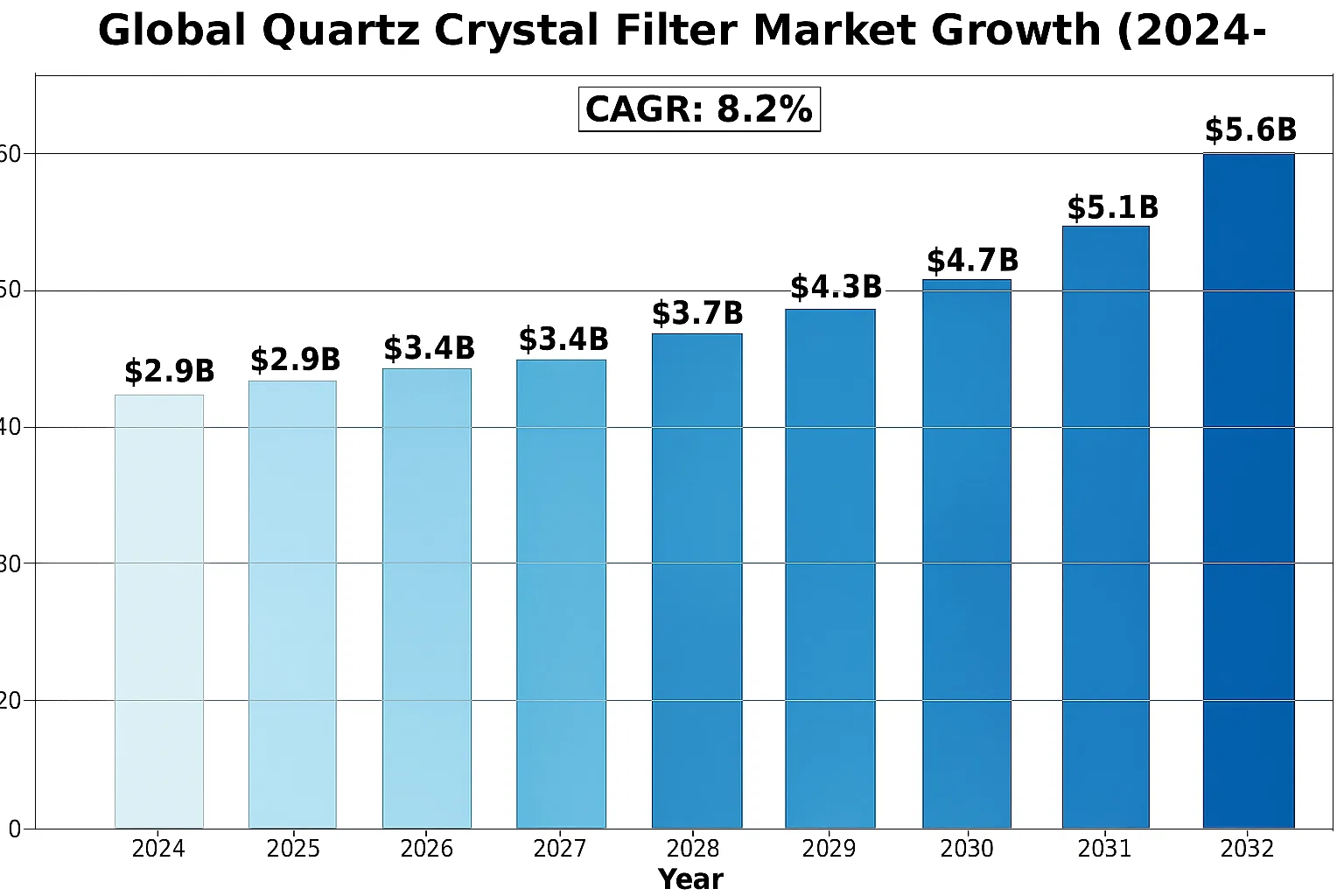
The global Quartz Crystal Filter Market was valued at 2927 million in 2024 and is projected to reach US$ 5026 million by 2032, at a CAGR of 8.2% during the forecast period.
Quartz crystal filters are precision electronic components that utilize the piezoelectric properties of quartz to provide highly selective frequency filtering. These devices function as band-pass or band-stop filters, composed of multiple metal electrode pairs arranged on quartz substrates. By leveraging the energy trapping theory of piezoelectric effects, they achieve precise frequency control with exceptionally high quality factors (Q factors), often exceeding 10,000. This makes them indispensable in applications requiring stable frequency selection with minimal signal loss.
The market growth is driven by increasing demand for reliable frequency control in telecommunications, consumer electronics, and defense applications. While 5G network expansion creates new opportunities, challenges persist in miniaturization for IoT devices. The 2-pole filter segment shows particular growth potential, expected to reach USD 1.42 billion by 2032. Key players like Murata, NDK, and Epson continue to dominate the market through innovations in temperature stability and reduced insertion loss.
MARKET DYNAMICS
MARKET DRIVERS
Growing Demand for High-Frequency Communication Technologies to Accelerate Market Expansion
The quartz crystal filter market is witnessing substantial growth due to increasing adoption in high-frequency communication technologies such as 5G networks, satellite communications, and radar systems. These applications require precise frequency control, where quartz crystal filters excel due to their superior temperature stability and low insertion loss. The global rollout of 5G infrastructure alone is projected to require over 15 million additional filters by 2027. As telecommunication networks evolve toward higher frequencies and lower latencies, quartz crystal filters become indispensable components in base stations and mobile devices.
Expanding Automotive Electronics Sector to Fuel Product Adoption
Modern vehicles incorporate more than 100 electronic control units that rely on quartz crystal filters for clock generation and signal processing. The automotive electronics market has grown by 28% since 2020, driven by advanced driver assistance systems (ADAS), vehicle-to-everything (V2X) communication, and infotainment solutions. Stringent automotive safety standards mandate reliable timing components, creating sustained demand for high-quality quartz filters. The integration of 5G connectivity in vehicles will further accelerate this trend, with premium vehicles now incorporating up to twelve quartz crystal filters per unit.
Military Modernization Programs to Drive Specialized Filter Demand
Defense applications account for nearly 35% of premium-grade quartz crystal filter sales, driven by modernization initiatives across major armed forces. These applications demand ruggedized filters with extreme temperature tolerance (-55°C to +125°C operational range) and anti-jamming capabilities. Recent geopolitical tensions have accelerated military communications upgrades, with projected defense electronics expenditures exceeding $250 billion globally in 2024. Quartz filters meet MIL-STD-202 shock/vibration specifications, making them irreplaceable in avionics, encrypted radios, and missile guidance systems.
MARKET RESTRAINTS
Emerging Alternative Technologies to Challenge Market Position
While quartz crystal filters dominate the mid-frequency range (10kHz to 300MHz), emerging technologies like bulk acoustic wave (BAW) and surface acoustic wave (SAW) filters are gaining traction in high-volume consumer applications. These alternatives offer 40-60% size reduction and better integration with semiconductor processes. Apple’s transition to BAW filters in iPhone RF front-end modules since 2018 has prompted other smartphone makers to evaluate alternatives. Though quartz maintains advantages in precision applications, the consumer electronics segment—representing 28% of filter demand—faces increasing substitution pressure.
Complex Manufacturing Processes to Elevate Production Costs
Quartz crystal filter production involves precision machining of piezoelectric quartz blanks, requiring specialized equipment with micron-level tolerances. The manufacturing yield for high-performance filters rarely exceeds 65%, creating cost pressures. Labor-intensive final tuning processes account for nearly 40% of total production expenses. Recent quartz crystal blank shortages have exacerbated these challenges, with lead times extending to 26 weeks for some MIL-spec grades. These factors contribute to 15-20% higher costs compared to alternative filter technologies in mass-market applications.
Regulatory Compliance to Increase Time-to-Market
Certification requirements for telecom (FCC/ETSI), automotive (AEC-Q200), and military (MIL-PRF-55310) applications create significant barriers to new market entrants. Full qualification of a new quartz filter design typically requires 9-18 months of testing, including 1,000-hour life tests and harsh environment validations. Recent revisions to RoHS directives have forced manufacturers to reformulate electrode materials, adding complexity. These compliance hurdles particularly impact smaller suppliers lacking dedicated qualification resources.
MARKET OPPORTUNITIES
Medical IoT Expansion to Create New Application Horizons
The healthcare sector presents significant untapped potential, with medical IoT devices requiring ultra-reliable timing solutions. Wireless patient monitors, portable ultrasound systems, and implantable devices increasingly incorporate quartz crystal filters for their EMI immunity and long-term stability. The global medical electronics market is projected to grow at 8.9% CAGR through 2030, with vital sign monitors alone requiring over 5 million precision filters annually. Recent FDA clearances for continuous glucose monitoring systems with 90-day wearables have opened new design opportunities for miniature filter solutions.
Industrial Automation Upgrade Cycle to Drive Replacement Demand
Industry 4.0 initiatives are accelerating factory automation equipment upgrades, creating replacement demand for industrial-grade filters. Modern programmable logic controllers (PLCs) and field instrumentation now require filters with 0.1ppm frequency stability to synchronize distributed control systems. The global industrial automation market is forecast to exceed $400 billion by 2027, with Asia-Pacific accounting for 42% of spending. Temperature-compensated quartz filters (TCXOs) are becoming standard in smart sensors, with annual shipments growing at 12% since 2022.
Space Commercialization to Enable High-Margin Applications
The NewSpace revolution is creating opportunities for radiation-hardened quartz crystal filters in small satellites and deep-space probes. Low-earth orbit (LEO) constellations require filters that maintain stability despite extreme thermal cycling (-150°C to +150°C). Commercial satellite launches have increased by 300% since 2018, with plans for over 50,000 new LEO satellites this decade. Space-grade quartz filters command 8-10x premium pricing over commercial equivalents, offering attractive margins for qualified suppliers.
MARKET CHALLENGES
Geopolitical Tensions to Disrupt Supply Chain Stability
The quartz crystal filter industry faces mounting supply chain risks, with over 60% of raw quartz coming from politically sensitive regions. Recent export controls on high-purity quartz sand have caused price volatility, with prices increasing by 30% since 2022. The industry relies heavily on specialized Japanese and German processing equipment, creating single points of failure. These vulnerabilities were exposed during the 2021 semiconductor shortage, when filter lead times extended beyond 52 weeks.
Workforce Skill Gaps to Impede Technological Advancements
Quartz filter manufacturing requires highly skilled technicians for precision lapping and frequency tuning—skills that take 5-7 years to master. An aging workforce and lack of vocational training programs have created critical talent shortages. Over 35% of master technicians are expected to retire within this decade, with insufficient replacements entering the field. This skills gap threatens manufacturers’ ability to adopt advanced processes like photolithographic electrode patterning.
Miniaturization Demands to Test Engineering Limits
Consumer electronics manufacturers now demand filters under 1.0mm x 0.8mm footprint, challenging fundamental piezoelectric limitations. While semiconductor-style packaging helps reduce size, it compromises performance parameters like Q-factor and phase noise. Achieving military-grade stability in sub-2mm packages remains an unsolved engineering challenge. These constraints force difficult trade-offs between size, performance, and cost—particularly for emerging wearable and IoT applications.
QUARTZ CRYSTAL FILTER MARKET TRENDS
Increasing Demand for High-Frequency Communication Devices Driving Market Growth
The rapid global expansion of 5G networks, IoT (Internet of Things) devices, and advanced wireless communication systems has significantly boosted demand for high-performance quartz crystal filters. These components play a crucial role in ensuring signal integrity and reducing electromagnetic interference in complex RF (Radio Frequency) circuits. The automotive sector’s shift towards connected vehicle technologies has further increased adoption, with advanced driver assistance systems (ADAS) requiring stable frequency control components. The medical devices industry, particularly in imaging and diagnostic equipment, also contributes substantially to the growing need for precision filters.
Other Trends
Miniaturization and Integration Challenges
While demand grows across sectors, manufacturers face increasing pressure to develop smaller, more integrated quartz crystal filters that maintain high Q-factors (quality factors). The rise of wearable electronics and compact IoT sensors has accelerated the development of surface-mount device (SMD) quartz filters, which now account for over 60% of the market by volume. However, achieving <15μm thickness while preserving frequency stability remains a significant technical hurdle. Some leading suppliers have begun incorporating MEMS (Micro-Electro-Mechanical Systems) fabrication techniques to address these challenges.
Supply Chain Diversification and Regional Market Shifts
Recent disruptions in the global electronics supply chain have prompted manufacturers to reevaluate production strategies, with an observable trend toward regionalization. The Asia-Pacific market, particularly China and Japan, has demonstrated resilience, accounting for nearly 48% of quartz crystal filter production capacity. Meanwhile, North American and European manufacturers are investing heavily in automation and smart factory technologies to compensate for higher labor costs. This strategic realignment coincides with growing military and aerospace applications, where stringent reliability requirements are driving premium pricing for defense-grade components with extended temperature ranges.
COMPETITIVE LANDSCAPE
Key Industry Players
Technological Innovation and Strategic Expansions Drive Market Competition
The global quartz crystal filter market features a semi-consolidated competitive landscape, dominated by established electronics component manufacturers with strong R&D capabilities. Murata Manufacturing and NDK collectively account for a significant market share, leveraging their extensive product portfolios and manufacturing expertise in piezoelectric components. These Japanese giants maintain technological leadership through continuous investment in miniaturization and frequency stability improvements.
While Asian manufacturers control a substantial portion of the supply chain, Western players like Golledge Electronics and ACT (American Crystal Technologies) have carved niches in specialized military and aerospace applications. This geographical diversification creates a balanced competitive dynamic where companies compete on both technical specifications and regional supply chain advantages.
The market has witnessed accelerated product development cycles as companies respond to emerging 5G and IoT applications. Epson Toyocom recently launched its new low-profile crystal filters for wearables, demonstrating how industry leaders are adapting to form factor challenges in consumer electronics. Similarly, AEC Electronic expanded its automotive-grade filter line to address growing demand in electric vehicle telematics.
Mid-tier competitors are pursuing strategic differentiation through application-specific solutions. QuartzCom strengthened its position in medical devices with FDA-cleared filters for imaging equipment, while ARGO Technology developed railway-certified components meeting EN 50155 standards. Such specialized offerings enable smaller players to compete effectively against larger corporations.
List of Key Quartz Crystal Filter Manufacturers Profiled
- Murata Manufacturing (Japan)
- NDK (Japan)
- Golledge Electronics (UK)
- ACT (American Crystal Technologies) (U.S.)
- Epson Toyocom (Japan)
- AEC Electronic (Switzerland)
- QuartzCom (Germany)
- ARGO Technology (China)
- SPK Electronics (Taiwan)
- SEVENSTAR ELECTRONIC (China)
- Wuhan Haichuang (China)
- SJK Crystal Technology (South Korea)
Segment Analysis:
By Type
2-pole Filter Segment Leads the Market Due to Wide Application in Intermediate Frequency Filtering
The market is segmented based on type into:
- 2-pole Filter
- 4-pole Filter
- Others
By Application
Consumer Electronics Segment Dominates with Increasing Demand for High-Frequency Stability Components
The market is segmented based on application into:
- Medical Instruments
- Consumer Electronics
- Rail Transportation
- Other
By End-User Industry
Telecommunications Sector Holds Significant Share Due to 5G Infrastructure Development
The market is segmented based on end-user industry into:
- Telecommunications
- Automotive
- Aerospace & Defense
- Industrial
Regional Analysis: Quartz Crystal Filter Market
North America
The North American quartz crystal filter market benefits from robust demand in telecommunications, defense, and medical instrumentation sectors, driven by the region’s advanced technology infrastructure. The U.S. remains a key revenue generator, with major manufacturers focusing on high-precision 2-pole and 4-pole filters for 5G infrastructure and aerospace applications. Strict regulatory standards, including FCC compliance, ensure premium-quality products dominate the market. However, competition from Asian manufacturers and supply chain disruptions pose challenges. Canada and Mexico are gradually adopting these components for industrial automation and automotive electronics, leveraging proximity to U.S. supply networks.
Europe
Europe’s market thrives on stringent EMC/EMI regulations and the push for miniaturized, energy-efficient components in IoT and automotive electronics. Germany leads due to its strong industrial automation sector, while France and the U.K. prioritize defense and aerospace applications, reflecting NATO and EU safety standards. The shift toward renewable energy systems has also spurred demand for reliable quartz crystal filters in grid stabilization equipment. Despite slower growth compared to Asia, the region maintains high profitability for premium products, supported by R&D investments from key players like Murata and Epson.
Asia-Pacific
Asia-Pacific dominates 59% of global quartz crystal filter demand, fueled by China’s massive electronics manufacturing sector and Japan’s leadership in high-frequency filters for consumer electronics. India and Southeast Asia are emerging as production hubs, driven by cost advantages and growing local procurement policies. Smartphone proliferation and 5G rollout are key growth drivers, though price sensitivity keeps mid-range 4-pole filters in highest demand. Challenges include IP protection issues and reliance on imported raw materials, but government initiatives like China’s “Made in 2025” are boosting domestic capabilities.
South America
South America’s market remains niche, focused on industrial automation and renewable energy projects in Brazil and Argentina. Limited local semiconductor infrastructure results in 95% import dependency, primarily from U.S. and Asian suppliers. Economic volatility and currency fluctuations hinder large-scale adoption, but the medical device sector shows promising uptake due to increasing healthcare investments. The lack of regional standards creates a fragmented landscape, with manufacturers prioritizing cost-effective solutions over high-performance variants.
Middle East & Africa
The MEA region displays nascent but strategic demand, particularly in oil & gas telemetry and defense communications. UAE and Saudi Arabia lead with smart city projects requiring precision timing components, while South Africa serves as a gateway for sub-Saharan industrial applications. Limited technical expertise and tariff barriers slow market penetration, though partnerships with global suppliers are gradually improving accessibility. The absence of local production facilities keeps prices 15–20% above global averages, but infrastructure modernization programs offer long-term potential.
Report Scope
This market research report provides a comprehensive analysis of the Global Quartz Crystal Filter market, covering the forecast period 2024–2032. It offers detailed insights into market dynamics, technological advancements, competitive landscape, and key trends shaping the industry.
Key focus areas of the report include:
- Market Size & Forecast: Historical data and future projections for revenue, unit shipments, and market value across major regions and segments. The Global Quartz Crystal Filter market was valued at USD 2,927 million in 2024 and is projected to reach USD 5,026 million by 2032, growing at a CAGR of 8.2%.
- Segmentation Analysis: Detailed breakdown by product type (2-pole Filter, 4-pole Filter), application (Medical Instruments, Consumer Electronics, Rail Transportation, Others), and end-user industry to identify high-growth segments.
- Regional Outlook: Insights into market performance across North America, Europe, Asia-Pacific, Latin America, and Middle East & Africa, including country-level analysis of key markets like the US, China, Japan, and Germany.
- Competitive Landscape: Profiles of leading market participants including Murata, NDK, Epson, Golledge Electronics, and ACT, covering their product portfolios, market share (top 5 players held approximately XX% in 2024), and strategic developments.
- Technology Trends & Innovation: Assessment of emerging technologies in quartz crystal filter design, manufacturing processes, and integration with modern electronic systems.
- Market Drivers & Restraints: Evaluation of factors driving market growth (increasing demand in telecommunications, automotive electronics) along with challenges (raw material price volatility, technical complexities).
- Stakeholder Analysis: Strategic insights for component manufacturers, OEMs, system integrators, and investors regarding market opportunities and competitive positioning.
Primary and secondary research methods are employed, including interviews with industry experts, analysis of company financials, and data from verified market intelligence sources to ensure accuracy and reliability.
FREQUENTLY ASKED QUESTIONS:
What is the current market size of Global Quartz Crystal Filter Market?
->Quartz Crystal Filter Market was valued at 2927 million in 2024 and is projected to reach US$ 5026 million by 2032, at a CAGR of 8.2% during the forecast period.
Which key companies operate in Global Quartz Crystal Filter Market?
-> Key players include Murata, NDK, Golledge Electronics, ACT, Epson, AEC Electronic, QuartzCom, ARGO Technology, SPK, and SEVENSTAR ELECTRONIC TECHNOLOGY(NAURA).
What are the key growth drivers?
-> Key growth drivers include increasing demand for precision filtering in telecommunications, expansion of 5G networks, growth in consumer electronics, and automotive electronics applications.
Which region dominates the market?
-> Asia-Pacific is the largest and fastest-growing market, driven by China’s electronics manufacturing sector, while North America remains a significant market for high-end applications.
What are the emerging trends?
-> Emerging trends include miniaturization of filters, development of high-frequency filters for 5G applications, and integration with IoT devices.

Get Sample Report PDF for Exclusive Insights
Report Sample Includes
- Table of Contents
- List of Tables & Figures
- Charts, Research Methodology, and more...
 Download Sample Report PDF


