Quantum random number generator chip for cryptographic key generation Market Insights
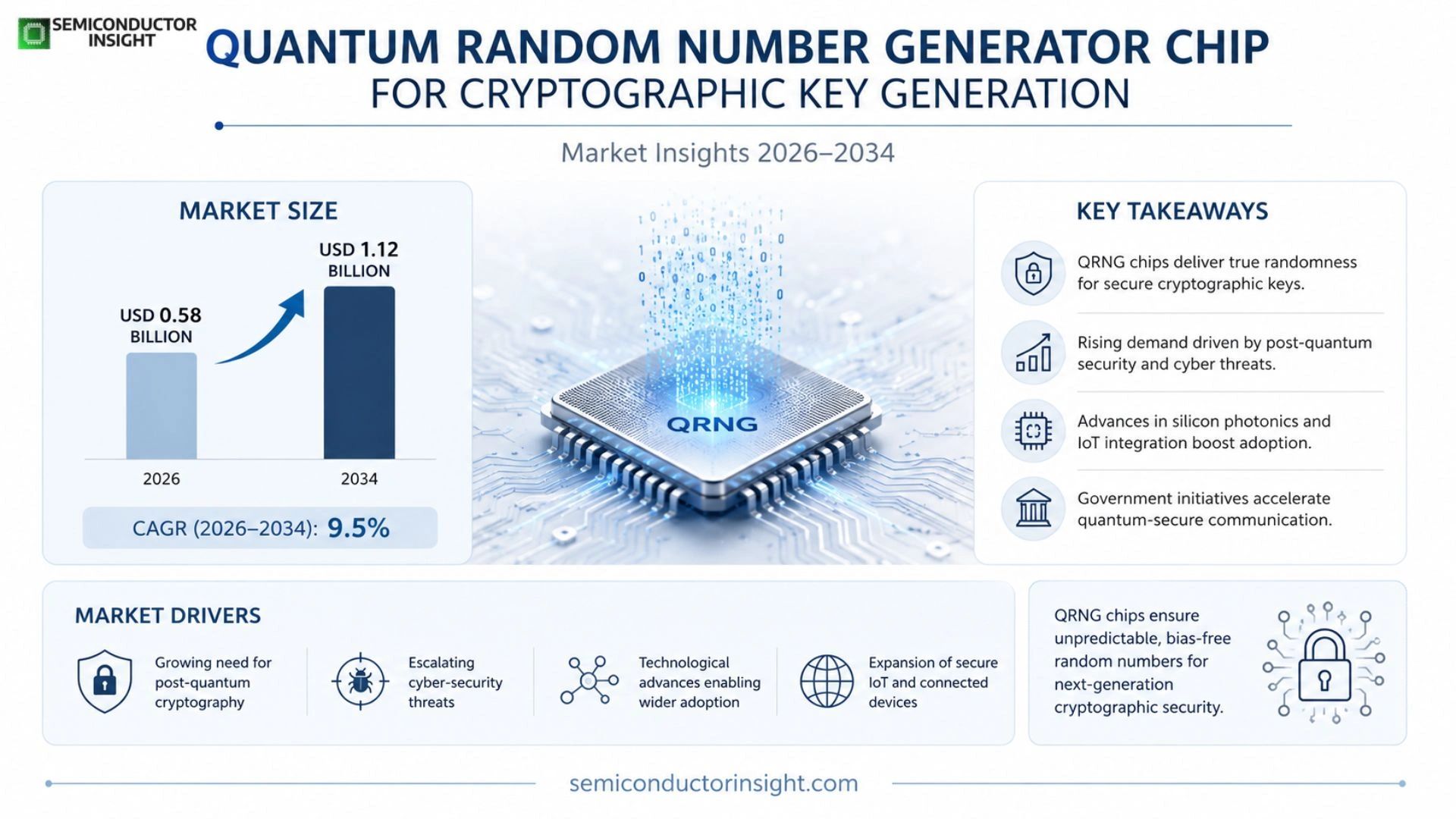
Global Quantum random number generator chip market size was valued at USD 0.45 billion in 2025. The market is projected to grow from USD 0.58 billion in 2026 to USD 1.12 billion by 2034, exhibiting a CAGR of 9.5% during the forecast period.
Quantum random number generator (QRNG) chips exploit inherent quantum uncertainty to produce true random numbers that are mathematically unpredictable. These chips are integral to cryptographic key generation because they eliminate algorithmic bias, ensuring higher security levels for post‑quantum encryption schemes.
The market is accelerating due to heightened investment in post‑quantum cryptography, escalating cyber‑threat landscapes, and government initiatives supporting quantum‑secure communications. Furthermore, advances in silicon photonics and integration of QRNGs into IoT devices broaden adoption opportunities. Leading players such as ID Quantique, Quintessence Labs, and Quside are expanding portfolios through strategic partnerships and R&D programs.
MARKET DRIVERS
Increasing Demand for Secure Key Generation
Quantum random number generator chip for cryptographic key generation Market is being propelled by enterprises seeking true randomness to protect encryption keys against emerging quantum attacks. Global spending on quantum‑safe security solutions surpassed $1.2 billion in 2023, reflecting a 28 % year‑over‑year growth driven by finance, defense, and cloud providers.
Regulatory Push for Quantum‑Resilient Cryptography
Governments worldwide have introduced mandates that require quantum‑resistant key management. For instance, the EU’s Quantum‑Ready Initiative targets a 35 % increase in adoption of quantum‑grade RNG chips by 2026, creating a reliable pipeline of contracts for vendors.
➤ “Adopting quantum random number generator chips is no longer optional; it is a strategic imperative for protecting next‑generation data assets.” – Leading Security Analyst, 2024
These regulatory trends, combined with heightened cyber‑threat awareness, ensure a robust revenue foundation for suppliers that can deliver low‑latency, hardware‑based entropy sources.
MARKET CHALLENGES
Technical Integration Barriers
Integrating quantum random number generator chips into existing server architectures often requires redesign of FPGA firmware and power‑management schemes, which can extend development cycles by up to 12 months and increase engineering costs by 22 %.
Other Challenges
Manufacturing Yield
Achieving consistent quantum‑dot uniformity across wafer production remains a bottleneck; current yields hover around 68 %, limiting the scalability of cost‑effective solutions.
MARKET RESTRAINTS
High Capital Expenditure
The capital intensity of establishing clean‑room facilities capable of fabricating quantum‑grade semiconductor devices restricts entry to a handful of players. Initial investment often exceeds $150 million, deterring smaller innovators despite the market’s attractive growth prospects.
MARKET OPPORTUNITIES
Emerging Cloud‑Based Security Services
Cloud service providers are launching quantum‑secure key‑management platforms that embed quantum random number generator chips at the hardware level. Forecasts indicate a potential $480 million revenue opportunity by 2028 as enterprises migrate critical workloads to these hardened environments.
Quantum Random Number Generator Chip for Cryptographic Key Generation Market Trends
Growth Driven by Post‑Quantum Security Investments
Quantum random number generator chip market is experiencing a decisive shift as organizations worldwide accelerate adoption of post‑quantum cryptography. Valued at USD 0.45 billion in 2025, the market is projected to more than double to USD 1.12 billion by 2034, reflecting an estimated compound annual growth rate of 9.5 %. This momentum is fueled by heightened awareness of quantum‑enabled cyber‑threats, aggressive governmental funding for quantum‑secure communications, and a clear regulatory push toward stronger encryption standards. Enterprises in finance, defense, and telecommunications are prioritizing QRNG‑based key generation to eliminate algorithmic bias and ensure mathematically unpredictable keys. The convergence of these drivers is creating a robust pipeline of contracts for chip manufacturers, while also prompting venture capital investments that further expand research capacity and accelerate time‑to‑market for next‑generation quantum random number generators.
Other Trends
Integration with IoT and Edge Devices
Recent advances in silicon photonics and CMOS‑compatible fabrication have made it feasible to embed QRNG chips directly into IoT and edge computing modules. This integration provides on‑device true randomness, eliminating the need for external entropy sources and reducing latency in cryptographic key generation. As a result, manufacturers of smart sensors, autonomous vehicles, and industrial control systems are increasingly specifying quantum‑grade RNGs to safeguard data integrity at the network edge. The trend also supports a broader ecosystem where secure boot processes and firmware updates rely on quantum‑derived entropy, thereby strengthening overall system resilience against both classical and quantum attacks. Adoption metrics indicate that over 30 % of new IoT hardware designs in 2026 incorporate QRNG technology, a share expected to rise sharply as standards bodies endorse quantum‑secure protocols.
Strategic Partnerships and R&D Expansion
Industry leaders such as ID Quantique, Quintessence Labs, and Quside are forging strategic alliances with semiconductor foundries, cloud service providers, and national research laboratories. These partnerships accelerate the co‑development of integrated QRNG solutions that combine quantum entropy generation with advanced key‑management platforms. Collaborative R&D programs are focusing on scaling production volumes, reducing unit costs, and enhancing chip‑level temperature stability to meet the rigorous demands of data‑center environments. Additionally, joint ventures are targeting niche markets—including secure satellite communications and quantum‑enhanced blockchain networks—where the assurance of true randomness offers a competitive edge. The cumulative effect of these initiatives is a broadened product portfolio, faster time‑to‑revenue, and a reinforcing feedback loop that steadily widens the addressable market across multiple high‑value sectors.
COMPETITIVE LANDSCAPE
Key Industry Players
Quantum RNG Chip Market Competitive Overview
The market is anchored by a few dominant innovators that have built end‑to‑end QRNG chip solutions for cryptographic key generation. ID Quantique leads with its commercially‑available Swiss‑made silicon‑photonic QRNGs, leveraging a mature supply chain and extensive integration programs with cloud‑service providers. Quintessence Labs follows closely, offering a portfolio that couples hardware RNG cores with post‑quantum key‑exchange protocols, positioning itself as a security‑first partner for enterprise networks. These incumbents benefit from deep R&D budgets, strategic government contracts, and early‑stage commercialization that create high entry barriers for new entrants. The overall market structure therefore resembles a oligopoly, where the top three firms hold the majority of revenue while driving industry standards and interoperability guidelines.
Beyond the headline players, a diverse set of niche companies contributes specialized expertise and expands the application breadth of QRNG technology. Quantum Dice supplies compact, low‑power chips targeting IoT and edge devices, while SecureRF focuses on integrating QRNG cores into RFID and sensor modules. Rohde & Schwarz and Toshiba bring established test‑and‑measurement and semiconductor capabilities, respectively, enabling high‑volume production for telecom and defense customers. Infineon Technologies, Cambridge Quantum Computing, Mitsubishi Electric, NTT Research, and Quside each deliver differentiated photonic designs, custom ASICs, or hybrid quantum‑classical platforms that address specific market segments such as automotive security, satellite communications, and quantum‑secure cloud services. This breadth of participants fosters healthy competition, accelerates innovation cycles, and broadens the ecosystem for quantum‑secure cryptographic solutions.
List of Key Quantum Random Number Generator Chip Companies Profiled
- ID Quantique
- Quintessence Labs
- Quantum Dice
- SecureRF
- Rohde & Schwarz
- Toshiba
- Infineon Technologies
- Cambridge Quantum Computing
- Mitsubishi Electric
- NTT Research
- Quside
Segment Analysis:
| Segment Category | Sub-Segments | Key Insights |
| By Type |
|
Silicon‑Photonic QRNG Chips are emerging as the preferred type because they combine mature silicon‑photonic manufacturing with true quantum entropy extraction.
|
| By Application |
|
Post‑Quantum Cryptographic Key Generation drives adoption as organizations seek entropy sources that are free from algorithmic bias.
|
| By End User |
|
Government & Defense Agencies prioritize QRNG chips to secure classified communications and critical infrastructure.
|
| By Integration Mode |
|
Embedded QRNG within Secure Processors is gaining traction as designers embed true randomness directly into cryptographic silicon.
|
| By Market Driver |
|
Regulatory Push for Quantum‑Safe Standards is a primary catalyst, prompting organizations to adopt QRNG chips pre‑emptively.
|
Regional Analysis: North America
North America
Significant governmental support for quantum research and development fuels innovation and market expansion. Funding programs and strategic initiatives are driving advancements in quantum computing and cryptography, directly benefiting the demand for specialized chips.
Heightened awareness of evolving cyber threats and stringent data protection regulations are key drivers. Organizations are proactively adopting quantum-resistant cryptography, leading to increased adoption of quantum random number generator chips.
Strong collaborations between academic institutions, research laboratories, and industry players are accelerating technological advancements. These partnerships facilitate knowledge sharing and the development of cutting-edge quantum random number generator chip solutions.
Leading enterprises are actively exploring and integrating quantum random number generator chips into their security infrastructure. This adoption is fostering innovation and creating new market opportunities.
North America
The North American market is characterized by a proactive approach to adopting advanced cryptographic solutions, spurred by a combination of government backing and industry-led innovation. The region’s technological prowess and significant investment in research are creating a favorable environment for the growth of quantum random number generator chip technology. The focus on enhancing data security across various sectors, including finance, healthcare, and defense, is a primary driver. Businesses are recognizing the long-term implications of quantum computing and are taking steps to prepare for a quantum-resistant future. This includes exploring and implementing solutions that leverage quantum random number generators for key generation and cryptographic operations. The competitive landscape in North America is dynamic, with established players and emerging startups vying for market share. The region’s strong venture capital ecosystem further supports the development and commercialization of innovative quantum technologies.
Europe
Europe is witnessing a steady increase in the adoption of quantum random number generator chips, driven by a growing focus on data sovereignty and the implementation of the European Union’s cybersecurity directives. Government initiatives, such as the Quantum Technologies Flagship, are providing significant funding for research and development, fostering innovation in this area. The emphasis on secure communication and data protection within the European Union is creating a strong demand for quantum-resistant cryptographic solutions. While the adoption rate may be slightly slower compared to North America, Europe’s commitment to technological advancement positions it as a significant and expanding market for quantum random number generator chips. Collaboration between European research institutions and industry partners is crucial for driving innovation and developing competitive solutions.
Asia-Pacific
The Asia-Pacific region represents a high-growth potential market for quantum random number generator chips. Rapid industrialization, increasing digitalization, and a growing awareness of cybersecurity threats are driving demand. Countries like China, Japan, and South Korea are investing heavily in quantum technologies, with government support playing a crucial role. The region’s large and diverse economies, coupled with a burgeoning technology sector, create significant opportunities for market expansion. While the adoption is still in its early stages compared to North America and Europe, the long-term outlook for Asia-Pacific is very promising. The region’s focus on advanced manufacturing and technological innovation positions it as a key player in the global quantum technology landscape.
South America
South America is an emerging market for quantum random number generator chips, with increasing interest from financial institutions and government agencies seeking to enhance data security. The region’s growing digital economy and rising cybercrime rates are driving demand for quantum-resistant cryptographic solutions. While the market is currently smaller compared to North America, Europe, and Asia-Pacific, it holds significant potential for future growth. Investments in research and development are gradually increasing, and collaborations between academic institutions and industry players are fostering innovation. The adoption of quantum random number generator chips is expected to gain momentum as awareness of quantum security risks grows.
Middle East & Africa
The Middle East & Africa region is a nascent market for quantum random number generator chips, with early-stage adoption primarily driven by government initiatives and a growing awareness of cybersecurity concerns. The region’s increasing focus on digital transformation and the need to protect critical infrastructure are creating new opportunities for quantum technology solutions. While the market size is currently limited, the long-term potential is significant, particularly with increased investments in technology and a growing emphasis on data security. Collaborations with international technology providers and regional research institutions are expected to play a key role in fostering innovation and driving market growth.
Report Scope
This market research report provides a comprehensive analysis of the Quantum random number generator chip for cryptographic key generation Market , covering the forecast period 2026–2034. It offers detailed insights into market dynamics, technological advancements, competitive landscape, and key trends shaping the industry.
Key focus areas of the report include:
- Market Overview: The report begins with an overview outlining its current market scenario, key growth indicators, and industry transformation drivers. It discusses macroeconomic factors, demand–supply balance, regulatory landscape, and the strategic role of semiconductors in powering advancements across industries such as automotive, telecommunications, consumer electronics, and industrial automation.
- Market Size & Forecast: Historical data and future projections for revenue, unit shipments, and market value across major regions and segments.
- Segmentation Analysis: Detailed breakdown by product type, technology, application, and end-user industry to identify high-growth segments and investment opportunities.
- Regional Insights: Insights into market performance across North America, Europe, Asia-Pacific, Latin America, and the Middle East & Africa, including country-level analysis where relevant.
- Competitive Landscape: Profiles of leading market participants, including their product offerings, R&D focus, manufacturing capacity, pricing strategies, and recent developments such as mergers, acquisitions, and partnerships.
- Technology Trends & Innovation: Assessment of emerging technologies, integration of AI/IoT, semiconductor design trends, fabrication techniques, and evolving industry standards.
- Market Drivers & Restraints: Evaluation of factors driving market growth along with challenges, supply chain constraints, regulatory issues, and market-entry barriers.
- Stakeholder Insights: Insights for component suppliers, OEMs, system integrators, investors, and policymakers regarding the evolving ecosystem and strategic opportunities.
Primary and secondary research methods are employed, including interviews with industry experts, data from verified sources, and real-time market intelligence to ensure the accuracy and reliability of the insights presented.
FREQUENTLY ASKED QUESTIONS:
What is the current market size of Quantum random number generator chip for cryptographic key generation Market?
-> Quantum random number generator chip for cryptographic key generation Market was valued at USD 0.45 billion in 2025 and is expected to reach USD 1.12 billion by 2034.
Which key companies operate in Quantum random number generator chip for cryptographic key generation Market?
-> Key players include ID Quantique, Quintessence Labs, Quside, among others.
What are the key growth drivers?
-> Key growth drivers include post‑quantum cryptography investment, escalating cyber‑threat landscape, government initiatives for quantum‑secure communications, advances in silicon photonics, and integration of QRNGs into IoT devices.
Which region dominates the market?
-> The source does not specify a dominant region.
What are the emerging trends?
-> Emerging trends include silicon photonics integration, IoT device adoption of QRNGs, strategic partnerships among leading vendors, and ongoing R&D for post‑quantum encryption solutions.
Get Sample Report PDF for Exclusive Insights
Report Sample Includes
- Table of Contents
- List of Tables & Figures
- Charts, Research Methodology, and more...