Quantum Photonic Chip Market Insights
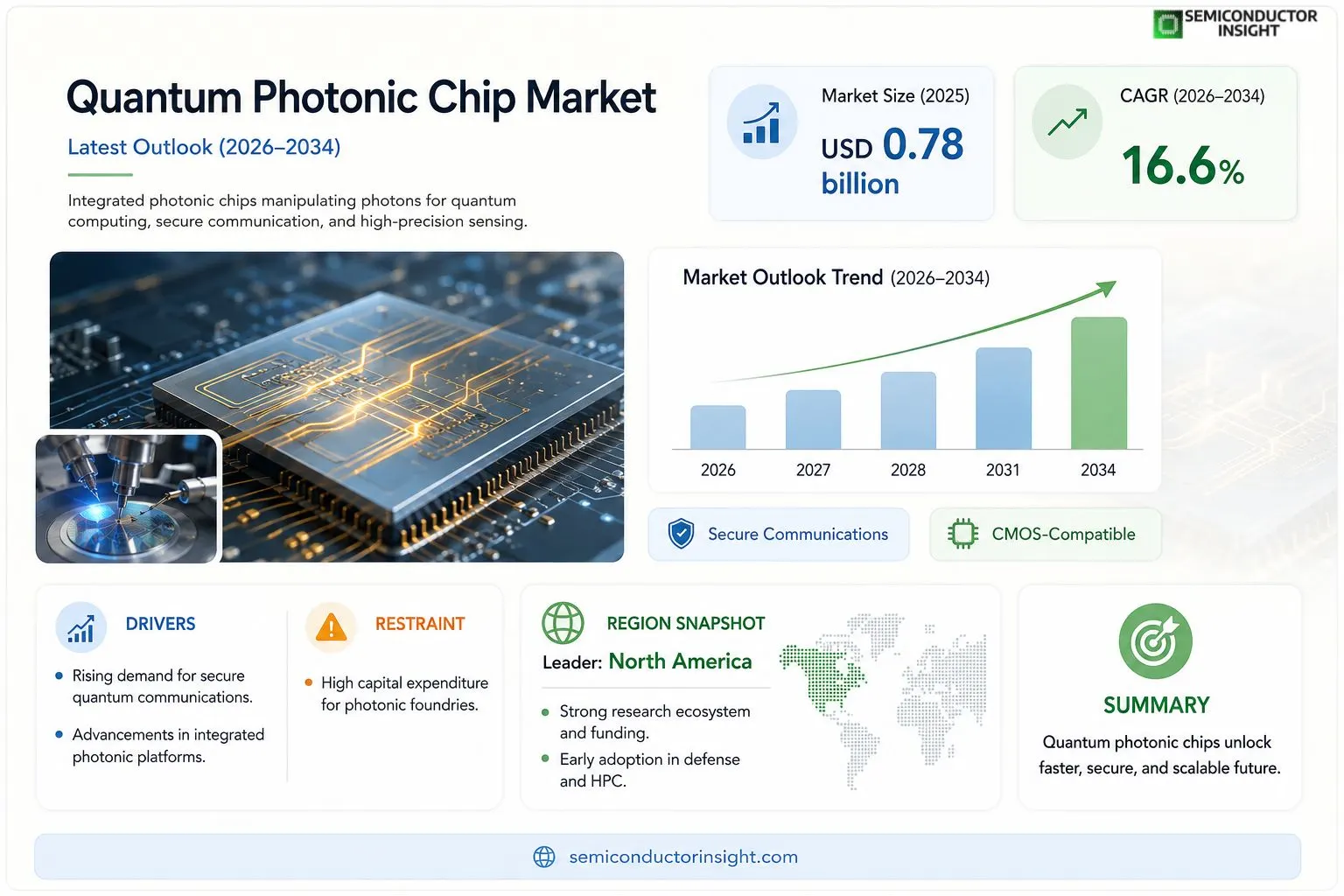
Global Quantum Photonic Chip market size was valued at USD 0.78 billion in 2025. The market is projected to grow from USD 0.78 billion in 2025 to USD 3.12 billion by 2034, exhibiting a CAGR of 16.6 % during the forecast period.
Quantum photonic chips are integrated optical circuits that manipulate photons for quantum information processing, enabling ultra‑fast computation, secure communication, and high‑precision sensing. These chips combine waveguides, modulators, detectors and quantum light sources on a single silicon‑based platform, thereby reducing system complexity while preserving quantum coherence.The market is experiencing rapid growth because of escalating investment in quantum technologies, rising demand for secure cryptographic solutions and breakthroughs in scalable manufacturing techniques such as CMOS‑compatible fabrication. Furthermore, collaborations between leading semiconductor firms and research institutions are accelerating product commercialization; for example, a strategic partnership announced in March 2024 between Intel and QuTech aims to deliver next‑generation quantum photonic processors within two years.
MARKET DRIVERS
Rising Demand for Secure Quantum Communications
Quantum Photonic Chip Market is being propelled by escalating requirements for ultra‑secure data transmission in finance, defense, and cloud services. Global shipments of quantum‑ready photonic modules grew to 1.2 million units in 2023, and industry forecasts project a compound annual growth rate of roughly 15% through 2028. This surge reflects enterprises’ willingness to invest in hardware that can support quantum‑key‑distribution protocols.
Advancements in Integrated Photonic Platforms
Recent breakthroughs in silicon‑nitride and indium phosphide integration have reduced device footprints by 40% while boosting bandwidth beyond 100 GHz. Such technological progress lowers the total cost of ownership, enabling mid‑size manufacturers to adopt quantum photonic chips for sensor fusion and edge‑AI workloads.
➤ “Quantum photonic chips deliver processing speeds that outpace conventional electronic counterparts, unlocking new commercial use‑cases.”
Overall, the convergence of security imperatives and platform miniaturization creates a robust growth engine, positioning Quantum Photonic Chip Market for sustained expansion over the next decade.
MARKET CHALLENGES
Manufacturing Complexity and Yield Issues
Fabricating high‑precision waveguides and low‑loss couplers demands sub‑nanometer tolerances, leading to yield rates that often linger below 70% for early‑stage volumes. These production bottlenecks inflate unit costs and deter cost‑sensitive adopters.
Other Challenges
Supply Chain Constraints
The reliance on specialty glass substrates and rare‑earth dopants creates a vulnerable supply chain, especially when geopolitical tensions disrupt material exports.Regulatory uncertainty around quantum‑grade encryption standards further slows market adoption, as vendors await clearer compliance pathways before committing to large‑scale deployments.
MARKET RESTRAINTS
High Capital Expenditure
Establishing dedicated photonic foundries requires capital outlays exceeding $500 million, a barrier for many entrants and a restraint on rapid capacity scaling.The scarcity of skilled photonic engineers compounds the investment challenge, as firms must allocate additional resources for training and talent acquisition.Absence of universally accepted performance standards hinders cross‑vendor interoperability, limiting broader ecosystem growth.
MARKET OPPORTUNITIES
Emerging Applications in Quantum Computing
Quantum photonic chips are poised to become the interconnect backbone for next‑generation quantum processors, offering low‑latency photon routing with minimal decoherence. This creates a lucrative niche as hardware vendors seek scalable photonic integration.Government R&D initiatives across Europe, North America, and Asia-Pacific are allocating upwards of $2 billion annually to quantum photonics, accelerating prototype development and commercialization pathways.Integration with mature silicon‑photonic platforms promises cost reductions of up to 30%, unlocking opportunities in data‑center networking and high‑performance computing where hybrid electronic‑photonic solutions are gaining traction.
Quantum Photonic Chip Market Trends
Scaling Manufacturing Through CMOS‑Compatible Processes
Manufacturers are increasingly adopting CMOS‑compatible photonic processes to improve yield and reduce cost. By integrating waveguides, modulators, detectors and quantum light sources on silicon platforms, production lines can leverage existing semiconductor infrastructure. This approach shortens time‑to‑market for quantum photonic chips and supports larger‑scale integration required for practical quantum computing and sensing applications. The trend is reinforced by advances in low‑loss waveguide design and high‑precision lithography, which together sustain quantum coherence while enabling mass‑production techniques previously reserved for classical electronics.
Other Trends
Secure Quantum Communications
The demand for cryptographically secure communication channels is driving significant interest in quantum photonic chip solutions. Integrated photonic circuits enable on‑chip generation of entangled photons and high‑speed quantum key distribution (QKD) without bulky external hardware. As enterprises and governments prioritize data protection, chip manufacturers are focusing on compact, low‑power designs that can be embedded directly into networking equipment. Early deployments demonstrate improved resistance to eavesdropping attacks, and ongoing research is expanding protocol compatibility to support a broader range of secure communication standards.
Strategic Partnerships Accelerating Commercialization
Collaboration between leading semiconductor firms and research institutions is a pivotal catalyst for market maturation. Notably, a strategic partnership announced in March 2024 between Intel and QuTech aims to deliver next‑generation quantum photonic processors within two years. Such alliances combine deep fabrication expertise with cutting‑edge quantum research, accelerating the transition from laboratory prototypes to commercial products. Across the ecosystem, joint development programs are also focusing on standardized design kits and shared test‑bed facilities, which lower entry barriers for emerging players and promote a more cohesive supply chain for Quantum Photonic Chip Market.
COMPETITIVE LANDSCAPEKey Industry Players
Quantum Photonic Chip Market Competitive Overview
The quantum photonic chip segment is currently anchored by a small number of large semiconductor and photonics specialists that wield deep R&D capabilities and access to advanced CMOS‑compatible fabrication lines. Intel stands out as the market leader, leveraging its silicon photonics heritage and a strategic partnership with the Netherlands‑based QuTech research institute to accelerate the development of scalable quantum photonic processors. IBM and ID Quantique complement Intel’s position by focusing on integrated single‑photon sources and high‑efficiency detectors, respectively, creating a tiered ecosystem where hardware, software, and security solutions converge. These flagship players dominate the high‑value contracts with national labs and cloud providers, shaping the overall market structure around a few tightly coupled supply‑chain alliances.Beyond the dominant tier, a vibrant set of niche innovators is expanding the technology’s breadth. Companies such as Xanadu, PsiQuantum, and Lumentum specialize in specialized waveguide architectures and low‑loss couplers that address specific application niches like quantum‑ready AI and secure communications. Emerging start‑ups—including QuTech’s spin‑off Quantum Motion, A*STAR’s Centre for Quantum Technologies, and Singapore‑based Qunicorn—bring unique quantum‑light‑source designs and advanced packaging expertise. Together, these players increase competitive pressure, drive cost reductions, and accelerate the transition from prototype to volume manufacturing.
List of Key Quantum Photonic Chip Companies Profiled
- Intel
- ID Quantique
- Xanadu
- PsiQuantum
- Lumentum
- QuTech
- Quantum Motion
- A*STAR – Centre for Quantum Technologies
- Qunicorn
- Riverlane
- QControl
- Xanadu (AI Quantum Cloud)
Segment Analysis:
| Segment Category | Sub-Segments | Key Insights |
| By Type |
|
Integrated Silicon Photonic Chips dominate the type landscape because they align with established semiconductor processes and preserve quantum coherence across complex circuits.
|
| By Application |
|
Quantum Computing is the flagship application, driving intensive research and development efforts.
|
| By End User |
|
Research Institutions lead adoption due to their focus on foundational breakthroughs and experimental platforms.
|
| By Technology |
|
Waveguide Architectures are pivotal as they dictate loss characteristics and routing flexibility.
|
| By Growth Driver |
|
Strategic Investment Funding fuels rapid prototype development and scale‑up capabilities.
|
Regional Analysis: North America
North America
Government funding and strategic initiatives are playing a crucial role in accelerating the development and adoption of quantum photonic chips in North America. These efforts are focused on fostering innovation, supporting startups, and building a skilled workforce.
The North American market benefits from a strong network of established semiconductor companies and emerging quantum technology firms. Strategic partnerships between these players and research institutions are driving advancements in chip design and manufacturing.
The defense and aerospace sectors are early adopters of quantum photonic chips, leveraging their capabilities for secure communication, advanced sensing, and cryptography. This application area represents a significant growth driver for the market.
North America boasts a deep talent pool in quantum physics, engineering, and computer science, with numerous leading universities and research centers contributing to advancements in quantum photonic chip technology.
North America
The North American market is characterized by significant investment in quantum computing and related technologies, creating a favorable environment for the development and deployment of quantum photonic chips. The region’s strong focus on cybersecurity and data privacy further enhances the demand for secure communication solutions utilizing these advanced chips. The emphasis on miniaturization and integration is leading to more compact and powerful quantum photonic systems. The expansion of cloud-based quantum computing services is also contributing to market growth. Furthermore, the growing interest in quantum sensing applications is creating new opportunities for quantum photonic chip manufacturers. The competitive landscape is shaped by a mix of established semiconductor giants and agile startups, all vying for a share of this rapidly expanding market. Intel and IBM are key players actively investing in quantum photonic chip development.
Europe
Europe is making strides in Quantum Photonic Chip Market, propelled by substantial public and private investments. Several European nations have launched national quantum initiatives with ambitious goals for technological leadership. The focus is on developing quantum technologies for various applications, including drug discovery, materials science, and financial modeling. Collaborations between European research institutions and industrial partners are fostering innovation in chip design and manufacturing. The European Union’s Quantum Flagship initiative is a major driver of research and development in the area. Countries like Germany, the UK, and France are emerging as key hubs for quantum technology development. While the market is still nascent compared to North America, Europe holds significant potential for growth. The emphasis is on developing specialized photonic chips for specific industrial applications.
Asia-Pacific
Asia-Pacific represents a dynamic and rapidly growing market for quantum photonic chips. Countries like China, Japan, and South Korea are aggressively investing in quantum technologies as part of their national strategic plans. China’s ambitious goals for quantum computing and communication are driving significant investment in quantum photonic chip development. Japan and South Korea possess strong technological capabilities in semiconductor manufacturing and photonics, providing a solid foundation for growth in this market. The region’s large electronics manufacturing base and strong demand for advanced communication technologies are further fueling demand for quantum photonic chips. However, geopolitical factors and trade tensions could pose challenges to market development. The focus is on cost-effective manufacturing and scaling up production of quantum photonic chips.
South America
South America is an emerging market for quantum photonic chips, with opportunities primarily in research institutions and niche applications. Government investment in scientific research and development is slowly fostering interest in quantum technologies. The region’s strong presence in the mining and agricultural sectors could potentially create demand for quantum sensing applications. However, the market is currently limited by a lack of established quantum technology infrastructure and a relatively small talent pool. As technological capabilities advance, South America is expected to witness gradual growth in Quantum Photonic Chip Market. Partnerships with international quantum technology companies will be crucial for market development.
Middle East & Africa
The Middle East and Africa represent a nascent market for quantum photonic chips, with significant potential for future growth. The region’s increasing investments in technology and innovation, coupled with a growing emphasis on cybersecurity, are creating opportunities for quantum technology applications. The Middle East’s focus on advanced communication networks and the development of smart cities could drive demand for quantum photonic chips. While the market is currently small, the region’s strategic importance and growing technological aspirations suggest significant growth potential in the long term. Attracting foreign investment and building local expertise will be essential for market development.
Report Scope
This market research report provides a comprehensive analysis of the Quantum Photonic Chip Market , covering the forecast period 2026–2034. It offers detailed insights into market dynamics, technological advancements, competitive landscape, and key trends shaping the industry.
Key focus areas of the report include:
- Market Overview: The report begins with an overview outlining its current market scenario, key growth indicators, and industry transformation drivers. It discusses macroeconomic factors, demand–supply balance, regulatory landscape, and the strategic role of semiconductors in powering advancements across industries such as automotive, telecommunications, consumer electronics, and industrial automation.
- Market Size & Forecast: Historical data and future projections for revenue, unit shipments, and market value across major regions and segments.
- Segmentation Analysis: Detailed breakdown by product type, technology, application, and end-user industry to identify high-growth segments and investment opportunities.
- Regional Insights: Insights into market performance across North America, Europe, Asia-Pacific, Latin America, and the Middle East & Africa, including country-level analysis where relevant.
- Competitive Landscape: Profiles of leading market participants, including their product offerings, R&D focus, manufacturing capacity, pricing strategies, and recent developments such as mergers, acquisitions, and partnerships.
- Technology Trends & Innovation: Assessment of emerging technologies, integration of AI/IoT, semiconductor design trends, fabrication techniques, and evolving industry standards.
- Market Drivers & Restraints: Evaluation of factors driving market growth along with challenges, supply chain constraints, regulatory issues, and market-entry barriers.
- Stakeholder Insights: Insights for component suppliers, OEMs, system integrators, investors, and policymakers regarding the evolving ecosystem and strategic opportunities.
Primary and secondary research methods are employed, including interviews with industry experts, data from verified sources, and real-time market intelligence to ensure the accuracy and reliability of the insights presented.
FREQUENTLY ASKED QUESTIONS:
What is the current market size of Quantum Photonic Chip Market?
-> Quantum Photonic Chip Market was valued at USD 0.78 billion in 2025 and is expected to reach USD 3.12 billion by 2034.
Which key companies operate in Quantum Photonic Chip Market?
-> Key players include Intel and QuTech, among other semiconductor and research organizations active in quantum photonic technologies.
What are the key growth drivers?
-> Growth drivers include escalating investment in quantum technologies, rising demand for secure cryptographic solutions, and breakthroughs in scalable CMOS‑compatible manufacturing techniques.
Which region dominates the market?
-> The reference does not specify a single dominant region; market activity is strong globally, with notable momentum in North America and Europe driven by major semiconductor players and research collaborations.
What are the emerging trends?
-> Emerging trends include integration of quantum photonic chips on silicon platforms, CMOS‑compatible fabrication, and strategic partnerships between semiconductor firms and research institutes such as the Intel‑QuTech collaboration.
Get Sample Report PDF for Exclusive Insights
Report Sample Includes
- Table of Contents
- List of Tables & Figures
- Charts, Research Methodology, and more...
 Download Sample Report PDF