Key Statistics
Key Takeaways
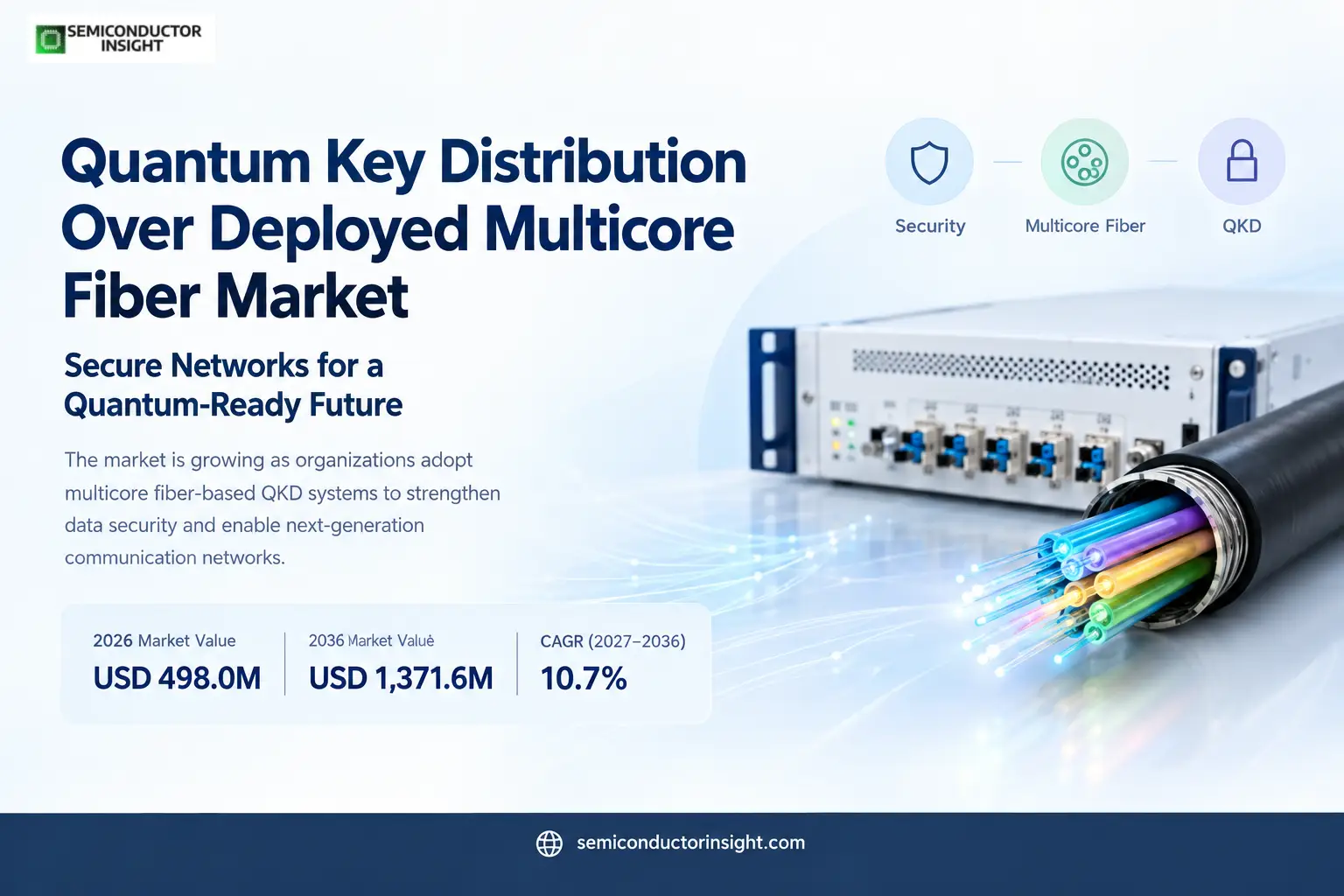
- Market value: The quantum key distribution over deployed multicore fiber market reached USD 498.0 million in 2026 and is projected to reach USD 1,371.6 million by 2036, representing a CAGR of 10.7% for 2027–2036 as customers adopt quantum key distribution transceivers, integrated photonic senders and receivers, key-management infrastructure and deployment integration specifically relevant to multicore optical fibre systems.
- Core-Integrated QKD: The largest type category commands an estimated ~46% of 2026 revenue; its commercial significance arises from long-term cryptographic confidentiality on fibre backbones and feasible quantum-key distribution without constructing a wholly separate dedicated optical cable system. Adjacent designs compete on performance, qualification and total installed cost.
- Secure Backbone Networks: The leading application accounts for an estimated ~48% of 2026 sales, driven by end-user requirements for measurable secret key rate, authenticated key handling, low-leakage fibre-core isolation and integration with existing optical transport management. Purchase decisions are typically channelled through telecom infrastructure contractors, national research network tenders, direct quantum-security vendor projects and optical network equipment partnerships.
- Europe: Leading regional expenditure accounts for an estimated ~37% of 2026 revenue, with regional growth close to ~10.8% annually. Geography reflects European research teams demonstrated practical four-dimensional QKD in L’Aquila and 2025 QKD coexistence over deployed multicore fibre, positioning the region as a key source of technical evidence.
- Commercial restraint: Inter-core optical crosstalk, raman noise from coexisting classical traffic, detector sensitivity, field key-rate stability and interoperability between dissimilar qkd nodes shape adoption. For quantum key distribution over deployed multicore fiber specifications involving quantum and high-capacity classical traffic coexistence, a strong customer pipeline does not automatically turn into qualified sensor and network-system orders until qualification, safety and installation conditions are satisfied.
Quantum Key Distribution over Deployed Multicore Fiber Market Overview
The quantum key distribution over deployed multicore fiber market was valued at USD 498.0 million in 2026 and is projected to reach USD 1,371.6 million by 2036, at a CAGR of 10.7% during 2027–2036. Europe is the largest regional market, with an estimated ~37% of 2026 expenditure. The market boundary covers photonic QKD endpoints, matched receiver systems, key managers and designated deployed-multicore fibre commissioning, excluding unrelated fibre traffic and ordinary PQC software migration, rather than revenue from loosely connected service activities.
The quantum key distribution over deployed multicore fiber market covers quantum key distribution transceivers, integrated photonic senders and receivers, key-management infrastructure and deployment integration specifically relevant to multicore optical fibre systems. The accounting boundary is equipment and commissioned QKD network integration over deployed multicore fibres, not all post-quantum software cryptography or the entire addressable commercial fibre network. Customers evaluating a supplier measure measurable secret key rate, authenticated key handling, low-leakage fibre-core isolation and integration with existing optical transport management.
Product scope should follow the transaction being priced: photonic QKD endpoints, matched receiver systems, key managers and designated deployed-multicore fibre commissioning, excluding unrelated fibre traffic and ordinary PQC software migration. For that reason the analysis separates hardware purchases from wider economic activities such as installed QKD endpoints, commissioned multicore fibre links, verified secure key rates and resilient quantum-safe communication routes.
Engineering advances focus on 2024 four-dimensional 52 km deployed multicore QKD demonstration in Italy and 2025 quantum-classical coexistence at 110.8 Tb/s over 25.2 km deployed fibre. Equipment designers are balancing inter-core optical crosstalk, Raman noise from coexisting classical traffic, detector sensitivity, field key-rate stability and interoperability between dissimilar QKD nodes. The most competitive solution is not necessarily the highest-throughput product: platform fit, environmental resilience and validation effort can dominate the field decision.
Deployment requires evidence that a quantum link works on its actual installed cable. The 2024 L’Aquila experiment demonstrated four-dimensional QKD across a 52-km deployed multicore-fibre loop, while a separate 2025 field study showed a 25.2-km link carrying QKD in one core and 110.8 Tb/s of classical traffic in the others. These are engineering demonstrations, not confirmed evidence that every listed supplier operates commercial multicore-QKD networks. Buyers therefore assess optical losses, Raman-noise rejection, key rate and equipment interoperability separately.
The immediate market transition is toward more practical and verifiable deployments of quantum key distribution transceivers, integrated photonic senders and receivers, key-management infrastructure and deployment integration specifically relevant to multicore optical fibre systems. For quantum key distribution over deployed multicore fiber specifications involving trusted-node and hybrid pqc/qkd deployments, leading firms have begun to offer more integrated product families while buyers require evidence of operability under real workloads. The binding constraints are inter-core optical crosstalk, Raman noise from coexisting classical traffic, detector sensitivity, field key-rate stability and interoperability between dissimilar QKD nodes.
Segment Analysis: By Type
By type, quantum key distribution over deployed multicore fiber is segmented into Core-Integrated QKD, Core-Selective QKD, Hybrid Multi-Core / Single-Core QKD. Core-Integrated QKD leads with an estimated ~46% of 2026 revenue and demand across national research networks, communications carriers, sovereign data-centre operators, banks, intelligence agencies and critical-infrastructure network operators. For quantum key distribution over deployed multicore fiber specifications involving cloud service encryption, the other types address alternative power, functional or mission requirements and are not interchangeable in system design. Each class has a different qualification pathway and unit-value profile.
| Type | Function | Market position |
|---|---|---|
| Core-Integrated QKD | Core-Integrated QKD addresses a defined performance and integration tier within quantum key distribution over deployed multicore fiber. For Core-Integrated QKD, the purchasing case depends on the customer’s target operating envelope and the integration tasks implied by measurable secret key rate, authenticated key handling, low-leakage fibre-core isolation and integration with existing optical transport management. | This type carries an estimated ~46% of 2026 market revenue and ~10.9% annual growth over the model window. It is the largest type and provides the reference price point. The Core-Integrated QKD procurement category competes on measurable secret key rate, authenticated key handling, low-leakage fibre-core isolation and integration with existing optical transport management. |
| Core-Selective QKD | Core-Selective QKD addresses a defined performance and integration tier within quantum key distribution over deployed multicore fiber. For Core-Selective QKD, the purchasing case depends on the customer’s target operating envelope and the integration tasks implied by measurable secret key rate, authenticated key handling, low-leakage fibre-core isolation and integration with existing optical transport management. | This type carries an estimated ~34% of 2026 market revenue and ~10.6% annual growth over the model window. It addresses a narrower deployment profile with differentiated value per unit. The Core-Selective QKD procurement category competes on measurable secret key rate, authenticated key handling, low-leakage fibre-core isolation and integration with existing optical transport management. |
| Hybrid Multi-Core / Single-Core QKD | Hybrid Multi-Core / Single-Core QKD addresses a defined performance and integration tier within quantum key distribution over deployed multicore fiber. For Hybrid Multi-Core / Single-Core QKD, the purchasing case depends on the customer’s target operating envelope and the integration tasks implied by measurable secret key rate, authenticated key handling, low-leakage fibre-core isolation and integration with existing optical transport management. | This type carries an estimated ~20% of 2026 market revenue and ~10.3% annual growth over the model window. For customers assessing Hybrid Multi-Core / Single-Core QKD market position, it addresses a narrower deployment profile with differentiated value per unit. The Hybrid Multi-Core / Single-Core QKD procurement category competes on measurable secret key rate, authenticated key handling, low-leakage fibre-core isolation and integration with existing optical transport management. |
Secondary segmentation: By End User
By End User provides another commercial perspective on quantum key distribution over deployed multicore fiber. Carrier operators can integrate quantum-key engines into established optical paths, whereas financial institutions focus on protected inter-data-centre transmissions. The Telecom Operators class leads this particular lens, while the remaining classes serve differing runtime requirements and budgets. For quantum key distribution over deployed multicore fiber specifications involving core-selective qkd, commercial analysis of secondary segmentation: by end user must not add these dimensions to type-level revenue, because each is an alternative classification of the same hardware purchases.
| Axis | Members | Commercial role |
|---|---|---|
| By End User | Telecom Operators; Financial Institutions; Government & Defense | Telecom Operators retains the leading expenditure position within By End User. For quantum key distribution over deployed multicore fiber commercial planning, engineering demand differs according to the specification criteria of By End User and the customer purchasing role. Procurement teams review the practical distinctions among Telecom Operators, Financial Institutions, Government & Defense before attributing equipment revenues. Within quantum key distribution over deployed multicore fiber, secondary segmentation: by end user is a non-additive view of the products already included in type revenue. |
Secondary segmentation: By Technology
By Technology provides another commercial perspective on quantum key distribution over deployed multicore fiber. Photonics integration governs laser modulation and multicore coupling, while single-photon receivers determine link sensitivity and refrigeration requirements. The Integrated Photonic Chips class leads this particular lens, while the remaining classes serve differing runtime requirements and budgets. Commercial analysis of secondary segmentation: by technology must not add these dimensions to type-level revenue, because each is an alternative classification of the same hardware purchases.
| Axis | Members | Commercial role |
|---|---|---|
| By Technology | Integrated Photonic Chips; Tunable Wavelength Sources; Cryogenic Single-Photon Detectors | Integrated Photonic Chips retains the leading expenditure position within By Technology. For quantum key distribution over deployed multicore fiber commercial planning, engineering demand differs according to the specification criteria of By Technology and the customer purchasing role. Procurement teams review the practical distinctions among Integrated Photonic Chips, Tunable Wavelength Sources, Cryogenic Single-Photon Detectors before attributing equipment revenues. Within quantum key distribution over deployed multicore fiber, secondary segmentation: by technology is a non-additive view of the products already included in type revenue. |
Secondary segmentation: By Deployment Scenario
By Deployment Scenario provides another commercial perspective on quantum key distribution over deployed multicore fiber. Field multicore fibre demonstrations concern metropolitan links, while subsea and campus systems require distinct attenuation, maintenance and trust-node architectures. The Urban Metropolitan Grids class leads this particular lens, while the remaining classes serve differing runtime requirements and budgets. Commercial analysis of secondary segmentation: by deployment scenario must not add these dimensions to type-level revenue, because each is an alternative classification of the same hardware purchases.
| Axis | Members | Commercial role |
|---|---|---|
| By Deployment Scenario | Urban Metropolitan Grids; Subsea Cable Links; Enterprise Campus Networks | Urban Metropolitan Grids retains the leading expenditure position within By Deployment Scenario. For quantum key distribution over deployed multicore fiber commercial planning, engineering demand differs according to the specification criteria of By Deployment Scenario and the customer purchasing role. Procurement teams review the practical distinctions among Urban Metropolitan Grids, Subsea Cable Links, Enterprise Campus Networks before attributing equipment revenues. Within quantum key distribution over deployed multicore fiber, secondary segmentation: by deployment scenario is a non-additive view of the products already included in type revenue. |
Segment Analysis: By Application
By application, quantum key distribution over deployed multicore fiber is divided among Secure Backbone Networks, Data Center Interconnects, Cloud Service Encryption, Others. Secure Backbone Networks has the largest estimated ~48% share in 2026. Customer requirements differ as strongly as national research networks, communications carriers, sovereign data-centre operators, banks, intelligence agencies and critical-infrastructure network operators differ from one another. For quantum key distribution over deployed multicore fiber specifications involving multicore photonic transmitter integration, suppliers adapt their service, training and qualification plans to these individual purchasing environments.
| Application | Demand characteristics |
|---|---|
| Secure Backbone Networks | Secure Backbone Networks accounts for an estimated ~48% of 2026 market value and is modelled at roughly ~10.9% annual growth. Orders for Secure Backbone Networks are triggered by requirements for installed QKD endpoints, commissioned multicore fibre links, verified secure key rates and resilient quantum-safe communication routes, as well as measurable secret key rate, authenticated key handling, low-leakage fibre-core isolation and integration with existing optical transport management. |
| Data Center Interconnects | Data Center Interconnects accounts for an estimated ~25% of 2026 market value and is modelled at roughly ~10.6% annual growth. Orders for Data Center Interconnects are triggered by requirements for installed QKD endpoints, commissioned multicore fibre links, verified secure key rates and resilient quantum-safe communication routes, as well as measurable secret key rate, authenticated key handling, low-leakage fibre-core isolation and integration with existing optical transport management. |
| Cloud Service Encryption | Cloud Service Encryption accounts for an estimated ~19% of 2026 market value and is modelled at roughly ~10.3% annual growth. Orders for Cloud Service Encryption are triggered by requirements for installed QKD endpoints, commissioned multicore fibre links, verified secure key rates and resilient quantum-safe communication routes, as well as measurable secret key rate, authenticated key handling, low-leakage fibre-core isolation and integration with existing optical transport management. |
| Others | Others accounts for an estimated ~8% of 2026 market value and is modelled at roughly ~10.1% annual growth. Orders for Others are triggered by requirements for installed QKD endpoints, commissioned multicore fibre links, verified secure key rates and resilient quantum-safe communication routes, as well as measurable secret key rate, authenticated key handling, low-leakage fibre-core isolation and integration with existing optical transport management. |
The route to market usually passes through telecom infrastructure contractors, national research network tenders, direct quantum-security vendor projects and optical network equipment partnerships. For quantum key distribution over deployed multicore fiber specifications involving high-dimensional multicore key generation research, customer qualification can take longer than component or qualified module production, especially where safety and interoperability are important. For quantum key distribution over deployed multicore fiber specifications involving itu standardisation of qkd interworking, a fast-growing end market does not always translate into a similar component-revenue growth rate because replacement cycles, configuration standards and negotiated prices vary. For quantum key distribution over deployed multicore fiber specifications involving quantum and high-capacity classical traffic coexistence, the channel analysis therefore separates equipment demand from downstream service earnings and investigates which firms actually own the purchasing decision.
Regional Analysis
Europe leads the global quantum key distribution over deployed multicore fiber market in 2026 with an estimated ~37% share. The three largest regions are Europe (~37%), Asia-Pacific (~27%), North America (~24%), while North America has the fastest modelled growth at ~10.9% CAGR. For quantum key distribution over deployed multicore fiber specifications involving trusted-node and hybrid pqc/qkd deployments, regional supply and demand are concentrated in Europe through local investment and distribution networks. For quantum key distribution over deployed multicore fiber specifications involving core-integrated qkd, smaller regions have different adoption gates rather than simply representing scaled-down versions of leading markets.
How does the commercial logic differ by region in the quantum key distribution over deployed multicore fiber market?
Global demand varies because inter-core optical crosstalk, Raman noise from coexisting classical traffic, detector sensitivity, field key-rate stability and interoperability between dissimilar QKD nodes. For quantum key distribution over deployed multicore fiber specifications involving multicore photonic transmitter integration, north America, Europe, Asia-Pacific, South America and the Middle East and Africa therefore differ in qualification practice, operating geography and available procurement channels. For quantum key distribution over deployed multicore fiber specifications involving carrier-managed qkd services, local supplier support and customer experience can matter as much as technology capability when systems must be deployed and serviced at scale. For quantum key distribution over deployed multicore fiber specifications involving trusted-node and hybrid pqc/qkd deployments, consequently the regional estimate is a distribution of equipment expenditure, not a count of every related downstream service transaction.
| Region | Position | Growth outlook | Demand profile | What decides supplier selection |
|---|---|---|---|---|
| Asia-Pacific | Second (~27%) | Measured (~10.9% CAGR) | Japanese fibre and Chinese quantum network research | Supplier selection in Asia-Pacific depends on japanese fibre and chinese quantum network research. Japan hosts NICT and Toshiba optical QKD integration demonstrations, China has large quantum-security programmes, and South Korean communications institutes examine fibre-based security. In Asia-Pacific, supply awards depend on measurable secret key rate, authenticated key handling, low-leakage fibre-core isolation and integration with existing optical transport management, performance under field workloads and dependable local technical support. For quantum key distribution over deployed multicore fiber specifications involving network-security requirements for long-lived confidential data, asia-Pacific procurement policies determine whether equipment purchases move directly from OEMs, via distributors or through larger system contracts. |
| North America | Third (~24%) | Fastest (~10.9% CAGR) | Carrier and national lab pilots | Supplier selection in North America depends on carrier and national lab pilots. The United States hosts metropolitan quantum corridor demonstrations including Toshiba-equipped links around Chicago; Canadian research groups explore secure inter-data-centre networks. In North America, supply awards depend on measurable secret key rate, authenticated key handling, low-leakage fibre-core isolation and integration with existing optical transport management, performance under field workloads and dependable local technical support. For quantum key distribution over deployed multicore fiber specifications involving high-dimensional multicore key generation research, north America procurement policies determine whether equipment purchases move directly from OEMs, via distributors or through larger system contracts. |
| Europe | Largest (~37%) | Measured (~10.8% CAGR) | Deployed multicore fibre proof points | Supplier selection in Europe depends on deployed multicore fibre proof points. European research teams demonstrated practical four-dimensional QKD in L’Aquila and 2025 QKD coexistence over deployed multicore fibre, positioning the region as a key source of technical evidence. In Europe, supply awards depend on measurable secret key rate, authenticated key handling, low-leakage fibre-core isolation and integration with existing optical transport management, performance under field workloads and dependable local technical support. For quantum key distribution over deployed multicore fiber specifications involving itu standardisation of qkd interworking, europe procurement policies determine whether equipment purchases move directly from OEMs, via distributors or through larger system contracts. |
| Middle East & Africa | Fourth (~7%) | Measured (~10.1% CAGR) | Targeted sovereign communications pilots | Supplier selection in Middle East & Africa depends on targeted sovereign communications pilots. UAE and Saudi communications programmes can assess QKD on protected government routes, but specialist fibre construction and operation create high project-entry barriers. In Middle East & Africa, supply awards depend on measurable secret key rate, authenticated key handling, low-leakage fibre-core isolation and integration with existing optical transport management, performance under field workloads and dependable local technical support. For quantum key distribution over deployed multicore fiber specifications involving quantum and high-capacity classical traffic coexistence, middle East & Africa procurement policies determine whether equipment purchases move directly from OEMs, via distributors or through larger system contracts. |
| South America | Fifth (~5%) | Measured (~9.8% CAGR) | Early-stage experimental network adoption | Supplier selection in South America depends on early-stage experimental network adoption. Brazilian telecom and university partnerships are positioned to test QKD links, with costly specialist equipment and limited installed multicore fibre restricting commercial scale. In South America, supply awards depend on measurable secret key rate, authenticated key handling, low-leakage fibre-core isolation and integration with existing optical transport management, performance under field workloads and dependable local technical support. For quantum key distribution over deployed multicore fiber specifications involving multicore photonic transmitter integration, south America procurement policies determine whether equipment purchases move directly from OEMs, via distributors or through larger system contracts. |
Competitive Landscape
Competitive dynamics in quantum key distribution over deployed multicore fiber span silicon or vehicle manufacturers, platform integrators and procurement intermediaries. Leading direct suppliers include ID Quantique, QuantumCTek, Toshiba, MagiQ Technologies, while other profiled companies participate through adjacent platforms or customer programmes. Competition hinges on measurable secret key rate, authenticated key handling, low-leakage fibre-core isolation and integration with existing optical transport management. For quantum key distribution over deployed multicore fiber specifications involving hybrid multi-core / single-core qkd, buyer access requires field validation, software support and a credible plan for spare parts and technical continuity.
Product leadership is defined by real implementation experience rather than company-wide revenue. ID Quantique, QuantumCTek, Toshiba, MagiQ Technologies have portfolios relevant to the sector, although each operates across a broader collection of products. For quantum key distribution over deployed multicore fiber specifications involving core-integrated qkd, it is important to assess only the relevant platform or device families when comparing supplier positions. For quantum key distribution over deployed multicore fiber specifications involving core-selective qkd, procurement wins also depend on reference designs, channel access and capability to fix deployment issues after installation.
Suppliers compete across multiple qualification thresholds. Buyers seek measurable secret key rate, authenticated key handling, low-leakage fibre-core isolation and integration with existing optical transport management and increasingly request integration toolchains, compliance records and known configurations. For quantum key distribution over deployed multicore fiber specifications involving core-selective qkd, continuous product revisions must be compatible with the customer’s service life and existing assets. For quantum key distribution over deployed multicore fiber specifications involving hybrid multi-core / single-core qkd, as a result, early price discounts do not guarantee a design win unless a supplier can maintain support through complete deployment cycles.
Adjacent companies are influential without necessarily supplying the market-defining device. Telecommunications operators, National quantum research networks, Government secure communications can affect platform specifications, distribution or adoption economics, while other manufacturers supply supporting electronics. For quantum key distribution over deployed multicore fiber specifications involving hybrid multi-core / single-core qkd, including the entire revenue of a service platform or parent company would overstate the equipment market. Tier comparisons distinguish direct hardware suppliers, niche specialists and system-level ecosystem participants.
For quantum key distribution over deployed multicore fiber specifications involving core-selective qkd, the most durable commercial advantage comes from repeatable delivery rather than isolated demonstrations. For quantum key distribution over deployed multicore fiber specifications involving hybrid multi-core / single-core qkd, component traceability, repair logistics, manufacturing capacity and the ability to meet an OEM testing protocol are material competitive factors. When inter-core optical crosstalk, Raman noise from coexisting classical traffic, detector sensitivity, field key-rate stability and interoperability between dissimilar QKD nodes, customers favour suppliers capable of maintaining stable product revisions. For quantum key distribution over deployed multicore fiber specifications involving data center interconnects, this favours vendors that combine technical capability with dependable field support and contract discipline.
Tier structure
| Tier | Companies | Basis of competition |
|---|---|---|
| Tier 1 | ID Quantique, QuantumCTek, Toshiba, MagiQ Technologies | For quantum key distribution over deployed multicore fiber specifications involving others, direct hardware suppliers compete on a combination of validated product capability and timely deliveries. The relevant offering must satisfy measurable secret key rate, authenticated key handling, low-leakage fibre-core isolation and integration with existing optical transport management. For quantum key distribution over deployed multicore fiber specifications involving network-security requirements for long-lived confidential data, when evaluating the Tier 1 category, purchasers consider interoperability, component life and testing evidence, not simply the supplier’s brand. The Tier 1 business grows through repeated orders from established telecom infrastructure contractors, national research network tenders, direct quantum-security vendor projects and optical network equipment partnerships. |
| Tier 2 | ID Quantique, QuantumCTek | Specialised vendors concentrate on narrower functional or customer niches. Their products may offer favourable trade-offs against inter-core optical crosstalk, Raman noise from coexisting classical traffic, detector sensitivity, field key-rate stability and interoperability between dissimilar QKD nodes. For quantum key distribution over deployed multicore fiber specifications involving high-dimensional multicore key generation research, for the Tier 2 supplier group, sales opportunities depend on the buyer’s willingness to support additional integration and qualification work. For quantum key distribution over deployed multicore fiber specifications involving itu standardisation of qkd interworking, for Tier 2 providers, long-term service arrangements can offset their smaller sales organisations and manufacturing footprints. |
| Ecosystem | Telecommunications operators, National quantum research networks, Government secure communications | For quantum key distribution over deployed multicore fiber specifications involving network-security requirements for long-lived confidential data, systems and service participants influence the final design without always producing the market-defining hardware. The Ecosystem participants shape customer requirements, installation plans and acceptance criteria connected to installed QKD endpoints, commissioned multicore fibre links, verified secure key rates and resilient quantum-safe communication routes. For quantum key distribution over deployed multicore fiber specifications involving itu standardisation of qkd interworking, including the full revenue of these Ecosystem participants as direct product-market sales would double-count adjacent activity. For quantum key distribution over deployed multicore fiber specifications involving quantum and high-capacity classical traffic coexistence, the supplier model therefore treats these participants separately from manufacturers of the primary hardware. |
Key companies profiled
- ID Quantique
- MagiQ Technologies
- QuTech
- QuantumCTek
- Qubitekk
- Quintessence Labs
- Huawei Technologies
- Ciena
- Nokia
- Corning Inc.
- Fujitsu
- Lumentum
- Rohde & Schwarz
- Toshiba
Production Capacity Analysis
Production in the quantum key distribution over deployed multicore fiber market combines product development, contracted manufacture, test and field qualification. Capacity must be evaluated for the equipment covered by equipment and commissioned QKD network integration over deployed multicore fibres, not all post-quantum software cryptography or the entire addressable commercial fibre network. For quantum key distribution over deployed multicore fiber specifications involving live-fibre quantum communication field trials, supplier output depends on reliable upstream components and the availability of teams able to certify each platform generation. For quantum key distribution over deployed multicore fiber specifications involving network-security requirements for long-lived confidential data, installed production lines are not equivalent to saleable market output when customer acceptance testing and configuration restrictions remain binding.
Upstream manufacturing begins with specialised equipment and electronics matched to quantum key distribution transceivers, integrated photonic senders and receivers, key-management infrastructure and deployment integration specifically relevant to multicore optical fibre systems. For quantum key distribution over deployed multicore fiber specifications involving cloud service encryption, designs are converted into repeatable builds using supplier-qualified parts, automated verification and controlled firmware releases. For quantum key distribution over deployed multicore fiber specifications involving others, factories operating multiple programmes must schedule production batches according to expected customer acceptance and servicing demand.
Diversified production and overseas service centres have a direct effect on the cost of quantum key distribution over deployed multicore fiber. For quantum key distribution over deployed multicore fiber specifications involving others, for customers operating across continents, replacement units and regulatory documentation can be as important as local final assembly. For quantum key distribution over deployed multicore fiber specifications involving live-fibre quantum communication field trials, companies may therefore dual-source electronics or maintain additional field-stock hubs where import lead times are unpredictable.
The practical bottlenecks include inter-core optical crosstalk, Raman noise from coexisting classical traffic, detector sensitivity, field key-rate stability and interoperability between dissimilar QKD nodes. For quantum key distribution over deployed multicore fiber specifications involving live-fibre quantum communication field trials, manufacturers must control incoming components, update software securely and demonstrate consistent performance in representative operating conditions. For quantum key distribution over deployed multicore fiber specifications involving network-security requirements for long-lived confidential data, a design sold into a regulated mission cannot be readily modified without further validation.
Market Dynamics
Market dynamics reflect customer demand for long-term cryptographic confidentiality on fibre backbones and feasible quantum-key distribution without constructing a wholly separate dedicated optical cable system, balanced against inter-core optical crosstalk, Raman noise from coexisting classical traffic, detector sensitivity, field key-rate stability and interoperability between dissimilar QKD nodes. For quantum key distribution over deployed multicore fiber specifications involving cloud service encryption, the drivers below describe directional factors on growth rather than independently measured contributions to the headline forecast. Technology choices are mediated by channel access and programme commissioning schedules. For quantum key distribution over deployed multicore fiber specifications involving live-fibre quantum communication field trials, projected market revenue therefore depends on actual procurement milestones, hardware qualification and completed operational rollouts.
MARKET DRIVERS
Drivers Impact Analysis*
| Driver | (~) % impact on CAGR forecast | Geographic relevance | Impact timeline |
|---|---|---|---|
| Live-fibre quantum communication field trials | +0.3% | Global / selected adopter markets | 2026–2036 |
| Network-security requirements for long-lived confidential data | +0.5% | Global / selected adopter markets | 2026–2036 |
| High-dimensional multicore key generation research | +0.6% | Global / selected adopter markets | 2026–2036 |
| ITU standardisation of QKD interworking | +0.8% | Global / selected adopter markets | 2026–2036 |
| Fleet or installed-base renewal | +0.9% | Global / selected adopter markets | 2026–2036 |
Live-fibre quantum communication field trials
Live-fibre quantum communication field trials supports demand for quantum key distribution over deployed multicore fiber. The commercial effect of live-fibre quantum communication field trials is observed when customers require installed QKD endpoints, commissioned multicore fibre links, verified secure key rates and resilient quantum-safe communication routes in a reliable operating environment. Purchasers affected by live-fibre quantum communication field trials translate requirements into specifications for measurable secret key rate, authenticated key handling, low-leakage fibre-core isolation and integration with existing optical transport management.
Network-security requirements for long-lived confidential data
Network-security requirements for long-lived confidential data supports demand for quantum key distribution over deployed multicore fiber. The commercial effect of network-security requirements for long-lived confidential data is observed when customers require installed QKD endpoints, commissioned multicore fibre links, verified secure key rates and resilient quantum-safe communication routes in a reliable operating environment. Purchasers affected by network-security requirements for long-lived confidential data translate requirements into specifications for measurable secret key rate, authenticated key handling, low-leakage fibre-core isolation and integration with existing optical transport management.
High-dimensional multicore key generation research
High-dimensional multicore key generation research supports demand for quantum key distribution over deployed multicore fiber. The commercial effect of high-dimensional multicore key generation research is observed when customers require installed QKD endpoints, commissioned multicore fibre links, verified secure key rates and resilient quantum-safe communication routes in a reliable operating environment. Purchasers affected by high-dimensional multicore key generation research translate requirements into specifications for measurable secret key rate, authenticated key handling, low-leakage fibre-core isolation and integration with existing optical transport management.
ITU standardisation of QKD interworking
ITU standardisation of QKD interworking supports demand for quantum key distribution over deployed multicore fiber. The commercial effect of itu standardisation of qkd interworking is observed when customers require installed QKD endpoints, commissioned multicore fibre links, verified secure key rates and resilient quantum-safe communication routes in a reliable operating environment. Purchasers affected by itu standardisation of qkd interworking translate requirements into specifications for measurable secret key rate, authenticated key handling, low-leakage fibre-core isolation and integration with existing optical transport management.
MARKET RESTRAINTS
Restraints Impact Analysis*
| Restraint | (~) % impact on CAGR forecast | Geographic relevance | Impact timeline |
|---|---|---|---|
| Core crosstalk and Raman-noise penalties | -0.2% | Selected end markets | 2026–2036 |
| High receiver and cooling capex | -0.3% | Selected end markets | 2026–2036 |
| Uncertain installed multicore-fibre availability | -0.4% | Selected end markets | 2026–2036 |
| Interoperability and security validation overhead | -0.6% | Selected end markets | 2026–2036 |
Core crosstalk and Raman-noise penalties
Core crosstalk and Raman-noise penalties can delay expenditure on quantum key distribution over deployed multicore fiber. Buyers facing inter-core optical crosstalk, Raman noise from coexisting classical traffic, detector sensitivity, field key-rate stability and interoperability between dissimilar QKD nodes may reduce fleet growth, defer system integration or select lower-cost equipment with longer lead times.
High receiver and cooling capex
High receiver and cooling capex can delay expenditure on quantum key distribution over deployed multicore fiber. For manufacturers serving High receiver and cooling capex, buyers facing inter-core optical crosstalk, Raman noise from coexisting classical traffic, detector sensitivity, field key-rate stability and interoperability between dissimilar QKD nodes may reduce fleet growth, defer system integration or select lower-cost equipment with longer lead times.
Uncertain installed multicore-fibre availability
Uncertain installed multicore-fibre availability can delay expenditure on quantum key distribution over deployed multicore fiber. During integration of Uncertain installed multicore-fibre availability, buyers facing inter-core optical crosstalk, Raman noise from coexisting classical traffic, detector sensitivity, field key-rate stability and interoperability between dissimilar QKD nodes may reduce fleet growth, defer system integration or select lower-cost equipment with longer lead times.
Interoperability and security validation overhead
Interoperability and security validation overhead can delay expenditure on quantum key distribution over deployed multicore fiber. In lifecycle planning for Interoperability and security validation overhead, buyers facing inter-core optical crosstalk, Raman noise from coexisting classical traffic, detector sensitivity, field key-rate stability and interoperability between dissimilar QKD nodes may reduce fleet growth, defer system integration or select lower-cost equipment with longer lead times.
MARKET OPPORTUNITIES
Quantum and high-capacity classical traffic coexistence
Quantum and high-capacity classical traffic coexistence provides a route into adjacent customer segments for quantum key distribution over deployed multicore fiber. The commercial opportunity is to solve a specific deployment problem involving measurable secret key rate, authenticated key handling, low-leakage fibre-core isolation and integration with existing optical transport management. New offerings targeting quantum and high-capacity classical traffic coexistence need documented interoperability, reliable suppliers and credible post-sale support.
Multicore photonic transmitter integration
Multicore photonic transmitter integration provides a route into adjacent customer segments for quantum key distribution over deployed multicore fiber. Within qualification procedures for Multicore photonic transmitter integration, the commercial opportunity is to solve a specific deployment problem involving measurable secret key rate, authenticated key handling, low-leakage fibre-core isolation and integration with existing optical transport management. New offerings targeting multicore photonic transmitter integration need documented interoperability, reliable suppliers and credible post-sale support.
Carrier-managed QKD services
Carrier-managed QKD services provides a route into adjacent customer segments for quantum key distribution over deployed multicore fiber. For commercial projects involving Carrier-managed QKD services, the commercial opportunity is to solve a specific deployment problem involving measurable secret key rate, authenticated key handling, low-leakage fibre-core isolation and integration with existing optical transport management. New offerings targeting carrier-managed qkd services need documented interoperability, reliable suppliers and credible post-sale support.
Trusted-node and hybrid PQC/QKD deployments
Trusted-node and hybrid PQC/QKD deployments provides a route into adjacent customer segments for quantum key distribution over deployed multicore fiber. In service networks supporting Trusted-node and hybrid PQC/QKD deployments, the commercial opportunity is to solve a specific deployment problem involving measurable secret key rate, authenticated key handling, low-leakage fibre-core isolation and integration with existing optical transport management.
Supply Chain Analysis
The value chain for quantum key distribution over deployed multicore fiber links design and qualification to production, distribution and field support. Its revenue boundary remains photonic QKD endpoints, matched receiver systems, key managers and designated deployed-multicore fibre commissioning, excluding unrelated fibre traffic and ordinary PQC software migration. Product sourcing is complicated by inter-core optical crosstalk, Raman noise from coexisting classical traffic, detector sensitivity, field key-rate stability and interoperability between dissimilar QKD nodes. For quantum key distribution over deployed multicore fiber specifications involving core-selective qkd, a dependable supply chain must therefore track revisions, validate suppliers and maintain spares for the actual operating life of deployed hardware.
Upstream. The upstream stage influences cost and reliability for quantum key distribution over deployed multicore fiber. Upstream participants manage inter-core optical crosstalk, Raman noise from coexisting classical traffic, detector sensitivity, field key-rate stability and interoperability between dissimilar QKD nodes while protecting availability of parts and validated software. For quantum key distribution over deployed multicore fiber specifications involving cloud service encryption, work at the upstream stage must support traceable revisions, acceptance documentation and the customer’s maintenance model.
Manufacturing. The manufacturing stage influences cost and reliability for quantum key distribution over deployed multicore fiber. Manufacturing participants manage inter-core optical crosstalk, Raman noise from coexisting classical traffic, detector sensitivity, field key-rate stability and interoperability between dissimilar QKD nodes while protecting availability of parts and validated software. For quantum key distribution over deployed multicore fiber specifications involving others, work at the manufacturing stage must support traceable revisions, acceptance documentation and the customer’s maintenance model.
Channel. The channel stage influences cost and reliability for quantum key distribution over deployed multicore fiber. Channel participants manage inter-core optical crosstalk, Raman noise from coexisting classical traffic, detector sensitivity, field key-rate stability and interoperability between dissimilar QKD nodes while protecting availability of parts and validated software. For quantum key distribution over deployed multicore fiber specifications involving live-fibre quantum communication field trials, work at the channel stage must support traceable revisions, acceptance documentation and the customer’s maintenance model.
Downstream. The downstream stage influences cost and reliability for quantum key distribution over deployed multicore fiber. Downstream participants manage inter-core optical crosstalk, Raman noise from coexisting classical traffic, detector sensitivity, field key-rate stability and interoperability between dissimilar QKD nodes while protecting availability of parts and validated software. For quantum key distribution over deployed multicore fiber specifications involving network-security requirements for long-lived confidential data, work at the downstream stage must support traceable revisions, acceptance documentation and the customer’s maintenance model.
Recent Developments
- 27 March 2026 Announced
Nokia published quantum-safe networking strategy on 27 March 2026. For buyers assessing quantum-safe networking strategy, the associated technical changes relate to quantum key distribution transceivers, integrated photonic senders and receivers, key-management infrastructure and deployment integration specifically relevant to multicore optical fibre systems. Their commercial relevance arises from specifications for measurable secret key rate, authenticated key handling, low-leakage fibre-core isolation and integration with existing optical transport management, supported by the named first-party publication. For quantum key distribution over deployed multicore fiber specifications involving live-fibre quantum communication field trials, customers still evaluate delivery conditions, configuration control and product servicing before accepting a deployment. This Nokia release establishes a particular technology milestone, not an automatically achieved share of the market or a confirmed volume of shipments. Source - 15 January 2026 Announced
ITU-T published qkd network interworking protocol framework on 15 January 2026. For buyers assessing qkd network interworking protocol framework, the associated technical changes relate to quantum key distribution transceivers, integrated photonic senders and receivers, key-management infrastructure and deployment integration specifically relevant to multicore optical fibre systems. For quantum key distribution over deployed multicore fiber specifications involving live-fibre quantum communication field trials, their commercial relevance arises from specifications for measurable secret key rate, authenticated key handling, low-leakage fibre-core isolation and integration with existing optical transport management, supported by the named first-party publication. For quantum key distribution over deployed multicore fiber specifications involving network-security requirements for long-lived confidential data, customers still evaluate delivery conditions, configuration control and product servicing before accepting a deployment. This ITU-T release establishes a particular technology milestone, not an automatically achieved share of the market or a confirmed volume of shipments. Source - 9 December 2025 Announced
Toshiba published commercial metropolitan qkd demonstration on 9 December 2025. For buyers assessing commercial metropolitan qkd demonstration, the associated technical changes relate to quantum key distribution transceivers, integrated photonic senders and receivers, key-management infrastructure and deployment integration specifically relevant to multicore optical fibre systems. For quantum key distribution over deployed multicore fiber specifications involving network-security requirements for long-lived confidential data, their commercial relevance arises from specifications for measurable secret key rate, authenticated key handling, low-leakage fibre-core isolation and integration with existing optical transport management, supported by the named first-party publication. For quantum key distribution over deployed multicore fiber specifications involving high-dimensional multicore key generation research, customers still evaluate delivery conditions, configuration control and product servicing before accepting a deployment. This Toshiba release establishes a particular technology milestone, not an automatically achieved share of the market or a confirmed volume of shipments. Source - 16 September 2025 Announced
NICT Toshiba NEC published qkd multiplexed with high-speed optical data demonstration on 16 September 2025. For buyers assessing qkd multiplexed with high-speed optical data demonstration, the associated technical changes relate to quantum key distribution transceivers, integrated photonic senders and receivers, key-management infrastructure and deployment integration specifically relevant to multicore optical fibre systems. For quantum key distribution over deployed multicore fiber specifications involving high-dimensional multicore key generation research, their commercial relevance arises from specifications for measurable secret key rate, authenticated key handling, low-leakage fibre-core isolation and integration with existing optical transport management, supported by the named first-party publication. For quantum key distribution over deployed multicore fiber specifications involving itu standardisation of qkd interworking, customers still evaluate delivery conditions, configuration control and product servicing before accepting a deployment. This NICT Toshiba NEC release establishes a particular technology milestone, not an automatically achieved share of the market or a confirmed volume of shipments. Source - 13 August 2025 Announced
Nature Light Science Applications published field deployed multicore quantum-classical coexistence study on 13 August 2025. For buyers assessing field deployed multicore quantum-classical coexistence study, the associated technical changes relate to quantum key distribution transceivers, integrated photonic senders and receivers, key-management infrastructure and deployment integration specifically relevant to multicore optical fibre systems. For quantum key distribution over deployed multicore fiber specifications involving itu standardisation of qkd interworking, their commercial relevance arises from specifications for measurable secret key rate, authenticated key handling, low-leakage fibre-core isolation and integration with existing optical transport management, supported by the named first-party publication. For quantum key distribution over deployed multicore fiber specifications involving quantum and high-capacity classical traffic coexistence, customers still evaluate delivery conditions, configuration control and product servicing before accepting a deployment. This Nature Light Science Applications release establishes a particular technology milestone, not an automatically achieved share of the market or a confirmed volume of shipments. Source - 23 February 2024 Announced
The researchers published the practical high-dimensional QKD field results on 23 February 2024. A four-dimensional time-path implementation passed quantum signals over a 52-km deployed multicore fibre loop in L’Aquila, Italy, using a 26-km four-core cable with two cores looped. A secret key rate of 51.5 kbps was reported with measured link loss of 22 dB. This supplies a directly inspected field benchmark for multicore-QKD designs; it does not automatically establish nationwide carrier service availability or annual equipment revenue. Source
REPORT SCOPE & SEGMENTATION
| Attribute | Details |
|---|---|
| Study Period | 2021–2036 |
| Historical Period | 2021–2025 |
| Base Year | 2026 |
| Estimated Year | 2027 |
| Forecast Period | 2027–2036 |
| 2026 Market Size | USD 498.0 million |
| 2027 Estimated Size | USD 551.1 million |
| 2036 Forecast Size | USD 1,371.6 million |
| CAGR (2027–2036) | 10.7% |
| Unit | USD million; multicore QKD equipment and integration revenue |
| Market Definition | equipment and commissioned QKD network integration over deployed multicore fibres, not all post-quantum software cryptography or the entire addressable commercial fibre network |
| By Type | Core-Integrated QKD · Core-Selective QKD · Hybrid Multi-Core / Single-Core QKD |
| By Application | Secure Backbone Networks · Data Center Interconnects · Cloud Service Encryption · Others |
| By End User | Telecom Operators · Financial Institutions · Government & Defense |
| By Technology | Integrated Photonic Chips · Tunable Wavelength Sources · Cryogenic Single-Photon Detectors |
| By Deployment Scenario | Urban Metropolitan Grids · Subsea Cable Links · Enterprise Campus Networks |
| By Region | Regional revenue values are attributed to the procurement geography; the estimate includes five global regions. Asia-PacificChina, Japan, South Korea, India North AmericaUnited States, Canada, Mexico EuropeGermany, France, United Kingdom, Italy Middle East & AfricaSaudi Arabia, United Arab Emirates, South Africa South AmericaBrazil, Argentina, Chile |
| Key Companies Profiled | ID Quantique, MagiQ Technologies, QuTech, QuantumCTek, Qubitekk, Quintessence Labs, Huawei Technologies, Ciena, Nokia, Corning Inc., Fujitsu, Lumentum, Rohde & Schwarz, Toshiba |
| Customization Scope | Country-level type and application revenue, manufacturer capability, buying-channel mapping, technical qualification, systems design and pricing for quantum key distribution over deployed multicore fiber. |
Frequently Asked Questions
What is the size and forecast of the quantum key distribution over deployed multicore fiber market?
The market is valued at USD 498.0 million in 2026 and is projected to reach USD 1,371.6 million by 2036, representing CAGR of 10.7% over 2027–2036. The category covers quantum key distribution transceivers, integrated photonic senders and receivers, key-management infrastructure and deployment integration specifically relevant to multicore optical fibre systems. For quantum key distribution over deployed multicore fiber specifications involving itu standardisation of qkd interworking, buyers should compare these figures only with similarly bounded product revenue rather than service or system totals from adjacent categories.
Which type has the largest share in the quantum key distribution over deployed multicore fiber market?
Core-Integrated QKD is the largest type with an estimated ~46% share of 2026 value. It is supported by long-term cryptographic confidentiality on fibre backbones and feasible quantum-key distribution without constructing a wholly separate dedicated optical cable system. For quantum key distribution over deployed multicore fiber specifications involving quantum and high-capacity classical traffic coexistence, the remaining categories meet different operating envelopes, so an equipment producer may need multiple solutions even when the leading class captures most of the market revenue.
Which application leads quantum key distribution over deployed multicore fiber demand?
Secure Backbone Networks leads with an estimated ~48% of 2026 revenue. This application values measurable secret key rate, authenticated key handling, low-leakage fibre-core isolation and integration with existing optical transport management. For quantum key distribution over deployed multicore fiber specifications involving multicore photonic transmitter integration, demand is converted into sales when customers pass their engineering and acceptance tests, establish operating procedures and secure a source of spare devices or replacement instruments.
Which is the largest regional market for quantum key distribution over deployed multicore fiber?
Europe leads with an estimated ~37% of 2026 revenue, while North America has the quickest modeled expansion. In procurement programmes centred on FAQ: Which is the largest regional market for quantum key distribution over deployed multicore fiber?, european research teams demonstrated practical four-dimensional QKD in L’Aquila and 2025 QKD coexistence over deployed multicore fibre, positioning the region as a key source of technical evidence.
What drives growth in the quantum key distribution over deployed multicore fiber market?
The strongest underlying driver is long-term cryptographic confidentiality on fibre backbones and feasible quantum-key distribution without constructing a wholly separate dedicated optical cable system. Equipment must still meet customer requirements for measurable secret key rate, authenticated key handling, low-leakage fibre-core isolation and integration with existing optical transport management. For quantum key distribution over deployed multicore fiber specifications involving trusted-node and hybrid pqc/qkd deployments, suppliers that can combine reliable performance with software and integration support are better positioned to convert demonstrations into repeatable procurement programmes.
What limits wider adoption of quantum key distribution over deployed multicore fiber?
Important restrictions include inter-core optical crosstalk, Raman noise from coexisting classical traffic, detector sensitivity, field key-rate stability and interoperability between dissimilar QKD nodes. For quantum key distribution over deployed multicore fiber specifications involving trusted-node and hybrid pqc/qkd deployments, these concerns affect schedules and the proportion of potential users ready to fund deployments. For quantum key distribution over deployed multicore fiber specifications involving core-integrated qkd, vendors can mitigate part of the risk with documented validation, long-term maintenance agreements and multiple qualified sources, but they cannot remove all policy or operating constraints.
Which companies are profiled in the quantum key distribution over deployed multicore fiber market?
The company coverage includes ID Quantique, MagiQ Technologies, QuTech, QuantumCTek, Qubitekk, Quintessence Labs. For quantum key distribution over deployed multicore fiber specifications involving core-integrated qkd, some names are directly relevant equipment suppliers while others participate through adjacent technologies, platform procurement or integration partnerships. For quantum key distribution over deployed multicore fiber specifications involving core-selective qkd, commercial assessment should distinguish direct product revenue from other corporate sales to avoid false market-share comparisons. Operating choices are influenced by inter-core optical crosstalk, Raman noise from coexisting classical traffic, detector sensitivity, field key-rate stability and interoperability between dissimilar QKD nodes.
How is quantum key distribution over deployed multicore fiber segmented?
Type segments comprise Core-Integrated QKD, Core-Selective QKD, Hybrid Multi-Core / Single-Core QKD. Application categories comprise Secure Backbone Networks, Data Center Interconnects, Cloud Service Encryption, Others. For quantum key distribution over deployed multicore fiber specifications involving hybrid multi-core / single-core qkd, these dimensions describe the same global expenditure from different perspectives and should not be added together. For quantum key distribution over deployed multicore fiber specifications involving secure backbone networks, geographic coverage spans North America, Europe, Asia-Pacific, South America and Middle East and Africa.
How does innovation affect supplier choice in the quantum key distribution over deployed multicore fiber market?
Innovations centre on 2024 four-dimensional 52 km deployed multicore QKD demonstration in Italy and 2025 quantum-classical coexistence at 110.8 Tb/s over 25.2 km deployed fibre. Their commercial value depends on how effectively the customer can deploy them, including measurable secret key rate, authenticated key handling, low-leakage fibre-core isolation and integration with existing optical transport management. For quantum key distribution over deployed multicore fiber specifications involving secure backbone networks, companies increasingly choose products with clear technical support, mature software or mission controls and predictable maintenance instead of paying solely for maximum specifications.
What does the quantum key distribution over deployed multicore fiber study include and exclude?
The scope includes equipment and commissioned QKD network integration over deployed multicore fibres, not all post-quantum software cryptography or the entire addressable commercial fibre network. For quantum key distribution over deployed multicore fiber specifications involving secure backbone networks, it excludes unrelated revenues from surrounding services and infrastructure so that segment and regional comparisons remain meaningful. For quantum key distribution over deployed multicore fiber specifications involving data center interconnects, the analysis covers production capability, competitive positioning, procurement practices, growth forces and leading product categories in a 2026 base-year and 2036 forecast framework.
Research Sources & Evidence Base

Get Sample Report PDF for Exclusive Insights
Report Sample Includes
- Table of Contents
- List of Tables & Figures
- Charts, Research Methodology, and more...
 Download Sample Report PDF