Quantum Interface IC Market Insights
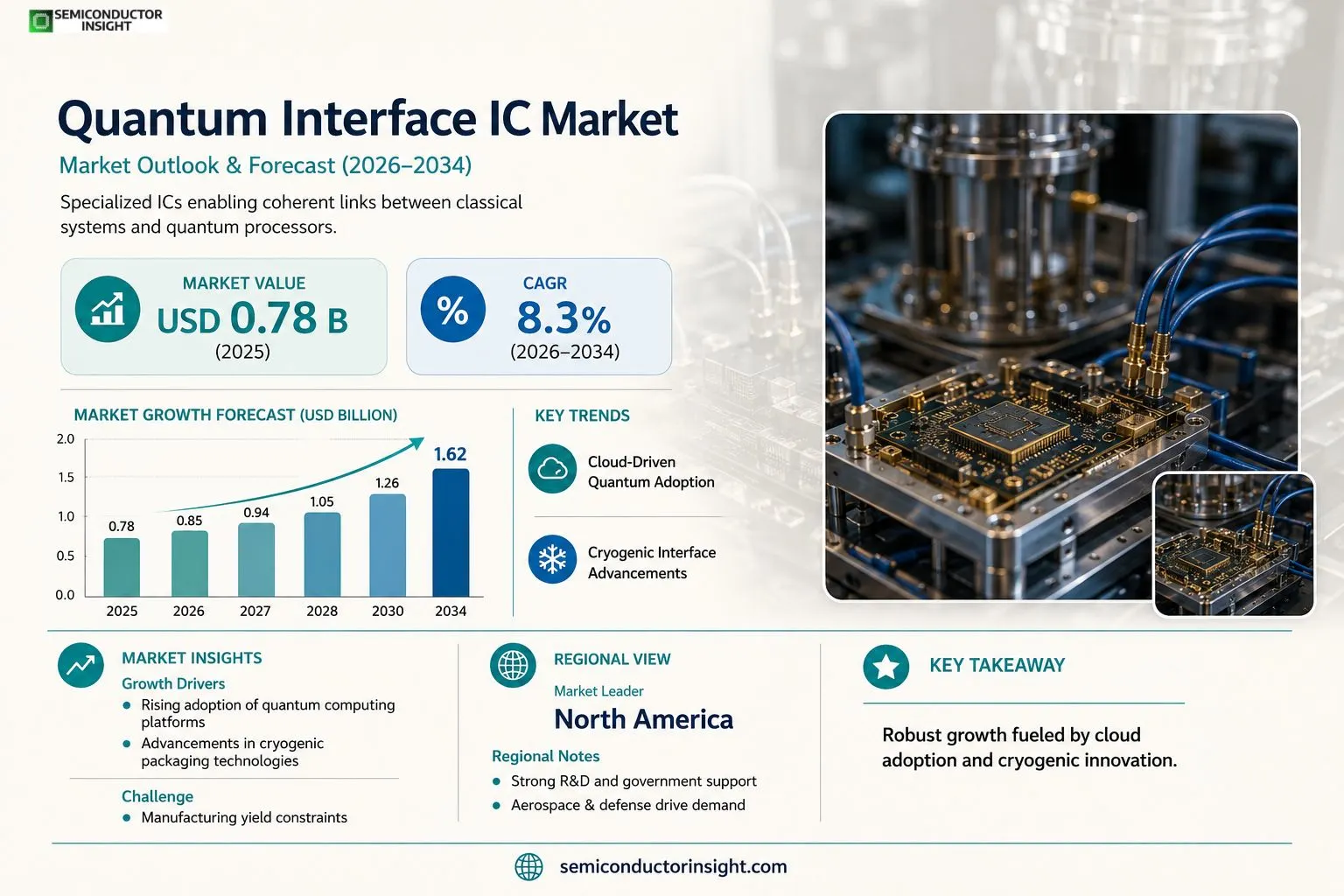
Global Quantum Interface IC market size was valued at USD 0.78 billion in 2025. The market is projected to grow from USD 0.85 billion in 2026 to USD 1.62 billion by 2034, exhibiting a CAGR of 8.3% during the forecast period.
Quantum Interface ICs are specialized integrated circuits that facilitate coherent communication between classical electronic platforms and quantum processors or sensors. These chips incorporate cryogenic‑compatible transistors, low‑noise amplifiers, and high‑precision timing modules, enabling tasks such as qubit control, readout multiplexing, and quantum‑state conversion.The market is experiencing rapid growth because venture capital inflows into quantum technologies have surged beyond USD 10 billion annually since 2022, while major cloud providers are expanding quantum‑as‑a‑service offerings that demand scalable interface solutions. Furthermore, government initiatives,such as the U.S. National Quantum Initiative Act,and corporate roadmaps from Intel, IBM, Google and Qorvo are accelerating product development cycles. Consequently, demand for high‑performance interface chips is rising across sectors ranging from cryptography to advanced sensing.
MARKET DRIVERS
Increasing Adoption of Quantum Computing Platforms
Quantum Interface IC Market is being propelled by the rapid uptake of quantum processors in research labs and commercial data centers. Enterprises are investing heavily in quantum‑ready hardware, creating a clear demand for high‑performance interface chips that can translate classical signals to quantum domains.
Advancements in Cryogenic Packaging Technologies
Recent breakthroughs in cryogenic packaging have reduced thermal losses and improved reliability, enabling more scalable system designs. These technical gains lower the barrier for integration, encouraging original equipment manufacturers to select specialized interface ICs for their quantum products.
➤ Industry analysts note that collaborative standards initiatives between chipset vendors and quantum processor developers are accelerating time‑to‑market for new solutions.
Overall, the convergence of higher computational ambitions and more mature manufacturing processes is establishing a robust growth engine for the market.
MARKET CHALLENGES
Manufacturing Yield Constraints
Producing quantum interface ICs demands ultra‑high precision lithography and defect‑free die, which currently results in lower yields compared with conventional silicon chips. The limited availability of high‑yield wafers restricts supply and can inflate pricing.
Other Challenges
Supply Chain Vulnerabilities
The reliance on rare‑earth materials and specialized cryogenic components creates supply‑chain fragility. Disruptions in any segment can delay product launches and increase inventory costs for manufacturers.
MARKET RESTRAINTS
High Production Costs
Because quantum interface ICs must meet stringent performance and reliability criteria, the cost of research, development, and production remains substantially higher than for standard mixed‑signal ICs, limiting adoption among cost‑sensitive customers.
MARKET OPPORTUNITIES
Integration with Edge AI Devices
Emerging use cases that combine quantum processing with edge artificial intelligence present a compelling opportunity. By embedding quantum interface ICs in edge devices, manufacturers can unlock new capabilities such as ultra‑fast optimization and secure key distribution, opening niche markets that are currently under‑served.
Quantum Interface IC Market Trends
Rapid Expansion Driven by Venture Capital and Cloud Adoption
The sector is experiencing a pronounced acceleration as venture capital investments in quantum technologies have consistently exceeded ten billion U.S. dollars per year since 2022. This capital surge, together with the rollout of quantum‑as‑a‑service platforms by major cloud providers, creates an immediate requirement for interface chips that can operate at cryogenic temperatures while delivering low‑noise amplification and precise timing. Leading semiconductor firms,including Intel, IBM, Google, and Qorvo,are integrating these specialized circuits into their development roadmaps, shortening time‑to‑market for new quantum processors. The convergence of financial backing, cloud‑driven demand, and manufacturer commitment is establishing a robust growth engine for Quantum Interface IC Market, with supply chains adapting rapidly to scale production capabilities.
Other Trends
Government Support and Emerging Standards
Policy frameworks such as the U.S. National Quantum Initiative Act are channeling substantial public resources toward quantum hardware, directly benefitting producers of interface integrated circuits. Concurrently, industry consortia are advancing standardization efforts for cryogenic‑compatible transistors, low‑noise amplifiers, and high‑precision timing modules. These standards lower integration risk for downstream users, enabling broader deployment in sectors that depend on quantum‑enhanced cryptography and ultra‑sensitive sensing. The combined effect of governmental funding and clearer technical guidelines is reinforcing confidence among OEMs and accelerating adoption across both established and emerging application domains.
Emerging Applications in Secure Communications and Advanced Sensing
Beyond the cloud environment, the market is diversifying into secure communication hardware and next‑generation quantum sensors. In secure communications, interface chips maintain qubit coherence during signal conversion, a prerequisite for quantum‑resistant encryption schemes. For advanced sensing, the same low‑noise, high‑precision capabilities enable detection of minute magnetic and gravitational variations, expanding the technology’s relevance to medical imaging and geophysical exploration. These application‑driven demand vectors complement the primary growth from cloud services, creating a multi‑pronged expansion trajectory that promises sustained momentum for Quantum Interface IC Market in the coming years.
COMPETITIVE LANDSCAPEKey Industry Players
Quantum Interface ICs – Driving Coherent Links Between Classical and Quantum Worlds
The market is anchored by a handful of semiconductor giants that dominate research funding, IP portfolios, and large‑scale manufacturing capabilities. Intel leads with its Horse Ridge and Eagle‑type cryogenic control families, leveraging deep‑submicron processes to integrate low‑noise amplifiers and timing modules on a single die. IBM’s Quantum System One platform relies on custom interface ASICs co‑developed with Q‑Control, while Google’s Quantum AI division partners with Qorvo to embed high‑precision RF front‑ends for superconducting qubits. These leaders shape a duopolistic‑plus‑structure in which a few vertically integrated firms capture the bulk of revenue, set performance benchmarks, and attract the majority of venture capital directed at quantum hardware.Beyond the marquee names, a vibrant ecosystem of niche innovators is expanding the functional breadth of the market. Companies such as Cryo‑IC (now part of Qorvo), Analog Devices, and Rohm specialize in cryogenic‑compatible transistors and ultra‑low‑noise amplifiers for sensor‑centric applications. European and Asian specialists,NTT, Pasqal, and QuTech,focus on photonic‑to‑electronic conversion and multiplexed readout architectures for trapped‑ion and neutral‑atom platforms. Start‑ups like Quesna and Quantum Motion provide ASICs optimized for silicon‑spin qubits, while Rigetti’s proprietary control chips integrate tightly with its cloud‑based quantum processor services. This breadth of specialized providers fuels differentiation, accelerates technology adoption, and mitigates supply‑chain risk for end‑users in cryptography, metrology, and advanced computing.
List of Key Quantum Interface IC Companies Profiled
- Intel Corporation
- IBM
- Google Quantum AI
- Qorvo, Inc.
- Analog Devices, Inc.
- Rohm Semiconductor
- NTT Corporation
- Pasqal
- QuTech
- Quesna
- Quantum Motion
- Rigetti Computing
Segment Analysis:
| Segment Category | Sub-Segments | Key Insights |
| By Type |
|
Superconducting Interface ICs are emerging as the core enabler for low‑latency qubit control; they excel in cryogenic environments, providing ultra‑low noise amplification and precise timing. Their architecture aligns closely with the needs of superconducting quantum processors, fostering tighter integration with error‑correction schemes. Vendors invest heavily in custom transistor stacks to sustain coherence and reduce signal distortion. |
| By Application |
|
Quantum Computing Hardware drives the most intense demand for interface ICs, as manufacturers require scalable readout multiplexers and precise timing modules. In cryptographic solutions, interface chips provide secure key‑distribution paths that bridge classical networks with quantum processors. Advanced sensing applications leverage the ultra‑sensitive detection capabilities of these ICs to translate quantum phenomena into actionable classical signals. |
| By End User |
|
Cloud Service Providers are shaping the market by demanding modular, plug‑and‑play interface solutions that can be rapidly provisioned across distributed data centers. Research labs prioritize custom‑tuned ICs for experimental validation of new qubit architectures, emphasizing flexibility over volume production. Defense and aerospace entities focus on ruggedized, low‑power variants to support secure communications and high‑precision navigation under extreme conditions. |
| By Technology Maturity |
|
Validated Commercial Grades have become the focal point for ecosystem partners, offering a reliable bridge between experimental designs and market‑ready deployments. Emerging prototypes still attract significant R&D interest, especially where novel materials enable breakthroughs in noise performance. Production‑scale solutions are beginning to appear in large‑volume cloud offerings, where repeatability and supply‑chain stability are paramount. |
| By Functional Role |
|
Qubit Control Interfaces dominate design conversations because precise voltage and timing regulation directly impacts gate fidelity. Readout & multiplexing modules are prized for their ability to aggregate signals from many qubits while preserving signal integrity. Quantum‑state conversion blocks enable seamless translation between photonic and superconducting domains, unlocking hybrid architectures that combine the strengths of disparate quantum technologies. |
Regional Analysis: North America
North America
The burgeoning quantum computing landscape relies heavily on seamless and efficient quantum interfaces to connect quantum processors with classical control systems. This demand is particularly strong in the United States and Canada, where significant investments are being directed towards building quantum infrastructure and talent. The growth trajectory of Quantum Interface IC Market in North America is closely tied to the progress in quantum processor development and the increasing complexity of quantum algorithms.
Government funding and strategic initiatives in the US and Canada are accelerating research and development in quantum interface technologies. These programs focus on supporting academic research, fostering partnerships between industry and academia, and promoting the development of a skilled workforce.
The allocation of resources towards quantum computing infrastructure and the establishment of national quantum strategies are key drivers of market growth.
The aerospace and defense sectors are key early adopters of quantum interface ICs due to their requirements for secure communication, advanced sensing, and high-performance computing in challenging environments. Quantum-resistant cryptography and enhanced data processing capabilities are significant drivers.
The need for robust and reliable quantum communication systems for secure data transmission in sensitive applications is fueling demand for specialized interface solutions.
North America boasts a strong network of leading academic institutions and research laboratories that are actively involved in pushing the boundaries of quantum interface technology. These institutions are driving innovation through fundamental research, exploring new materials and architectures, and developing advanced control techniques.
Collaboration between researchers and industry partners is crucial for translating academic discoveries into commercially viable products.
High-performance computing (HPC) centers in North America are exploring the potential of quantum interfaces to augment classical computing capabilities and address complex computational problems. Integrating quantum processors with classical systems through efficient interfaces is essential for realizing the full benefits of hybrid quantum-classical computing.
The demand for advanced quantum interface ICs is growing as HPC centers seek to enhance their computational power and tackle increasingly demanding simulations.
Europe
Europe’s Quantum Interface IC Market is witnessing steady growth, fueled by substantial government support under initiatives like the Quantum Flagship. The region is focusing on developing specialized interfaces for industrial applications, particularly in areas like advanced manufacturing and pharmaceuticals. Collaborations between European research institutions and companies are strengthening the ecosystem, driving innovation and commercialization of quantum interface technologies. The emphasis on data security and industrial competitiveness is prominent.
Asia-Pacific
The Asia-Pacific region, particularly China and Japan, is rapidly emerging as a significant player in Quantum Interface IC Market. Significant investments are being directed towards building domestic quantum computing capabilities, creating a strong demand for advanced interface solutions. The region’s robust manufacturing base and focus on technological advancement offer a favorable environment for market growth. Focus is heavily on integration with existing industrial systems.
South America
South America presents a nascent market for Quantum Interface ICs, with initial adoption primarily occurring in research institutions and universities. Opportunities exist for specialized applications in areas like financial modeling and materials science, but significant investments in infrastructure and workforce development are needed to unlock the market’s full potential. The focus is on early-stage research and development.
Middle East & Africa
The Middle East & Africa region is at an early stage of exploring the potential of Quantum Interface ICs. Government initiatives are beginning to emerge, focusing on developing quantum computing expertise and fostering collaborations with international research institutions. While the market is currently small, it holds long-term potential for applications in areas like energy optimization and cybersecurity. Minimal initial investment is being made.
Report Scope
This market research report provides a comprehensive analysis of the Quantum Interface IC Market , covering the forecast period 2026–2034. It offers detailed insights into market dynamics, technological advancements, competitive landscape, and key trends shaping the industry.
Key focus areas of the report include:
- Market Overview: The report begins with an overview outlining its current market scenario, key growth indicators, and industry transformation drivers. It discusses macroeconomic factors, demand–supply balance, regulatory landscape, and the strategic role of semiconductors in powering advancements across industries such as automotive, telecommunications, consumer electronics, and industrial automation.
- Market Size & Forecast: Historical data and future projections for revenue, unit shipments, and market value across major regions and segments.
- Segmentation Analysis: Detailed breakdown by product type, technology, application, and end-user industry to identify high-growth segments and investment opportunities.
- Regional Insights: Insights into market performance across North America, Europe, Asia-Pacific, Latin America, and the Middle East & Africa, including country-level analysis where relevant.
- Competitive Landscape: Profiles of leading market participants, including their product offerings, R&D focus, manufacturing capacity, pricing strategies, and recent developments such as mergers, acquisitions, and partnerships.
- Technology Trends & Innovation: Assessment of emerging technologies, integration of AI/IoT, semiconductor design trends, fabrication techniques, and evolving industry standards.
- Market Drivers & Restraints: Evaluation of factors driving market growth along with challenges, supply chain constraints, regulatory issues, and market-entry barriers.
- Stakeholder Insights: Insights for component suppliers, OEMs, system integrators, investors, and policymakers regarding the evolving ecosystem and strategic opportunities.
Primary and secondary research methods are employed, including interviews with industry experts, data from verified sources, and real-time market intelligence to ensure the accuracy and reliability of the insights presented.
FREQUENTLY ASKED QUESTIONS:
What is the current market size of Quantum Interface IC Market?
-> Quantum Interface IC Market was valued at USD 0.78 billion in 2025 and is expected to reach USD 1.62 billion by 2034. The forecast period exhibits a CAGR of 8.3 %.
Which key companies operate in Quantum Interface IC Market?
-> Key players include Axalta Coating Systems, AkzoNobel, BASF SE, PPG, Sherwin-Williams, and 3M, among others.
What are the key growth drivers?
-> Key growth drivers include railway infrastructure investments, urbanization, and demand for durable coatings.
Which region dominates the market?
-> Asia-Pacific is the fastest-growing region, while Europe remains a dominant market.
What are the emerging trends?
-> Emerging trends include bio-based coatings, smart coatings, and sustainable rail solutions.
Get Sample Report PDF for Exclusive Insights
Report Sample Includes
- Table of Contents
- List of Tables & Figures
- Charts, Research Methodology, and more...
 Download Sample Report PDF