QSFP-DD Digital Coherent Optics Transceiver Market Insights
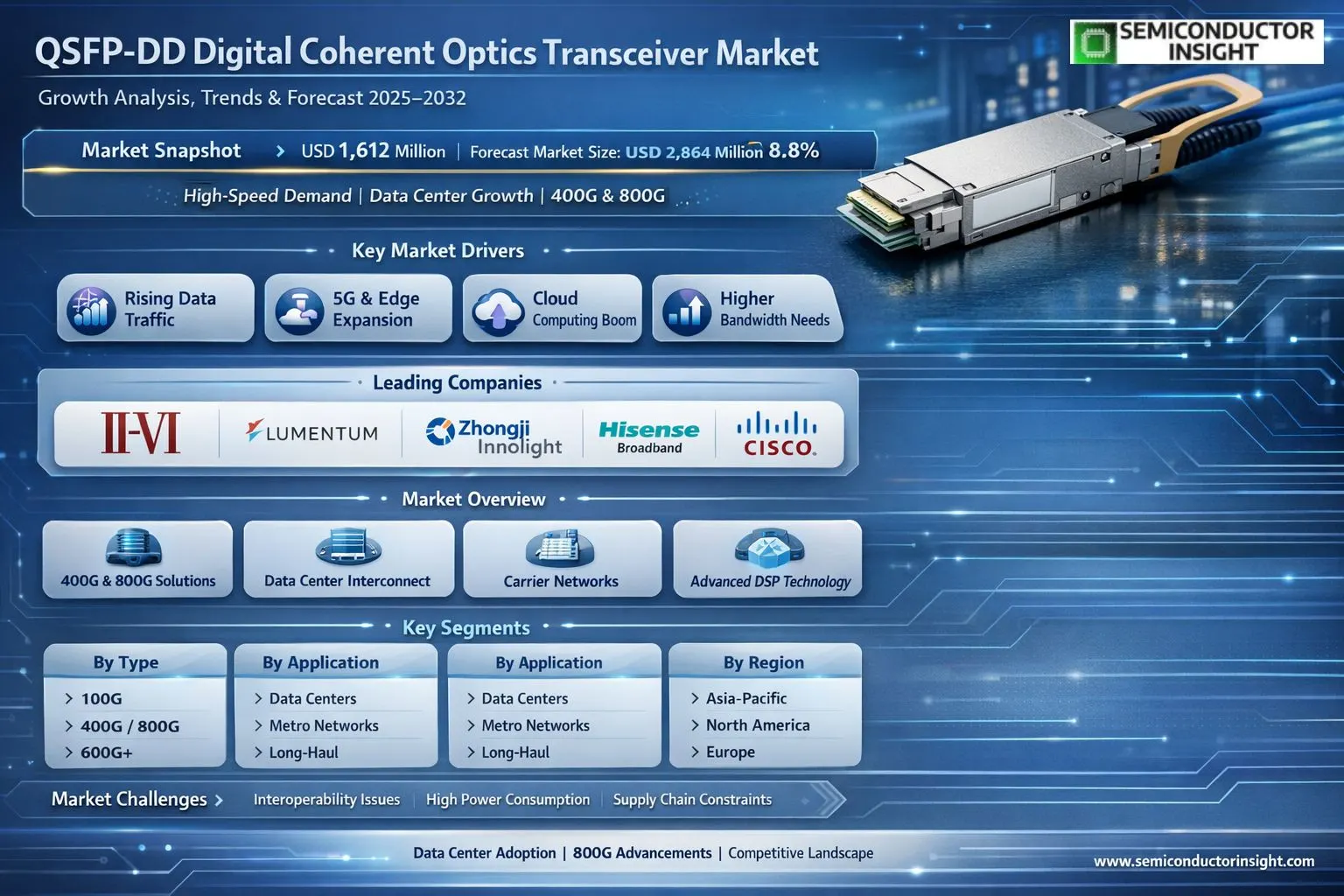
Global QSFP-DD Digital Coherent Optics Transceiver market size was valued at USD 1,612 million in 2025. The market is projected to reach USD 2,864 million by 2032, exhibiting a CAGR of 8.8% during the forecast period.
The QSFP-DD Digital Coherent Optics Transceiver is a high-performance optical communication device designed with the QSFP-DD (Quad Small Form-factor Pluggable Double Density) interface standard. It integrates digital coherent technology with a high-density optical interface to provide higher bandwidth, lower latency, and enhanced signal modulation capabilities. This transceiver is widely used in data centers, carrier networks, and high-speed communication systems. It supports multiple transmission rates such as 400G, 800G, and beyond, meeting the growing demands of large-scale networks and cloud computing.
The market is experiencing rapid growth due to several factors, including surging data traffic from AI, cloud services, and 5G deployments, alongside advancements in digital signal processing for longer reach. Furthermore, the push for higher port densities in metro and DCI networks accelerates adoption. Initiatives by key players fuel further expansion. II-VI Incorporated, Lumentum, Zhongji Innolight, Hisense Broadband, Accelink Technologies, Cisco, Broadcom, Intel, Hgtech, and Eoptolink are some of the key players operating in the market with diverse portfolios.
MARKET DRIVERS
Surging Demand for High-Speed Data Transmission
QSFP-DD Digital Coherent Optics Transceiver Market is propelled by explosive growth in data center interconnectivity, where hyperscale operators require 400G and 800G solutions to handle petabyte-scale traffic. Global data traffic is projected to exceed 175 Zettabytes annually by 2025, necessitating advanced coherent optics for efficient long-haul and metro deployments.
5G Rollout and Edge Computing Expansion
Deployment of 5G networks worldwide amplifies bandwidth demands, pushing telecom providers toward QSFP-DD digital coherent transceivers for backhaul and fronthaul links. These modules support coherent DSP technology, enabling reaches up to 120km at 400G, aligning with edge computing trends that decentralize data processing.
➤ Industry forecasts indicate the QSFP-DD DCO market will grow at a 28% CAGR through 2030, driven by AI workloads requiring low-latency optics.
Cloud providers like AWS and Google are standardizing QSFP-DD interfaces, fostering ecosystem maturity and volume production, which further accelerates market penetration in enterprise and service provider segments.
MARKET CHALLENGES
Interoperability and Standardization Issues
Ensuring seamless integration of QSFP-DD digital coherent optics transceivers across multi-vendor environments remains a key hurdle, as varying DSP implementations lead to compatibility gaps. Network operators face testing complexities, delaying widespread adoption despite OIF and MSA guidelines.
Other Challenges
Power consumption in high-density QSFP-DD modules, often exceeding 15W per port, strains data center cooling infrastructures, prompting redesigns amid sustainability mandates.
Supply Chain and Component Shortages
Rare-earth materials for lasers and advanced photonic chips create bottlenecks, with lead times stretching to 40 weeks, impacting deployment timelines for 400G upgrades.
MARKET RESTRAINTS
Elevated Costs of Coherent Technology
QSFP-DD Digital Coherent Optics Transceiver Market faces restraint from premium pricing, with modules costing 2-3 times more than PAM4 counterparts due to integrated coherent DSP and tunable lasers. This limits uptake in cost-sensitive regions outside North America and Europe.Regulatory compliance for coherent systems, including FCC emissions and RoHS standards, adds development overhead, slowing innovation cycles for smaller vendors.Competition from pluggable PAM4 optics in shorter reaches caps coherent QSFP-DD demand to long-haul applications, representing under 30% of total transceiver volumes currently.Maturing silicon photonics alternatives threaten traditional InP-based coherent tech, pressuring margins in the QSFP-DD segment.
MARKET OPPORTUNITIES
Transition to 800G and 1.6T Networks
Upcoming 800G QSFP-DD digital coherent optics transceivers open avenues in next-gen data centers, supporting AI training clusters with doubled spectral efficiency via higher-order modulation like 16QAM.Hyperscale investments exceeding $100 billion annually in optical infrastructure favor coherent solutions for DCI, with QSFP-DD enabling ZR/ZR+ pluggables standardized by OIF.Expansion into subsea and regional networks offers growth, as QSFP-DD modules reduce footprint while extending reach, capturing shares from fixed transponders.
QSFP-DD Digital Coherent Optics Transceiver Market Trends
Accelerated Adoption in Data Center Interconnections
QSFP-DD Digital Coherent Optics Transceiver Market is experiencing robust growth due to surging requirements for high-bandwidth connectivity in data center interconnection applications. This transceiver, adhering to the Quad Small Form-factor Pluggable Double Density interface, incorporates digital coherent technology to deliver superior signal modulation, enabling reliable transmission over extended distances with minimal latency. As cloud computing expands and hyperscale data centers proliferate, the demand for QSFP-DD modules supporting 400G and higher rates has intensified, positioning them as critical components in modern network architectures.
Other Trends
Advancements in High-Speed Product Segments
Within QSFP-DD Digital Coherent Optics Transceiver Market, segments such as 200G/400G and 600G/800G coherent transceivers are gaining prominence, driven by the need for scalable solutions in carrier networks and metropolitan area networks. Manufacturers are focusing on enhancing modulation capabilities and integration density to support next-generation speeds, addressing the challenges of bandwidth-intensive applications like video streaming and AI-driven workloads. This shift underscores a broader industry movement toward coherent optics that can handle dense wavelength division multiplexing effectively.
Intensifying Competition Among Key Manufacturers
Competition in QSFP-DD Digital Coherent Optics Transceiver Market is heating up, with leading players including II-VI Incorporated, Lumentum, Zhongji Innolight, Hisense Broadband, Accelink Technologies, Cisco, Broadcom, Intel, Hgtech, and Eoptolink innovating to capture larger shares. These companies are investing in research for improved power efficiency and form-factor compatibility, responding to market dynamics such as supply chain optimizations and customer demands for interoperable solutions. Regional strengths, particularly in North America and Asia, are fostering collaborative developments that propel QSFP-DD Digital Coherent Optics Transceiver Market forward. Additionally, applications in other high-speed communication systems are expanding the addressable market, ensuring sustained momentum amid evolving network infrastructures.
COMPETITIVE LANDSCAPE
Key Industry Players
QSFP-DD Digital Coherent Optics Transceiver Market Leaders and Emerging Challengers
QSFP-DD Digital Coherent Optics Transceiver Market is characterized by a concentrated competitive structure dominated by a handful of established technology leaders. II-VI Incorporated and Lumentum stand out as frontrunners, leveraging advanced photonic integration and coherent DSP expertise to capture substantial market share. These players benefit from strong R&D investments and partnerships with major data center operators, enabling them to deliver high-performance modules supporting 400G and 800G rates. The top five manufacturers, including Zhongji Innolight, Hisense Broadband, and Accelink Technologies, collectively hold a significant portion of global revenue, reflecting the industry’s oligopolistic nature amid rapid demand for DCI and metro network upgrades. Intense innovation in modulation formats and power efficiency defines the market dynamics, with incumbents focusing on scalability to meet cloud-scale bandwidth needs.
Beyond the leaders, a robust ecosystem of niche players contributes specialized capabilities, particularly in regional markets and emerging speed tiers like 600G/800G coherent transceivers. Companies such as Cisco, Broadcom, and Intel integrate QSFP-DD solutions into broader networking portfolios, emphasizing system-level interoperability. Chinese firms like Hgtech and Eoptolink excel in cost-competitive manufacturing for Asia-Pacific deployments, while Fujitsu Optical Components and NEC target enterprise and carrier segments with customized optics. GIGALIGHT and FIBERSTAMP TECHNOLOGY address hyperscale data center interconnections, fostering competition through faster time-to-market and application-specific adaptations. Juniper rounds out the field with coherent optics optimized for edge routing, underscoring the market’s fragmentation by geography and use case.
List of Key QSFP-DD Digital Coherent Optics Transceiver Companies Profiled
- II-VI Incorporated
- Lumentum
- Zhongji Innolight
- Hisense Broadband
- Accelink Technologies
- Cisco
- Broadcom
- Intel
- Hgtech
- Eoptolink
- Fujitsu Optical Components Limited
- GIGALIGHT
- FIBERSTAMP TECHNOLOGY
- Juniper
- NEC
Segment Analysis:
| Segment Category | Sub-Segments | Key Insights |
| By Type |
|
200G/400G Coherent Transceiver
|
| By Application |
|
Data Center Interconnection (DCI)
|
| By End User |
|
Data Centers
|
| By Reach |
|
Medium Reach
|
| By Protocol |
|
400ZR
|
Regional Analysis: QSFP-DD Digital Coherent Optics Transceiver Market
Asia-Pacific
Hyperscalers in Asia-Pacific drive QSFP-DD Digital Coherent Optics Transceiver demand through massive data center expansions, prioritizing coherent optics for inter-rack and campus connectivity. Pluggable modules enable flexible scaling, reducing operational costs while supporting AI workloads and edge computing growth.
Key production centers streamline QSFP-DD fabrication, leveraging advanced silicon photonics for coherent performance. Local ecosystems ensure quick prototyping and cost efficiencies, making Asia-Pacific the go-to source for high-volume QSFP-DD Digital Coherent Optics Transceiver supply.
Widespread fiber optic upgrades incorporate QSFP-DD Digital Coherent Optics Transceivers for metro and long-haul links, enhancing spectral efficiency. Telecom operators favor these modules for their interoperability in multi-vendor environments.
R&D collaborations advance QSFP-DD coherent technologies, focusing on DSP enhancements for higher baud rates. Startups and incumbents co-develop solutions tailored to regional bandwidth explosions.
North America
North America excels in QSFP-DD Digital Coherent Optics Transceiver Market through pioneering innovation and hyperscale cloud leadership. Tech giants spearhead deployments in sprawling data center campuses, utilizing QSFP-DD modules for coherent transmission over dark fiber networks. R&D investments refine digital signal processing for ultra-low latency, vital for AI training clusters. Regulatory frameworks support spectrum-efficient optics, while venture capital nurtures silicon photonics startups. Enterprise adoption in financial services demands QSFP-DD Digital Coherent Optics Transceivers for secure, high-capacity links, fostering a mature ecosystem of interoperability standards.
Europe
Europe advances steadily in QSFP-DD Digital Coherent Optics Transceiver Market, emphasizing sustainable and regulated deployments. Submarine cable projects bolster transatlantic connectivity, integrating QSFP-DD coherent optics for reliable long-haul performance. Data sovereignty initiatives drive localized data centers favoring pluggable QSFP-DD modules. Collaborative research consortia enhance coherent DSP algorithms, improving energy efficiency amid green mandates. Telecom providers upgrade backbones with QSFP-DD Digital Coherent Optics Transceivers, supporting diverse 5G applications across urban and rural divides.
South America
South America emerges as a growth frontier in QSFP-DD Digital Coherent Optics Transceiver Market, propelled by digital inclusion efforts. Investments in undersea cables and fiber backbones incorporate QSFP-DD modules for continental connectivity. Urban data hubs in Brazil and Mexico adopt coherent optics to handle video streaming and e-commerce surges. Partnerships with global suppliers accelerate QSFP-DD Digital Coherent Optics Transceiver integration, bridging infrastructure gaps while prioritizing cost-effective scalability.
Middle East & Africa
Middle East & Africa witness accelerating traction in QSFP-DD Digital Coherent Optics Transceiver Market, driven by smart city visions and oil-funded diversification. Gulf states deploy QSFP-DD coherent transceivers in expansive data centers supporting IoT ecosystems. African fiber projects enhance regional internet access, leveraging QSFP-DD modules for efficient backbone upgrades. Strategic alliances introduce advanced QSFP-DD Digital Coherent Optics Transceivers, fostering digital economy foundations amid rising bandwidth needs.
Report Scope
This market research report provides a comprehensive analysis of QSFP-DD Digital Coherent Optics Transceiver Market, covering the forecast period 2025–2032. It offers detailed insights into market dynamics, technological advancements, competitive landscape, and key trends shaping the industry.
Key focus areas of the report include:
- Market Overview: The report begins with an overview outlining its current market scenario, key growth indicators, and industry transformation drivers. It discusses macroeconomic factors, demand–supply balance, regulatory landscape, and the strategic role of QSFP-DD Digital Coherent Optics Transceivers in powering advancements across industries such as data centers, telecommunications, carrier networks, and cloud computing.
- Market Size & Forecast: Historical data and future projections for revenue, unit shipments, and market value across major regions and segments.
- Segmentation Analysis: Detailed breakdown by product type, technology, application, and end-user industry to identify high-growth segments and investment opportunities.
- Regional Insights: Insights into market performance across North America, Europe, Asia-Pacific, Latin America, and the Middle East & Africa, including country-level analysis where relevant.
- Competitive Landscape: Profiles of leading market participants, including their product offerings, R&D focus, manufacturing capacity, pricing strategies, and recent developments such as mergers, acquisitions, and partnerships.
- Technology Trends & Innovation: Assessment of emerging technologies, integration of AI/IoT, semiconductor design trends, fabrication techniques, and evolving industry standards.
- Market Drivers & Restraints: Evaluation of factors driving market growth along with challenges, supply chain constraints, regulatory issues, and market-entry barriers.
- Stakeholder Insights: Insights for component suppliers, OEMs, system integrators, investors, and policymakers regarding the evolving ecosystem and strategic opportunities.
Primary and secondary research methods are employed, including interviews with industry experts, data from verified sources, and real-time market intelligence to ensure the accuracy and reliability of the insights presented.
FREQUENTLY ASKED QUESTIONS:
What is the current market size of QSFP-DD Digital Coherent Optics Transceiver Market?
-> Global QSFP-DD Digital Coherent Optics Transceiver market was valued at USD 1,612 million in 2025 and is projected to reach USD 2,864 million by 2032, at a CAGR of 8.8% during the forecast period.
Which key companies operate in QSFP-DD Digital Coherent Optics Transceiver Market?
-> Key players include II-VI Incorporated, Lumentum, Zhongji Innolight, Hisense Broadband, Accelink Technologies, Cisco, among others.
What are the key growth drivers?
-> Key growth drivers include demand for higher bandwidth, lower latency in data centers, carrier networks, high-speed communication systems, and cloud computing.
Which region dominates the market?
-> Asia is the fastest-growing region, while North America remains a dominant market.
What are the emerging trends?
-> Emerging trends include support for 400G, 800G and beyond transmission rates, digital coherent technology integration, QSFP-DD high-density interfaces.

Get Sample Report PDF for Exclusive Insights
Report Sample Includes
- Table of Contents
- List of Tables & Figures
- Charts, Research Methodology, and more...
 Download Sample Report PDF