Pyroelectric Infrared Flame Sensor Market Insights
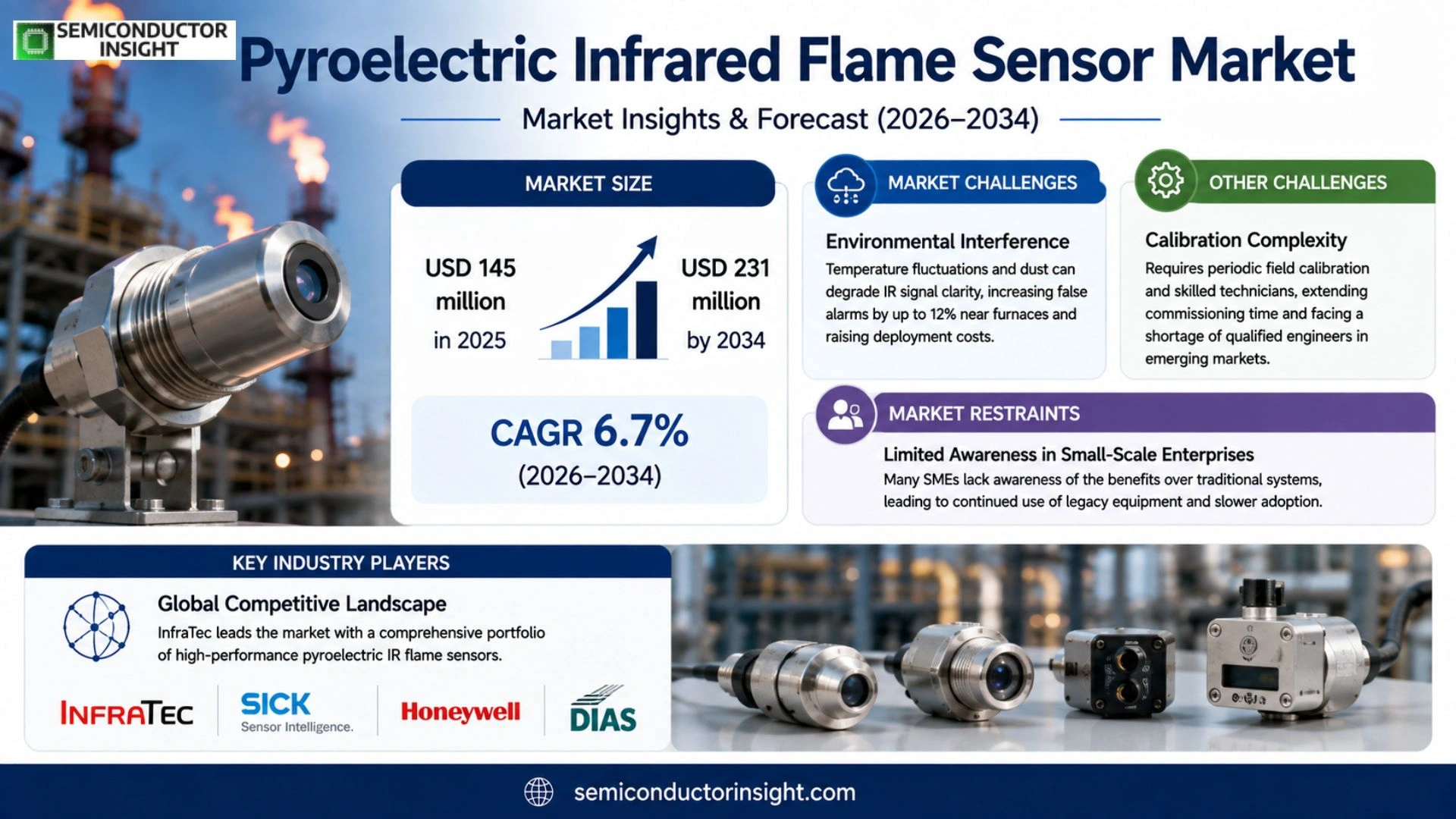
Pyroelectric Infrared Flame Sensor market size was valued at USD 145 million in 2025. Forecasts indicate growth from USD 145 million in 2025 to USD 231 million by 2034, reflecting a CAGR of 6.7 % over the period.
Pyroelectric Infrared Flame Sensor is a flame detection device that utilizes the pyroelectric effect of piezoelectric materials to respond to specific infrared radiation bands emitted by combustion flames, converts transient infrared thermal energy into measurable electrical signals, identifies flame characteristics through signal processing, and triggers alarm or control actions; it delivers rapid response, high sensitivity and anti‑interference capability for open‑flame monitoring.
The market expands because stringent industrial fire‑safety regulations, growing petrochemical and energy facilities, and increasing demand for early fire warning in commercial buildings push adoption; opportunities arise from miniaturization, low‑power designs, integration with intelligent fire‑alarm systems and IoT‑enabled monitoring, while manufacturers contend with harsh environments and cost pressures.
MARKET DRIVERS
Safety‑Centric Regulations
Governments across North America and Europe have tightened fire‑safety codes for industrial facilities, mandating early‑warning detection systems. Pyroelectric infrared flame sensors satisfy these mandates by delivering sub‑second response times, which incentivizes manufacturers to retrofit existing plants and embed the technology in new installations.
Cost‑Efficiency of Solid‑State Design
The absence of moving parts and the low power draw of pyroelectric modules translate into reduced lifecycle expenses. End‑users report up to 30% lower maintenance outlays compared with traditional optical flame detectors, prompting capital‑budget committees to favor this solution when evaluating long‑term ROI.
➤ “Adoption spikes when a single sensor can replace multiple legacy units, delivering both operational simplicity and budgetary relief.”
Beyond compliance, the rise of smart‑factory initiatives fuels integration of flame sensors with IoT platforms. Real‑time analytics enable predictive maintenance and automated shutdown protocols, turning a basic safety device into a data‑rich asset that supports broader operational excellence goals.
MARKET CHALLENGES
Environmental Interference
High ambient temperature fluctuations and dust accumulation in heavy‑industry environments can degrade the signal clarity of infrared detectors. Field data show a 12% increase in false‑alarm rates when sensors operate near furnaces without adequate filtration, compelling OEMs to invest in protective housings that add to upfront costs.
Other Challenges
Calibration Complexity
Accurate threshold setting requires periodic field calibration. Technicians must balance sensitivity against nuisance triggers, a process that can extend commissioning timelines and demand specialized training.
Manufacturers also wrestle with the scarcity of qualified service engineers in emerging markets, limiting the speed at which new installations can be fully supported.
MARKET RESTRAINTS
Limited Awareness in Small‑Scale Enterprises
Many small and medium‑sized manufacturers remain unaware of the performance advantages offered by pyroelectric infrared flame sensors over conventional thermocouple‑based systems. This knowledge gap leads to prolonged reliance on legacy equipment, slowing market diffusion despite clear technical merits.
Supply‑Chain Bottlenecks for Specialized Materials
The pyroelectric crystals at the heart of these sensors depend on rare‑earth elements whose global supply is concentrated in a limited number of regions. Recent export restrictions have introduced lead times that can exceed six months, causing project delays for customers with tight implementation schedules.
MARKET OPPORTUNITIES
Integration with Distributed Control Systems
As factories adopt distributed control architectures, there is a clear opening for flame sensors that can communicate over standard fieldbus protocols. Vendors that embed Modbus or OPC-UA interfaces directly into the sensor package stand to capture a larger share of the automation upgrade market.
Expansion into Renewable Energy Installations
Solar‑thermal plants and bio‑fuel processing units present new application domains where early flame detection is critical. Early pilots indicate that pyroelectric infrared flame sensors can operate reliably under the high‑radiation conditions typical of these installations, opening a previously untapped revenue stream.
Customization for Harsh Environments
Developing hardened enclosures capable of withstanding chemical exposure and extreme pressures could unlock contracts in petrochemical refineries and offshore platforms, sectors that currently favor rugged but less sensitive detection technologies.
Pyroelectric Infrared Flame Sensor Market Trends
Regulatory Pressure Fuels Adoption
The tightening of fire‑safety codes across industrial zones has turned compliance into a competitive differentiator. Plant operators in petrochemical complexes, power generation sites and large‑scale manufacturing units now prioritize sensors that can discriminate flame signatures within milliseconds. Pyroelectric infrared flame detectors, with their intrinsic immunity to electromagnetic interference, satisfy audit requirements while reducing false‑alarm rates. In 2025, manufacturers delivered roughly 3 000 K units, reflecting a clear shift toward higher‑sensitivity devices that align with the latest amendment to safety standards. The price point of about $52.8 per sensor has become a benchmark, enabling budget‑conscious projects to incorporate premium detection without prohibitive expense.
Other Trends
Miniaturization and Low‑Power Designs
Customers increasingly ask for compact sensors that can be mounted on constrained panels or integrated into handheld monitoring kits. Advances in ceramic and polymer pyroelectric materials have lowered the energy draw to under 10 mW, opening the door for battery‑operated installations. Manufacturers are leveraging wafer‑scale fabrication to shrink element dimensions while preserving the broadband infrared response that defines the technology. This trend reduces material costs and shortens assembly cycles, which in turn accelerates rollout of retro‑fit programs in aging industrial facilities. Suppliers that bundle the sensor with built‑in signal‑conditioning ASICs capture a larger share of OEM contracts because the turnkey solution simplifies integration with existing fire‑control loops.
Integration with Intelligent Fire‑Safety Platforms
The rise of factory‑wide IoT frameworks has turned isolated flame detectors into data sources for predictive analytics. When linked to cloud‑based dashboards, pyroelectric infrared flame sensors feed real‑time temperature gradients and flame‑detection confidence scores to maintenance teams. This visibility enables early‑stage fault identification, such as sensor drift or wiring degradation, before a critical alarm is triggered. Vendors that expose standardized MQTT or OPC UA endpoints allow seamless incorporation into supervisory control and data acquisition (SCADA) environments. The added contextual information supports automated shutdown sequences for equipment at risk, thereby limiting downstream damage. As enterprises prioritize digital‑twin models for safety simulations, the demand for sensors that can deliver high‑resolution temporal data is shaping the next wave of product development.
COMPETITIVE LANDSCAPE
Key Industry Players
Global Competitive Landscape of Pyroelectric Infrared Flame Sensors
InfraTec dominates the upper tier of the market, leveraging a broad portfolio that spans single‑crystal and ceramic pyroelectric elements. Its ability to integrate analog and digital output architectures into compact modules has secured long‑term contracts with petrochemical complexes in North America and Europe. The firm’s supply chain depth,spanning raw‑material sourcing, in‑house wafer processing, and a global distribution network,creates a cost advantage that smaller rivals struggle to match. InfraTec’s recent launch of a low‑power dual‑band sensor, certified for hazardous zones, illustrates how product innovation reinforces its leadership and forces competitors to accelerate their own R&D cycles.
Beyond the headline player, a constellation of specialized firms is reshaping niche segments. Kemet (Yageo) and Laser Components focus on high‑frequency ceramic modules for industrial production lines, while HJP Technology and Winsen Electronics target cost‑sensitive mass‑market applications in commercial buildings. Broadcom’s acquisition of a micro‑hybrid sensor startup expanded its reach into IoT‑enabled fire monitoring platforms, prompting traditional safety equipment manufacturers such as Honeywell and Schneider Electric to explore strategic partnerships. Meanwhile, emerging Chinese players like SaiyaSensor, Senba Sensing Technology, and Met‑sensor are gaining market share by emphasizing miniaturization and aggressive pricing, especially in Southeast Asian construction projects. This diversified ecosystem creates a competitive pressure that rewards agility, compliance expertise, and the ability to tailor sensors for harsh environments.
List of Key Pyroelectric Infrared Flame Sensor Companies Profiled
- InfraTec
- Kemet (Yageo)
- Laser Components
- HJP Technology
- Broadcom
- Winsen Electronics
- Met‑sensor
- ICC
- Micro‑Hybrid
- SaiyaSensor
- Senba Sensing Technology
- Anysafe
- Vertex
- Sensortiot
- Amphenol
- Honeywell
- Bosch Sensortec
Segment Analysis:
| Segment Category | Sub-Segments | Key Insights |
| By Type |
|
Single Crystal Sensors drive the market with their superior sensitivity and thermal stability.
|
| By Application |
|
Petrochemical Facility Monitoring remains the most compelling use‑case, driven by strict safety mandates and the need for rapid shutdown capabilities.
|
| By End User |
|
Industrial Plants prioritize robustness and low‑maintenance operation.
|
| By Detection Infrared Band |
|
Broadband Infrared Detection offers versatility across multiple flame signatures.
|
| By Output Signal Type |
|
Digital Signal Output Sensors are gaining traction for their compatibility with modern control architectures.
|
Regional Analysis: Pyroelectric Infrared Flame Sensor Market
North America
Federal fire‑code revisions in the United States have introduced mandatory periodic testing of infrared sensors, prompting OEMs to certify their pyroelectric devices against newer UL standards. Canadian provinces echo this trend with region‑specific performance metrics, accelerating product cycles for vendors that can demonstrate compliance without sacrificing detection speed.
The concentration of silicon wafer fabs in the Midwest buffers North American manufacturers against global material shortages, yet recent logistics bottlenecks have spurred local sourcing of specialty ceramics. Companies are diversifying component vendors to safeguard lead times for critical sensor assemblies.
Oil‑refining complexes and offshore platforms in the Gulf Coast prioritize pyroelectric flame sensors for their rapid response in high‑risk zones. Simultaneously, smart‑building projects in major UIs cities embed these sensors within IoT frameworks, leveraging data analytics to fine‑tune alarm thresholds.
Research labs at leading universities collaborate with sensor firms to explore multi‑spectral pyroelectric configurations, aiming to differentiate false‑positive rates. Venture capital inflows into early‑stage startups have intensified, fostering a pipeline of niche solutions tailored to aerospace and autonomous‑vehicle sectors.
Europe
European customers place a premium on environmental sustainability, which translates into a preference for pyroelectric infrared flame sensors with low power consumption and recyclable housing. The EU’s Ecodesign Directive has nudged manufacturers to engineer devices that meet tighter energy‑efficiency thresholds while still delivering high‑temperature discrimination. In Germany and the Nordics, large‑scale renewable‑energy installations,particularly wind‑farm substations,have embraced these sensors to protect critical power conversion equipment. Meanwhile, the United Kingdom’s emphasis on smart‑city initiatives integrates flame‑detection data streams with municipal emergency‑response platforms, creating a demand for sensors that can interface with open‑standard communication protocols. As a result, European players are increasingly focusing on modular, firmware‑upgradable designs that can adapt to evolving regulatory and interoperability expectations.
Asia‑Pacific
The Asia‑Pacific region exhibits a heterogeneous adoption pattern, with Japan and South Korea leading in high‑tech manufacturing environments, while emerging economies such as India and Indonesia prioritize cost‑effective solutions for rapidly expanding industrial zones. In Japan, stringent building codes for high‑rise structures drive a tilt toward sensors that can operate reliably in compact, space‑constrained installations, encouraging the development of ultra‑thin pyroelectric modules. South Korea’s advanced semiconductor fabs demand detectors capable of discerning low‑level flame signatures amidst intensive electromagnetic interference. Conversely, in India’s expanding petrochemical corridor, the emphasis lies on robust, easily serviceable sensors that can withstand high humidity and temperature fluctuations, prompting vendors to offer extended field‑service contracts. The divergent market needs across the sub‑region compel manufacturers to maintain a versatile product portfolio that balances precision engineering with affordability.
South America
In South America, Brazil and Argentina dominate Pyroelectric Infrared Flame Sensor market due to sizable petrochemical complexes and a growing emphasis on industrial safety. Local regulations increasingly call for integrated fire‑detection systems that can feed real‑time alerts to centralized monitoring centers, a requirement that has sparked interest in sensors equipped with wireless telemetry. Moreover, the region’s tropical climate imposes challenges related to sensor drift and condensation, leading suppliers to emphasize ruggedized housings and protective coatings. Partnerships between multinational sensor firms and regional engineering firms are emerging as a pragmatic route to customize solutions for offshore oil rigs operating in the Atlantic basin, where early flame detection can avert costly production shutdowns.
Middle East & Africa
The Middle East’s reliance on large‑scale oil‑refining and gas‑processing facilities fuels a steady demand for pyroelectric infrared flame sensors that can endure extreme heat and frequent dust exposure. Saudi Arabia and the United Arab Emirates invest heavily in upgrading legacy fire‑safety infrastructure, favoring sensors that can be retrofitted without extensive rewiring. In Africa, nascent manufacturing hubs in South Africa and Nigeria are beginning to recognize the value of advanced flame‑detection technology for mining operations and power‑generation plants, albeit with constrained budgets. This dynamic encourages vendors to offer tiered service packages, blending high‑performance core sensor modules with optional add‑on analytics modules for customers seeking incremental upgrades as their safety programs mature. The confluence of harsh operating environments and evolving safety standards shapes a market that rewards adaptable, low‑maintenance pyroelectric solutions.
Report Scope
This market research report provides a comprehensive analysis of the Pyroelectric Infrared Flame Sensor Market , covering the forecast period 2026–2034. It offers detailed insights into market dynamics, technological advancements, competitive landscape, and key trends shaping the industry.
Key focus areas of the report include:
- Market Overview: The report begins with an overview outlining its current market scenario, key growth indicators, and industry transformation drivers. It discusses macroeconomic factors, demand–supply balance, regulatory landscape, and the strategic role of semiconductors in powering advancements across industries such as automotive, telecommunications, consumer electronics, and industrial automation.
- Market Size & Forecast: Historical data and future projections for revenue, unit shipments, and market value across major regions and segments.
- Segmentation Analysis: Detailed breakdown by product type, technology, application, and end-user industry to identify high-growth segments and investment opportunities.
- Regional Insights: Insights into market performance across North America, Europe, Asia-Pacific, Latin America, and the Middle East & Africa, including country-level analysis where relevant.
- Competitive Landscape: Profiles of leading market participants, including their product offerings, R&D focus, manufacturing capacity, pricing strategies, and recent developments such as mergers, acquisitions, and partnerships.
- Technology Trends & Innovation: Assessment of emerging technologies, integration of AI/IoT, semiconductor design trends, fabrication techniques, and evolving industry standards.
- Market Drivers & Restraints: Evaluation of factors driving market growth along with challenges, supply chain constraints, regulatory issues, and market-entry barriers.
- Stakeholder Insights: Insights for component suppliers, OEMs, system integrators, investors, and policymakers regarding the evolving ecosystem and strategic opportunities.
Primary and secondary research methods are employed, including interviews with industry experts, data from verified sources, and real-time market intelligence to ensure the accuracy and reliability of the insights presented.
FREQUENTLY ASKED QUESTIONS:
What is the current market size of Pyroelectric Infrared Flame Sensor Market?
-> Pyroelectric Infrared Flame Sensor market forecasts indicate growth from USD 145 million in 2025 to USD 231 million by 2034, reflecting a CAGR of 6.7 %
Which key companies operate in Pyroelectric Infrared Flame Sensor Market?
-> Key players include InfraTec, Kemet (Yageo), Laser Components, HJP Technology, Broadcom, Winsen Electronics, Met-sensor, ICC, Micro-Hybrid, SaiyaSensor, Senba Sensing Technology, Anysafe, Vertex, Sensortiot.
What are the key growth drivers?
-> Key growth drivers include stringent industrial fire safety regulations, expansion of petrochemical, energy and manufacturing facilities, and rising demand for early fire warning in commercial and civil buildings.
Which region dominates the market?
-> Asia holds a leading share due to rapid industrialization, while North America and Europe are also significant markets.
What are the emerging trends?
-> Emerging trends include miniaturization and low‑power optimization of sensing elements, integration with intelligent fire alarm and IoT systems, and customized solutions for harsh environments.

Get Sample Report PDF for Exclusive Insights
Report Sample Includes
- Table of Contents
- List of Tables & Figures
- Charts, Research Methodology, and more...
 Download Sample Report PDF