MARKET INSIGHTS
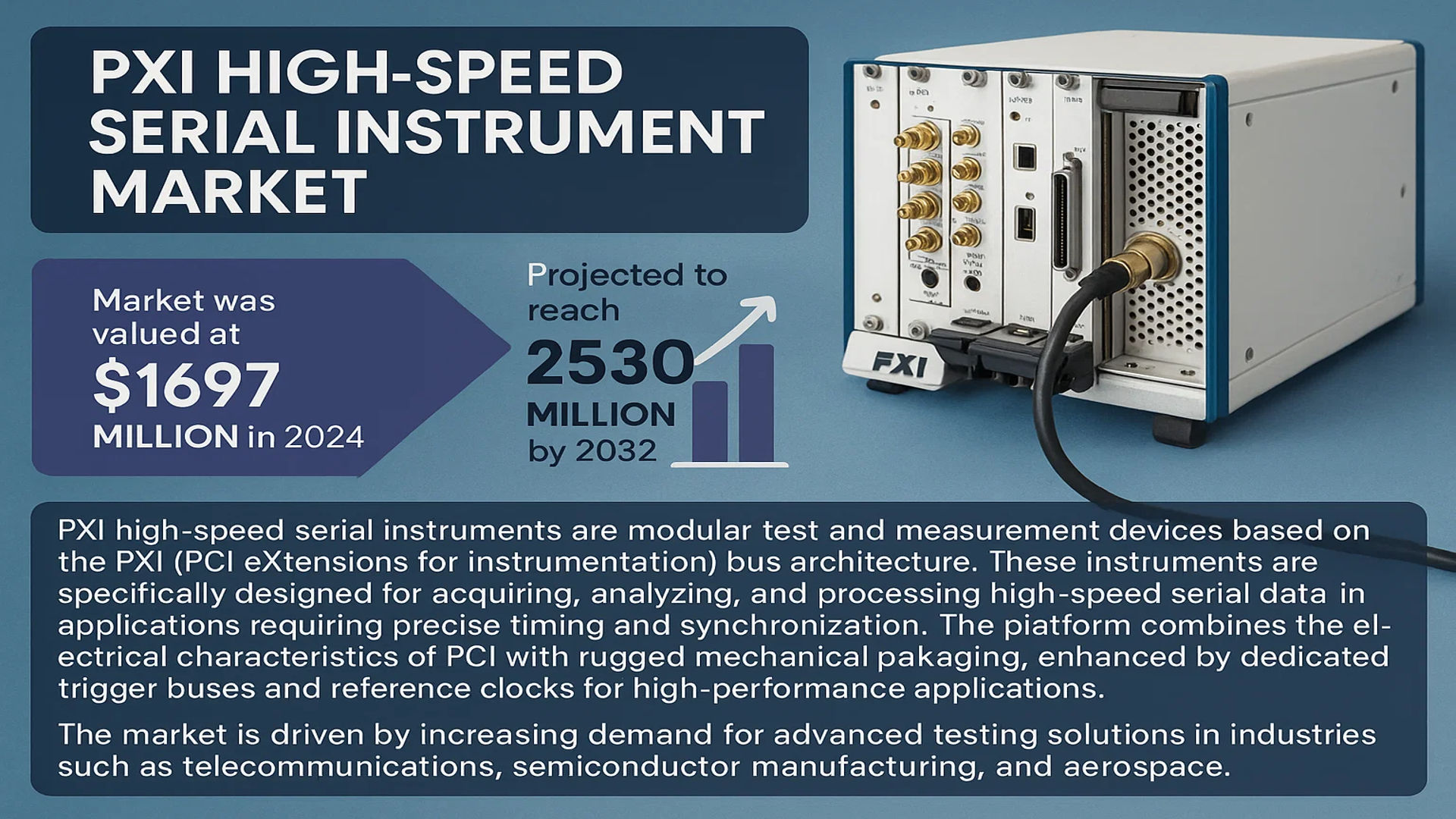
The global PXI High-speed Serial Instrument Market was valued at 1697 million in 2024 and is projected to reach US$ 2530 million by 2032, at a CAGR of 5.9% during the forecast period.
PXI high-speed serial instruments are modular test and measurement devices based on the PXI (PCI eXtensions for Instrumentation) bus architecture. These instruments are specifically designed for acquiring, analyzing, and processing high-speed serial data in applications requiring precise timing and synchronization. The platform combines the electrical characteristics of PCI with rugged mechanical packaging, enhanced by dedicated trigger buses and reference clocks for high-performance applications.
The market is driven by increasing demand for advanced testing solutions in industries such as telecommunications, semiconductor manufacturing, and aerospace. While North America currently leads in market share, Asia-Pacific is witnessing accelerated growth due to expanding 5G infrastructure and semiconductor production. Key players like NI, Keysight Technologies, and Tektronix are investing in product innovations to address evolving industry requirements, particularly in high-bandwidth applications above 40Gbps.
MARKET DYNAMICS
MARKET DRIVERS
Rising Demand for High-Speed Data Transmission Standards to Accelerate Market Growth
The global PXI high-speed serial instrument market is witnessing robust growth due to increasing adoption of advanced communication protocols like PCIe Gen 4/5, USB4, and Thunderbolt. These next-generation interfaces require sophisticated testing solutions capable of handling data rates exceeding 64 Gbps, creating significant demand for PXI-based instruments. With 5G network deployments expanding globally, test requirements for high-speed serial interfaces in base stations and communication equipment have intensified. The telecommunications sector accounted for nearly 35% of total PXI instrument demand in recent industry analyses, reflecting this critical driver.
Automation in Semiconductor Testing to Fuel Instrument Adoption
Semiconductor manufacturers are increasingly adopting PXI platforms for automated device testing, drawn by their modular architecture and scalability. The ability to integrate high-speed serial instruments with other test modules provides comprehensive solutions for wafer probing and final test applications. Major foundries have reported 20-30% improvements in test throughput after implementing PXI-based automated test systems. As chip complexity grows with advanced packaging technologies like 3D ICs and chiplets, the demand for high-performance serial test instrumentation continues its upward trajectory.
Defense and Aerospace Modernization Programs to Boost Market Expansion
Government investments in next-generation radar systems, electronic warfare equipment, and satellite communications are driving adoption of PXI high-speed serial instruments. These applications require reliable testing of high-speed serial links in rugged environments, a capability where PXI excels. Recent defense budget allocations in major economies have shown consistent growth in electronics testing budgets, with a notable portion dedicated to modular instrumentation solutions. The aerospace sector’s transition to more connected avionics systems further amplifies this demand driver.
MARKET RESTRAINTS
High Initial Investment Costs to Limit Market Penetration
While PXI high-speed serial instruments offer superior performance, their premium pricing creates adoption barriers for small and medium enterprises. A complete PXI test system with high-speed serial capabilities often requires significant capital expenditure, including chassis, controllers, and specialized modules. This financial hurdle is particularly pronounced in cost-sensitive markets where traditional benchtop instruments may still dominate. The need for specialized training and supporting infrastructure further adds to the total cost of ownership.
Technical Complexity in System Integration to Impede Growth
Designing and maintaining high-speed serial test systems presents substantial engineering challenges. Signal integrity issues become increasingly critical at multi-gigabit data rates, requiring precise impedance matching and advanced calibration techniques. Many organizations lack the technical expertise to properly implement these complex systems, leading to extended deployment timelines. The industry faces an ongoing shortage of engineers skilled in both high-speed digital design and modular instrumentation architectures.
Competition from Alternative Test Architectures to Present Challenges
The PXI platform faces growing competition from emerging test paradigms, including cloud-based testing solutions and semiconductor-built self-test capabilities. Some industry segments are adopting chip-embedded test interfaces that reduce reliance on external instrumentation. While PXI maintains advantages in flexibility and performance, these alternative approaches could capture portions of the test equipment market, particularly in high-volume production environments.
MARKET OPPORTUNITIES
Emerging Automotive Electronics to Create New Growth Avenues
The automotive industry’s rapid adoption of advanced driver assistance systems (ADAS) and autonomous driving technologies presents significant opportunities. Modern vehicles now incorporate numerous high-speed serial links for sensors, infotainment, and vehicle networks. Testing these complex electronic systems requires instrumentation capable of handling automotive-specific protocols like Automotive Ethernet while meeting stringent environmental requirements. PXI’s modular nature allows customization for these specialized applications.
Artificial Intelligence Integration to Enhance Instrument Capabilities
The incorporation of AI and machine learning into test systems opens new possibilities for high-speed serial instruments. Smart algorithms can automate signal analysis, predict test failures, and optimize measurement parameters in real-time. Several leading vendors have begun introducing AI-enhanced PXI modules that significantly reduce test times for high-speed interfaces. This technological convergence creates opportunities for both instrument manufacturers and end-users seeking productivity gains.
Expansion in Emerging Markets to Drive Long-Term Growth
Developing economies are witnessing rapid growth in electronics manufacturing and telecommunications infrastructure. Countries in Southeast Asia and Eastern Europe are establishing themselves as important production hubs for electronic components, creating demand for sophisticated test equipment. While these markets currently have lower penetration of high-end instrumentation, their expanding industrial bases represent significant untapped potential for PXI high-speed serial solutions.
MARKET CHALLENGES
Rapid Technology Evolution to Pressure Instrument Development Cycles
The blistering pace of advancement in serial data standards presents ongoing challenges for instrument manufacturers. Each new generation of interfaces requires complete redesigns of test equipment to support higher speeds and emerging protocols. Maintaining compatibility with legacy systems while developing next-generation capabilities strains R&D resources. The industry must balance these technical demands with the need to deliver cost-effective solutions.
Thermal Management in High-Density PXI Systems to Present Engineering Hurdles
High-speed serial instruments generate significant heat due to their powerful processing requirements. This heat dissipation becomes particularly challenging in dense PXI chassis configurations where multiple high-performance modules operate simultaneously. Effective thermal design is critical to maintaining signal integrity and measurement accuracy, requiring sophisticated cooling solutions that add complexity and cost to system designs.
Global Supply Chain Disruptions to Impact Production Stability
The semiconductor shortages experienced in recent years have highlighted vulnerabilities in the test equipment supply chain. Many PXI instruments rely on specialized components with limited alternative sources. Extended lead times for critical parts can delay instrument deliveries and system deployments, potentially slowing market growth. Manufacturers are reevaluating their supply chain strategies to improve resilience against such disruptions.
PXI HIGH-SPEED SERIAL INSTRUMENT MARKET TRENDS
Growing Demand for Modular Test Systems Fuels Market Expansion
The global PXI High-speed Serial Instrument market is experiencing robust growth, driven by the increasing adoption of modular test and measurement systems across industries such as telecommunications, aerospace, and semiconductors. PXI-based instruments offer significant advantages over traditional benchtop equipment, including higher throughput, greater flexibility, and reduced physical footprint. As industries move towards Industry 4.0 and IoT-enabled automation, the need for scalable, high-performance test solutions has intensified. The market was valued at $1,697 million in 2024 and is projected to reach $2,530 million by 2032, growing at a CAGR of 5.9%.
Other Trends
Rise in 5G and Beyond Deployment
The global rollout of 5G networks and ongoing research into 6G technologies are accelerating demand for high-speed serial test equipment capable of handling multi-gigabit data rates. PXI instruments, particularly high-speed serial digitizers and generators, are essential for validating signal integrity, latency, and throughput in next-generation wireless communication systems. With telecommunication firms investing heavily in infrastructure upgrades, the need for precise, real-time data acquisition and analysis is propelling market expansion.
Semiconductor Industry Drives Adoption of Advanced PXI Solutions
The semiconductor sector remains a key growth driver for PXI high-speed serial instruments, particularly as chip manufacturers develop high-bandwidth memory and high-speed interconnect technologies like PCIe 6.0 and DDR5. PXI-based bit error rate testers (BERTs) are increasingly utilized for validating serializer/deserializer (SerDes) performance in data-intensive applications. Furthermore, the shift towards more sophisticated automated test equipment (ATE) solutions in semiconductor manufacturing is reinforcing the demand for modular, software-defined instrumentation systems.
Integration of AI and Machine Learning in Test Automation
Advancements in artificial intelligence and machine learning are being integrated into PXI test platforms to enhance fault detection, predictive maintenance, and automated decision-making. Manufacturers are leveraging these technologies to improve the efficiency of signal processing, reduce test times, and optimize resource allocation. This integration is particularly relevant in aerospace and defense applications, where high-speed serial data transmission must meet stringent reliability standards under extreme conditions.
COMPETITIVE LANDSCAPE
Key Industry Players
Innovation and Strategic Partnerships Drive Market Leadership in PXI High-Speed Serial Instruments
The global PXI high-speed serial instrument market is characterized by a dynamic competitive environment where established technology leaders and emerging players compete through product innovation and market expansion strategies. National Instruments (NI) maintains a dominant position due to its comprehensive PXI-based modular test platforms and strong foothold in aerospace, defense, and semiconductor applications. The company’s recent partnership with key industry players to enhance 5G testing solutions further solidifies its market leadership.
Keysight Technologies follows closely behind NI, leveraging its extensive R&D capabilities to deliver high-performance PXI solutions for evolving serial data protocols. Their recent introduction of 64 GBaud PXIe instrumentation demonstrates technological leadership in meeting demanding high-speed testing requirements. Meanwhile, Tektronix has been making significant strides in the oscilloscope segment, integrating advanced PXI solutions with their traditional test equipment portfolio.
Market dynamics are rapidly evolving as companies expand their presence across application segments. Teledyne LeCroy and Rohde & Schwarz have strengthened their market positions through strategic acquisitions and development of specialized PXI solutions for automotive and industrial applications. These developments reflect the growing demand for high-speed serial testing solutions across diverse industry verticals.
The competitive landscape also features specialized providers like Pickering Interfaces and ADLINK Technology, who are capitalizing on niche applications in military/aerospace and communication infrastructure. Their focused approach on reliability and customization options creates unique value propositions in this technology-driven market.
List of Key PXI High-speed Serial Instrument Companies Profiled
- National Instruments (NI) (U.S.)
- Keysight Technologies (U.S.)
- Tektronix (U.S.)
- Teledyne LeCroy (U.S.)
- Rohde & Schwarz (Germany)
- ADLINK Technology (Taiwan)
- Pickering Interfaces (U.K.)
- Agilent Technologies (U.S.)
- Vital System (China)
Segment Analysis:
By Type
PXI High-speed Serial Digitizer Segment Leads Due to Rising Demand in Signal Processing
The market is segmented based on type into:
- PXI High-speed Serial Digitizer
- Subtypes: Multi-channel digitizers, time-interleaved digitizers
- PXI High-speed Serial Generator
- Bit Error Rate Tester
- Others
By Application
Communication Industry Segment Dominates Owing to Growing Network Infrastructure Needs
The market is segmented based on application into:
- Communication Industry
- Semiconductor Industry
- Aerospace
- Others
By Speed
High-bandwidth Applications Driving Demand for Faster Solutions
The market is segmented based on speed specifications:
- Below 5 Gbps
- 5-10 Gbps
- Above 10 Gbps
By End-User
Manufacturing Sector Accounts for Significant Market Share
The market is segmented based on end-user into:
- Electronics Manufacturers
- Research Organizations
- Testing Service Providers
- Government & Defense
Regional Analysis: PXI High-speed Serial Instrument Market
North America
North America, particularly the U.S., dominates the PXI high-speed serial instrument market due to its advanced technological infrastructure and strong presence of key players such as NI, Keysight Technologies, and Tektronix. The region benefits from high investments in defense, aerospace, and telecommunications sectors, where PXI-based testing solutions are critical for ensuring product reliability and compliance. Additionally, stringent regulatory standards in the semiconductor and communication industries drive the adoption of high-precision test equipment. The U.S. government’s focus on 5G deployment and semiconductor self-sufficiency further fuels market growth, with significant R&D investments supporting innovation.
Europe
Europe holds a substantial share of the PXI high-speed serial instrument market, driven by robust demand from the automotive, aerospace, and industrial automation sectors. Germany and the U.K. are key contributors, leveraging their strong manufacturing bases and technological expertise. The region’s emphasis on Industry 4.0 and smart manufacturing necessitates reliable test and measurement solutions for high-speed data protocols. Furthermore, EU mandates ensure the use of standardized testing methodologies, boosting the adoption of PXI-based instruments. However, market growth faces challenges from economic fluctuations and the need for higher initial investments in advanced testing infrastructure.
Asia-Pacific
Asia-Pacific is the fastest-growing region in the PXI high-speed serial instrument market, with China, Japan, and South Korea leading the charge. The rapid expansion of 5G networks, coupled with aggressive semiconductor production in China and Taiwan, drives demand for high-speed testing solutions. India’s push toward digital transformation and local electronics manufacturing also contributes to regional growth. While cost sensitivity remains a challenge, the need for automation and quality control in manufacturing processes is accelerating the adoption of PXI instruments. The presence of major contract manufacturers further solidifies the region’s market potential.
South America
South America’s PXI high-speed serial instrument market is in a developing phase, with Brazil and Argentina emerging as key markets. The region’s limited industrial automation and technological infrastructure, however, constrain its growth potential. While telecommunications and automotive sectors are gradually adopting PXI solutions, economic instability and lower R&D investments hinder large-scale deployment. Nonetheless, increasing foreign investments in electronics and aerospace industries signal long-term opportunities for market expansion.
Middle East & Africa
The Middle East & Africa region shows moderate growth in the PXI high-speed serial instrument market, primarily driven by telecommunications and defense sectors in countries like Saudi Arabia, UAE, and Israel. The need for advanced testing in 5G infrastructure and aerospace applications presents growth opportunities. However, limited local manufacturing capabilities and reliance on imported solutions slow down market penetration. Government initiatives to boost industrial diversification could enhance demand for PXI instruments in the coming years.
Report Scope
This market research report provides a comprehensive analysis of the global PXI High-speed Serial Instrument market, covering the forecast period 2024–2032. It offers detailed insights into market dynamics, technological advancements, competitive landscape, and key trends shaping the industry.
Key focus areas of the report include:
- Market Size & Forecast: Historical data and future projections for revenue, unit shipments, and market value across major regions and segments. The global PXI High-speed Serial Instrument market was valued at USD 1,697 million in 2024 and is projected to reach USD 2,530 million by 2032, growing at a CAGR of 5.9%.
- Segmentation Analysis: Detailed breakdown by product type (PXI High-speed Serial Digitizer, PXI High-speed Serial Generator, Bit Error Rate Tester, Others), application (Communication Industry, Semiconductor Industry, Aerospace, Others), and end-user industry.
- Regional Outlook: Insights into market performance across North America (U.S., Canada, Mexico), Europe (Germany, France, U.K.), Asia-Pacific (China, Japan, India), and other regions with country-level analysis.
- Competitive Landscape: Profiles of leading market participants including NI, Keysight Technologies, Agilent, Tektronix, and Rohde & Schwarz, covering their product portfolios, market share, and strategic initiatives.
- Technology Trends & Innovation: Assessment of emerging PXI technologies, integration with advanced test systems, and evolving industry standards for high-speed serial data testing.
- Market Drivers & Restraints: Evaluation of factors driving market growth such as increasing demand for high-speed data testing in 5G and IoT, along with challenges like high equipment costs.
- Stakeholder Analysis: Strategic insights for test equipment manufacturers, semiconductor companies, system integrators, and investors in the PXI instrumentation ecosystem.
The research methodology combines primary interviews with industry experts and analysis of verified market data from authoritative sources to ensure accuracy and reliability.
FREQUENTLY ASKED QUESTIONS:
What is the current market size of Global PXI High-speed Serial Instrument Market?
-> PXI High-speed Serial Instrument Market was valued at 1697 million in 2024 and is projected to reach US$ 2530 million by 2032, at a CAGR of 5.9% during the forecast period.
Which key companies operate in Global PXI High-speed Serial Instrument Market?
-> Key players include NI, Keysight Technologies, Agilent, Tektronix, Teledyne LeCroy, Rohde & Schwarz, and ADLINK, among others.
What are the key growth drivers?
-> Key growth drivers include rising demand for high-speed data testing in 5G networks, increasing semiconductor complexity, and adoption of modular test systems.
Which region dominates the market?
-> North America currently leads the market, while Asia-Pacific is expected to witness the highest growth rate during the forecast period.
What are the emerging trends?
-> Emerging trends include integration of AI in test systems, development of higher bandwidth PXI modules, and increasing adoption in aerospace & defense applications.

Get Sample Report PDF for Exclusive Insights
Report Sample Includes
- Table of Contents
- List of Tables & Figures
- Charts, Research Methodology, and more...