MARKET INSIGHTS
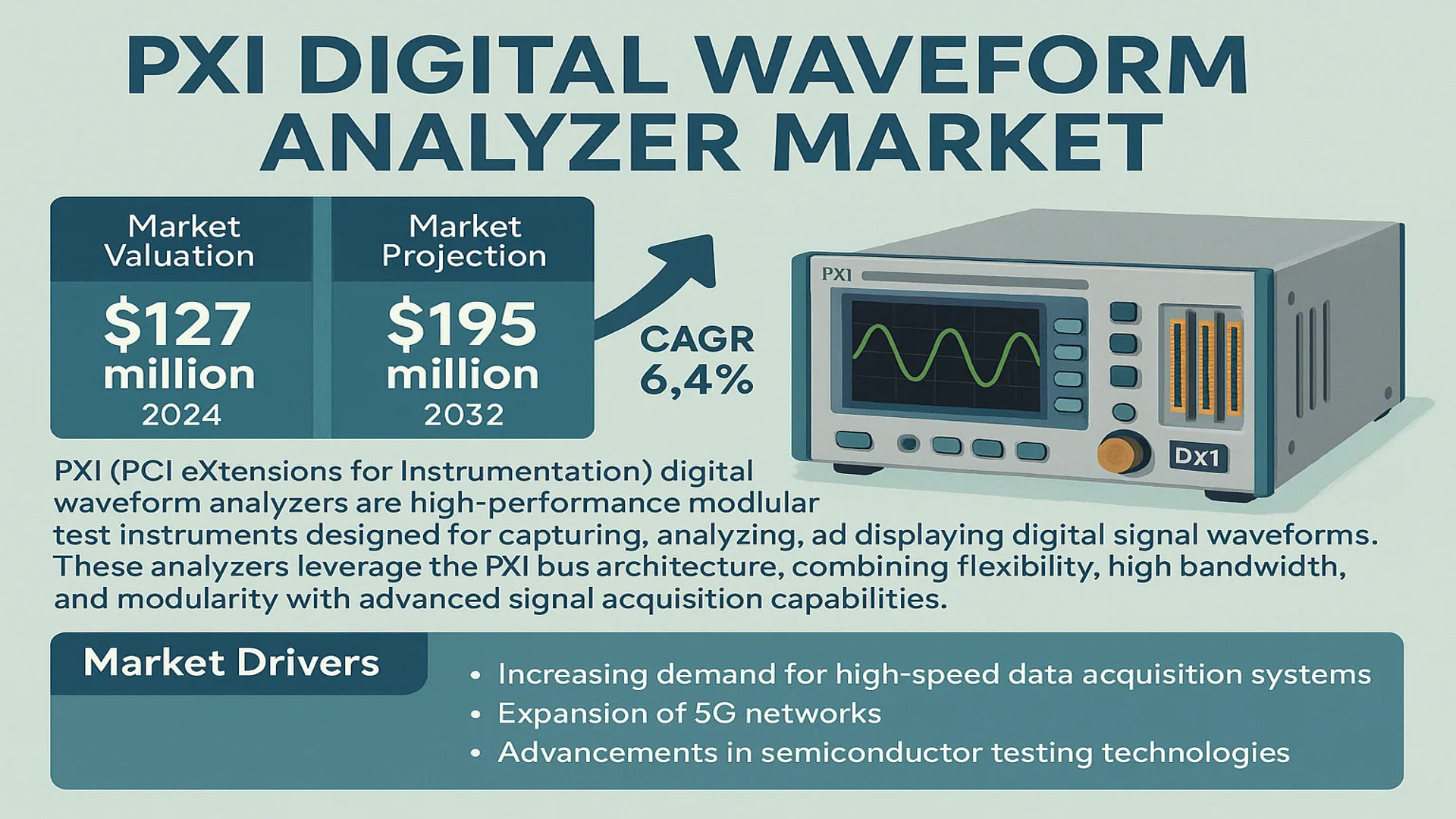
The global PXI Digital Waveform Analyzer Market was valued at 127 million in 2024 and is projected to reach US$ 195 million by 2032, at a CAGR of 6.4% during the forecast period.
PXI (PCI eXtensions for Instrumentation) digital waveform analyzers are high-performance modular test instruments designed for capturing, analyzing, and displaying digital signal waveforms. These analyzers leverage the PXI bus architecture, combining flexibility, high bandwidth, and modularity with advanced signal acquisition capabilities. They play a critical role in automated testing, R&D verification, and production testing across industries such as electronics manufacturing, telecommunications, and semiconductor development.
The market growth is driven by increasing demand for high-speed data acquisition systems, expansion of 5G networks, and advancements in semiconductor testing technologies. While North America currently dominates the market due to strong R&D investments, Asia-Pacific is expected to witness the fastest growth, fueled by China’s expanding electronics manufacturing sector. Key players like NI, Keysight Technologies, and Tektronix are enhancing product portfolios with higher sampling rates and improved protocol analysis features to meet evolving industry requirements.
MARKET DYNAMICS
MARKET DRIVERS
Rising Demand for High-Speed Data Acquisition in Electronics Manufacturing
The increasing complexity of electronic devices and the need for rapid prototyping are driving demand for PXI digital waveform analyzers. Modern electronics require high-speed signal analysis with sampling rates exceeding 10 GS/s and bandwidths over 1 GHz to validate high-frequency components. With the global electronics manufacturing sector maintaining a 5-7% annual growth rate, manufacturers are investing heavily in advanced test equipment that can handle complex digital signals while reducing time-to-market.
5G Infrastructure Deployment Accelerating Market Growth
The global rollout of 5G networks represents a significant growth opportunity for PXI digital waveform analyzer solutions. These instruments are critical for testing high-frequency 5G waveforms and beamforming technologies, with leading manufacturers developing specialized modules capable of analyzing millimeter-wave frequencies up to 44 GHz. With over 300 commercial 5G networks currently deployed worldwide, the demand for modular test solutions that can be adapted to evolving standards continues to strengthen the market position of PXI-based analyzers.
Automated Test System Integration Fueling Adoption
Manufacturers across industries are increasingly adopting PXI digital waveform analyzers as part of complete automated test systems. The modular architecture allows seamless integration with other PXI instruments, significantly reducing test system footprint while improving measurement accuracy. In automotive electronics testing, for example, these systems can reduce validation time by up to 40% compared to traditional benchtop instruments, leading to widespread adoption by tier-1 suppliers and OEMs.
MARKET RESTRAINTS
High Initial Investment Costs Limit SME Adoption
While PXI digital waveform analyzers offer superior performance, their premium pricing acts as a market restraint, particularly for small and medium enterprises. A complete PXI-based test system including chassis, controller, and specialized modules can require capital expenditure exceeding $50,000, creating a significant entry barrier for budget-constrained organizations. Although lifecycle costs may be lower than benchtop alternatives, the upfront investment remains a key consideration for potential buyers.
Technical Complexity Requires Skilled Personnel
The configuration and programming of PXI systems demands specialized knowledge of both hardware integration and software development. Many organizations face challenges finding personnel proficient in LabVIEW, TestStand, and other specialized programming environments used with these analyzers. The global shortage of test engineering talent, particularly in emerging manufacturing economies, continues to slow market penetration despite the technical advantages of PXI solutions.
Performance Limitations for Ultra-High Frequency Applications
While PXI digital waveform analyzers excel in many applications, they face constraints when testing signals beyond 50 GHz, where traditional benchtop instruments maintain a performance advantage. This limitation affects adoption in cutting-edge research and defense applications requiring analysis of extremely high-frequency signals. Though recent advancements have pushed PXI performance boundaries, the technology still trails dedicated benchtop analyzers in certain specialized applications.
MARKET OPPORTUNITIES
Emerging AI and Machine Learning Integration
The integration of artificial intelligence with PXI digital waveform analyzers presents significant growth opportunities. Advanced signal processing algorithms can identify complex patterns and anomalies that traditional methods might miss. Leading manufacturers are developing smart analysis modules capable of predictive maintenance and automated fault detection, particularly valuable for industries with critical testing requirements such as aerospace and medical devices.
Expansion in Automotive Electronics Validation
The automotive industry’s transition to electric and autonomous vehicles creates substantial demand for advanced testing solutions. PXI digital waveform analyzers are increasingly used to validate complex automotive systems including ADAS components, battery management systems, and in-vehicle networking. With the global automotive electronics market projected to maintain strong growth, this sector represents a key opportunity for PXI analyzer manufacturers to expand their customer base.
Cloud-Based Test System Development
The emergence of cloud-connected PXI systems enables new remote monitoring and data analysis capabilities. This evolution allows for centralized test management across multiple manufacturing sites and facilitates collaborative engineering workflows. As Industry 4.0 adoption accelerates, manufacturers are showing strong interest in networked test systems that leverage the scalability and flexibility of PXI architectures combined with cloud data analytics.
MARKET CHALLENGES
Intense Competition from Alternative Test Platforms
The PXI digital waveform analyzer market faces significant competition from benchtop instruments, USB-based solutions, and emerging semiconductor test equipment. While PXI offers superior modularity, price pressures from alternative platforms continue to challenge market growth. Some manufacturers are developing hybrid test strategies incorporating multiple instrument types, requiring PXI vendors to demonstrate clear return on investment to maintain market share.
Rapid Technological Evolution Requires Continuous R&D
The fast pace of technological change in digital communications and semiconductor design forces PXI manufacturers to continually upgrade their product offerings. Developing new modules that support emerging standards while maintaining backward compatibility represents an ongoing challenge, particularly as development cycles shorten across multiple industries, from consumer electronics to defense applications.
Global Supply Chain Vulnerabilities Impact Availability
Recent disruptions in semiconductor and electronic component supply chains have affected production schedules for PXI-based test equipment. The specialized components required for high-performance digital waveform analysis often face longer lead times, potentially delaying system deliveries and installation timelines. Manufacturers are working to diversify supply chains, but these challenges remain a consideration for customers requiring rapid deployment of test solutions.
PXI DIGITAL WAVEFORM ANALYZER MARKET TRENDS
Adoption of Modular Test Systems Driving Market Growth
The shift toward modular test systems in industries such as aerospace, defense, and telecommunications is significantly boosting demand for PXI digital waveform analyzers. These analyzers provide high-speed signal acquisition, flexible configuration, and seamless integration with existing test setups, making them ideal for automated testing environments. The market is projected to grow at a 6.4% CAGR from 2024 to 2032, reaching approximately $195 million by 2032. This growth is largely attributed to the increasing need for precision measurement tools in both R&D and production testing. As industries prioritize faster time-to-market and higher testing efficiency, PXI-based analyzers offer a competitive edge due to their scalability and reduced test system footprint.
Other Trends
Rise in Demand for Mixed-Signal Testing
With the expanding complexity of electronic devices, the demand for mixed-signal PXI waveform analyzers has surged. These analyzers combine high-resolution analog signal measurement with digital signal processing, catering to applications in IoT, 5G, and advanced semiconductor testing. The mixed-signal segment is expected to witness above-average growth, as industries increasingly adopt integrated test solutions capable of handling digital, analog, and RF signals simultaneously. The ability to capture and correlate multiple signal types in real-time enhances debugging efficiency, making these analyzers indispensable in modern test environments.
Technological Advancements in High-Speed Protocols
Advancements in high-speed communication protocols, including PCIe Gen 5 and DDR5, are accelerating the need for PXI digital waveform analyzers with higher bandwidth and resolution. Manufacturers like Keysight Technologies and Tektronix are developing analyzers capable of capturing and processing signals at rates exceeding 10 GS/s, enabling accurate analysis of ultra-high-speed digital interfaces. The proliferation of 6G research and automotive radar systems further drives demand for analyzers with real-time processing and deep memory depth. While the adoption of these advanced tools is increasing, cost remains a challenge for small and medium-sized enterprises, restricting broader market penetration in emerging economies.
COMPETITIVE LANDSCAPE
Key Industry Players
Innovation and Strategic Expansion Drive Market Leadership
The global PXI Digital Waveform Analyzer market exhibits a dynamic and moderately consolidated competitive landscape, with major players leveraging technological advancements and geographic expansion to maintain dominance. While the market features both established and emerging participants, innovation in modular test instrumentation remains a key differentiator.
National Instruments (NI) and Keysight Technologies collectively hold a significant share of the market, primarily due to their comprehensive PXI-based solutions and robust distribution networks. NI’s leadership stems from its legacy in automated test systems, with flagship products like the PXIe-5160 offering high-resolution waveform analysis capabilities. Meanwhile, Keysight’s M9100 series has gained traction in semiconductor testing applications due to its multi-channel synchronization features.
Specialized manufacturers such as Pickering Interfaces and ADLINK Technology are strengthening their positions through niche applications. Pickering’s focus on ruggedized PXI solutions for defense applications and ADLINK’s emphasis on 5G test solutions demonstrate how market segmentation strategies are driving growth. Recent partnerships between these firms and telecommunications equipment manufacturers illustrate the increasing convergence of test instrumentation with next-gen network requirements.
The competitive intensity is further heightened by R&D investments in protocol-aware analyzers, with Tektronix and Teledyne LeCroy introducing solutions featuring advanced decoding capabilities for automotive Ethernet and PCIe standards. These developments reflect broader industry trends toward application-specific waveform analysis in emerging technology sectors.
List of Key PXI Digital Waveform Analyzer Manufacturers
- National Instruments (NI) (U.S.)
- Keysight Technologies (U.S.)
- Pickering Interfaces (U.K.)
- ADLINK Technology (Taiwan)
- Tektronix (U.S.)
- Spectrum Instrumentation (Germany)
- Teledyne LeCroy (U.S.)
- VX Instruments (Germany)
- Hunan Aixep Measurement and Control Technology (China)
Segment Analysis:
By Type
General Purpose Segment Holds Major Share Owing to Wide Test & Measurement Applications
The market is segmented based on type into:
- General Purpose
- Mixed Signal
- Protocol Analysis
By Application
Electronic Manufacturing & Testing Leads the Market Due to Increasing Adoption in Automated Production Lines
The market is segmented based on application into:
- Electronic Manufacturing and Testing
- Communication Industry
- Semiconductor Industry
- Other
By Region
North America Dominates Owing to Strong Presence of Key Players and Advanced Testing Infrastructure
The market is segmented based on region into:
- North America
- Europe
- Asia
- South America
- Middle East & Africa
Regional Analysis: PXI Digital Waveform Analyzer Market
Asia-Pacific
The Asia-Pacific region dominates the PXI Digital Waveform Analyzer market, driven by China’s aggressive semiconductor expansion and India’s growing electronics manufacturing sector. China alone accounts for over 38% of regional demand, fueled by government initiatives like “Made in China 2025” which prioritizes advanced test and measurement capabilities. Japan maintains strong adoption in automotive electronics testing, while South Korea’s semiconductor giants are accelerating purchases for chip verification. Though price sensitivity favors general-purpose analyzers, there’s rising demand for mixed-signal and protocol analysis modules as local manufacturers move up the value chain. Supply chain localization efforts are reshaping the competitive landscape, with firms like Hunan Aixep gaining market share.
North America
North America’s market is characterized by high-value, low-volume purchases focused on R&D applications. The U.S. defense sector’s shift toward modular test systems (PXI Alliance reports 22% CAGR in defense applications) and 5G infrastructure rollout are key drivers. Leading players like NI and Keysight Technologies concentrate on developing analyzers with AI-powered signal processing, particularly for aerospace and quantum computing applications. While the region trails Asia in unit shipments, it leads in adoption of 64+ channel high-density systems for complex waveform analysis. Recent CHIPS Act funding is expected to boost semiconductor testing demand through 2030.
Europe
European demand centers on industrial automation and automotive validation, with Germany accounting for nearly 30% of regional sales. Stringent electromagnetic compliance (EMC) regulations are pushing adoption in automotive electronics, especially for EV power systems analysis. The market shows distinct preference for multi-domain analyzers that combine digital acquisition with RF measurement capabilities. While growth is steady (projected 4.8% CAGR), Brexit-related supply chain disruptions continue to impact UK-based manufacturers. Collaborative research initiatives like Horizon Europe are funding next-gen waveform analysis solutions for 6G development.
South America
This emerging market faces infrastructure limitations but shows promise in oil/gas equipment monitoring and basic electronics manufacturing. Brazil represents over 60% of regional demand, primarily for general-purpose analyzers in industrial maintenance applications. Currency volatility discourages capital investments, causing many firms to rely on refurbished PXI systems. However, increasing telecommunications infrastructure projects across the Andean region are creating opportunities for protocol analyzer adoption. Local presence of ADLINK Technology provides some supply chain stability against import challenges.
Middle East & Africa
The region exhibits nascent but growing demand, particularly in defense and telecommunications sectors. UAE and Israel account for 70% of analyzer purchases, focusing on radar system testing and 5G deployment. Limited technical expertise drives preference for turnkey PXI solutions with integrated software. Though market penetration remains low compared to other regions, major infrastructure projects like Saudi Arabia’s NEOM are expected to boost test equipment requirements. Local distributors are forming partnerships with global manufacturers to improve service networks, addressing traditional after-sales support challenges.
Report Scope
This market research report provides a comprehensive analysis of the global PXI Digital Waveform Analyzer market, covering the forecast period 2024–2032. It offers detailed insights into market dynamics, technological advancements, competitive landscape, and key trends shaping the industry.
Key focus areas of the report include:
- Market Size & Forecast: Historical data and future projections for revenue, unit shipments, and market value across major regions and segments. The Global PXI Digital Waveform Analyzer market was valued at USD 127 million in 2024 and is projected to reach USD 195 million by 2032, at a CAGR of 6.4% during the forecast period.
- Segmentation Analysis: Detailed breakdown by product type (General Purpose, Mixed Signal, Protocol Analysis), application (Electronic Manufacturing and Testing, Communication Industry, Semiconductor Industry, Others), and end-user industry to identify high-growth segments and investment opportunities.
- Regional Outlook: Insights into market performance across North America, Europe, Asia-Pacific, Latin America, and the Middle East & Africa, including country-level analysis. The U.S. market size is estimated at USD million in 2024, while China is projected to reach USD million by 2032.
- Competitive Landscape: Profiles of leading market participants, including their product offerings, R&D focus, manufacturing capacity, pricing strategies, and recent developments such as mergers, acquisitions, and partnerships. Key players include NI, Keysight Technologies, Pickering Interfaces, ADLINK Technology, Tektronix, among others.
- Technology Trends & Innovation: Assessment of emerging technologies, integration of AI/IoT in test and measurement systems, evolving industry standards, and advancements in PXI platform capabilities.
- Market Drivers & Restraints: Evaluation of factors driving market growth along with challenges, including increasing demand for automated test systems, growth in semiconductor industry, and technological advancements in 5G and IoT applications.
- Stakeholder Analysis: Insights for component suppliers, OEMs, system integrators, investors, and policymakers regarding the evolving ecosystem and strategic opportunities in the PXI Digital Waveform Analyzer market.
Primary and secondary research methods are employed, including interviews with industry experts, data from verified sources, and real-time market intelligence to ensure the accuracy and reliability of the insights presented.
FREQUENTLY ASKED QUESTIONS:
What is the current market size of Global PXI Digital Waveform Analyzer Market?
-> PXI Digital Waveform Analyzer Market was valued at 127 million in 2024 and is projected to reach US$ 195 million by 2032, at a CAGR of 6.4% during the forecast period.
Which key companies operate in Global PXI Digital Waveform Analyzer Market?
-> Key players include NI, Keysight Technologies, Pickering Interfaces, ADLINK Technology, Tektronix, Spectrum Instrumentation, Teledyne LeCroy, VX Instruments, and Hunan Aixep Measurement and Control Technology, among others.
What are the key growth drivers?
-> Key growth drivers include increasing demand for automated test systems, growth in semiconductor industry, and technological advancements in 5G and IoT applications.
Which region dominates the market?
-> North America currently leads the market, while Asia-Pacific is expected to witness the highest growth rate during the forecast period.
What are the emerging trends?
-> Emerging trends include integration of AI/ML in test systems, development of higher bandwidth analyzers, and increasing adoption of PXI-based solutions in defense and aerospace applications.

Get Sample Report PDF for Exclusive Insights
Report Sample Includes
- Table of Contents
- List of Tables & Figures
- Charts, Research Methodology, and more...
 Download Sample Report PDF