MARKET INSIGHTS
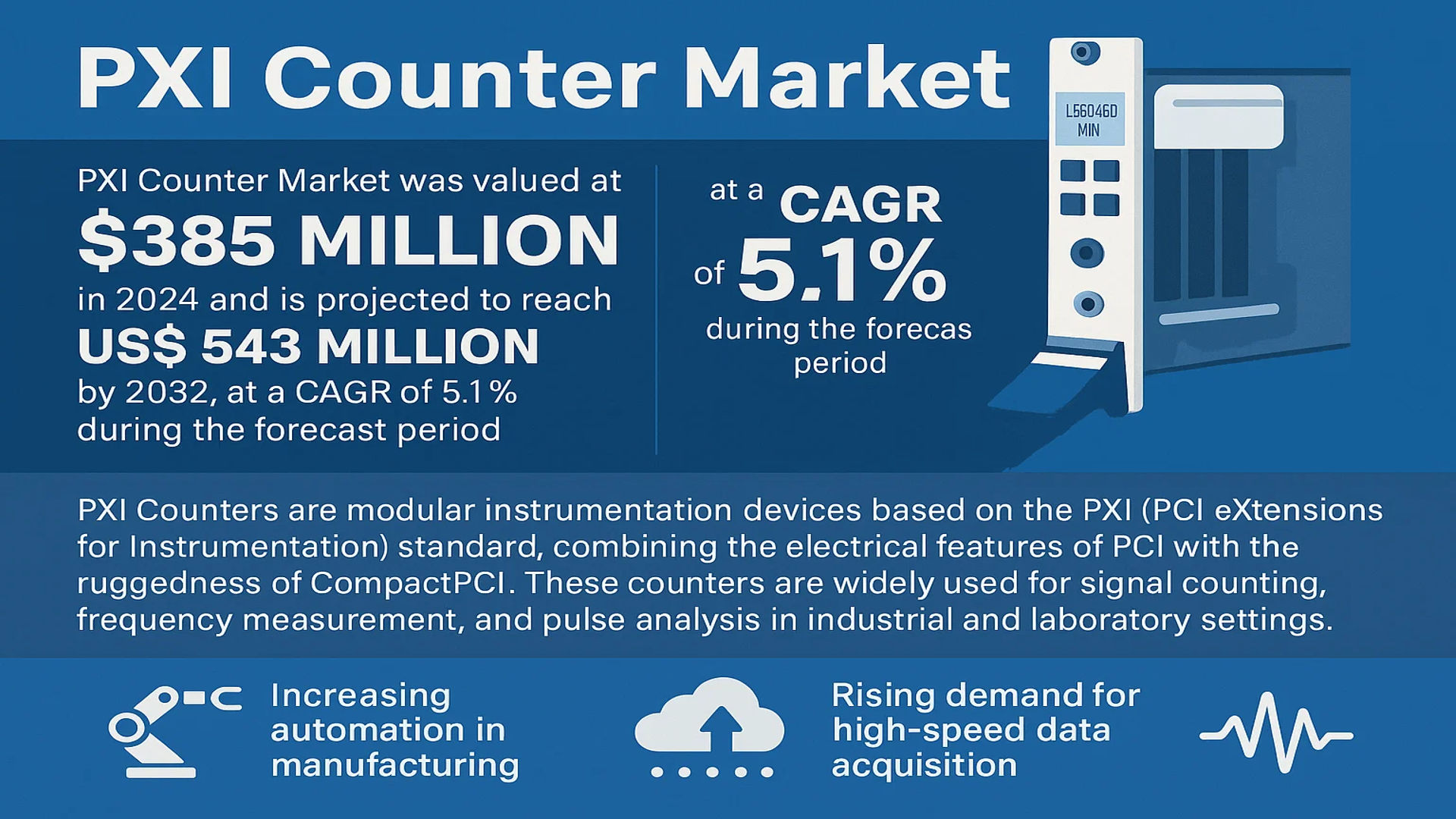
The global PXI Counter Market was valued at 385 million in 2024 and is projected to reach US$ 543 million by 2032, at a CAGR of 5.1% during the forecast period.
PXI Counters are modular instrumentation devices based on the PXI (PCI eXtensions for Instrumentation) standard, combining the electrical features of PCI with the ruggedness of CompactPCI. These counters are widely used for signal counting, frequency measurement, and pulse analysis in industrial and laboratory settings. Their ability to support both single-channel and multi-channel configurations makes them versatile for applications in electronic communication, automotive testing, aerospace, and other high-precision industries.
The market growth is driven by increasing automation in manufacturing, rising demand for high-speed data acquisition, and advancements in test and measurement technologies. Furthermore, the adoption of PXI-based systems in 5G infrastructure development and semiconductor testing is accelerating market expansion. Key players such as National Instruments, Keysight Technologies, and Tektronix dominate the market, offering advanced solutions to meet diverse industry needs.
MARKET DYNAMICS
MARKET DRIVERS
Rising Demand for High-Speed Data Acquisition in Industrial Applications to Propel Market Growth
The PXI Counter market is experiencing robust growth driven by increasing adoption in industrial automation and manufacturing sectors. Modern production facilities require precise timing and frequency measurements for quality control, with PXI counters providing the necessary accuracy. The automotive industry, for example, utilizes these modules for engine testing and electronic component validation, where measurement tolerances often exceed 0.01% accuracy. This sector’s expansion, particularly in electric vehicle production which grew by over 35% in key markets last year, directly fuels demand for advanced PXI counter solutions.
Military and Aerospace Sector Investments Accelerate Technological Advancements
Defense spending on avionics testing and satellite communication systems continues to drive innovation in PXI counter technology. Modern radar systems require counters capable of gigahertz-level frequency measurements with nanosecond precision, pushing manufacturers to develop specialized multi-channel PXI modules. The global aerospace testing equipment market, projected to maintain a 6.8% CAGR through 2030, creates substantial opportunities for high-performance counters in navigation system validation and component stress testing applications.
5G Infrastructure Deployment Spurs Demand for RF Test Solutions
The ongoing global 5G rollout represents a crucial growth driver for the PXI Counter market. Network equipment manufacturers require advanced counters for base station testing, with the need to verify signal integrity at frequencies up to 40GHz. Current 5G testing protocols demand counters with synchronization accuracy below 100 picoseconds – specifications that traditional benchtop instruments struggle to meet cost-effectively. As telecom operators continue deploying next-generation networks, the demand for specialized PXI counter solutions in this vertical is expected to grow substantially.
MARKET RESTRAINTS
High Initial Investment Costs Limit Adoption Among SMEs
While PXI counters offer superior performance, their adoption faces constraints due to significant upfront costs. Complete PXI systems including chassis, controllers, and software can require investments exceeding $50,000, putting them beyond reach for many small and medium enterprises. This cost barrier is particularly evident in developing markets where price sensitivity remains high. Additionally, the specialized nature of PXI systems often necessitates dedicated training programs, further increasing total cost of ownership.
Integration Complexities with Legacy Systems Create Adoption Hurdles
Many industrial facilities operating older test equipment face technical challenges when incorporating PXI counter modules into existing workflows. Compatibility issues between PXI platforms and traditional GPIB or USB-based instruments often require additional interface hardware and custom software development. These integration complexities can delay deployment timelines and increase project risks, causing some potential users to postpone upgrades or seek alternative solutions.
Limited Awareness in Emerging Markets Slows Regional Growth
Despite significant growth potential, market expansion in developing regions faces constraints due to limited technical familiarity with PXI architectures. Many engineering teams in these markets have extensive experience with standalone instruments but lack training on modular test systems. This knowledge gap, combined with concerns about long-term support and maintenance, creates hesitation in adopting PXI-based solutions even when they offer clear technical advantages.
MARKET OPPORTUNITIES
Emerging Applications in Quantum Computing Present New Growth Frontiers
The development of quantum computing systems creates novel opportunities for ultra-high performance PXI counters. Quantum coherence experiments require timing resolution in the picosecond range with exceptional stability – specifications aligning perfectly with advancements in PXI counter technology. As quantum research transitions from academic labs to commercial applications, demand for specialized counting solutions in this niche is projected to grow significantly over the next decade.
Expansion of Automated Test Equipment in Electronics Manufacturing
The electronics manufacturing sector’s shift toward fully automated test systems presents substantial growth potential for PXI counters. Modern production lines require integrated solutions that combine counting, signal generation, and analysis in compact form factors. PXI’s modular architecture is particularly well-suited for these applications, with capabilities to test multiple product parameters simultaneously. This trend is particularly evident in semiconductor fabrication, where test cell density requirements continue to increase annually.
Development of Hybrid Test Systems Combining PXI and PXIe
The emergence of hybrid test platforms incorporating both PXI and PXIe architectures creates new opportunities for counter module manufacturers. These systems combine the robustness of traditional PXI with the high bandwidth of PCI Express, enabling solutions that meet diverse testing requirements. Product developers focusing on backward compatibility while offering enhanced performance through hybrid configurations are well-positioned to capitalize on this evolving market segment.
MARKET CHALLENGES
Intense Competition from Lower-Cost Test Alternatives
The PXI Counter market faces persistent pressure from alternative test solutions, particularly USB-based instruments offering comparable functionality at lower price points. While these alternatives typically sacrifice measurement precision and system expandability, their affordability makes them attractive for budget-constrained applications. This competitive dynamic forces PXI manufacturers to continually demonstrate superior value propositions through advanced features and long-term reliability.
Rapid Technological Obsolescence Risks
The fast pace of technological advancement in test and measurement creates challenges for PXI counter developers. Measurement requirements evolve constantly, with new standards and protocols emerging across industries. Maintaining product relevance requires significant ongoing R&D investment, with the risk that newly launched modules may become obsolete within short timeframes if they fail to anticipate market needs accurately.
Supply Chain Disruptions Impacting Component Availability
The global semiconductor shortage continues to affect production schedules for PXI counter modules, particularly those requiring specialized high-speed ADCs and FPGAs. Lead times for certain critical components have extended beyond 52 weeks in some cases, forcing manufacturers to redesign products or seek alternative suppliers. These supply chain challenges complicate production planning and may impact the ability to meet growing market demand in the short term.
PXI COUNTER MARKET TRENDS
Integration of PXI Counters in Industrial Automation to Drive Market Growth
The increasing adoption of PXI counters in industrial automation is emerging as a key trend in the market, fueled by the need for high-precision signal processing and frequency measurement in manufacturing environments. With industries emphasizing Industry 4.0 and smart factory solutions, PXI counters are becoming indispensable tools for real-time monitoring and process control. A significant portion of manufacturers are leveraging these modules for tasks such as equipment condition monitoring, automated testing, and quality assurance, ensuring operational efficiency and reducing downtime. The ability of PXI counters to seamlessly integrate with modular instrumentation systems enhances their applicability across various automated production lines.
Other Trends
Expansion in Telecommunications and 5G Infrastructure
The rapid deployment of 5G networks is accelerating demand for PXI counters, particularly in signal integrity testing and frequency synchronization. As telecom operators invest heavily in network densification, the need for reliable test and measurement solutions has surged, with PXI counters offering scalability and high-speed data acquisition capabilities. These modules are widely used in validating 5G base stations, RF components, and mobile devices, ensuring compliance with stringent performance standards. With global 5G adoption projected to cover over 1.7 billion connections by 2025, the telecommunications sector is expected to remain a major contributor to PXI counter market growth.
Advancements in Multi-Channel PXI Counters
Technological advancements in multi-channel PXI counters are reshaping their adoption across high-throughput testing applications. These counters, capable of synchronizing multiple measurements simultaneously, are particularly valuable in aerospace, defense, and semiconductor testing. The shift toward multi-channel solutions is driven by the need for higher efficiency in complex test systems, where parallel testing reduces cycle times and enhances productivity. Furthermore, innovations in timing resolution and low-latency signal processing have strengthened their position in mission-critical industries, contributing to an estimated 6.3% CAGR for this segment in the coming years.
COMPETITIVE LANDSCAPE
Key Industry Players
Leading Vendors Focus on Innovation and Strategic Collaborations to Gain Market Share
The global PXI Counter market is characterized by a competitive yet evolving environment, with established players competing to capitalize on the growing demand for high-performance test and measurement solutions. National Instruments (NI) remains a dominant force in the industry, leveraging decades of expertise in PXI-based instrumentation and modular test systems. The company’s strong foothold in aerospace, automotive, and telecommunications applications has solidified its leadership position.
Meanwhile, Keysight Technologies has been aggressively expanding its PXI product portfolio, particularly in multi-channel counter modules, to meet the needs of complex automated test environments. Their recent investments in software-defined test architectures have given them an edge in next-generation applications.
The market also sees strong participation from Tektronix and ADLINK Technology, both of which have made significant strides in developing ruggedized PXI counters for harsh industrial environments. These players are focusing on integrating advanced timing and synchronization capabilities to differentiate their offerings.
While the top five companies collectively held nearly 40% of the global market share in 2024, competition is intensifying as mid-sized players like Spectrum Instrumentation and Pickering Interfaces introduce more cost-effective solutions without compromising performance. This trend is particularly evident in emerging economies where price sensitivity remains high.
Recent merger and acquisition activities have reshaped the competitive dynamics, with AMETEK strengthening its position through strategic acquisitions of specialized PXI module manufacturers. Such consolidations are expected to continue as companies strive to offer more comprehensive test system solutions.
List of Key PXI Counter Manufacturers Profiled
- National Instruments (U.S.)
- Keysight Technologies (U.S.)
- Tektronix (U.S.)
- Pickering Interfaces (U.K.)
- ADLINK Technology (Taiwan)
- AMETEK (U.S.)
- JYTEK (China)
- Spectrum Instrumentation (Germany)
- Marvin Test Solutions (U.S.)
- Astronics Test Systems (U.S.)
Segment Analysis:
By Type
Single Channel Segment Leads Due to Cost-Effectiveness and Widespread Use in Basic Test Systems
The market is segmented based on type into:
- Single Channel
- Multi-channel
- Subtypes: 4-channel, 8-channel, 16-channel, and others
By Application
Electronic Communication Segment Dominates Owing to High Demand for Signal Measurement in Telecom Infrastructure
The market is segmented based on application into:
- Electronic Communication
- Subtypes: Base station testing, network equipment validation
- Automotive Industry
- Subtypes: ECU testing, sensor validation
- Aerospace
- Subtypes: Avionics testing, satellite communications
- Other
- Subtypes: Industrial automation, medical devices
By End User
Test & Measurement Equipment Manufacturers Dominate as Primary Consumers of PXI Counter Technology
The market is segmented based on end user into:
- Test & Measurement Equipment Manufacturers
- Research Laboratories
- Telecom Service Providers
- Aerospace & Defense Contractors
- Automotive OEMs
Regional Analysis: PXI Counter Market
Asia-Pacific
The Asia-Pacific region dominates the global PXI Counter market, primarily driven by rapid technological advancements and manufacturing growth in China, Japan, and South Korea. China alone contributes significantly to regional demand due to its expanding electronics and automotive sectors, supported by government initiatives like “Made in China 2025.” The semiconductor boom in Taiwan and South Korea further fuels adoption of PXI counters for precision testing. While cost-sensitive markets still prefer traditional solutions, increasing investments in Industry 4.0 and 5G infrastructure are accelerating the shift toward modular instrumentation platforms. Local manufacturers are gaining traction by offering competitive pricing, though global players like Keysight Technologies maintain strong positions through technological leadership.
North America
North America holds a leading position in PXI Counter innovation, with the U.S. accounting for over 60% of regional market revenue. The presence of major aerospace/defense contractors and semiconductor firms drives demand for high-performance counters, particularly in applications requiring MIL-STD-705 compliance. National Instruments, headquartered in Austin, Texas, remains a dominant force with their PXIe-6614 counter/timer modules. Recent developments include increased integration of AI-driven analytics in test systems, particularly for autonomous vehicle validation. However, supply chain disruptions and export controls on advanced technologies to China have created both challenges and opportunities for domestic suppliers.
Europe
Europe’s market growth is propelled by stringent industrial automation standards and expanding R&D in automotive electronics, particularly in Germany and France. The region shows strong preference for multi-channel PXI counters that comply with EU electromagnetic compatibility (EMC) directives. Germany’s robust automotive test ecosystem, including major OEMs like BMW and Bosch, utilizes these systems for EV battery and powertrain validation. While Brexit initially caused supply chain fragmentation, the UK has emerged as a hub for aerospace testing solutions. Environmental regulations push manufacturers toward energy-efficient designs, though higher costs sometimes limit adoption among smaller enterprises.
Middle East & Africa
This emerging market shows gradual growth, primarily centered around oil/gas equipment monitoring and telecommunications infrastructure in Gulf Cooperation Council (GCC) countries. The UAE’s diversification into advanced manufacturing has created niche demand, with local providers like Spectrafy Electronics gaining market share. Limited technical expertise and budget constraints remain barriers, but partnerships with global firms and technology transfer programs are helping bridge the gap. South Africa leads in mining sector applications, though economic volatility has slowed investment in cutting-edge test solutions.
South America
The Brazilian and Argentine markets exhibit moderate growth, driven mainly by agricultural equipment manufacturing and basic industrial automation. Economic instability has constrained large-scale adoption, leading many firms to rely on refurbished or older-generation PXI equipment. However, increasing foreign automotive investments—particularly in Mexico’s growing EV sector—are expected to boost demand for modern test systems. Local players face intense competition from Chinese suppliers offering lower-cost alternatives, though quality concerns persist regarding these entry-level solutions.
Report Scope
This market research report provides a comprehensive analysis of the global PXI Counter market, covering the forecast period 2024–2032. It offers detailed insights into market dynamics, technological advancements, competitive landscape, and key trends shaping the industry.
Key focus areas of the report include:
- Market Size & Forecast: Historical data and future projections for revenue, unit shipments, and market value across major regions and segments. The global PXI Counter market was valued at USD 385 million in 2024 and is projected to reach USD 543 million by 2032, growing at a CAGR of 5.1%.
- Segmentation Analysis: Detailed breakdown by product type (Single Channel, Multi-channel), application (Electronic Communication, Automotive Industry, Aerospace, Others), and end-user industry to identify high-growth segments.
- Regional Outlook: Insights into market performance across North America (U.S., Canada, Mexico), Europe (Germany, France, U.K.), Asia-Pacific (China, Japan, India), and other regions with country-level analysis.
- Competitive Landscape: Profiles of leading market participants including National Instruments, Keysight Technologies, Tektronix, Pickering Interfaces, and ADLINK Technology, covering their product offerings, market share, and recent developments.
- Technology Trends & Innovation: Assessment of emerging PXI-based test systems, integration with automated test equipment, and evolving industry standards for modular instrumentation.
- Market Drivers & Restraints: Evaluation of factors such as increasing demand for automated test systems in electronics manufacturing versus challenges like high initial costs and technical complexity.
- Stakeholder Analysis: Strategic insights for test equipment manufacturers, system integrators, and industrial automation providers regarding market opportunities and competitive positioning.
The research methodology combines primary interviews with industry experts and analysis of verified market data from reliable sources to ensure accuracy and reliability.
FREQUENTLY ASKED QUESTIONS:
What is the current market size of Global PXI Counter Market?
-> PXI Counter Market was valued at 385 million in 2024 and is projected to reach US$ 543 million by 2032, at a CAGR of 5.1% during the forecast period.
Which key companies operate in Global PXI Counter Market?
-> Key players include National Instruments, Keysight Technologies, Tektronix, Pickering Interfaces, ADLINK Technology, AMETEK, and Spectrum Instrumentation.
What are the key growth drivers?
-> Growth is driven by increasing automation in electronics testing, demand for modular test systems, and expansion of 5G infrastructure requiring advanced measurement solutions.
Which region dominates the market?
-> North America currently leads in market share, while Asia-Pacific is emerging as the fastest-growing region due to electronics manufacturing growth.
What are the emerging trends?
-> Emerging trends include integration of PXI counters with AI-driven test systems, cloud-based test management, and development of higher-speed counter modules for 5G and IoT applications.

Get Sample Report PDF for Exclusive Insights
Report Sample Includes
- Table of Contents
- List of Tables & Figures
- Charts, Research Methodology, and more...
 Download Sample Report PDF