Pulsed power metallized film capacitor for defibrillator Market Insights
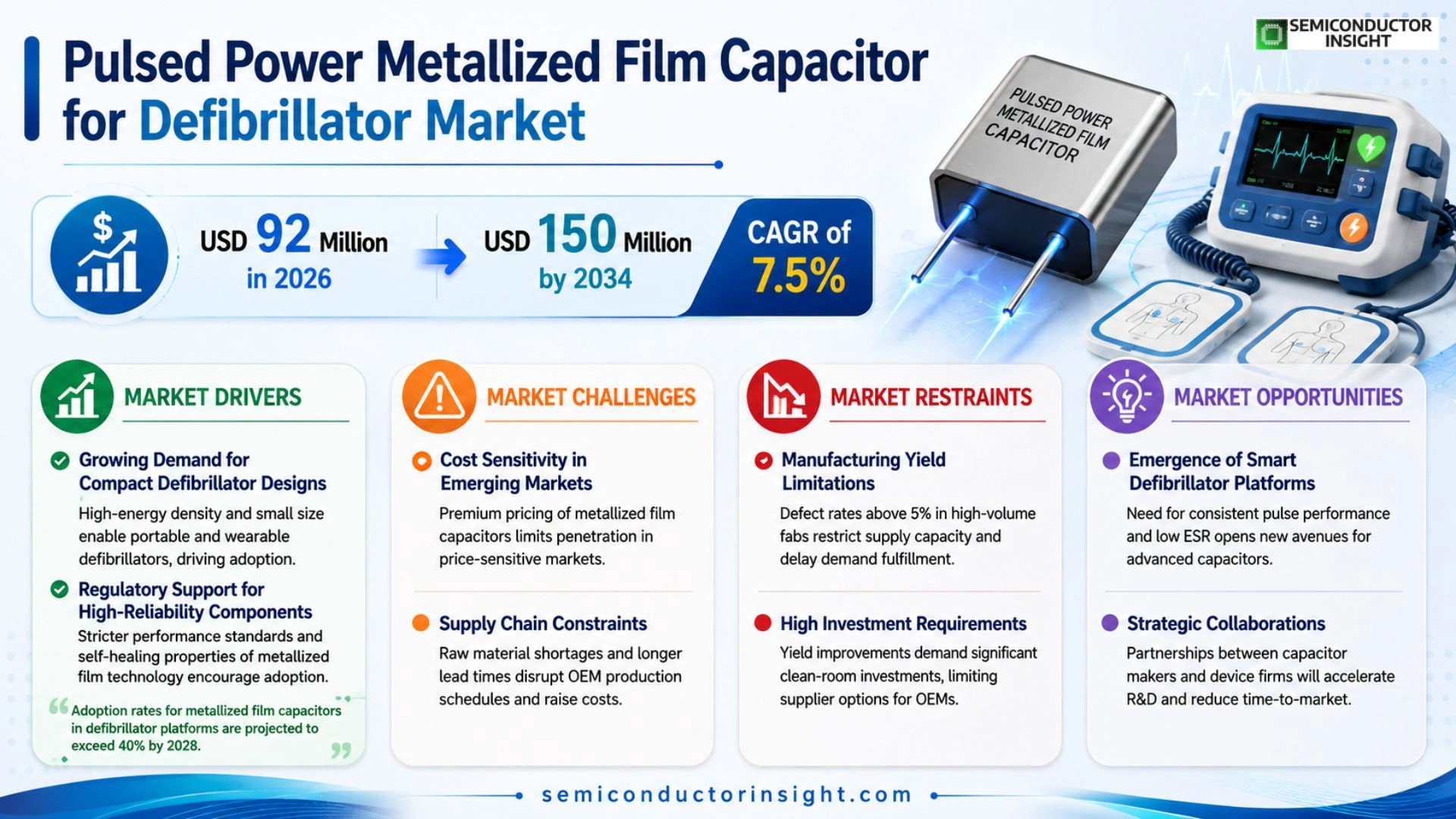
Pulsed power metallized film capacitor for defibrillator market size was valued at USD 85 million in 2025. The market is projected to grow from USD 92 million in 2026 to USD 150 million by 2034, exhibiting a CAGR of 7.5% during the forecast period.
Pulsed power metallized film capacitors are high‑energy storage components engineered to deliver rapid discharge pulses required by modern implantable and external defibrillators. Their thin‑film construction provides low ESR, high reliability, and a compact form factor, enabling precise control of shock waveforms while complying with stringent medical safety standards.
The market is experiencing robust growth because healthcare providers are increasingly adopting advanced cardiac emergency systems, and regulatory bodies are approving next‑generation defibrillators with improved energy efficiency. Furthermore, rising incidence of cardiovascular diseases worldwide drives demand for reliable life‑saving devices. Key players such as Medtronic plc, Philips Healthcare, GE Healthcare, and CardioTech Innovations are expanding their product portfolios through R&D investments and strategic collaborations to capture emerging opportunities.
MARKET DRIVERS
Growing Demand for Compact Defibrillator Designs
The shift toward portable and wearable defibrillators has accelerated the need for high‑energy density components. Pulsed power metallized film capacitors deliver rapid discharge while occupying minimal board space, making them ideal for next‑generation emergency medical devices.
Regulatory Support for High‑Reliability Components
International health agencies have tightened performance standards for life‑saving equipment. The superior self‑healing characteristics of metallized film technology align with these stricter guidelines, encouraging manufacturers to adopt the solution.
➤ “Adoption rates for metallized film capacitors in defibrillator platforms are projected to exceed 40% by 2028, driven by the dual imperatives of size reduction and reliability.”
In addition, the expanding geriatric population in developed economies is creating a larger installed base of automated external defibrillators, further fueling the market for these capacitors.
MARKET CHALLENGES
Cost Sensitivity in Emerging Markets
While the technical advantages are clear, price‑competitiveness remains a barrier. Emerging economies prioritize low‑cost medical solutions, and the premium associated with advanced metallized film capacitors can limit market penetration.
Other Challenges
Supply Chain Constraints
Raw material availability, especially high‑purity polypropylene films, experiences periodic shortages, leading to lead‑time extensions that affect OEM production schedules.
Furthermore, the need for specialized testing equipment to validate pulse performance adds to the overall expense for device manufacturers.
MARKET RESTRAINTS
Manufacturing Yield Limitations
The intricate metallization process can result in defect rates that exceed 5% in high‑volume fabs, restricting the ability to meet sudden spikes in demand.
Yield improvements require significant capital investment in clean‑room infrastructure, which many smaller suppliers are unable to justify.
Consequently, OEMs often face limited supplier options, increasing reliance on a few large manufacturers and reducing negotiating power.
MARKET OPPORTUNITIES
Emergence of Smart Defibrillator Platforms
Integrating wireless telemetry and AI‑driven diagnostics requires capacitors with consistent pulse characteristics and low ESR. Pulsed power metallized film capacitors are uniquely positioned to meet these specifications, opening avenues for new product development.
Additionally, partnerships between capacitor manufacturers and medical device firms are expected to accelerate R&D cycles, shortening time‑to‑market for innovative defibrillator solutions.
Pulsed power metallized film capacitor for defibrillator Market Trends
Accelerating Adoption of High‑Energy Capacitors
The global market for pulsed power metallized film capacitor for defibrillator devices is witnessing a pronounced shift toward next‑generation cardiac emergency systems. Manufacturers are prioritizing thin‑film designs that deliver rapid, high‑energy discharge pulses while maintaining low equivalent series resistance (ESR). This technical advantage translates into more compact defibrillator modules, facilitating integration into both implantable and external platforms. Healthcare providers, responding to rising incidences of cardiovascular emergencies, are increasingly specifying devices that incorporate these capacitors for their reliability and precise shock‑wave control.
Other Trends
Regulatory Advances Supporting Device Integration
Regulatory agencies worldwide have updated safety and performance standards to accommodate the unique characteristics of pulsed power metallized film capacitors. Recent guidelines emphasize stringent testing for energy delivery consistency and electromagnetic compatibility, encouraging manufacturers to align product development with approved protocols. The clearer regulatory pathway reduces time‑to‑market for innovative defibrillator models, prompting firms such as Medtronic plc and Philips Healthcare to expand R&D pipelines focused on capacitor‑centric architectures.
Strategic Partnerships and Portfolio Expansion
Key industry players are forming strategic collaborations to strengthen their position in the market. Joint ventures between capacitor specialists and major medical device companies enable shared expertise in material science, reliability engineering, and clinical validation. These alliances accelerate the rollout of capacitor‑enhanced defibrillators that meet heightened energy‑efficiency targets while adhering to stringent medical safety criteria. As a result, the competitive landscape is shifting toward integrated solutions that combine advanced capacitor technology with sophisticated diagnostic software.
COMPETITIVE LANDSCAPE
Key Industry Players
Pulsed Power Metallized Film Capacitor for Defibrillator Market Overview
Pulsed power metallized film capacitor market for defibrillators reached USD 85 million in 2025 and is projected to climb to USD 150 million by 2034, growing at a 7.5 % CAGR. Leading OEMs such as Medtronic plc, Philips Healthcare, GE Healthcare and Abbott Laboratories dominate the landscape by integrating high‑energy film capacitors directly into next‑generation implantable and external defibrillator platforms. These firms leverage extensive R&D pipelines and strategic collaborations with capacitor specialists to secure supply chains and meet stringent IEC‑60601‑1 medical safety standards. Their market share is reinforced by large service‑base contracts with hospitals and national health systems, enabling economies of scale that reduce unit costs while preserving reliability. Regulatory approvals in the U.S., EU and Asia have accelerated product introductions, and the ability of these incumbents to file 510(k) submissions swiftly gives them a competitive edge. Their portfolio diversification across both implantable cardioverter‑defibrillators (ICDs) and automated external defibrillators (AEDs) further entrenches their position, allowing cross‑selling of capacitor modules across device families.
Beyond the tier‑1 manufacturers, a cohort of specialist capacitor makers and medical device innovators contributes significant differentiation. Companies such as CardioTech Innovations, Vishay Intertechnology, KEMET Corporation, TDK Corporation, Murata Manufacturing, Boston Scientific, Siemens Healthineers, Johnson & Johnson’s DePuy Synthes unit, and emerging Asian firms like Yageo (which acquired KEMET) focus on ultra‑low ESR film designs, custom form‑factors, and accelerated aging testing for compliance with ISO 13485. These players often partner with the larger OEMs through supply agreements or joint development programs to co‑engineer capacitor modules that meet device‑specific pulse‑width and voltage‑rating requirements. Niche firms such as CardioTech Innovations have carved a reputation for rapid‑prototype capabilities, enabling defibrillator startups to accelerate time‑to‑market. Meanwhile, established component giants like Vishay and Murata leverage their global manufacturing footprints to provide cost‑effective, high‑volume production, supporting the scale‑up of next‑generation defibrillator lines.
List of Key Pulsed Power Metallized Film Capacitor for Defibrillator Companies Profiled
- Medtronic plc
- Philips Healthcare
- GE Healthcare
- Abbott Laboratories
- Siemens Healthineers
- Boston Scientific
- Johnson & Johnson
- Vishay Intertechnology
- TDK Corporation
- Murata Manufacturing
- CardioTech Innovations
- KEMET Corporation
Segment Analysis:
| Segment Category | Sub-Segments | Key Insights |
| By Type |
|
Standard Metallized Film Capacitors
|
| By Application |
|
Implantable Defibrillators
|
| By End User |
|
Hospitals & Clinical Centers
|
| By Reliability Requirement |
|
High Reliability
|
| By Regulatory Landscape |
|
FDA‑Approved
|
Regional Analysis: Pulsed power metallized film capacitor for defibrillator Market
The FDA’s detailed guidance on medical‑device power systems creates a clear compliance pathway. Manufacturers leverage pre‑market approval routes that emphasize reliability testing, which aligns well with the high‑performance requirements of pulsed‑power metallized film capacitors for defibrillators.
Companies such as Texas Capacitors, AVX, and KEMET lead the region, investing heavily in thin‑film technologies that improve energy density while maintaining low ESR, critical for rapid discharge in emergency cardiac care.
A well‑integrated supply chain, from raw polymer films to precision winding facilities, ensures consistent component availability. Regional logistics hubs reduce lead times, supporting the fast‑track deployment of new defibrillator models.
Collaborative research programs between universities and industry accelerate breakthroughs in dielectric materials, enabling capacitors that deliver higher pulse power with reduced footprint, a trend that drives market growth.
Europe
Europe exhibits a steady trajectory in Pulsed power metallized film capacitor for defibrillator Market, propelled by strong public‑health initiatives and harmonized medical device directives across EU member states. Leading players such as EPCOS and Vishay leverage the region’s advanced manufacturing base to produce high‑precision components that meet stringent safety standards. Cross‑border collaborations between research institutes in Germany, France, and the Netherlands foster material innovations that improve pulse reliability while lowering cost. Although regulatory alignment streamlines approvals, reimbursement pressures require manufacturers to demonstrate clear clinical benefit, encouraging a focus on performance‑driven design. The market benefits from a growing network of specialized distributors that ensure rapid component delivery to OEMs of emergency cardiac equipment.
Asia‑Pacific
The Asia‑Pacific region is emerging as a dynamic contributor to Pulsed power metallized film capacitor for defibrillator Market, driven by expanding healthcare access and rising investment in medical‑device manufacturing hubs in China, Japan, and South Korea. Local firms are adopting thin‑film capacitor technologies to meet the demand for compact, high‑energy solutions in portable defibrillators destined for remote and rural areas. Government incentives supporting advanced electronics and a surge in domestic R&D activities accelerate product innovation. Market participants also benefit from lower production costs, which help offset the higher price sensitivity typical of emerging economies. Partnerships with multinational OEMs enable technology transfer, positioning the region as a future source of both volume and cutting‑edge capability.
South America
South America shows a cautious but promising outlook for Pulsed power metallized film capacitor for defibrillator Market. Brazil and Argentina lead regional adoption, driven by national programs aimed at improving emergency cardiac response in urban centers. Manufacturers are focusing on cost‑effective designs that balance reliability with affordability, reflecting the economic constraints of many healthcare systems. Limited local component production means the region relies on imports, prompting strategic agreements with North American and European suppliers to secure steady supply. Continued training of medical personnel and growing awareness of sudden cardiac arrest outcomes are expected to stimulate demand for advanced defibrillator units equipped with high‑performance pulsed‑power capacitors.
Middle East & Africa
In the Middle East & Africa, Pulsed power metallized film capacitor for defibrillator Market is propelled by rising investments in modern hospital infrastructure and government‑led initiatives to upgrade emergency medical services. The United Arab Emirates and South Africa serve as regional hubs, attracting global component manufacturers seeking to establish localized assembly lines. Emphasis on rugged, temperature‑stable capacitor designs addresses the varied climatic conditions across the region, ensuring consistent device performance. While market penetration remains modest compared with mature regions, expanding private‑sector healthcare facilities and increasing awareness of cardiac health are expected to generate steady growth, positioning the area as a long‑term opportunity for specialized capacitor suppliers.
Report Scope
This market research report provides a comprehensive analysis of the Pulsed power metallized film capacitor for defibrillator Market , covering the forecast period 2026–2034. It offers detailed insights into market dynamics, technological advancements, competitive landscape, and key trends shaping the industry.
Key focus areas of the report include:
- Market Overview: The report begins with an overview outlining its current market scenario, key growth indicators, and industry transformation drivers. It discusses macroeconomic factors, demand–supply balance, regulatory landscape, and the strategic role of semiconductors in powering advancements across industries such as automotive, telecommunications, consumer electronics, and industrial automation.
- Market Size & Forecast: Historical data and future projections for revenue, unit shipments, and market value across major regions and segments.
- Segmentation Analysis: Detailed breakdown by product type, technology, application, and end-user industry to identify high-growth segments and investment opportunities.
- Regional Insights: Insights into market performance across North America, Europe, Asia-Pacific, Latin America, and the Middle East & Africa, including country-level analysis where relevant.
- Competitive Landscape: Profiles of leading market participants, including their product offerings, R&D focus, manufacturing capacity, pricing strategies, and recent developments such as mergers, acquisitions, and partnerships.
- Technology Trends & Innovation: Assessment of emerging technologies, integration of AI/IoT, semiconductor design trends, fabrication techniques, and evolving industry standards.
- Market Drivers & Restraints: Evaluation of factors driving market growth along with challenges, supply chain constraints, regulatory issues, and market-entry barriers.
- Stakeholder Insights: Insights for component suppliers, OEMs, system integrators, investors, and policymakers regarding the evolving ecosystem and strategic opportunities.
Primary and secondary research methods are employed, including interviews with industry experts, data from verified sources, and real-time market intelligence to ensure the accuracy and reliability of the insights presented.
FREQUENTLY ASKED QUESTIONS:
What is the current market size of Pulsed power metallized film capacitor for defibrillator Market?
-> Pulsed power metallized film capacitor for defibrillator market size is projected to grow from USD 92 million in 2026 to USD 150 million by 2034, reflecting a CAGR of 7.5%
Which key companies operate in Pulsed power metallized film capacitor for defibrillator Market?
-> Key players include Medtronic plc, Philips Healthcare, GE Healthcare, and CardioTech Innovations, among others.
What are the key growth drivers?
-> Key growth drivers include increasing adoption of advanced cardiac emergency systems, regulatory approvals of next‑generation defibrillators, and rising incidence of cardiovascular diseases worldwide.
Which region dominates the market?
-> The reference does not specify a single dominant region; market activity is observed globally with significant participation in North America, Europe and Asia‑Pacific.
What are the emerging trends?
-> Emerging trends include development of next‑generation defibrillators with improved energy efficiency and ongoing R&D collaborations among leading manufacturers.
Get Sample Report PDF for Exclusive Insights
Report Sample Includes
- Table of Contents
- List of Tables & Figures
- Charts, Research Methodology, and more...