Market Insights
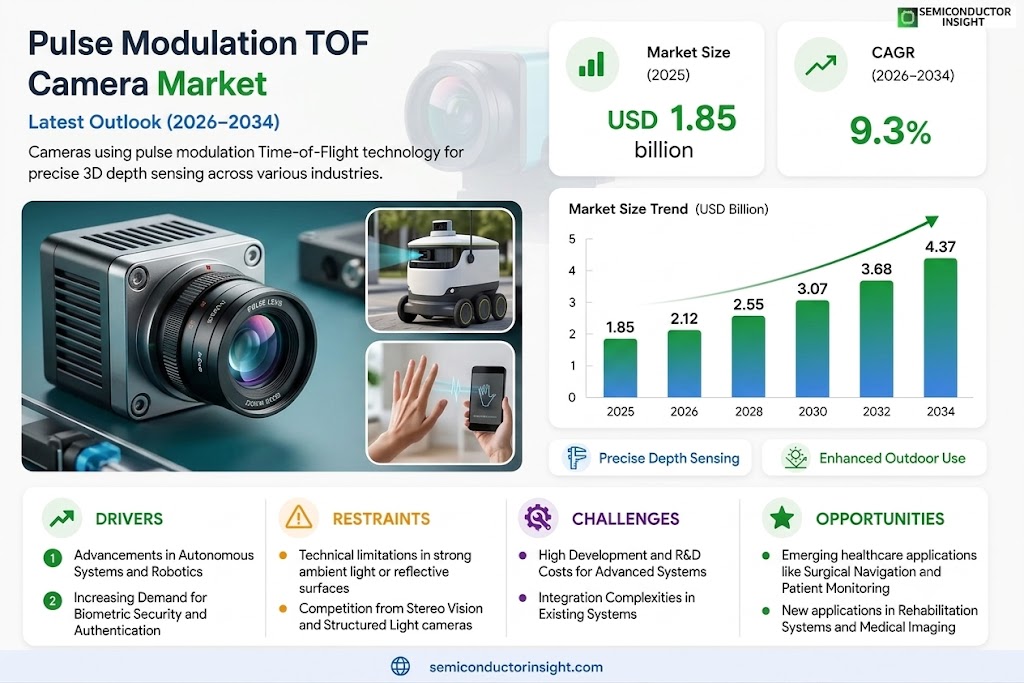
Global Pulse Modulation TOF Camera Market size was valued at USD 1.85 billion in 2025. The market is projected to grow from USD 2.12 billion in 2026 to USD 4.37 billion by 2034, exhibiting a CAGR of 9.3% during the forecast period.
A Pulse Modulation Time-of-Flight (TOF) camera is a depth-sensing device that measures distance by emitting infrared light pulses and calculating the time taken for reflections to return. This technology enables real-time 3D imaging with applications ranging from autonomous vehicles to industrial automation. Unlike traditional cameras, TOF systems excel in low-light conditions and offer high-speed data capture, making them indispensable for modern machine vision solutions.
The market growth is driven by increasing adoption in automotive safety systems, where TOF cameras enhance collision avoidance capabilities. Consumer electronics manufacturers are also integrating this technology for advanced facial recognition and augmented reality features. Industrial sectors leverage TOF cameras for precision measurement and robotic guidance, particularly in logistics and manufacturing environments where accuracy and speed are critical.
MARKET DRIVERS
Growing Demand for 3D Imaging Solutions
Pulse Modulation TOF Camera Market is experiencing significant growth due to rising demand for high-precision 3D imaging across multiple industries. These cameras offer superior depth-sensing capabilities compared to traditional technologies, making them ideal for applications in autonomous vehicles, robotics, and industrial automation.
Advancements in Time-of-Flight Technology
Recent breakthroughs in Pulse Modulation TOF technology have improved accuracy while reducing power consumption and system costs. These innovations are driving adoption in consumer electronics, particularly in smartphones and augmented reality devices.
Government initiatives supporting Industry 4.0 and smart city development are further accelerating market expansion, as Pulse Modulation TOF cameras play a crucial role in these implementations.
MARKET CHALLENGES
Technical Limitations in Extreme Conditions
Pulse Modulation TOF cameras face performance challenges in environments with strong ambient light or highly reflective surfaces. These limitations currently restrict deployment in certain outdoor applications and industrial settings.
Other Challenges
High Development Costs
Initial R&D and production costs for advanced Pulse Modulation TOF systems remain substantial, creating barriers for smaller manufacturers entering the market.
Integration Complexities
Embedding Pulse Modulation TOF technology into existing systems often requires specialized expertise, slowing adoption rates in some sectors.
MARKET RESTRAINTS
Competition from Alternative Technologies
Stereo vision cameras and structured light systems continue to challenge Pulse Modulation TOF cameras in certain applications due to their lower cost and established market presence. This competition is particularly strong in consumer electronics and some industrial segments.
MARKET OPPORTUNITIES
Emerging Applications in Healthcare
Pulse Modulation TOF Camera Market is finding new growth avenues in medical applications, including surgical navigation, patient monitoring, and rehabilitation systems. The technology’s precise depth mapping capabilities are proving valuable in these healthcare settings.
Expansion in Smart Home Devices
Integration of Pulse Modulation TOF technology into smart home security systems and IoT devices represents a significant opportunity, with major tech companies investing heavily in this application space.
Pulse Modulation TOF Camera Market Trends
Expanding Applications in Consumer Electronics
Pulse Modulation TOF Camera Market is witnessing significant growth driven by increasing adoption in consumer electronics. These cameras are now integral to smartphones for advanced facial recognition, augmented reality applications, and gesture control systems. Major manufacturers are integrating TOF technology to enhance user experience through improved depth sensing capabilities.
Other Trends
Industrial Automation Adoption
Industrial sectors are rapidly adopting Pulse Modulation TOF cameras for automation processes. Their high accuracy in distance measurement makes them ideal for logistics automation, warehouse management, and quality control systems. The technology enables real-time 3D imaging for package dimensioning and robotic navigation in manufacturing environments.
Technological Advancements in Autonomous Systems
Pulse Modulation TOF technology is becoming crucial for autonomous driving systems, offering reliable object detection and distance measurement in varying light conditions. The automotive industry’s push towards advanced driver-assistance systems (ADAS) is creating new opportunities for TOF camera implementations in vehicle safety and navigation applications.
Miniaturization and Cost Reduction
Manufacturers are focusing on developing compact and cost-effective Pulse Modulation TOF camera solutions. This trend is enabling broader market penetration, particularly in mid-range consumer devices and industrial equipment where space and budget constraints exist.
Regional Market Developments
Asia-Pacific is emerging as a key growth region for Pulse Modulation TOF cameras, driven by strong demand from consumer electronics manufacturers and expanding industrial automation sectors. Meanwhile, North America continues to lead in automotive applications, supported by technological innovation in autonomous vehicle development.
COMPETITIVE LANDSCAPE
Key Industry Players
Strategic Positioning in the Rapidly Evolving TOF Camera Market
Pulse Modulation TOF Camera Market is dominated by technology leaders such as Sony and Microsoft, who control significant market share through advanced R&D capabilities and integration with consumer electronics ecosystems. IFM Electronic and Basler AG maintain strong positions in industrial applications, leveraging precision engineering for automation and robotics use cases. The market exhibits moderate consolidation, with top 5 players accounting for approximately 40% of global revenue in 2025.
Emerging specialists like Vzense Technology and pmdtechnologies ag are gaining traction through innovative chip designs optimized for automotive ADAS applications. Chinese manufacturers including Becom Systems are expanding rapidly in the consumer electronics segment through competitive pricing strategies. Niche players such as Osela and LUCID Vision Labs are focusing on high-performance solutions for specialized industrial applications.
List of Key Pulse Modulation TOF Camera Companies Profiled
- IFM Electronic
- Becom Systems
- Basler AG
- Vzense Technology
- LUCID Vision Labs
- Sony Semiconductor Solutions
- Osela
- Analog Devices (ADI)
- Microsoft
- Apple
- IDS Imaging Development Systems
- pmdtechnologies ag
- Sick AG
- Texas Instruments
- STMicroelectronics
Segment Analysis:
| Segment Category | Sub-Segments | Key Insights |
| By Type |
|
Integrated TOF Cameras are showing higher adoption rates due to their compact design and seamless integration capabilities with existing systems. The trend towards miniaturization in electronics is driving demand for integrated solutions. Standalone units maintain relevance in industrial settings where modular systems are preferred for flexible deployment and maintenance. |
| By Application |
|
Consumer Electronics represents the fastest growing application segment, driven by widespread adoption in smartphones and AR/VR devices. The technology’s ability to enable advanced features like facial recognition and gesture control makes it particularly valuable in this space. Industrial automation applications benefit from the cameras’ precision in object detection and measurement capabilities. |
| By End User |
|
Electronics OEMs are leading adopters as they incorporate TOF cameras into smartphones, tablets, and smart home devices. Automotive manufacturers are showing increasing interest for driver assistance systems, though adoption faces challenges due to stringent automotive certification requirements. Industrial equipment providers value the technology for machine vision applications in quality control and automation. |
| By Resolution |
|
Medium Resolution cameras currently dominate the market, offering the optimal balance between performance and cost. High resolution variants are gaining traction in precision-intensive applications like autonomous vehicles, though they face challenges with higher power consumption and processing requirements. Low resolution models remain relevant for basic proximity sensing applications. |
| By Detection Range |
|
Short Range TOF cameras are most prevalent, particularly in consumer electronics and robotics applications. The technology excels in these close-proximity scenarios due to its fast response times. Long range capabilities are seeing increased development for automotive and industrial applications, though they require more powerful illumination sources and advanced signal processing algorithms. |
Regional Analysis: Pulse Modulation TOF Camera Market
North America
U.S. automakers lead in incorporating Pulse Modulation TOF cameras for gesture control and cabin monitoring. This technology enhances safety features in premium electric vehicles, with major OEMs developing proprietary systems.
Advanced surgical robotics in North American hospitals utilize these cameras for precise 3D mapping. The technology supports minimally invasive procedures with FDA-cleared systems gaining traction across major healthcare networks.
Logistics and manufacturing sectors implement Pulse Modulation TOF cameras for quality control and robotic picking systems. Tech partnerships between camera manufacturers and warehouse automation providers are strengthening ecosystem development.
Leading universities and corporate labs collaborate on next-gen applications, from augmented reality to agricultural monitoring. Several DARPA-funded projects explore advanced Pulse Modulation TOF capabilities for defense applications.
Europe
European markets show strong adoption of Pulse Modulation TOF cameras in industrial automation and automotive safety systems. German automakers integrate this technology for pedestrian detection and automated parking features, complying with stringent EU safety regulations. The region’s precision manufacturing sector utilizes these cameras for quality inspection in high-value production lines. Medical device manufacturers leverage the technology for patient positioning systems and rehabilitation monitoring. European Union funding supports cross-border R&D collaborations focusing on improved energy efficiency and miniaturization of Pulse Modulation TOF components.
Asia-Pacific
Asia-Pacific demonstrates rapid growth in Pulse Modulation TOF camera adoption, driven by consumer electronics and smart city projects. Chinese manufacturers develop cost-competitive solutions for smartphone facial recognition and retail analytics. Japanese companies lead in industrial robotics integration, while South Korea focuses on augmented reality applications. Smart infrastructure projects across Singapore and India deploy these cameras for traffic management and security surveillance. The region benefits from strong semiconductor manufacturing capabilities supporting local camera production.
Middle East & Africa
The MEA region shows emerging demand for Pulse Modulation TOF cameras in security and oil/gas sector applications. Smart city initiatives in UAE and Saudi Arabia incorporate these cameras for crowd monitoring and access control systems. Oil refineries deploy the technology for equipment inspection in hazardous environments. South Africa’s mining industry tests Pulse Modulation TOF solutions for underground mapping and worker safety monitoring, though adoption remains in early stages compared to other regions.
South America
South American markets exhibit niche adoption of Pulse Modulation TOF technology, primarily in agricultural automation and border security. Brazilian agribusinesses test these cameras for crop health monitoring and yield estimation. Customs authorities in Chile and Argentina evaluate the technology for port security and cargo inspection systems. Limited local manufacturing creates dependencies on imports, though regional R&D initiatives are expanding to develop localized solutions.
Report Scope
This market research report provides a comprehensive analysis of the Pulse Modulation TOF Camera Market, covering the forecast period 2025–2034. It offers detailed insights into market dynamics, technological advancements, competitive landscape, and key trends shaping the industry.
Key focus areas of the report include:
- Market Overview: The report begins with an overview outlining its current market scenario, key growth indicators, and industry transformation drivers. It discusses macroeconomic factors, demand–supply balance, regulatory landscape, and the strategic role of TOF cameras in powering advancements across industries such as autonomous driving, industrial automation, consumer electronics, and robotics.
- Market Size & Forecast: Historical data and future projections for revenue, unit shipments, and market value across major regions and segments.
- Segmentation Analysis: Detailed breakdown by product type, technology, application, and end-user industry to identify high-growth segments and investment opportunities.
- Regional Insights: Insights into market performance across North America, Europe, Asia, South America, and Middle East & Africa, including country-level analysis where relevant.
- Competitive Landscape: Profiles of leading market participants, including their product offerings, R&D focus, manufacturing capacity, pricing strategies, and recent developments such as mergers, acquisitions, and partnerships.
- Technology Trends & Innovation: Assessment of emerging technologies, integration of AI/IoT, semiconductor design trends, fabrication techniques, and evolving industry standards.
- Market Drivers & Restraints: Evaluation of factors driving market growth along with challenges, supply chain constraints, regulatory issues, and market-entry barriers.
- Stakeholder Insights: Insights for component suppliers, OEMs, system integrators, investors, and policymakers regarding the evolving ecosystem and strategic opportunities.
Primary and secondary research methods are employed, including interviews with industry experts, data from verified sources, and real-time market intelligence to ensure the accuracy and reliability of the insights presented.
FREQUENTLY ASKED QUESTIONS:
What is the current market size of Pulse Modulation TOF Camera Market?
-> Pulse Modulation TOF Camera Market size was valued at USD 1.85 billion in 2025. The market is projected to grow from USD 2.12 billion in 2026 to USD 4.37 billion by 2034, exhibiting a CAGR of 9.3% during the forecast period.
Which key companies operate in Pulse Modulation TOF Camera Market?
-> Key players include Ifm, Becom Systems, Basler, Vzense Technology, LUCID Vision Labs, Sony, Osela, ADI, Microsoft, Apple, IDS Imaging Development Systems, pmdtechnologies ag, and Sick AG, among others.
What are the key applications of Pulse Modulation TOF cameras?
-> Key applications include autonomous driving, industrial automation, consumer electronics (face recognition, gesture control), robotics (obstacle avoidance, navigation), and logistics/security monitoring.
Which region dominates the Pulse Modulation TOF Camera Market?
-> Asia shows strong growth potential, with significant adoption in China, Japan, and South Korea. North America and Europe also hold substantial market shares.
What are the key advantages of Pulse Modulation TOF technology?
-> Key advantages include long-distance measurement capability, fast response time, small size, and cost-effectiveness compared to alternative depth sensing technologies.

Get Sample Report PDF for Exclusive Insights
Report Sample Includes
- Table of Contents
- List of Tables & Figures
- Charts, Research Methodology, and more...