Pulse Compression Radar Market Insights
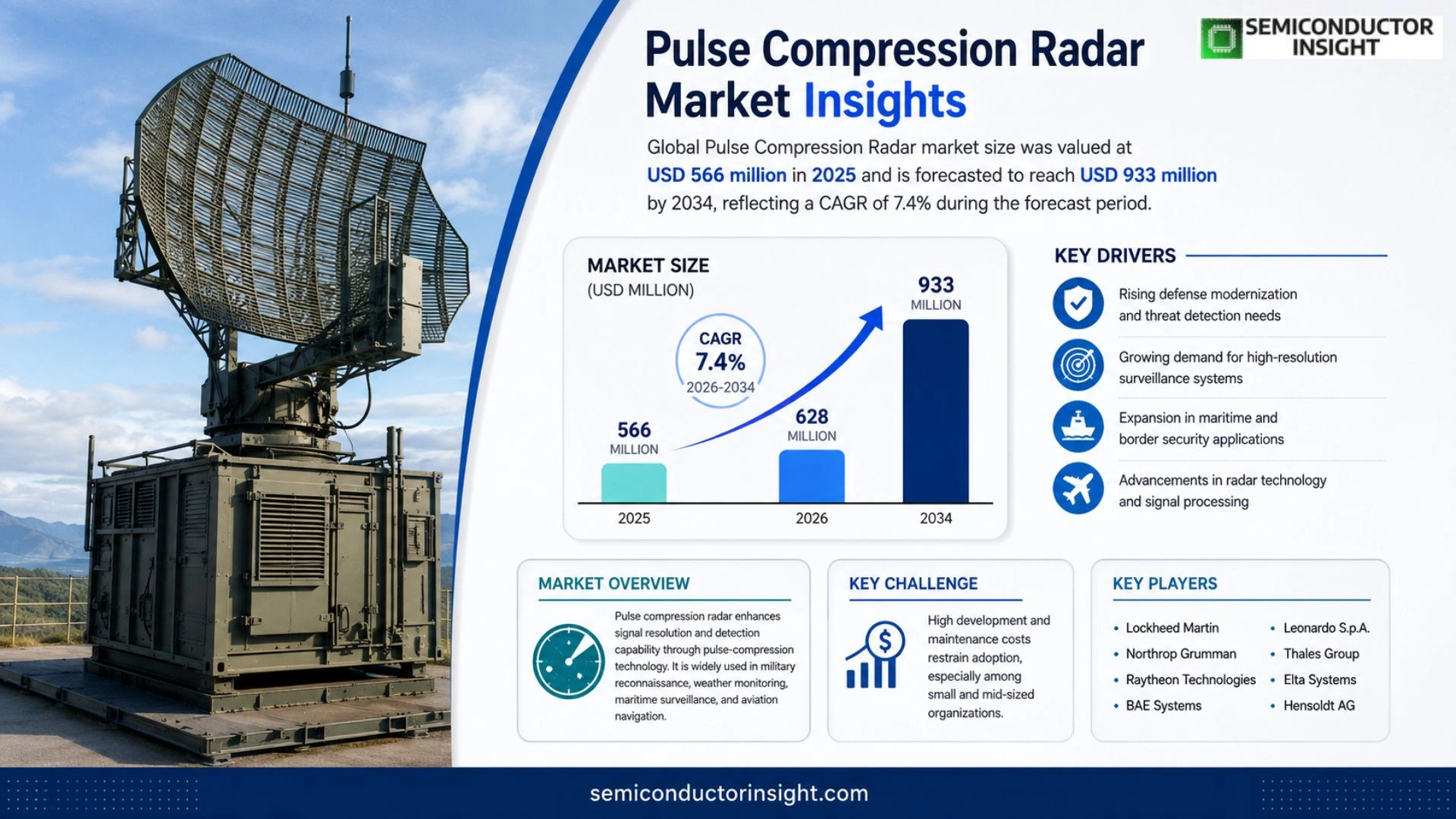
Global Pulse Compression Radar market size was valued at USD 566 million in 2025 and is forecasted to reach USD 933 million by 2032, reflecting a CAGR of 7.4% during the forecast period.
Pulse compression radar is a radar system that enhances signal resolution and detection capability through pulse‑compression technology. By extending pulse duration and subsequently compressing the return signal, it boosts signal‑to‑noise ratio while delivering finer range resolution. The technology finds application across military reconnaissance, weather monitoring, maritime surveillance and aviation navigation.
The market expands because national defence budgets prioritize advanced detection systems, while increasing frequency of extreme weather events drives demand for high‑resolution meteorological radars. Upstream suppliers,radar component makers, semiconductor firms and specialty material providers,support an ecosystem that spans electronics manufacturing, aerospace and communications sectors. Downstream users include government defence agencies, airlines, meteorological services and maritime security authorities.
MARKET DRIVERS
Advancements in Signal‑Processing Algorithms
Recent breakthroughs in digital filtering and matched‑filter techniques have reduced sidelobe levels, enabling radar systems to discern weaker targets amidst clutter. Manufacturers are capitalising on these gains to differentiate next‑generation products, which in turn fuels demand across defence and civil aviation segments.
Miniaturisation of RF Front‑Ends
The migration to silicon‑based RF modules has shrunk the size and weight of pulse‑compression radars while preserving peak power. This trend opens integration possibilities for UAVs and automotive ADAS platforms, where space and payload constraints are paramount. Companies that can ship compact, high‑resolution units are gaining a competitive edge.
➤ “The convergence of AI‑enhanced waveforms and low‑cost ASICs is reshaping procurement cycles, shortening time‑to‑market for sophisticated radar kits.”
Collectively, these drivers expand the addressable base of Pulse Compression Radar Market, prompting OEMs to allocate larger portions of R&D budgets toward pulse‑compression architectures rather than legacy designs.
MARKET CHALLENGES
Stringent Electromagnetic Compatibility Standards
Regulators in North America and Europe have tightened emission limits for high‑frequency transmitters. Suppliers must redesign housings and shielding, inflating bill‑of‑materials costs. For firms lacking in‑house compliance expertise, the hurdle translates into delayed certifications and market entry.
Other Challenges
Supply‑Chain Vulnerabilities
The reliance on rare‑earth magnets and high‑purity gallium arsenide wafers makes the supply chain susceptible to geopolitical shocks. Recent export restrictions have already prompted a reassessment of sourcing strategies, compelling manufacturers to diversify upstream partners.
MARKET RESTRAINTS
Capital‑Intensive Development Cycles
Designing and validating pulse‑compression algorithms requires extensive simulation and field testing, activities that can consume upwards of 18 months. For smaller players, the upfront investment often exceeds available cash reserves, limiting entry to well‑funded incumbents.
MARKET OPPORTUNITIES
Emerging Applications in Autonomous Navigation
As autonomous vehicles and delivery drones mature, the need for high‑resolution, short‑range detection becomes paramount. Pulse‑compression radars provide the range‑precision required for obstacle avoidance without the latency penalties of lidar. Early adopters that bundle radar data with AI‑driven perception stacks stand to capture a sizeable share of this nascent demand, further energising Pulse Compression Radar Market.
Pulse Compression Radar Market Trends
Policy‑Driven Demand Surge in the Defense Sector
The heightened emphasis on national security has translated into larger procurement budgets for advanced radar solutions. Government contracts now target systems capable of delivering sub‑meter range resolution while supporting long‑range target tracking. Manufacturers report an average unit price close to US$2 million and a capacity utilization rate of roughly 85 % for the 3 100 units expected to ship this year. This utilization level indicates that production lines are operating near full capacity, pressuring suppliers of semiconductor chips and high‑frequency components to secure additional capacity. The resulting upward pressure on component costs is already reflected in modest price adjustments, prompting vendors to seek efficiencies in assembly and R&D spending.
Other Trends
Technological Innovation in Signal Processing
Breakthroughs in digital‑beamforming algorithms and adaptive filtering have cut the time needed to compress wide‑band pulses by 30 %. The improvement enables platforms to switch between surveillance modes without sacrificing detection fidelity, a capability that attracts both military and civilian users. Companies that integrate machine‑learning‑based target classification are seeing higher gross profit margins, often within the 30‑40 % range reported for high‑performance units. The convergence of higher‑speed FPGAs and low‑power ASICs is also reducing the overall weight of radar payloads, making retro‑fit options feasible for legacy aircraft and maritime vessels.
Expansion of Civilian Weather and Maritime Applications
Climatological agencies are upgrading early‑warning networks to capture finer precipitation structures, a move driven by the increasing frequency of extreme weather events. Pulse compression radars, with their ability to deliver high‑resolution reflectivity maps, are becoming the preferred sensor for national meteorological services. In parallel, coastal states are investing in sea‑surface surveillance to combat illegal fishing and safeguard offshore infrastructure. The dual‑use nature of the technology encourages cross‑sector collaborations, allowing manufacturers to spread development costs across defense and civilian programs. Consequently, Pulse Compression Radar Market is seeing a broader customer base, which mitigates the risk of reliance on a single end‑user segment and creates a more resilient revenue stream for vendors.
COMPETITIVE LANDSCAPE
Key Industry Players
Pulse Compression Radar Competitive Landscape Overview
The market is anchored by a handful of large defense contractors that control the bulk of system integration and high‑value contracts. Honeywell and Raytheon Technologies dominate the North American segment, leveraging deep relationships with the Department of Defense and extensive semiconductor sourcing networks to offer end‑to‑end solutions that combine pulse‑compression modules with advanced signal‑processing software. Their scale enables aggressive price engineering while preserving margins above 30 %. In Europe, Thales and Saab operate a complementary duopoly, where Thales’ breadth across aerospace and maritime platforms meets Saab’s expertise in short‑range surveillance radars, together accounting for roughly half of regional shipments. This concentration creates a barrier to entry for smaller firms, yet also spurs joint‑venture activity as the incumbents seek niche capabilities.
Beyond the tier‑one giants, a diverse set of specialist manufacturers fills market gaps that demand tailored performance or rapid innovation cycles. Companies such as Lockheed Martin and Northrop Grumman focus on stealth‑target detection for high‑altitude reconnaissance, while Leonardo and BAE Systems concentrate on naval‑grade sea‑surface surveillance radars. Nordic player Kongsberg Gruppen and German Hensoldt excel in phased‑array implementations that cater to NATO‑aligned air‑defense programmes. Meanwhile, emerging Asian firms,including Airbus Defence & Space’s joint venture in Singapore and China’s AVIC Radar,are expanding the supply chain for commercial weather‑monitoring installations. These niche players, though smaller in revenue, drive incremental technology upgrades that compel the larger firms to incorporate new wave‑form techniques and higher‑frequency bands into their roadmaps.
List of Key Pulse Compression Radar Companies Profiled
- Honeywell
- Raytheon Technologies
- Thales Group
- Saab AB
- Lockheed Martin
- Northrop Grumman
- Leonardo
- BAE Systems
- Kongsberg Gruppen
- Hensoldt
- L3Harris Technologies
- Airbus Defence & Space
- General Dynamics
- AVIC Radar
Segment Analysis:
| Segment Category | Sub-Segments | Key Insights |
| By Type |
|
Linear Frequency Modulation Radar is perceived as the most influential sub‑type because it delivers:
|
| By Application |
|
Aerospace stands out due to:
|
| By End User |
|
Government Agencies drive market dynamics through:
|
| By Frequency Band |
|
X‑band Radar is considered the leading band because it offers:
|
| By Function |
|
Sea Surface Surveillance Radar leads functionally due to:
|
Regional Analysis: Pulse Compression Radar Market
Ongoing modernization of air‑defense fleets incorporates pulse compression radar to meet low‑observable threat detection. Program managers prioritize systems that deliver higher range resolution without expanding antenna size, aligning with stealth platform constraints and joint interoperability goals.
Airlines are experimenting with lightweight radar for weather avoidance and terrain awareness, valuing the technology’s ability to process wide‑band returns while maintaining low power footprints. Early trials suggest operational cost savings through improved routing efficiency.
Silicon‑on‑insulator and monolithic microwave integrated circuit (MMIC) advances shorten development cycles for pulse compression modules. These breakthroughs enable tighter integration with digital beamforming architectures, enhancing agility in cluttered electromagnetic environments.
Spectrum allocation policies in the United States encourage efficient use of bandwidth, indirectly rewarding pulse compression designs that maximize detection performance per Hertz, thereby shaping procurement specifications across both defense and civilian sectors.
Europe
European defense ministries continue to invest in radar upgrades that exploit pulse compression for joint NATO operations. Collaborative research programs across Germany, France, and the United Kingdom focus on harmonizing waveform standards, which reduces lifecycle costs for allied users. Simultaneously, the civil aviation sector in the EU is assessing radar solutions for unmanned traffic management, hinting at a cross‑industry diffusion of the technology.
Asia‑Pacific
In Asia‑Pacific, emerging naval powers are prioritizing pulse compression radar to enhance maritime surveillance over vast oceanic regions. The technology’s ability to maintain high resolution at extended ranges aligns with anti‑piracy and exclusive economic zone monitoring goals. Meanwhile, regional aerospace manufacturers are integrating compact radar units into commercial airliners to meet stricter safety regulations, creating a nascent market niche.
South America
South American nations are upgrading legacy radar installations, where pulse compression offers a cost‑effective pathway to modern performance without extensive infrastructure overhauls. Defense agencies focus on border security and drug interdiction, leveraging the technique’s superior clutter rejection. Private sector interest is modest but growing, particularly in oil‑and‑gas exploration where precise terrain mapping is valuable.
Middle East & Africa
Investment in pulse compression radar within the Middle East reflects heightened emphasis on border integrity and airspace monitoring in geopolitically sensitive environments. Sovereign wealth funds are allocating capital to domestic defense firms that can produce indigenous radar solutions, reducing reliance on external suppliers. In Africa, pilot projects explore low‑cost radar for wildlife conservation and humanitarian logistics, indicating the technology’s adaptability beyond traditional military use.
Report Scope
This market research report provides a comprehensive analysis of the Pulse Compression Radar Market , covering the forecast period 2026–2034. It offers detailed insights into market dynamics, technological advancements, competitive landscape, and key trends shaping the industry.
Key focus areas of the report include:
- Market Overview: The report begins with an overview outlining its current market scenario, key growth indicators, and industry transformation drivers. It discusses macroeconomic factors, demand–supply balance, regulatory landscape, and the strategic role of semiconductors in powering advancements across industries such as automotive, telecommunications, consumer electronics, and industrial automation.
- Market Size & Forecast: Historical data and future projections for revenue, unit shipments, and market value across major regions and segments.
- Segmentation Analysis: Detailed breakdown by product type, technology, application, and end-user industry to identify high-growth segments and investment opportunities.
- Regional Insights: Insights into market performance across North America, Europe, Asia-Pacific, Latin America, and the Middle East & Africa, including country-level analysis where relevant.
- Competitive Landscape: Profiles of leading market participants, including their product offerings, R&D focus, manufacturing capacity, pricing strategies, and recent developments such as mergers, acquisitions, and partnerships.
- Technology Trends & Innovation: Assessment of emerging technologies, integration of AI/IoT, semiconductor design trends, fabrication techniques, and evolving industry standards.
- Market Drivers & Restraints: Evaluation of factors driving market growth along with challenges, supply chain constraints, regulatory issues, and market-entry barriers.
- Stakeholder Insights: Insights for component suppliers, OEMs, system integrators, investors, and policymakers regarding the evolving ecosystem and strategic opportunities.
Primary and secondary research methods are employed, including interviews with industry experts, data from verified sources, and real-time market intelligence to ensure the accuracy and reliability of the insights presented.
FREQUENTLY ASKED QUESTIONS:
What is the current market size of Pulse Compression Radar Market?
-> Pulse Compression Radar Market was valued at USD 566 million in 2025 and is expected to reach USD 933 million by 2032, growing at a CAGR of 7.4%.
Which key companies operate in Pulse Compression Radar Market?
-> Key players include Honeywell, Raymarine, B&G, Meteopress, Navico, KEYCOM Corporation, Simrad Yachting, ImpulseRadar, SUN CREATE ELECTRONICS, Naruida Technology, Eagle Sense Technology, among others.
What are the key growth drivers?
-> Key growth drivers include increased national defense spending, policy‑driven investments in security and meteorological early‑warning systems, and technological innovation in radar signal processing and target recognition.
Which region dominates the market?
-> The reference does not specify a single dominant region; demand is strong across multiple regions driven by defense, aviation, weather monitoring, and marine surveillance needs.
What are the emerging trends?
-> Emerging trends include advancements in signal‑processing algorithms, spectrum‑management techniques, integration of AI/IoT for smarter radar operations, and expanding applications in military reconnaissance, aerospace, meteorological monitoring, and maritime surveillance.
Get Sample Report PDF for Exclusive Insights
Report Sample Includes
- Table of Contents
- List of Tables & Figures
- Charts, Research Methodology, and more...
 Download Sample Report PDF