MARKET INSIGHTS
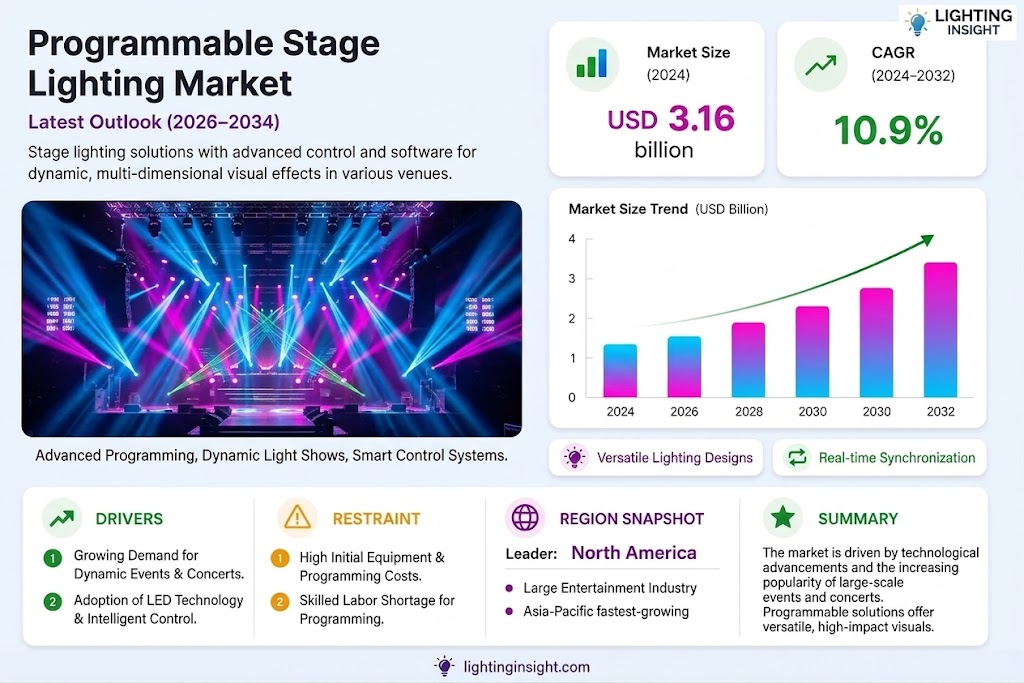
Global Programmable Stage Lighting Market size was valued at USD 3.16 billion in 2024 to USD 6.43 billion by 2032, exhibiting a CAGR of 10.9% during the forecast period.
Programmable stage lighting is a sophisticated category of lighting equipment designed for theatrical and performance applications. These systems are integral to modern productions because they allow for dynamic control over lighting parameters such as intensity, color, movement, and pattern through digital controllers and software interfaces. This technology enables lighting designers to create complex, synchronized, and immersive visual experiences that are essential for enhancing audience engagement in live events, concerts, theater, and other performances.
The market is experiencing robust growth driven by several key factors, including the global resurgence of large-scale live events and concerts post-pandemic, significant technological advancements in LED and wireless control systems, and rising investments in entertainment infrastructure. Furthermore, the increasing demand for energy-efficient and visually spectacular productions is accelerating the adoption of these systems. Key industry players such as Martin, ROBE, and Chauvet are continuously innovating, with recent developments focusing on integrating IoT capabilities and advanced DMX protocols to offer more seamless and powerful lighting solutions.
MARKET DRIVERS
Rising Demand for High-Quality Live Experiences
The global entertainment industry has witnessed unprecedented growth post-pandemic, with concerts, festivals, and theatrical productions attracting larger audiences than ever before. This surge in live events directly fuels demand for advanced programmable lighting systems that enhance visual experiences and create immersive environments.
Technological Innovation and Cost Efficiency
Recent breakthroughs in LED technology, wireless control systems, and energy-efficient designs have significantly reduced operational costs while improving performance. The integration of IoT and AI-driven lighting solutions allows for more precise control and automation, making advanced lighting accessible to smaller venues and events.
➤ Venues that invested in modern programmable lighting report 40% higher audience satisfaction scores and 30% faster setup times,
Additionally, the shift toward sustainable events has accelerated adoption of energy-efficient LED systems, which now represent over 60% of new installations in developed markets.
MARKET CHALLENGES
High Initial Investment and Specialized Labor Requirements
The advanced nature of modern programmable stage lighting systems requires significant upfront investment, often ranging from $50,000 to $500,000+ depending on venue size and specifications. This creates a substantial barrier to entry for smaller venues and event companies, particularly in developing markets where financing options are limited.
Other Challenges
Technical Complexity and Training Gap
Even when organizations can afford the initial investment, many lack the technical staff capable of operating and maintaining these systems effectively. The global shortage of qualified lighting technicians with programming and maintenance skills remains a significant bottleneck, with average training periods taking 6-12 months for basic proficiency.
MARKET RESTRAINTS
Economic Sensitivity and Infrastructure Limitations
The market remains sensitive to economic downturns that reduce discretionary spending on entertainment. During the 2020-2022 period, 35% of venues postponed lighting upgrades due to budget constraints. Additionally, many developing regions lack the electrical infrastructure required to support high-density LED systems, limiting market penetration in these areas.
MARKET OPPORTUNITIES
Emerging Markets and Technological Convergence
Rapid urbanization in Asia-Pacific and Latin America is creating new entertainment districts requiring advanced lighting solutions. The convergence of lighting with VR, AR, and interactive technologies is creating new application areas beyond traditional entertainment into corporate events, worship spaces, and immersive art installations. The market is expected to grow fastest in India, Brazil, and Southeast Asia, where 60+ new entertainment venues are scheduled for completion by 2026.
Programmable Stage Lighting Market Trends
LED Dominance and Technological Integration
The global programmable stage lighting market is witnessing a significant shift towards LED technology, which now commands over 75% market share. This transition is driven by LED’s superior energy efficiency, longer lifespan, and enhanced color capabilities compared to traditional halogen and discharge lighting. Manufacturers are increasingly integrating smart control systems with IoT connectivity, enabling remote programming and synchronization with audio-visual systems for immersive experiences. The integration of DMX and ArtNet protocols has become standard, allowing precise control of intensity, color, and movement patterns across large-scale installations.
Other Trends
Market Consolidation and Vertical Integration
Recent years have seen increased merger and acquisition activity as major players seek to expand their product portfolios and geographical reach. Leading manufacturers are vertically integrating their supply chains, developing in-house capabilities for key components like LED modules and control systems. This trend is particularly evident among Chinese manufacturers who are expanding their presence in both domestic and international markets through strategic partnerships and acquisitions of smaller specialized firms.
Sustainability and Energy Efficiency
Environmental considerations are increasingly influencing purchasing decisions, with venues and production companies prioritizing energy-efficient solutions. LED-based systems consume up to 85% less energy than traditional tungsten lighting while generating significantly less heat. This has driven rapid adoption in venues with high energy costs and those subject to carbon emission regulations. Manufacturers are responding with more efficient driver circuits, improved thermal management, and recyclable materials in product construction, aligning with global sustainability initiatives while reducing operational costs for end-users.
COMPETITIVE LANDSCAPE
Key Industry Players
Global Leaders in Programmable Stage Lighting Innovation
The programmable stage lighting market is dominated by established players with strong technological capabilities and global distribution networks. Martin Professional (a Harman International brand) leads the market with comprehensive lighting solutions for entertainment and architectural applications, while ROBE Lighting excels in high-performance moving lights and effects for professional stages worldwide. Chauvet Professional offers innovative LED lighting and control solutions across entertainment, architectural, and commercial markets.
Specialized manufacturers are capturing niche market segments with focused expertise. ACME Group provides extensive theatrical and entertainment lighting equipment with strong presence in Asian markets. Osram offers advanced lighting solutions including stage lighting components and systems. Electronic Theatre Controls (ETC) delivers premium architectural and entertainment lighting with robust control systems. Signify’s Vari-Lite division maintains leadership in automated lighting fixtures for touring and theater applications. LumenPulse specializes in architectural and entertainment lighting with advanced control systems.
List of Key Programmable Stage Lighting Companies
- Martin Professional (Harman International)
- ROBE Lighting
- Chauvet Professional
- ACME Group
- Osram
- Vari-Lite (Signify)
- Electronic Theatre Controls
- LumenPulse
- ADJ Group
- Guangzhou Haoyang Electronic Co., Ltd. (Golden Sea)
- SGM Lighting
- Guangzhou Yajiang Photoelectric Equipment CO.,Ltd
- High-end Systems
- PR Lighting Ltd
- Guangzhou Dasen Lighting Corporation Limited
Segment Analysis:
| Segment Category | Sub-Segments | Key Insights |
| By Type |
|
Moving Head Lights lead due to their versatility in creating dynamic lighting scenes and patterns. The demand for high-quality beam effects in concerts and theatrical productions drives this segment’s dominance. |
| By Application |
|
Concerts & Live Events dominate as they require the most sophisticated and dynamic lighting setups to create immersive audience experiences. High-budget productions invest heavily in advanced programmable lighting. |
| By End User |
|
Entertainment Venues lead as they constitute the primary market for high-end programmable lighting installations. Stadiums, concert halls, and theaters invest in permanent installations that also serve as marketing assets. |
| By Control System |
|
DMX-512 Standard remains the industry standard due to its universal compatibility and reliability in professional environments. The protocol’s robustness in large-scale installations makes it irreplaceable despite newer technologies emerging. |
| By Connectivity |
|
Wireless & Hybrid Systems are gaining traction due to their flexibility in temporary events and rental scenarios. The reduced cabling and setup time make them particularly valuable for touring productions and events. |
Regional Analysis: Programmable Stage Lighting Market
North America
North American venues prioritize integrated lighting solutions that work seamlessly with audio and visual systems. The region leads in adopting wireless DMX protocols and cloud-based lighting control platforms that allow for remote programming and real-time adjustments during live performances.
The massive North American entertainment industry creates sustained demand for programmable lighting. Major music tours, Broadway productions, and large-scale corporate events require sophisticated lighting designs that can be easily reprogrammed for different segments of the show.
North American venues increasingly prioritize energy-efficient lighting solutions. Programmable LED systems have largely replaced traditional lighting due to their lower power consumption and longer lifespan, while offering superior creative control for lighting designers.
North America benefits from extensive technical support and training infrastructure for lighting professionals. Manufacturer training programs, rental house support teams, and industry associations ensure technicians can effectively utilize advanced programmable lighting systems.
Europe
Europe maintains a strong position in the programmable stage lighting market, driven by its robust theater tradition and major music festivals. The region has seen increased adoption of automated and robotic lighting systems in both traditional theater settings and large-scale outdoor events. European manufacturers are particularly strong in developing rugged, reliable equipment capable of withstanding extensive touring schedules. Environmental regulations have accelerated adoption of energy-efficient LED-based systems.
Asia-Pacific
The Asia-Pacific market shows the fastest growth rate for programmable stage lighting, driven by expanding entertainment industries and infrastructure development. Major cities across China, Japan, South Korea, and Australia are investing heavily in entertainment venue infrastructure. The region benefits from cost-effective manufacturing of lighting equipment while increasingly adopting higher-end professional systems. Growing middle class demands higher quality entertainment experiences.
Latin America
Latin America shows promising growth in the programmable stage lighting market, particularly in major cities with growing entertainment districts. Brazil and Mexico lead the region with increasing numbers of music festivals and theater productions. While budgets may be more limited compared to North America, the region shows strong adoption of mid-range professional equipment with good value propositions. The market is growing as entertainment becomes more accessible.
Middle East & Africa
The Middle East shows strong growth in programmable stage lighting, particularly in the GCC region where major events and entertainment districts are being developed. Dubai and Abu Dhabi have become hubs for international performances. In Africa, South Africa leads the market with growing entertainment industries, while other regions show gradual adoption. The market remains cost-conscious but increasingly invests in professional-grade equipment for venues and events.
Report Scope
This report provides a comprehensive analysis of the global programmable stage lighting market, covering the forecast period 2025-2032. It offers detailed insights into market dynamics, technological advancements, competitive landscape, and key trends shaping the industry.
Key focus areas of the report include:
- Market Overview: The report begins with an overview outlining the current market scenario, key growth indicators, and industry transformation drivers. It discusses macroeconomic factors, demand-supply balance, regulatory landscape, and the strategic role of advanced lighting technologies in enhancing performance across entertainment, events, and architectural sectors.
- Market Size & Forecast: Historical data and future projections for revenue, unit shipments, and market value across major regions and segments.
- Segmentation Analysis: Detailed breakdown by product type, technology, application, and end-user industry to identify high-growth segments and investment opportunities.
- Regional Insights: Insights into market performance across North America, Europe, Asia-Pacific, Latin America, and the Middle East & Africa, including country-level analysis where relevant.
- Competitive Landscape: Profiles of leading market participants, including their product offerings, R&D focus, manufacturing capacity, pricing strategies, and recent developments such as mergers, acquisitions, and partnerships.
- Technology Trends & Innovation: Assessment of emerging technologies, integration of smart controls, IoT integration, and evolving design standards.
- Market Drivers & Restraints: Evaluation of factors driving market growth along with challenges, supply chain constraints, regulatory issues, and market-entry barriers.
- Stakeholder Insights: Insights for lighting manufacturers, venue operators, system integrators, investors, and policymakers regarding the evolving ecosystem and strategic opportunities.
Primary and secondary research methods are employed, including interviews with industry experts, data from verified sources, and real-time market intelligence to ensure the accuracy and reliability of the insights presented.
FREQUENTLY ASKED QUESTIONS:
What is the current market size of Programmable Stage Lighting Market?
-> The global programmable stage lighting market was valued at USD 3160 million in 2024 and is projected to reach USD 6427 million by 2032.
Which key companies operate in Programmable Stage Lighting Market?
-> Key players include Martin, ROBE, Chauvet, ACME Group, Osram, Vari-Lite (Signify), Electronic Theatre Controls, LumenPulse, ADJ, Guangzhou Haoyang Electronic Co., Ltd. (Golden Sea), and SGM Lighting, among others.
What are the key growth drivers?
-> Key growth drivers include increasing demand for entertainment and events, technological advancements in LED technology, and growing adoption of smart lighting solutions in commercial spaces.
Which region dominates the market?
-> Asia-Pacific is the fastest-growing region, with China alone accounting for approximately 26% of the global market. North America and Europe remain significant markets with advanced adoption rates.
What are the emerging trends?
-> Emerging trends include integration of IoT and smart controls, development of energy-efficient LED solutions, and increasing adoption of wireless and DMX-controlled systems.

Get Sample Report PDF for Exclusive Insights
Report Sample Includes
- Table of Contents
- List of Tables & Figures
- Charts, Research Methodology, and more...