Programmable gain amplifier with dB-linear step control Market Insights
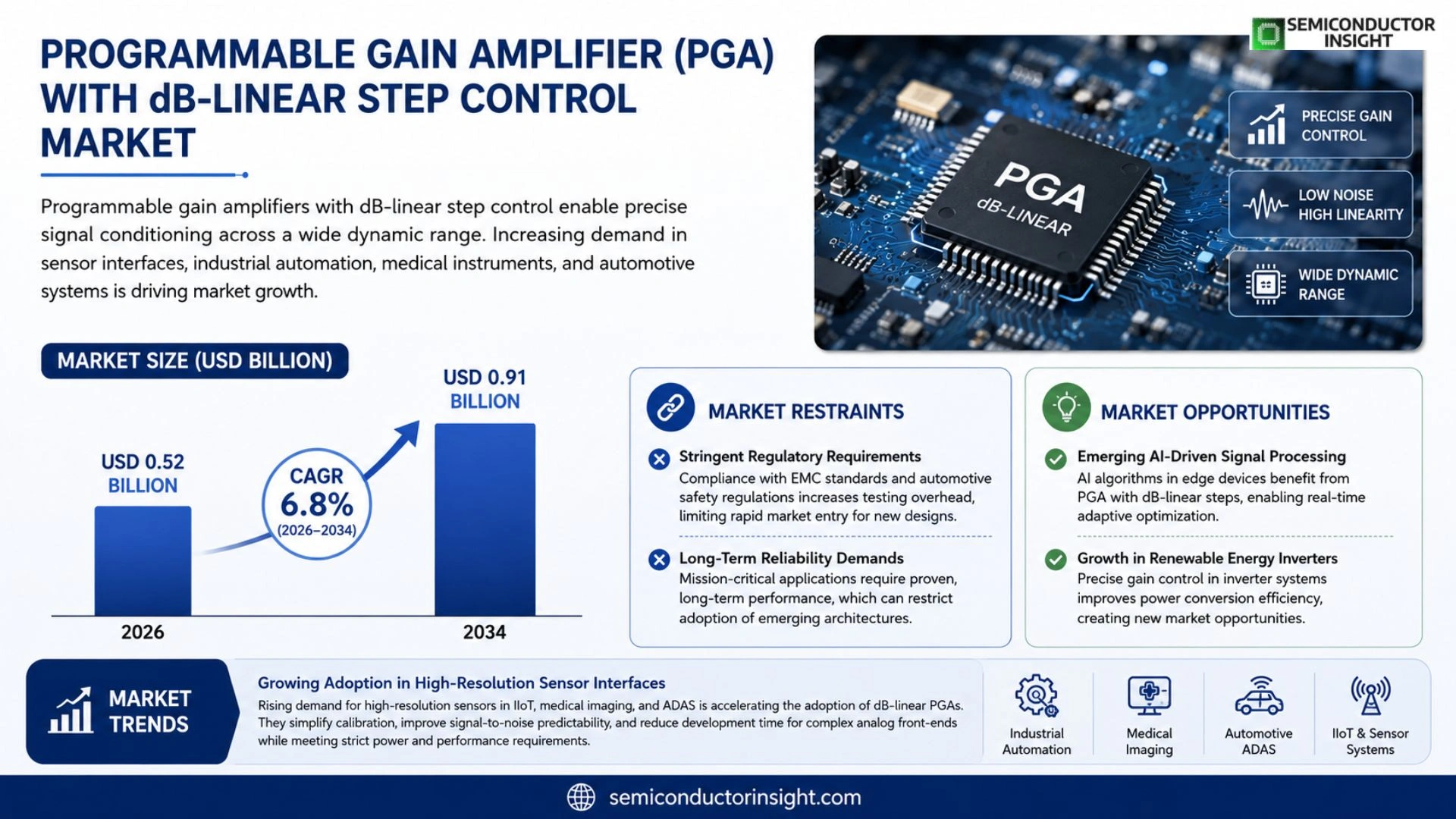
Global Programmable gain amplifier (PGA) market size was valued at USD 0.48 billion in 2025. The market is projected to grow from USD 0.52 billion in 2026 to USD 0.91 billion by 2034, exhibiting a CAGR of 6.8% during the forecast period.
Programmable gain amplifiers with dB‑linear step control are precision analog front‑end components that enable users to adjust amplification in uniform decibel increments, simplifying calibration across audio, instrumentation, and communication systems. Their linear dB stepping ensures predictable signal‑to‑noise performance throughout a wide dynamic range.
The market is experiencing steady expansion because demand for high‑resolution sensor interfaces, IoT edge devices, and automotive ADAS systems is rising. Furthermore, advances in mixed‑signal ASIC integration reduce bill‑of‑materials costs, encouraging adoption of dB‑linear PGA modules. However, competition from digital signal processing alternatives poses pricing pressure, prompting manufacturers such as Texas Instruments, Analog Devices, Maxim Integrated, and ON Semiconductor to invest in next‑generation low‑power architectures.
MARKET DRIVERS
Increasing Adoption in Automotive and Industrial IoT
Programmable gain amplifier with dB-linear step control Market is being propelled by the rapid integration of advanced driver‑assistance systems (ADAS) and predictive maintenance platforms. Manufacturers require precise gain steps to maintain signal integrity across a wide dynamic range, and dB‑linear control offers the needed accuracy.
Growth of 5G Infrastructure
Telecommunications equipment for 5G base stations relies on low‑noise amplification with fine‑tuned gain. The demand for programmable solutions that can be remotely adjusted without hardware changes is a key catalyst for market expansion.
➤ Industry surveys indicate that designers prioritize dB‑linear step control to reduce calibration time and improve system robustness.
In addition, the rise of modular hardware platforms in aerospace testing environments encourages the use of programmable gain amplifiers, further driving market momentum.
MARKET CHALLENGES
High Development Costs and Component Complexity
Designing a Programmable gain amplifier with dB-linear step control Market solution requires sophisticated analog‑digital interfacing and extensive validation, which can inflate R&D budgets and extend product cycles.
Other Challenges
Supply Chain Volatility
The reliance on precision semiconductor substrates makes the market vulnerable to raw material shortages, potentially delaying new product introductions.
MARKET RESTRAINTS
Stringent Regulatory Requirements
Compliance with electromagnetic compatibility (EMC) standards and automotive safety regulations imposes additional testing overhead, which can constrain rapid market entry for new programmable gain designs.
Moreover, the necessity for long‑term reliability in mission‑critical applications limits the adoption of emerging architectures that have not yet demonstrated extended field performance.
MARKET OPPORTUNITIES
Emerging AI‑Driven Signal Processing
Artificial‑intelligence algorithms embedded in edge devices increasingly depend on adaptable analog front‑ends. Programmable gain amplifiers with dB‑linear step control can be dynamically optimized by AI, opening lucrative opportunities for vendors that integrate smart control loops.
Furthermore, the expansion of renewable energy inverter technology creates a niche for precise gain control to maximize power conversion efficiency, presenting another growth avenue for the market.
Programmable gain amplifier with dB-linear step control Market Trends
Growing Adoption in High‑Resolution Sensor Interfaces
Programmable gain amplifier with dB-linear step control Market is being reshaped by a surge in high‑resolution sensor deployments across industrial IoT, medical imaging, and automotive advanced driver‑assistance systems (ADAS). Engineers value the uniform decibel increments because they simplify calibration, improve signal‑to‑noise predictability, and reduce development cycles for complex analog front‑ends. Recent design cycles show a clear preference for dB‑linear PGA modules when integrating multi‑channel sensor arrays that require consistent gain steps across a wide dynamic range. This trend is reinforced by the need for tighter power budgets, where low‑power architectures deliver the required performance without inflating bill‑of‑materials costs.
Other Trends
Mixed‑Signal ASIC Integration
Manufacturers such as Texas Instruments, Analog Devices, Maxim Integrated, and ON Semiconductor are embedding Programmable gain amplifier with dB-linear step control functionality directly into mixed‑signal ASICs. This integration cuts board space, minimizes external component variance, and streamlines supply chains. The resulting modules provide programmable gain steps that are calibrated at silicon level, ensuring that end‑users can achieve fine‑tuned amplification with minimal external trimming. The industry reports a noticeable shift toward consolidating analog and digital blocks, which drives economies of scale and accelerates time‑to‑market for next‑generation edge devices.
Competitive Pressure from Digital Signal Processing Solutions
Despite strong adoption, Programmable gain amplifier with dB-linear step control Market faces pricing pressure from increasingly capable digital signal processing (DSP) alternatives. DSP techniques can emulate gain control digitally, prompting OEMs to evaluate cost versus performance trade‑offs. In response, leading analog vendors are focusing on ultra‑low power designs and introducing programmable step granularity that outperforms digital equivalents in latency‑critical applications. The balance between analog precision and digital flexibility continues to drive strategic R&D investments, ensuring that analog PGA solutions remain a critical component in high‑performance sensing and communication platforms.
COMPETITIVE LANDSCAPE
Key Industry Players
Programmable Gain Amplifier with dB‑Linear Step Control – Competitive Overview
Programmable gain amplifier (PGA) market is heavily anchored by a few large semiconductor firms that dominate both volume and technology leadership. Texas Instruments leads with its PGA series that integrates fine‑resolution dB‑linear stepping, targeting automotive ADAS, industrial sensor hubs, and high‑fidelity audio. Analog Devices follows closely, leveraging its mixed‑signal ASIC expertise to deliver ultra‑low‑noise, low‑power PGA modules that appeal to IoT edge devices. Maxim Integrated (now part of Analog Devices) and ON Semiconductor complement the landscape by offering cost‑optimized parts for consumer electronics and portable medical equipment. These incumbents shape market structure through extensive design‑win programs, broad distribution networks, and sustained R&D investments that keep the CAGR around 6‑7 % as the market expands from $0.52 billion in 2026 to $0.91 billion by 2034.
Beyond the tier‑one players, a cohort of niche specialists contributes differentiated solutions that address specific application niches. Microchip Technology supplies PGA families with integrated digital interfaces for precise calibration in measurement equipment. NXP Semiconductors and STMicroelectronics focus on automotive‑grade devices that meet stringent functional safety standards. Infineon Technologies, Rohm Semiconductor, and Renesas Electronics each bring proprietary low‑power architectures for battery‑operated IoT sensors. Skyworks Solutions and Cirrus Logic target high‑performance audio front‑ends, while AMS AG provides advanced CMOS processes that enable ultra‑compact PGA blocks for wearable health monitors. This breadth of capable vendors intensifies competition, driving innovation in power efficiency, integration density, and dB‑linear step accuracy.
List of Key Programmable Gain Amplifier Companies Profiled
- Texas Instruments
- Analog Devices
- Maxim Integrated (now part of Analog Devices)
- ON Semiconductor
- Microchip Technology
- NXP Semiconductors
- STMicroelectronics
- Infineon Technologies
- Rohm Semiconductor
- Renesas Electronics
- Skyworks Solutions
- Cirrus Logic
- AMS AG
- Linear Technology (integrated into Analog Devices)
Segment Analysis:
| Segment Category | Sub-Segments | Key Insights |
| By Type |
|
Voltage‑Controlled PGA is preferred for its intuitive analog tuning, seamless integration with high‑resolution sensor fronts, and ability to maintain linear dB steps without extensive digital overhead. • Engineers value its predictable gain behavior during calibration. • It aligns well with legacy analog architectures, reducing redesign effort. • The simplicity of voltage control supports rapid prototyping in emerging IoT devices. |
| By Application |
|
Sensor Interface drives adoption because it delivers stable gain across wide dynamic ranges, essential for precision measurement and edge analytics. • Uniform dB stepping simplifies algorithmic compensation in mixed‑signal ASICs. • Designers appreciate the reduced BOM complexity when the PGA integrates directly with sensor front‑ends. • Reliability under varying environmental conditions makes it a cornerstone for industrial and automotive sensing. |
| By End User |
|
IoT Device Manufacturers prioritize programmable gain amplifiers with dB‑linear control for low‑power, compact designs that must accommodate diverse sensor signals. • The ability to fine‑tune gain without complex firmware enhances time‑to‑market. • Linear dB steps align with adaptive signal conditioning strategies used in edge AI workloads. • Consistency across device families supports scalable product portfolios. |
| By Integration Level |
|
Mixed‑Signal ASIC emerges as the leading integration path, offering tight coupling between analog gain control and digital signal processing. • Consolidation reduces board space and improves signal integrity. • Designers benefit from customizable gain curves embedded directly in silicon. • The approach aligns with industry trends toward highly integrated edge modules. |
| By Power Profile |
|
Low‑Power is the dominant choice for battery‑operated and energy‑constrained applications. • Designers seek architectures that preserve linear dB stepping while minimizing quiescent current. • The low‑power focus enables deployment in wearable sensors and remote monitoring nodes. • It also supports compliance with stringent thermal budgets in automotive electronics. |
Regional Analysis: Programmable gain amplifier with dB-linear step control Market
High‑resolution audio demand, proliferation of 5G base stations, and growth of autonomous vehicle platforms are propelling demand for fine‑grained gain control. Designers seek dB‑linear steps to simplify calibration and improve signal fidelity across diverse operating conditions.
FCC and IEC standards encourage precise gain linearity for safety‑critical communications. Compliance requirements stimulate adoption of calibrated dB‑step solutions, reinforcing market momentum in North America.
Established semiconductor giants dominate, yet niche players focusing on ultra‑low‑noise architectures are gaining traction. Strategic partnerships accelerate technology diffusion across automotive and telecom segments.
Europe
Europe remains a strong secondary market for Programmable gain amplifier with dB-linear step control Market, driven by stringent automotive safety regulations and a vibrant consumer electronics sector. German and French manufacturers lead in integrating dB‑linear gain chips into electric vehicle infotainment systems, while the UK’s wireless rollout fuels demand for precise gain control in small‑cell infrastructure. Collaborative research programs funded by the EU encourage advances in low‑power designs, positioning the region for steady growth despite modest supply‑chain disruptions.
Asia‑Pacific
Asia‑Pacific exhibits rapid adoption of programmable gain amplifiers, particularly in China, South Korea, and Japan, where IoT and 5G deployments accelerate market expansion. The region’s cost‑sensitive manufacturing base fosters competitive pricing, while increasing consumer demand for high‑definition audio in smartphones and smart speakers drives product innovation. Emerging markets such as India and Southeast Asia add volume potential, though they face challenges related to component sourcing and standardization.
South America
South America shows gradual uptake of Programmable gain amplifier with dB-linear step control Market as telecom operators upgrade networks and automotive manufacturers localize production. Brazil’s expanding broadband initiatives and Argentina’s focus on consumer electronics create modest but steady demand. Limited R&D infrastructure and reliance on imported components keep growth measured, yet policy incentives for technology adoption could spur acceleration.
Middle East & Africa
The Middle East & Africa region presents nascent yet promising opportunities for programmable gain solutions, especially in United Arab Emirates and South Africa where smart city projects and defense communications demand high‑precision gain control. Investment in data‑center infrastructure and growing entertainment venues drive niche demand. However, market development is constrained by lower overall semiconductor manufacturing capacity and price sensitivity.
Report Scope
This market research report provides a comprehensive analysis of the Programmable gain amplifier with dB-linear step control Market , covering the forecast period 2026–2034. It offers detailed insights into market dynamics, technological advancements, competitive landscape, and key trends shaping the industry.
Key focus areas of the report include:
- Market Overview: The report begins with an overview outlining its current market scenario, key growth indicators, and industry transformation drivers. It discusses macroeconomic factors, demand–supply balance, regulatory landscape, and the strategic role of semiconductors in powering advancements across industries such as automotive, telecommunications, consumer electronics, and industrial automation.
- Market Size & Forecast: Historical data and future projections for revenue, unit shipments, and market value across major regions and segments.
- Segmentation Analysis: Detailed breakdown by product type, technology, application, and end-user industry to identify high-growth segments and investment opportunities.
- Regional Insights: Insights into market performance across North America, Europe, Asia-Pacific, Latin America, and the Middle East & Africa, including country-level analysis where relevant.
- Competitive Landscape: Profiles of leading market participants, including their product offerings, R&D focus, manufacturing capacity, pricing strategies, and recent developments such are mergers, acquisitions, and partnerships.
- Technology Trends & Innovation: Assessment of emerging technologies, integration of AI/IoT, semiconductor design trends, fabrication techniques, and evolving industry standards.
- Market Drivers & Restraints: Evaluation of factors driving market growth along with challenges, supply chain constraints, regulatory issues, and market-entry barriers.
- Stakeholder Insights: Insights for component suppliers, OEMs, system integrators, investors, and policymakers regarding the evolving ecosystem and strategic opportunities.
Primary and secondary research methods are employed, including interviews with industry experts, data from verified sources, and real-time market intelligence to ensure the accuracy and reliability of the insights presented.
FREQUENTLY ASKED QUESTIONS:
What is the current market size of Programmable gain amplifier with dB-linear step control Market?
-> Programmable gain amplifier (PGA) market size is projected to grow from USD 0.52 billion in 2026 to USD 0.91 billion by 20344, reflecting a CAGR of 6.8%
Which key companies operate in Programmable gain amplifier with dB-linear step control Market?
-> Key players include Texas Instruments, Analog Devices, Maxim Integrated, ON Semiconductor, among others.
What are the key growth drivers?
-> Key growth drivers include increasing demand for high‑resolution sensor interfaces, IoT edge devices, automotive ADAS systems, and cost reductions from mixed‑signal ASIC integration.
Which region dominates the market?
-> Asia‑Pacific is emerging as the fastest‑growing region, while North America remains the dominant market due to its established semiconductor manufacturing base.
What are the emerging trends?
-> Emerging trends include integration of mixed‑signal ASICs, development of ultra‑low‑power dB‑linear PGA architectures, and greater adoption of AI‑enabled signal processing to complement analog front‑ends.

Get Sample Report PDF for Exclusive Insights
Report Sample Includes
- Table of Contents
- List of Tables & Figures
- Charts, Research Methodology, and more...