Private 5G URLLC for automated guided vehicle control in factory Market Insights
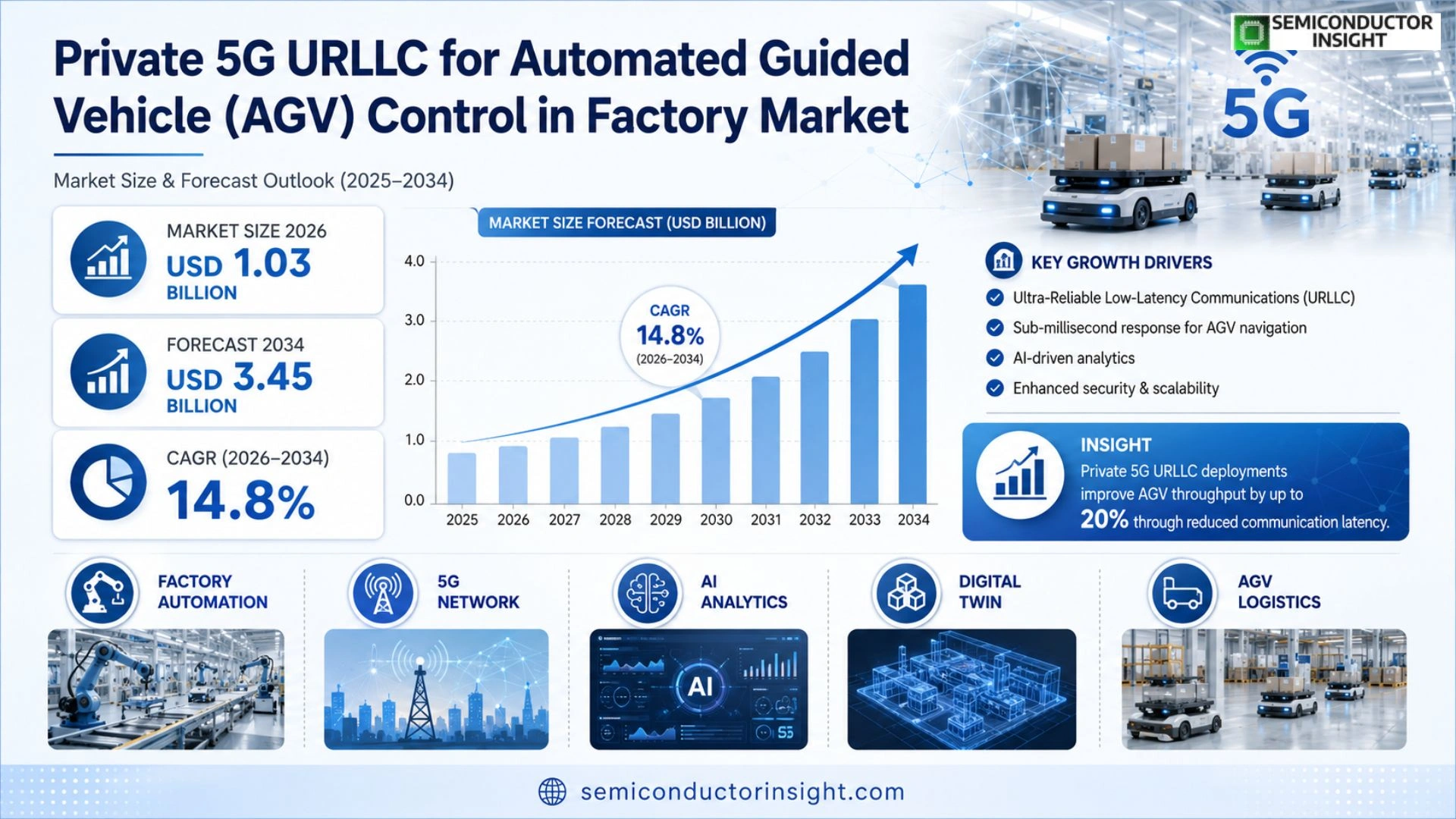
Global Private 5G URLLC for automated guided vehicle control market size was valued at USD 0.92 billion in 2025. The market is projected to grow from USD 1.03 billion in 2026 to USD 3.45 billion by 2034, exhibiting a CAGR of 14.8% during the forecast period.
Private 5G URLLC (Ultra‑Reliable Low‑Latency Communication) delivers sub‑millisecond latency and near‑perfect reliability, critical attributes for synchronizing fleets of automated guided vehicles (AGVs) on modern factory floors. By operating on dedicated spectrum within a private network, manufacturers obtain deterministic performance that Wi‑Fi or public cellular networks cannot guarantee. The market is experiencing rapid growth because Industry 4.0 initiatives push widespread AGV adoption while manufacturers demand higher throughput and safety standards. Furthermore, rising capital expenditure on digital twins and smart factories amplifies the need for robust connectivity. Key players such as Nokia, Ericsson, Huawei, Qualcomm and Samsung are accelerating deployments through strategic partnerships, e.g., Ericsson’s collaboration with Siemens announced in March 2024 to embed private 5G URLLC into its digital manufacturing suite, thereby reinforcing the upward trajectory of this niche yet critical segment.
MARKET DRIVERS
Enhanced Reliability for Critical AGV Operations
Private 5G URLLC for automated guided vehicle control in factory Market is propelled by the need for ultra‑reliable low‑latency communications that guarantee sub‑millisecond response times, essential for real‑time navigation and collision avoidance of AGVs. Manufacturers are investing in dedicated networks to eliminate the variability inherent in public broadband.
Integration with Industry 4.0 Ecosystems
Seamless integration with digital twins, edge computing, and AI‑driven analytics enables factories to optimize material flow and reduce downtime. Reliability, security, and scalability of private 5G networks are key enablers for these advanced use cases.
➤ Enterprises that deploy private 5G URLLC report up to 20% improvement in AGV throughput due to reduced communication latency.
In addition, regulatory support for spectrum allocation encourages broader adoption, positioning private 5G as a cornerstone of next‑generation manufacturing logistics.
MARKET CHALLENGES
High Initial Capital Expenditure
Deploying a dedicated private 5G infrastructure entails significant upfront costs for spectrum licensing, base stations, and integration services. Smaller manufacturers may find the investment prohibitive without clear short‑term ROI.
Other Challenges
Complex Integration with Legacy Systems
Many factories operate heterogeneous control systems; aligning them with 5G URLLC standards requires extensive engineering, testing, and staff training.
Furthermore, the scarcity of skilled professionals proficient in both telecom and industrial automation adds to project timelines and budget uncertainties.
MARKET RESTRAINTS
Regulatory and Spectrum Allocation Barriers
While many regions are easing access to mid‑band spectrum, the regulatory approval process can still be lengthy, causing delays in network rollout. Uncertainty around future spectrum policies may deter investment decisions.
MARKET OPPORTUNITIES
Growth of Edge‑Enabled Manufacturing
The convergence of edge computing with private 5G URLLC creates opportunities for localized decision‑making, reducing dependence on central cloud resources and enhancing data sovereignty. This synergy supports advanced use cases such as real‑time predictive maintenance for AGVs.
Additionally, collaborative partnerships between telecom providers and automation vendors are emerging, offering bundled solutions that lower entry barriers and accelerate time‑to‑market for new adopters.
Private 5G URLLC for automated guided vehicle control in factory Market Trends
Accelerated Adoption of Private 5G URLLC for AGV Coordination
The manufacturing sector is increasingly relying on Private 5G URLLC to meet the stringent latency and reliability demands of automated guided vehicle (AGV) fleets on the shop floor. Sub‑millisecond response times enable real‑time path planning, collision avoidance, and synchronized material handling, which directly improve line throughput and safety. Because the private network operates on dedicated spectrum, manufacturers can guarantee deterministic performance that public cellular services or Wi‑Fi cannot reliably deliver. This technical advantage is prompting a rapid shift from legacy fieldbus solutions toward Private 5G URLLC for automated guided vehicle control in factory environments.
Other Trends
Integration with Digital Twin Platforms
Digital twins are becoming the central nervous system of smart factories, and Private 5G URLLC provides the connective tissue required for high‑fidelity data exchange. By linking AGVs to a virtual replica of the production line, operators can simulate routing changes, predict wear‑and‑tear, and execute predictive maintenance without interrupting live operations. The low‑latency link ensures that sensor streams from each vehicle are reflected in the twin in near real time, allowing closed‑loop optimization that was previously unattainable.
Strategic Partnerships Expanding the Ecosystem
Leading telecommunications vendors are forming joint ventures with industrial automation leaders to accelerate deployment of Private 5G URLLC for automated guided vehicle control in factory settings. Collaborations such as the announced partnership between a major network equipment provider and a global systems integrator focus on embedding 5G modules directly into AGV chassis and providing end‑to‑end service assurance. These alliances not only streamline implementation but also create a standardized portfolio of hardware, software, and services that reduces total cost of ownership for adopters.
Looking ahead, the convergence of Industry 4.0 initiatives, increasing capital investment in smart factory infrastructure, and the maturity of Private 5G URLLC technology will sustain the momentum of these trends. Manufacturers that adopt the technology early are likely to achieve measurable gains in operational efficiency, asset utilization, and safety compliance, establishing a competitive edge in increasingly automated production ecosystems.
COMPETITIVE LANDSCAPE
Key Industry Players
Competitive Landscape of Private 5G URLLC for AGV Control
Private 5G URLLC market for automated guided vehicle (AGV) control is currently anchored by a handful of global telecom giants that command the majority of large‑scale deployments. Ericsson, leveraging its collaboration with Siemens announced in March 2024, provides end‑to‑end private‑network solutions that integrate directly with Siemens’ digital manufacturing suite, delivering sub‑millisecond latency and deterministic reliability essential for synchronized AGV fleets. Nokia follows a similar trajectory, coupling its AirScale portfolio with extensive edge‑computing capabilities to support multi‑tenant factory environments. Huawei’s CloudEngine and Huawei Marine‑5G platforms are also gaining traction in regions where spectrum allocation favors private networks, while Qualcomm supplies the critical chipset ecosystem that enables ultra‑reliable connectivity across diverse equipment vendors. Samsung’s Exynos 5G modem line rounds out the core of the ecosystem, ensuring that OEMs can embed URLLC‑grade radios into AGVs without sacrificing power efficiency. Collectively, these leaders shape a market structure that is heavily weighted toward vertically integrated solutions, extensive R&D investment, and strategic partnerships that accelerate rollout timelines across North America, Europe, and Asia‑Pacific.
Beyond the dominant tier, a vibrant cohort of niche and specialized players enriches the competitive landscape by addressing vertical‑specific requirements and offering plug‑and‑play modules for mid‑size manufacturers. Intel’s Xeon Edge processors and network‑interface cards provide high‑performance compute at the edge, enabling real‑time analytics for AGV coordination. Cisco’s Industrial Ethernet switches and IoT gateways facilitate secure, low‑latency data transport within factory LANs. Dell Technologies supplies ruggedized servers optimized for private‑5G core functions, while Zebra Technologies focuses on asset‑tracking and on‑device telemetry that complement URLLC networks. NEC and Fujitsu contribute AI‑enhanced network orchestration tools, whereas Bosch and Hitachi deliver sensor‑fusion platforms that integrate seamlessly with private‑5G radios. This diversified group ensures that even smaller‑scale factories can adopt URLLC without the need for large‑scale telecom contracts, fostering broader market penetration and driving overall industry growth.
List of Key Private 5G URLLC for Automated Guided Vehicle Control Companies Profiled
- Nokia
- Ericsson
- Huawei
- Qualcomm
- Samsung
- Siemens
- Intel
- Cisco
- Dell Technologies
- Zebra Technologies
- NEC
- Fujitsu
- Bosch
- Hitachi
- Marvell
Segment Analysis:
| Segment Category | Sub-Segments | Key Insights |
| By Type |
|
Standalone Private 5G
|
| By Application |
|
Material Transport
|
| By End User |
|
Automotive Manufacturing
|
| By Deployment Scale |
|
Enterprise‑wide Rollout
|
| By Integration Architecture |
|
Digital‑Twin Integrated Network
|
Regional Analysis: North America
United States
Private 5G URLLC is being implemented for precise navigation of AGVs, collaborative robotics, real-time monitoring of production processes, and enhanced predictive maintenance. The low latency ensures seamless coordination between AGVs and other factory systems, optimizing workflow and reducing downtime.
The US market features a mix of established telecommunications providers expanding into Private 5G, specialized industrial technology companies, and emerging startups focused on URLLC solutions. Partnerships between these players and system integrators are crucial for successful deployments.
The regulatory landscape surrounding Private 5G in the US is evolving, with ongoing discussions regarding spectrum allocation and licensing. Clear guidelines and policies are expected to further accelerate the adoption of this technology in industrial sectors.
Significant investments are being directed towards Private 5G infrastructure and the development of specialized AGV control systems within US manufacturing. This indicates a strong commitment to digital transformation and the pursuit of enhanced operational capabilities.
Europe
The European market for Private 5G URLLC in factory automation is characterized by a strong emphasis on data privacy and security, aligning with regulations like GDPR. While adoption is growing steadily, it is being approached with a more cautious and strategic mindset compared to the US. Key regions driving adoption include Germany, the UK, and France, where advanced manufacturing sectors are prominent. The focus in Europe is often on integrating Private 5G with existing industrial automation systems and ensuring seamless interoperability.
Asia-Pacific
Asia-Pacific, particularly China and Japan, represents a substantial growth opportunity for Private 5G URLLC in factory control. These regions boast highly advanced manufacturing industries and are actively investing in Industry 4.0 initiatives. China is emerging as a global leader in 5G technology and is aggressively deploying Private 5G networks across various sectors, including manufacturing. Japan’s strong robotics industry also presents a significant demand for low-latency communication solutions.
South America
South America is witnessing initial adoption of Private 5G URLLC in factory automation, driven by increasing investments in industrial digitalization. Brazil and Argentina are key markets with growing manufacturing sectors seeking to improve efficiency and competitiveness. However, the market is still in its early stages of development and faces challenges related to infrastructure and cost.
Middle East & Africa
The Middle East and Africa represent a nascent market for Private 5G URLLC in factory automation, with significant potential for growth. Countries like Saudi Arabia and the UAE are actively pursuing industrial diversification and smart city initiatives, creating demand for advanced manufacturing technologies. While the market is currently small, it is expected to gain traction in the coming years as infrastructure develops and awareness of the technology increases.
Report Scope
This market research report provides a comprehensive analysis of the Private 5G URLLC for automated guided vehicle control in factory Market , covering the forecast period 2026–2034. It offers detailed insights into market dynamics, technological advancements, competitive landscape, and key trends shaping the industry.
Key focus areas of the report include:
- Market Overview: The report begins with an overview outlining its current market scenario, key growth indicators, and industry transformation drivers. It discusses macroeconomic factors, demand–supply balance, regulatory landscape, and the strategic role of semiconductors in powering advancements across industries such as automotive, telecommunications, consumer electronics, and industrial automation.
- Market Size & Forecast: Historical data and future projections for revenue, unit shipments, and market value across major regions and segments.
- Segmentation Analysis: Detailed breakdown by product type, technology, application, and end-user industry to identify high-growth segments and investment opportunities.
- Regional Insights: Insights into market performance across North America, Europe, Asia-Pacific, Latin America, and the Middle East & Africa, including country-level analysis where relevant.
- Competitive Landscape: Profiles of leading market participants, including their product offerings, R&D focus, manufacturing capacity, pricing strategies, and recent developments such as mergers, acquisitions, and partnerships.
- Technology Trends & Innovation: Assessment of emerging technologies, integration of AI/IoT, semiconductor design trends, fabrication techniques, and evolving industry standards.
- Market Drivers & Restraints: Evaluation of factors driving market growth along with challenges, supply chain constraints, regulatory issues, and market-entry barriers.
- Stakeholder Insights: Insights for component suppliers, OEMs, system integrators, investors, and policymakers regarding the evolving ecosystem and strategic opportunities.
Primary and secondary research methods are employed, including interviews with industry experts, data from verified sources, and real-time market intelligence to ensure the accuracy and reliability of the insights presented.
FREQUENTLY ASKED QUESTIONS:
What is the current market size of Private 5G URLLC for automated guided vehicle control in factory Market?
-> Private 5G URLLC for automated guided vehicle control in factory Market was valued at USD 0.92 billion in 2025 and is expected to reach USD 3.45 billion by 2034.
Which key companies operate Private 5G URLLC for automated guided vehicle control in factory Market?
-> Key players include Nokia, Ericsson, Huawei, Qualcomm, and Samsung, among others.
What are the key growth drivers?
-> Key growth drivers include Industry 4.0 initiatives, increasing AGV adoption, demand for higher throughput and safety, rising capital expenditure on digital twins and smart factories, and the need for deterministic low‑latency connectivity.
Which region dominates the market?
-> The reference does not specify a dominant region; regional performance varies based on Industry 4.0 adoption rates.
What are the emerging trends?
-> Emerging trends include strategic partnerships for private‑5G deployments, integration of AI/IoT with URLLC for real‑time AGV coordination, and the expansion of digital twin ecosystems within smart factories.
Get Sample Report PDF for Exclusive Insights
Report Sample Includes
- Table of Contents
- List of Tables & Figures
- Charts, Research Methodology, and more...
 Download Sample Report PDF