MARKET INSIGHTS
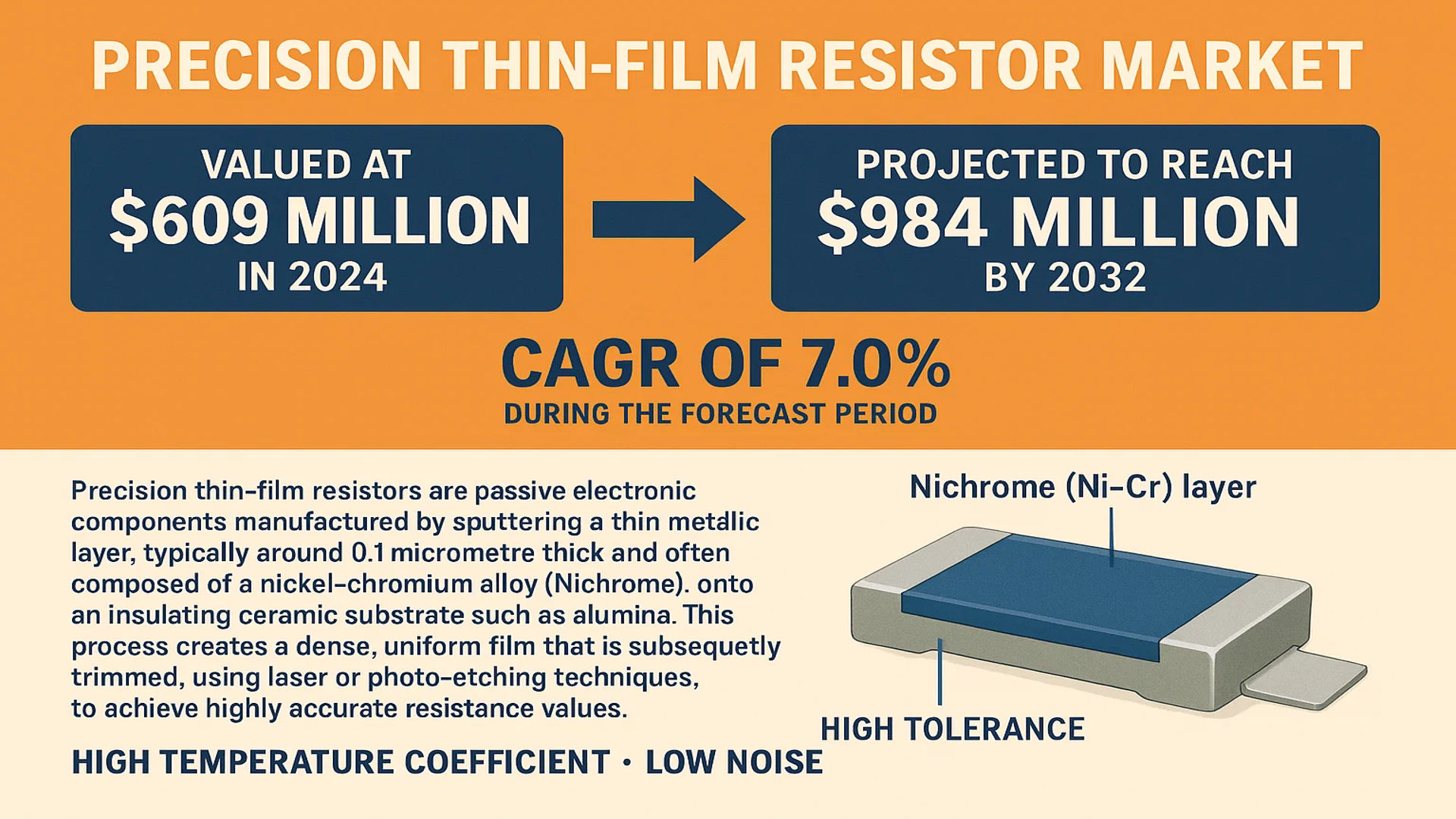
The global Precision Thin-film Resistor Market was valued at 609 million in 2024 and is projected to reach US$ 984 million by 2032, at a CAGR of 7.0% during the forecast period.
Precision thin-film resistors are passive electronic components manufactured by sputtering a thin metallic layer, typically around 0.1 micrometre thick and often composed of a nickel-chromium alloy (Nichrome), onto an insulating ceramic substrate such as alumina. This process creates a dense, uniform film that is subsequently trimmed, using laser or photo-etching techniques, to achieve highly accurate resistance values. These components are characterized by their high tolerance (as tight as 0.05%), low temperature coefficient, and low noise, making them indispensable in applications demanding extreme accuracy and stability.
The market is experiencing steady growth, primarily driven by the expanding demand for high-precision instrumentation across medical, automotive, and telecommunications sectors. A key factor is the rapid advancement and miniaturization of electronic devices, which require reliable and stable passive components. Furthermore, the Asia Pacific region dominates consumption, accounting for a significant market share, with China, Japan, and India being the primary drivers due to their robust electronics manufacturing bases. Leading players such as Vishay, Susumu, and KOA Speer Electronics operate in this market with extensive portfolios, continuously innovating to meet the evolving requirements for precision and miniaturization.
MARKET DYNAMICS
MARKET DRIVERS
Rising Demand for High-Precision Instrumentation Across Multiple Industries
The global precision thin-film resistor market is experiencing significant growth due to the escalating demand for high-accuracy electronic components across various industries. These resistors are essential in applications requiring exceptional stability, low temperature coefficients, and tight tolerance levels, typically within 0.05% to 0.1%. The instrumentation sector, which includes test and measurement equipment, analytical instruments, and industrial control systems, accounts for approximately 38% of the total market demand. Medical equipment represents another critical driver, with precision resistors being integral to devices such as MRI machines, patient monitors, and diagnostic equipment where measurement accuracy can directly impact patient outcomes. The automotive electronics segment is growing at a remarkable pace, with electric vehicles and advanced driver-assistance systems (ADAS) requiring precision resistors for sensor interfaces, battery management systems, and control units. The communication device segment, particularly 5G infrastructure and satellite communication systems, further contributes to market expansion due to the need for stable high-frequency performance.
Technological Advancements in Manufacturing Processes
Technological innovations in thin-film deposition and patterning techniques are substantially driving market growth. The adoption of advanced sputtering technologies has enabled manufacturers to achieve thinner, more uniform resistive layers with improved performance characteristics. Laser trimming technology has evolved to provide higher precision in resistance value adjustment, allowing for tolerances as tight as ±0.01% in some premium applications. The development of nickel-chromium (NiCr) and tantalum nitride (TaN) alloy systems has resulted in resistors with temperature coefficients as low as 5 ppm/°C, meeting the stringent requirements of aerospace, military, and medical applications. Recent manufacturing advancements have also focused on improving stability under various environmental conditions, with some products demonstrating long-term stability of 0.1% over 2000 hours at 70°C. These technological improvements have expanded the application range of precision thin-film resistors while simultaneously reducing production costs through enhanced yield rates and automation.
Expansion of Automotive Electronics and Electric Vehicle Production
The automotive industry’s rapid transformation toward electrification and automation is creating substantial demand for precision thin-film resistors. Electric vehicles require numerous precision resistors for battery management systems, where they monitor cell voltages with accuracy requirements often exceeding 0.1%. ADAS systems utilize these components in sensor interfaces, radar systems, and camera modules where signal integrity is paramount. The global production of electric vehicles reached approximately 10.5 million units in 2023, representing a 35% increase from the previous year, directly correlating with increased resistor demand. Automotive applications typically require resistors that can withstand harsh environmental conditions, including temperature ranges from -55°C to 155°C, vibration resistance, and high reliability over extended periods. This sector’s growth is particularly pronounced in Asia Pacific, where major automotive manufacturing countries like China, Japan, and South Korea are accelerating their electric vehicle production capabilities.
MARKET RESTRAINTS
High Manufacturing Costs and Complex Production Processes
The precision thin-film resistor market faces significant constraints due to the substantial capital investment and technical expertise required for manufacturing. The production process involves multiple sophisticated steps including substrate preparation, vacuum deposition, photolithography, laser trimming, and protective coating application. Establishing a production line capable of manufacturing resistors with tolerances below 0.1% requires investment exceeding 25 million dollars for medium-scale operations. The vacuum deposition equipment alone can account for approximately 40% of the total capital expenditure. Additionally, maintaining consistent quality requires stringent environmental controls, with cleanroom standards typically at ISO Class 6 or better. The raw materials, particularly the specialized alloys and high-purity ceramics, contribute significantly to the overall product cost. These economic factors create substantial barriers to entry for new market participants and limit production scalability for existing manufacturers.
Technical Limitations in Extreme Operating Conditions
While precision thin-film resistors offer excellent performance in standard applications, they face limitations in extreme operating environments that restrain market expansion in certain segments. In high-temperature applications exceeding 175°C, the stability of thin-film resistors can be compromised due to material migration and oxidation effects. High-power applications present another challenge, as the thin resistive layer has limited power dissipation capability compared to thick-film or wirewound alternatives. The maximum power rating for most precision thin-film resistors typically ranges from 0.1W to 1W, restricting their use in power electronics applications. In high-voltage environments, the thin dielectric layers between the resistive element and substrate can experience breakdown voltages typically limited to 200-500 volts. These technical constraints necessitate alternative solutions in applications such as industrial motor drives, power supplies, and high-voltage measurement equipment, thereby limiting the addressable market for precision thin-film resistors.
Competition from Alternative Technologies and Integration Trends
The market faces growing competition from alternative technologies and integrated solutions that threaten traditional discrete resistor applications. The trend toward system-in-package (SiP) and system-on-chip (SoC) designs often incorporates resistive elements directly into integrated circuits, reducing the need for external discrete components. Thick-film resistor networks provide a cost-effective alternative for applications where ultra-high precision is not required, typically offering tolerances of 1-2% at significantly lower costs. The development of digital potentiometers and programmable resistor arrays has created competition in applications requiring adjustable resistance values. Furthermore, the miniaturization trend in electronics is driving demand for resistor arrays and networks that save board space compared to multiple discrete components. These competitive pressures are particularly evident in consumer electronics and cost-sensitive industrial applications, where manufacturers seek to balance performance requirements with overall system cost.
MARKET CHALLENGES
Supply Chain Vulnerabilities and Material Sourcing Constraints
The precision thin-film resistor industry faces significant challenges related to supply chain stability and raw material availability. The manufacturing process requires specialized materials including high-purity alumina substrates (99.6% or higher), nickel-chromium and tantalum nitride sputtering targets, and precious metals for termination and bonding. Many of these materials are subject to price volatility and supply constraints. The alumina substrate market, for instance, experienced price increases of 18-22% during recent supply chain disruptions. The sputtering targets market is highly concentrated, with limited suppliers capable of providing materials meeting the stringent purity requirements. Additionally, the global semiconductor shortage has impacted capacitor and semiconductor availability, affecting complete circuit assembly. These supply chain challenges are compounded by geopolitical factors and trade restrictions that affect material flow across regions, particularly between major manufacturing hubs in Asia and end markets in North America and Europe.
Other Challenges
Rapid Technological Obsolescence
The fast pace of technological advancement in electronics creates challenges related to product lifecycle management. As end equipment evolves, resistor requirements change in terms of size, performance, and functionality. The industry must continuously invest in research and development to keep pace with evolving customer requirements. The transition to higher frequency applications in 5G and automotive radar systems requires resistors with improved high-frequency characteristics. The miniaturization trend demands smaller package sizes while maintaining performance specifications, creating manufacturing challenges. Products that were standard five years ago may no longer meet current application requirements, necessitating continuous product development and potentially leading to inventory management challenges for manufacturers and distributors.
Environmental Compliance and Regulatory Requirements
Increasing environmental regulations present additional challenges for precision thin-film resistor manufacturers. Compliance with regulations such as RoHS (Restriction of Hazardous Substances) and REACH (Registration, Evaluation, Authorisation and Restriction of Chemicals) requires careful material selection and manufacturing process control. The elimination of lead-based solders and certain flame retardants has necessitated reformulation of materials and processes. Additionally, carbon footprint reduction targets and energy efficiency requirements are driving changes in manufacturing operations. These regulatory requirements vary by region, creating complexity for global manufacturers serving multiple markets. Compliance often involves additional testing, documentation, and certification processes that increase operational costs and time-to-market for new products.
MARKET OPPORTUNITIES
Growing Adoption in Renewable Energy and Power Management Systems
The global transition toward renewable energy systems presents substantial opportunities for precision thin-film resistor manufacturers. Solar inverters, wind turbine control systems, and energy storage systems require high-precision resistors for current sensing, voltage monitoring, and control circuits. The solar inverter market alone is projected to require millions of precision resistors annually, with growth rates exceeding 20% in key markets. Smart grid infrastructure and power quality management systems utilize these components for accurate measurement and protection functions. Electric vehicle charging stations, particularly DC fast chargers, represent another growing application area where precision resistors are essential for power conversion and control. The increasing complexity of power management systems in data centers, industrial equipment, and consumer electronics further drives demand for precision measurement components. These applications often require resistors with high stability over temperature and time, creating opportunities for manufacturers offering products with enhanced performance characteristics.
Expansion in Aerospace and Defense Applications
The aerospace and defense sector offers significant growth opportunities for precision thin-film resistor manufacturers. These applications demand components with exceptional reliability, radiation hardness, and performance under extreme environmental conditions. Satellite systems, radar equipment, avionics, and military communications equipment utilize precision resistors in critical measurement and signal conditioning circuits. The global space economy has been growing at approximately 9% annually, driving demand for space-grade electronic components. Military modernization programs worldwide are incorporating more sophisticated electronic systems requiring precision components. These applications typically have longer product lifecycles and higher margin opportunities compared to commercial markets. However, they also require stringent qualification processes, traceability, and compliance with military standards. Manufacturers capable of meeting these requirements can access markets with stable demand patterns and reduced price sensitivity.
Development of Advanced Packaging and Integration Solutions
Innovations in packaging technology and integration approaches create new opportunities for precision thin-film resistor manufacturers. The development of embedded resistor technology allows for resistors to be incorporated directly into printed circuit boards, saving space and improving performance in high-frequency applications. Advanced packaging techniques such as wafer-level packaging and 3D integration enable more compact and efficient electronic systems. The trend toward higher integration has led to opportunities for resistor arrays and networks that provide multiple precision resistors in single packages. These integrated solutions offer improved matching between resistors and reduced parasitic effects compared to discrete components. The market for resistor networks is growing at approximately 8% annually, driven by demand from communications, computing, and automotive applications. Manufacturers investing in these advanced packaging technologies can capture value in growing market segments while differentiating their offerings from standard discrete products.
PRECISION THIN-FILM RESISTOR MARKET TRENDS
Miniaturization and High-Frequency Demands in Electronics Propel Market Growth
The relentless drive towards miniaturization in the electronics industry is a primary catalyst for the precision thin-film resistor market. As devices shrink, the components within them must follow suit, demanding resistors that offer high stability and precision in an increasingly compact form factor. This trend is particularly pronounced in the telecommunications sector, where the rollout of 5G infrastructure requires components capable of operating efficiently at high frequencies. Thin-film technology excels here because its manufacturing process allows for extremely fine patterning and tight tolerance control, often within 0.05% to 0.1%, which is critical for signal integrity. Furthermore, the low parasitic inductance and capacitance of thin-film resistors make them indispensable for high-speed data transmission applications. The market is responding with innovations in packaging and materials to meet these escalating performance criteria in smaller footprints.
Other Trends
Automotive Electrification and Advanced Driver-Assistance Systems (ADAS)
The automotive industry’s rapid transition towards electrification and autonomy is creating substantial demand for highly reliable electronic components. Precision thin-film resistors are integral to various systems within modern vehicles, including battery management systems (BMS) for electric vehicles, where they provide accurate current sensing, and in ADAS sensors and control units that require unwavering signal accuracy for safety-critical functions. These applications necessitate components that can perform with high precision over a wide temperature range, often from -55°C to 155°C, and exhibit excellent long-term stability. The growth of the automotive electronics segment, which is projected to be a multi-billion-dollar market itself, directly fuels the consumption of these high-performance resistors.
Expansion in Medical and Industrial Instrumentation
There is a significant and growing uptake of precision thin-film resistors in medical equipment and sophisticated industrial instrumentation. In the medical field, devices such as patient monitors, diagnostic imaging systems (MRI, CT scanners), and analytical lab equipment demand components with exceptional accuracy, low noise, and high reliability to ensure patient safety and diagnostic precision. Similarly, in industrial settings, test and measurement equipment, process control systems, and factory automation rely on these resistors for their stability and low temperature coefficient of resistance (TCR), which can be as low as 5 ppm/°C. This ensures consistent performance despite environmental fluctuations, a non-negotiable requirement for maintaining quality and safety in industrial processes. The expansion of automation and smart manufacturing initiatives globally continues to bolster this demand.
COMPETITIVE LANDSCAPE
Key Industry Players
Technological Innovation and Strategic Expansion Define Market Leadership
The global precision thin-film resistor market exhibits a semi-consolidated competitive structure, characterized by the presence of established multinational corporations, specialized manufacturers, and emerging regional players. Vishay Intertechnology, Inc. stands as a dominant force, leveraging its extensive product portfolio that includes high-stability, ultra-precision resistors with tolerances as tight as ±0.01%. Their global manufacturing footprint and significant R&D investments, which exceeded $150 million in 2023, solidify their market leadership across critical sectors like medical equipment and automotive electronics.
Susumu Co., Ltd. and KOA Speer Electronics, Inc. have also captured substantial market share, collectively accounting for approximately 18% of global sales revenue in 2024. Their growth is propelled by deep expertise in thin-film deposition technologies and strong relationships with automotive and communication device OEMs in Asia and North America. Both companies have recently expanded production capacity to meet the surging demand for miniaturized, high-performance components.
Furthermore, these leading players are actively pursuing growth through strategic mergers, acquisitions, and partnerships. For instance, geographic expansion into high-growth markets like Southeast Asia and Eastern Europe is a common tactic to capture new customer bases. New product launches focusing on advanced materials, such as nickel-chromium (NiCr) and tantalum nitride (TaN) films, which offer superior temperature coefficients and long-term stability, are critical for maintaining a competitive edge.
Meanwhile, companies like Yageo Corporation and Panasonic Corporation are intensifying their market presence through robust vertical integration and significant capital expenditure in automated, high-volume production lines. Their strategy emphasizes cost leadership and supply chain resilience, which is particularly crucial for serving the high-volume communication device and consumer electronics segments. This focus on operational excellence and innovation ensures their continued influence and growth within the competitive landscape.
List of Key Precision Thin-film Resistor Companies Profiled
- Vishay Intertechnology, Inc. (U.S.)
- Susumu Co., Ltd. (Japan)
- KOA Speer Electronics, Inc. (U.S.)
- Viking Tech Corporation (Taiwan)
- Yageo Corporation (Taiwan)
- Panasonic Corporation (Japan)
- Walsin Technology Corporation (Taiwan)
- Ta-I Technology Co., Ltd. (Taiwan)
- Bourns, Inc. (U.S.)
- UniOhm Co., Ltd. (China)
- TE Connectivity Ltd. (Switzerland)
- Samsung Electro-Mechanics (South Korea)
- Ralec Electronics Corp. (Taiwan)
- Ever Ohms Technology Co., Ltd. (Taiwan)
Segment Analysis:
By Type
Ultra Precision 0.05% Tolerance Segment Dominates Due to Critical Requirements in High-End Instrumentation
The market is segmented based on type into:
- Ultra Precision 0.05% Tolerance
- 0.1% Tolerance
- Others
By Application
Instrumentation Segment Leads Due to Unmatched Demands for Accuracy and Stability in Measurement Devices
The market is segmented based on application into:
- Instrumentation
- Medical Equipment
- Automotive Electronics
- Communication Device
- Others
By End User
Industrial Manufacturing Sector Holds Significant Share Owing to Integration in Automation and Control Systems
The market is segmented based on end user into:
- Industrial Manufacturing
- Healthcare
- Telecommunications
- Automotive
- Others
Regional Analysis: Precision Thin-film Resistor Market
Asia-Pacific
Asia-Pacific is the dominant global region for the Precision Thin-film Resistor market, accounting for over 45% of worldwide consumption as of 2024. This leadership is primarily driven by the massive electronics manufacturing ecosystems in China, Japan, and South Korea. China, in particular, is the world’s largest producer and consumer, fueled by its extensive network of consumer electronics, telecommunications, and automotive electronics factories. The region benefits from strong government support for semiconductor and component industries, significant R&D investments from local players like Yageo, Walsin Technology, and Samsung Electro-Mechanics, and a robust supply chain. While cost-competitive manufacturing is a historic strength, there is a pronounced and accelerating shift towards producing higher-value, ultra-precision components (0.05% tolerance) to meet the sophisticated demands of 5G infrastructure, advanced medical imaging equipment, and electric vehicle power management systems. The forecasted CAGR for the region remains strong, slightly above the global average of 7.0%, due to sustained industrial expansion and technological upgrading.
North America
North America represents the second-largest market for Precision Thin-film Resistors, characterized by high demand for advanced, high-reliability components. The region’s market is propelled by its strong aerospace, defense, medical equipment, and test and measurement instrumentation sectors, where performance and precision are non-negotiable. Key manufacturers with a significant presence, such as Vishay and Bourns, cater to these demanding applications with products featuring very low temperature coefficients and tight tolerances. Furthermore, substantial investments in next-generation technologies like autonomous vehicles, AI infrastructure, and quantum computing are creating new, high-value applications that require the stability and accuracy provided by thin-film technology. The market is less driven by volume and more by innovation and performance specifications, with a notable focus on developing resistors that can operate reliably in extreme environments.
Europe
The European market for Precision Thin-film Resistors is mature and technologically advanced, with a focus on high-quality engineering and innovation. Germany, the U.K., and the Nordic countries are key consumption hubs, driven by their world-leading automotive, industrial automation, and medical technology industries. Strict EU regulations and standards concerning product quality, safety, and environmental impact compel manufacturers to utilize highly reliable components like precision thin-film resistors. The market is supported by a strong presence of research institutions and technical universities fostering innovation. European-based companies and global players operating in the region are increasingly focusing on developing resistors for sustainable technologies, including renewable energy systems and electric vehicle charging infrastructure, which require efficient and stable power management solutions.
South America
The Precision Thin-film Resistor market in South America is emerging and relatively niche compared to global leaders. Growth is primarily concentrated in industrial and automotive manufacturing centers in Brazil and Argentina. The market is constrained by economic volatility, which impacts capital investment in high-tech manufacturing, and a reliance on imported components for advanced applications. However, a gradual modernization of industrial infrastructure and the slow adoption of more sophisticated automotive electronics and medical devices present a long-term growth opportunity. The demand is currently skewed towards more standard tolerance resistors (e.g., 0.1%) due to cost sensitivity, but as local industries advance, the need for higher precision components is expected to slowly increase.
Middle East & Africa
The market in the Middle East & Africa is in its early stages of development. Demand is sporadic and primarily linked to specific infrastructure projects, the oil and gas industry’s need for measurement and control instrumentation, and telecommunications expansion in select nations like Israel, Turkey, and the UAE. There is limited local manufacturing capability, leading to a heavy dependence on imports. While the overall market volume is small, certain segments show potential. For instance, investments in smart city initiatives and digital infrastructure in Gulf Cooperation Council (GCC) countries could drive future demand for the communication devices and instrumentation that utilize these components. Growth will be incremental and tied to broader economic diversification and technological adoption plans across the region.
Report Scope
This market research report provides a comprehensive analysis of the global and regional Precision Thin-film Resistor markets, covering the forecast period 2025–2032. It offers detailed insights into market dynamics, technological advancements, competitive landscape, and key trends shaping the industry.
Key focus areas of the report include:
- Market Size & Forecast: Historical data and future projections for revenue, unit shipments, and market value across major regions and segments.
- Segmentation Analysis: Detailed breakdown by product type, technology, application, and end-user industry to identify high-growth segments and investment opportunities.
- Regional Outlook: Insights into market performance across North America, Europe, Asia-Pacific, Latin America, and the Middle East & Africa, including country-level analysis where relevant.
- Competitive Landscape: Profiles of leading market participants, including their product offerings, R&D focus, manufacturing capacity, pricing strategies, and recent developments such as mergers, acquisitions, and partnerships.
- Technology Trends & Innovation: Assessment of emerging technologies, integration of AI/IoT, semiconductor design trends, fabrication techniques, and evolving industry standards.
- Market Drivers & Restraints: Evaluation of factors driving market growth along with challenges, supply chain constraints, regulatory issues, and market-entry barriers.
- Stakeholder Analysis: Insights for component suppliers, OEMs, system integrators, investors, and policymakers regarding the evolving ecosystem and strategic opportunities.
Primary and secondary research methods are employed, including interviews with industry experts, data from verified sources, and real-time market intelligence to ensure the accuracy and reliability of the insights presented.
FREQUENTLY ASKED QUESTIONS:
What is the current market size of Global Precision Thin-film Resistor Market?
-> Precision Thin-film Resistor Market was valued at 609 million in 2024 and is projected to reach US$ 984 million by 2032, at a CAGR of 7.0% during the forecast period.
Which key companies operate in Global Precision Thin-film Resistor Market?
-> Key players include Vishay, Susumu, KOA Speer Electronics, Viking Tech, Yageo, Panasonic, Walsin Technology, Ta-I Technology, Bourns, and TE Connectivity, among others.
What are the key growth drivers?
-> Key growth drivers include demand from precision instrumentation, medical equipment, automotive electronics, and the expansion of 5G communication infrastructure.
Which region dominates the market?
-> Asia-Pacific is the largest consumption region, accounting for over 45% of global demand, with China being the dominant market.
What are the emerging trends?
-> Emerging trends include miniaturization of components, development of ultra-high precision resistors with 0.01% tolerance, and integration of thin-film technology in advanced semiconductor packaging.

Get Sample Report PDF for Exclusive Insights
Report Sample Includes
- Table of Contents
- List of Tables & Figures
- Charts, Research Methodology, and more...