Market Insights
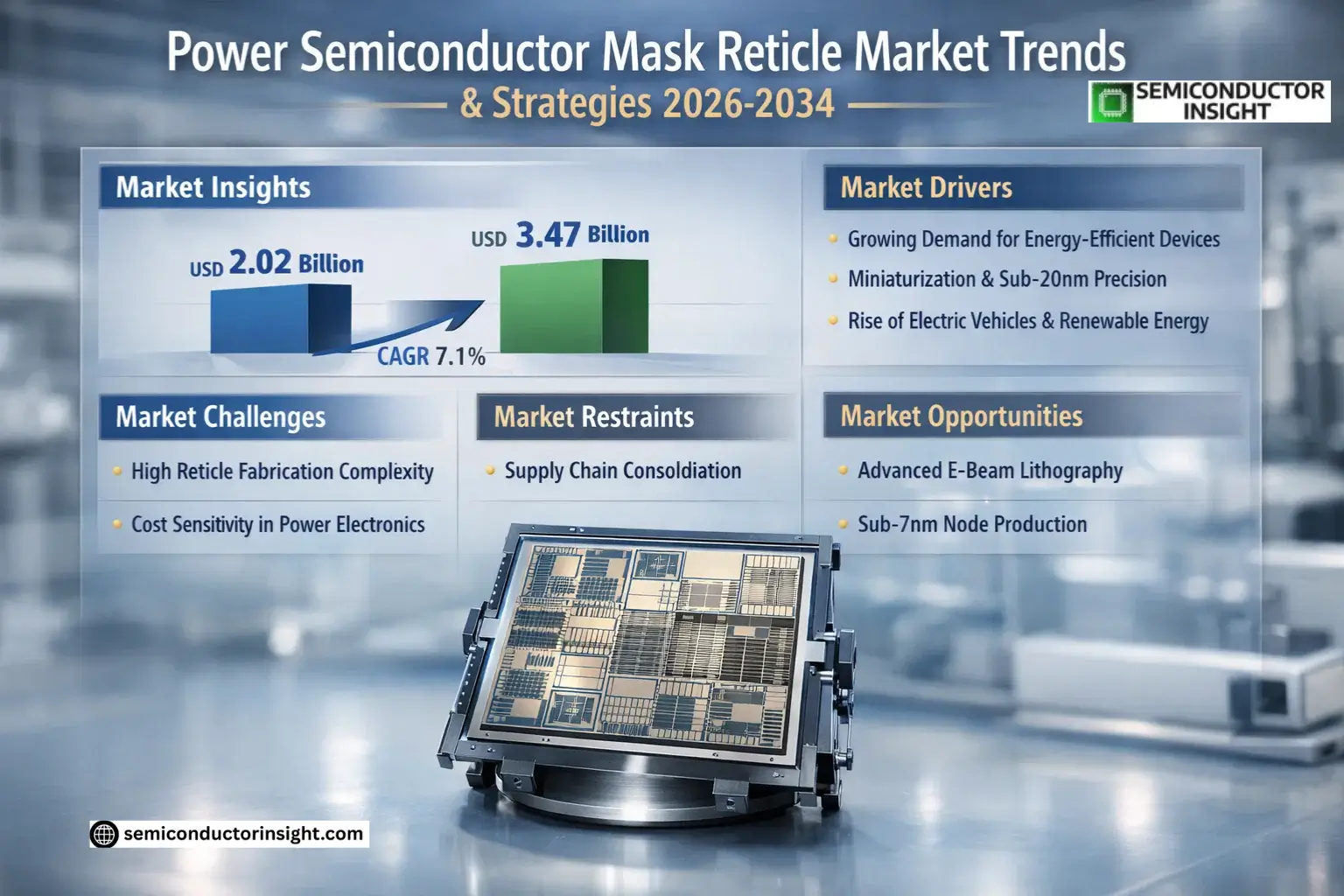
Global Power Semiconductor Mask Reticle Market size was valued at USD 1.85 billion in 2025. The market is projected to grow from USD 2.02 billion in 2026 to USD 3.47 billion by 2034, exhibiting a CAGR of 7.1% during the forecast period.
Power semiconductor mask reticles are critical components used in the fabrication of power semiconductor devices, enabling precise patterning of integrated circuits. These reticles serve as templates for photolithography processes, defining the intricate geometries required for power MOSFETs, IGBTs, and other high-voltage devices. The technology plays a pivotal role in energy-efficient electronics across automotive, industrial, and consumer applications.
Market growth is driven by increasing demand for electric vehicles and renewable energy systems, which rely heavily on advanced power semiconductors. While the transition to larger wafer sizes presents technical challenges, innovations in EUV lithography and multi-patterning techniques are creating new opportunities. Key players like Photronics and Toppan Photomasks continue to invest in cutting-edge manufacturing capabilities to meet evolving industry requirements.
MARKET DRIVERS
Growing Demand for Energy-Efficient Power Devices
The rising adoption of power semiconductor devices in electric vehicles, renewable energy systems, and smart grids is accelerating demand for high-precision Power Semiconductor Mask Reticles. These components are critical for fabricating advanced power MOSFETs, IGBTs, and GaN/SiC devices that enable energy conversion efficiency improvements of up to 30% compared to conventional silicon.
Miniaturization and Complexity in Power Electronics
As power semiconductors shrink below 100nm nodes while handling higher voltages, the Power Semiconductor Mask Reticle Market sees increased requirements for sub-20nm edge placement accuracy. Leading manufacturers are investing in multi-patterning reticles that can achieve <5nm overlay precision for high-voltage applications.
Automotive electrification remains the dominant driver, with EV power modules requiring 3-5x more mask layers than traditional automotive ICs.
MARKET CHALLENGES
High Reticle Fabrication Complexity
Producing Power Semiconductor Mask Reticles for high-voltage applications requires specialized e-beam lithography systems capable of handling thick resist layers up to 1μm while maintaining critical dimension uniformity below ±5%. This technical barrier limits production capacity among mask shops.
Other Challenges
Cost Sensitivity in Power Electronics
While logic semiconductor nodes continue scaling, many power devices remain at mature nodes where customers resist reticle price increases. Mask costs now account for 15-20% of total wafer fabrication expenses for power ICs.
MARKET RESTRAINTS
Consolidation in the Semiconductor Supply Chain
Power Semiconductor Mask Reticle Market faces constraints from vertical integration trends, with major IDMs bringing mask production in-house. This has reduced opportunities for independent mask shops in certain power semiconductor segments like automotive-grade IGBTs.
MARKET OPPORTUNITIES
Wide Bandgap Semiconductor Adoption
SiC and GaN power devices require specialized Power Semiconductor Mask Reticles with unique materials and defect specifications. The GaN power device market alone is forecast to grow at 35% CAGR through 2030, creating parallel demand for advanced reticle solutions.
Power Semiconductor Mask Reticle Market Trends
Technological Advancements Driving Market Growth
Power Semiconductor Mask Reticle Market is experiencing steady growth due to advancements in semiconductor manufacturing technologies. Leading manufacturers like Photronics and Toppan Photomasks are investing in higher precision mask reticles to support sub-7nm node production. The demand for smaller, more efficient power semiconductors in electric vehicles and renewable energy systems is accelerating this technological shift.
Other Trends
Increasing Adoption of 5-Inch Reticles
The 5-inch segment continues to dominate the Power Semiconductor Mask Reticle Market as it offers optimal balance between resolution and cost-efficiency for medium-node applications. Growth in industrial electronics and automotive systems is driving demand for these mid-range reticle solutions.
Asia-Pacific Emerges as Key Manufacturing Hub
China, South Korea, and Taiwan are rapidly expanding their Power Semiconductor Mask Reticle production capacity. Local manufacturers including ShenZhen Longtu Photomask and Taiwan Mask Corporation are gaining significant market share through competitive pricing and regional supply chain advantages. This geographic shift is reshaping global competitive dynamics.
Growing Demand for Automotive Applications
The automotive electronics segment is emerging as a major growth driver for Power Semiconductor Mask Reticles, particularly for electric vehicle power management systems. Manufacturers are developing specialized reticle solutions to meet the stringent reliability requirements of automotive-grade semiconductors.
Market Consolidation Through Strategic Partnerships
Recent industry trends show increasing mergers and collaborations among mask reticle suppliers to combine technical expertise and expand market reach. Major players are forming alliances with semiconductor foundries to co-develop advanced reticle solutions for next-generation power devices.
COMPETITIVE LANDSCAPE
Key Industry Players
Photronics and Toppan Photomasks Dominate Power Semiconductor Mask Reticle Production
Global Power Semiconductor Mask Reticle Market is consolidated with Photronics, Toppan Photomasks, and DNP collectively holding significant market share. Photronics leads with advanced lithography solutions specifically tailored for power semiconductor applications. The top five players accounted for approximately XX% market revenue in 2025, with major manufacturing clusters in North America and Asia-Pacific regions.
Niche players like ShenZhen Longtu Photomask are gaining traction by offering cost-competitive solutions for emerging applications in automotive electronics. Taiwan Mask Corporation has strengthened its position through strategic partnerships with leading foundries. The market sees increasing R&D investments in next-generation mask technologies to support wide bandgap semiconductor production.
List of Key Power Semiconductor Mask Reticle Companies Profiled
- Photronics
- Toppan Photomasks
- Dai Nippon Printing (DNP)
- Hoya Corporation
- ShenZhen Longtu Photomask
- Shenzhen Qingyi Photomask
- Taiwan Mask Corporation
- Compugraphics Photomask Solutions
- Photronics (Asia)
- Nippon Filcon
- PKU Electronics
- Newway Photomask
- LG Innotek
- Plasma-Therm
- Samsung Electronics
Segment Analysis:
| Segment Category | Sub-Segments | Key Insights |
| By Type |
|
5 Inches segment dominates due to its widespread compatibility with existing semiconductor manufacturing equipment. Key factors driving adoption:
|
| By Application |
|
Automotive Electronics segment shows strong growth potential with notable industry trends:
|
| By End User |
|
Foundries segment represents the largest user base with significant influence:
|
| By Technology Node |
|
Mature Nodes segment maintains strong position due to specific industry dynamics:
|
| By Material |
|
Quartz-based reticles remain industry standard with distinct advantages:
|
Regional Analysis: Power Semiconductor Mask Reticle Market
Asia-Pacific
Taiwan possesses the world’s most concentrated semiconductor mask reticle supply chain, with major players like Taiwan Mask Corporation serving global foundries. The island’s integrated ecosystem enables rapid prototyping and high-volume production of power semiconductor reticles with superior yield rates.
Japan maintains competitive advantage in ultra-fine power semiconductor reticles, with companies like Dai Nippon Printing producing masks below 10nm features. The country’s expertise in high-density power devices and wide bandgap semiconductor materials drives specialized mask requirements.
South Korea’s reticle industry supports power semiconductor applications in memory-logic integration, serving market leaders Samsung and SK Hynix. Korean manufacturers develop specialized mask solutions for 3D NAND flash memory applications requiring precise vertical stacking.
China’s aggressive semiconductor investments are driving rapid growth in domestic power semiconductor reticle production. New fabrication facilities in Shanghai and Beijing focus on mid-range power devices, creating opportunities for local mask suppliers seeking technology transfers.
North America
North America maintains strong capabilities in power semiconductor mask reticles through technology leadership and niche applications. The region specializes in high-voltage power devices for automotive and industrial applications, with mask makers developing specialized solutions for wide bandgap semiconductors. Silicon Valley’s proximity to major EDA tool developers provides early access to mask optimization technologies. Arizona’s expanding semiconductor manufacturing base is creating new demand for local reticle solutions to support power device production. Research collaborations between national laboratories and private sector drive innovation in next-generation power semiconductor masking techniques.
Europe
Europe’s power semiconductor mask reticle market focuses on automotive and industrial applications, with strong demand from German and Italian power electronics manufacturers. The region maintains leadership in high-power IGBT and SiC device manufacturing, requiring specialized mask solutions for rugged applications. Photomask producers benefit from close collaboration with equipment suppliers in the Netherlands and Germany. The European Chips Act is expected to strengthen domestic capacity through targeted investments in power semiconductor manufacturing facilities, creating opportunities for mask technology providers.
Middle East & Africa
The Middle East is emerging as a strategic location for power semiconductor mask reticle production, supported by growing investments in semiconductor manufacturing infrastructure. Israel’s expertise in power electronics drives specialized mask requirements for defense and energy applications. Gulf nations are developing semiconductor industrial zones that could attract power device manufacturers in coming years. Meanwhile, South Africa maintains small but technologically advanced power semiconductor capabilities focused on mining and industrial applications.
South America
South America’s power semiconductor mask reticle market remains in early development stages but shows potential in power management applications. Brazil’s electronics manufacturing sector drives demand for automotive and consumer power devices, creating opportunities for local mask solutions. The region benefits from proximity to North American semiconductor ecosystems, with potential to develop specialized reticle manufacturing for power conversion applications. Government initiatives to expand high-tech manufacturing could support future market growth.
Report Scope
This market research report provides a comprehensive analysis of the Power Semiconductor Mask Reticle Market, covering the forecast period 2025–2034. It offers detailed insights into market dynamics, technological advancements, competitive landscape, and key trends shaping the industry.
Key focus areas of the report include:
- Market Overview: The report begins with an overview outlining its current market scenario, key growth indicators, and industry transformation drivers. It discusses macroeconomic factors, demand–supply balance, regulatory landscape, and the strategic role of semiconductors in powering advancements across industries such as industrial electronics, automotive electronics, and consumer electronics.
- Market Size & Forecast: Historical data and future projections for revenue, unit shipments, and market value across major regions and segments.
- Segmentation Analysis: Detailed breakdown by product type, including 5 Inches, 6 Inches, and Others, to identify high-growth segments and investment opportunities.
- Regional Insights: Insights into market performance across North America, Europe, Asia, South America, and Middle East & Africa, including country-level analysis where relevant.
- Competitive Landscape: Profiles of leading market participants, including their product offerings, R&D focus, manufacturing capacity, pricing strategies, and recent developments such as mergers, acquisitions, and partnerships.
- Technology Trends & Innovation: Assessment of emerging technologies, integration of AI/IoT, semiconductor design trends, fabrication techniques, and evolving industry standards.
- Market Drivers & Restraints: Evaluation of factors driving market growth along with challenges, supply chain constraints, regulatory issues, and market-entry barriers.
- Stakeholder Insights: Insights for component suppliers, OEMs, system integrators, investors, and policymakers regarding the evolving ecosystem and strategic opportunities.
Primary and secondary research methods are employed, including interviews with industry experts, data from verified sources, and real-time market intelligence to ensure the accuracy and reliability of the insights presented.
FREQUENTLY ASKED QUESTIONS:
What is the current market size of Power Semiconductor Mask Reticle Market?
-> Power Semiconductor Mask Reticle Market size was valued at USD 1.85 billion in 2025. The market is projected to grow from USD 2.02 billion in 2026 to USD 3.47 billion by 2034, exhibiting a CAGR of 7.1% during the forecast period.
Which key companies operate in Power Semiconductor Mask Reticle Market?
-> Key players include Photronics, Toppan Photomasks, DNP, Hoya, ShenZhen Longtu Photomask, Shenzhen Qingyi Photomask, and Taiwan mask corporation, among others.
What are the key growth drivers?
-> Key growth drivers include rising demand from industrial and automotive electronics sectors, technological advancements in semiconductor manufacturing, and increasing investments in semiconductor fabrication facilities.
Which region dominates the market?
-> Asia is the fastest-growing region, particularly China, while North America remains a significant market.
What are the emerging trends?
-> Emerging trends include increasing adoption of advanced fabrication techniques, development of new mask reticle materials, and rising demand for higher precision in semiconductor manufacturing.
Get Sample Report PDF for Exclusive Insights
Report Sample Includes
- Table of Contents
- List of Tables & Figures
- Charts, Research Methodology, and more...
 Download Sample Report PDF