MARKET INSIGHTS
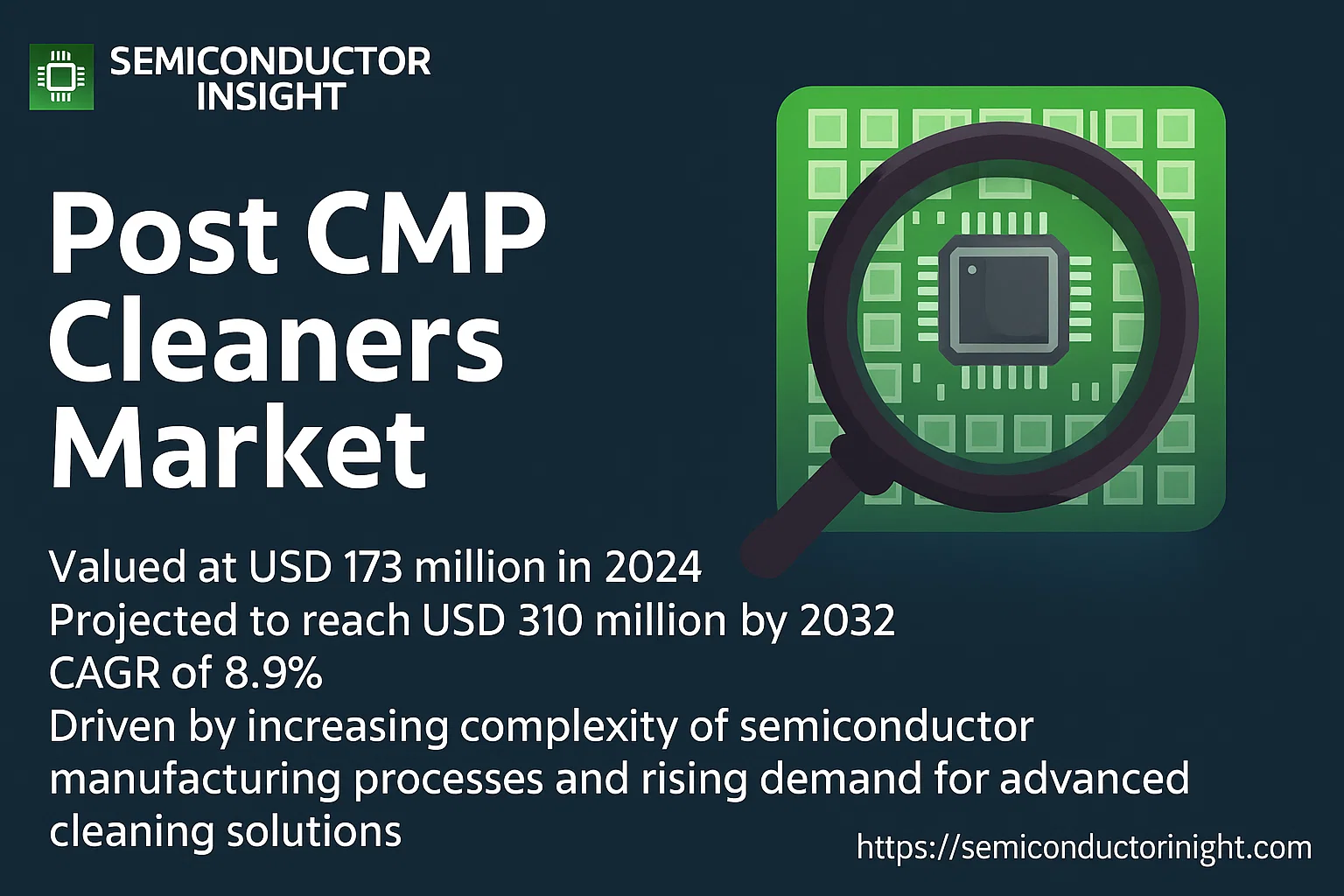
Global Post CMP Cleaners Market was valued at USD 173 million in 2024 and is projected to reach USD 310 million by 2032, exhibiting a CAGR of 8.9% during the forecast period. This growth is primarily driven by the increasing complexity of semiconductor manufacturing processes and the rising demand for advanced cleaning solutions that ensure high yields and device reliability. Post CMP (Chemical Mechanical Planarization) cleaning is a critical step to remove contaminants like metallic impurities, particles, and organic residues that can degrade device performance.
Key market drivers include the robust expansion of the semiconductor industry, particularly in the Asia-Pacific region, and the ongoing miniaturization of semiconductor devices which demands more precise cleaning capabilities. The market is characterized by the presence of established players like Entegris, Versum Materials (Merck KGaA), and Fujifilm, who are focusing on developing advanced formulations that offer high selectivity and cleaning efficiency while being environmentally sustainable. The transition to more advanced nodes, such as those below 10nm, is also creating new opportunities for specialized chemical suppliers.
Technological advancements, such as the development of multi-functional cleaners that combine chemical and mechanical actions, are expected to further propel the market. These innovations help in addressing challenges like the removal of stubborn residues without damaging delicate structures. The market’s growth is also supported by significant investments in new semiconductor fabrication facilities (fabs) globally, particularly in the United States, Taiwan, and South Korea.
MARKET DRIVERS
Advancements in Semiconductor Node Scaling
The relentless march of Moore’s Law continues to drive the semiconductor industry toward smaller, more complex nodes. As manufacturers move toward sub-7nm and 3nm processes, the chemical mechanical planarization (CMP) step becomes increasingly critical. Post-CMP cleaners are essential for removing abrasive particles, metallic contaminants, and organic residues without damaging delicate, high-aspect-ratio structures. This technological demand is a primary driver for advanced cleaner formulations and equipment.
Rising Demand for 3D NAND and Advanced Logic Devices
The proliferation of 3D NAND flash memory and complex logic devices like FinFETs and GAA transistors creates intricate surface topographies that are challenging to clean effectively. The increasing number of layers in 3D NAND necessitates highly effective post-CMP cleaning solutions to prevent defect-related yield loss. The market for these devices is projected to grow significantly, directly fueling demand for specialized post-CMP cleaning chemistries and tools.
➤ The global semiconductor CMP consumables market, a key indicator for post-CMP cleaners, is expected to grow at a CAGR of approximately 6.5% over the next five years.
Furthermore, the expansion of the Internet of Things (IoT), 5G infrastructure, and automotive electronics requires more semiconductor content, all of which rely on defect-free chips. This broad-based demand across multiple end-use industries ensures a steady and growing market for post-CMP cleaning products and technologies.
MARKET CHALLENGES
Stringent Defectivity and Yield Requirements
The primary challenge in the post-CMP cleaning market is meeting the increasingly stringent defectivity requirements at advanced nodes. Even nanometer-scale residues or particles can cause catastrophic device failure. Developing cleaning solutions that achieve near-perfect particle removal efficiency while being gentle on low-k dielectrics and ultrathin barrier layers is technically demanding and costly. The cost of failure is extremely high, putting immense pressure on suppliers.
Other Challenges
Chemistry and Material Compatibility
As new materials like cobalt, ruthenium, and novel high-mobility channel materials are introduced, formulating compatible cleaning chemistries that do not cause corrosion, etching, or unwanted surface modification is a significant hurdle. The R&D cycle for new cleaners must keep pace with the introduction of new materials in fab processes.
Environmental and Regulatory Pressures
Post-CMP cleaning often involves chemicals that are subject to strict environmental, health, and safety (EHS) regulations. The need to develop effective, yet “greener” chemistries with lower environmental impact adds complexity and cost to product development and can limit the use of certain effective but hazardous components.
MARKET RESTRAINTS
High R&D and Manufacturing Costs
The development of advanced post-CMP cleaning formulations requires substantial investment in research and development. The cost of raw materials, particularly high-purity specialty chemicals, is significant. Furthermore, the manufacturing process demands controlled environments to prevent contamination, adding to operational expenses. These high costs can act as a barrier to entry for new players and restrain overall market growth by limiting product affordability for smaller fabrication facilities.
Cyclical Nature of the Semiconductor Industry
The post-CMP cleaner market is intrinsically linked to the capital expenditure cycles of the semiconductor industry. During periods of downturn or overcapacity, semiconductor manufacturers delay or cancel new equipment purchases and reduce consumable usage. This cyclicality creates volatility and uncertainty for suppliers of post-CMP cleaners, making long-term planning and investment challenging.
MARKET OPPORTUNITIES
Advent of New Cleaning Technologies
There is a significant opportunity in the development and commercialization of novel cleaning technologies that go beyond traditional wet bench and single-wafer cleaning. Techniques such as cryogenic aerosol cleaning, supercritical CO2 cleaning, and laser-assisted cleaning offer potential for superior cleaning efficiency with reduced chemical and water consumption. Companies that can successfully integrate these technologies into high-volume manufacturing stand to gain considerable market share.
Expansion of Semiconductor Manufacturing Geographically
Government initiatives worldwide, particularly in the United States, Europe, and parts of Asia, are promoting domestic semiconductor manufacturing capacity through substantial subsidies and policy support (e.g., the CHIPS Act). This geographic expansion of fab construction creates a robust pipeline of new customers for post-CMP cleaner suppliers, representing a major long-term growth opportunity.
Demand for Advanced Packaging Solutions
The rise of advanced packaging platforms like 2.5D/3D ICs and heterogeneous integration requires specialized CMP and cleaning processes for through-silicon vias (TSVs) and micro-bumps. This segment is growing faster than the traditional front-end market and presents a lucrative niche for post-CMP cleaning solutions tailored to the unique challenges of packaging applications.
Post CMP Cleaners Market Trends
Strong Growth Trajectory Driven by Semiconductor Demand
The global Post CMP Cleaners market is experiencing significant expansion, with its value assessed at $173 million in 2024. It is projected to grow at a compound annual growth rate (CAGR) of 8.9%, reaching an estimated $310 million by 2032. This robust growth is primarily fueled by the relentless demand for advanced semiconductor devices and the continual miniaturization of electronic components. As chip manufacturers push towards smaller process nodes, the critical importance of removing contaminants like metallic impurities, particles, and organic residues after the Chemical Mechanical Planarization (CMP) process becomes paramount, directly driving the consumption of specialized cleaning chemistries.
Other Trends
Consolidated Market Leadership
The competitive landscape is characterized by a high degree of consolidation, with the top three companies—Entegris, Versum Materials (Merck KGaA), and Anjimirco Shanghai—collectively holding a dominant market share exceeding 60%. This concentration reflects the significant technological expertise and stringent quality control required to produce high-purity cleaning solutions that meet the exacting standards of the semiconductor industry. The market leadership of these established players is reinforced by their extensive R&D investments and strong relationships with major foundries.
Segmentation by Type and Application
The market is distinctly segmented by product type into Acidic Post CMP Cleaners and Alkaline Post CMP Cleaners, each formulated to address specific residue challenges on different wafer materials. By application, the market is divided into segments targeting the removal of Metal Impurities and Particles, Organic Residues, and other specialized cleaning needs. The precise formulation required for each application underscores the trend towards highly customized and application-specific solutions.
Geographical Market Dynamics
Regionally, Asia represents the largest and fastest-growing market, driven by the concentration of semiconductor fabrication plants, particularly in China, Japan, South Korea, and Southeast Asia. North America and Europe also hold significant shares, supported by the presence of key industry players and ongoing technological innovation. The regional analysis highlights the global nature of the semiconductor supply chain and the universal need for high-performance Post CMP cleaning solutions to ensure chip yield and reliability.
COMPETITIVE LANDSCAPE
Key Industry Players
Intense consolidation with the top three players commanding a dominant market share
The global Post-CMP Cleaners market is characterized by a high degree of consolidation, with global leaders Entegris and Versum Materials (Merck KGaA) establishing a strong foothold. These companies, along with other major players, leverage their extensive R&D capabilities, robust global supply chains, and deep domain expertise in semiconductor materials to maintain a competitive edge. The top three companies collectively account for over 60% of the global market share, highlighting the challenges faced by new entrants in establishing a significant presence. Competition is primarily based on product purity, formulation efficacy for advanced technology nodes (sub-10nm and below), and the ability to provide comprehensive technical support to leading semiconductor fabricators.
Beyond the dominant players, the market features several other significant competitors that focus on specific niches, regional markets, or particular chemical formulations. Companies such as Mitsubishi Chemical Corporation and Fujifilm are key contenders, offering specialized cleaning solutions. Niche players and regional suppliers like Anjimirco Shanghai compete by catering to specific geographic demands or by providing cost-effective alternatives. The competitive dynamics are further influenced by continuous technological advancements aimed at improving cleaning efficiency, reducing defects, and meeting the stringent purity requirements of next-generation semiconductor manufacturing processes.
List of Key Post-CMP Cleaners Companies Profiled
- Entegris
- Versum Materials (Merck KGaA)
- Mitsubishi Chemical Corporation
- Fujifilm
- DuPont
- Kanto Chemical Company, Inc.
- BASF SE
- Solexir
- Technic
- Anjimirco Shanghai
- JSR Corporation
- Avantor Performance Materials
Segment Analysis:
| Segment Category | Sub-Segments | Key Insights |
| By Type |
|
Acidic Post CMP Cleaners are the leading segment, primarily due to their exceptional efficacy in removing metal contaminants and slurry residues from wafer surfaces after chemical mechanical planarization. Their specific formulations are critical for advanced node semiconductor manufacturing where even minute levels of ionic contamination can severely impact device performance and yield. The demand is driven by the complex multi-patterning processes used in leading-edge logic and memory chips. |
| By Application |
|
Metal Impurities and Particles constitutes the dominant application segment, as the primary function of post-CMP cleaning is to eliminate these specific contaminants that originate from the CMP slurry and byproducts. The relentless push for smaller feature sizes and the adoption of new materials like cobalt and ruthenium interconnects make effective removal of metallic residues absolutely critical to prevent short circuits, electromigration failures, and ensure long-term device reliability across all semiconductor types. |
| By End User |
|
Semiconductor Foundries represent the leading end-user segment, driven by their massive production volumes for a diverse range of fabless chip companies and their focus on cutting-edge process technologies. The intense competition among foundries to offer superior yield and performance for next-generation nodes creates sustained demand for high-purity, high-selectivity cleaners. These facilities are characterized by their high utilization rates and continuous process refinement, making them the most significant consumers of advanced post-CMP cleaning chemistries. |
| By Technology Node |
|
Advanced Nodes are the dominant and fastest-evolving segment, demanding the most sophisticated cleaning solutions. As transistor densities increase and new materials are introduced, the tolerance for post-CMP defects becomes exceptionally low. Cleaners for these nodes require superior selectivity to prevent damage to fragile structures like ultra-low-k dielectrics and FinFETs, driving innovation in formulation complexity and performance. This segment’s growth is a key indicator of the overall health and technological trajectory of the semiconductor industry. |
| By Formulation Complexity |
|
Multi-Component Blended Formulations lead the segment due to their ability to address the multifaceted contamination challenges of modern semiconductor processes. These advanced formulations combine various chelating agents, surfactants, and corrosion inhibitors to simultaneously remove particles, organic residues, and metallic impurities without damaging the wafer surface. The dominance of these complex blends reflects the industry’s need for comprehensive cleaning performance and higher process margins, which single-chemistry products cannot provide for most advanced applications. |
Regional Analysis: Post CMP Cleaners Market
Asia-Pacific
The concentration of leading-edge semiconductor foundries in Taiwan and South Korea creates a highly concentrated demand center for Post CMP cleaners. This proximity to major fabs drives the development of highly specialized cleaning chemistries and rapid adoption of new formulations, as manufacturers require impeccable surface preparation for sub-7nm and finer technology nodes, ensuring minimal defects and optimal device performance.
Significant national investments, particularly from China and South Korea, aimed at achieving semiconductor self-sufficiency have dramatically accelerated the expansion of local manufacturing capacities. These policies are creating long-term, stable demand for consumables like Post CMP cleaners and encouraging the growth of domestic specialty chemical suppliers, fostering a dynamic and self-reliant regional ecosystem.
The early and widespread adoption of GAAFET transistors, advanced memory stacks, and complex 3D NAND structures in the region pushes the performance boundaries of Post CMP cleaners. Suppliers are compelled to innovate constantly to remove residues from high-aspect-ratio features without damaging delicate structures, making technology leadership a key driver for market growth.
A deeply integrated supply chain, from raw chemical producers to equipment OEMs and end-user fabs, characterizes the Asia-Pacific market. This integration allows for close collaboration between cleaner formulators and their customers, leading to the development of highly effective, application-specific solutions and ensuring efficient logistics and responsive technical support for major manufacturing sites.
North America
The North American market, particularly the United States, is a significant and technologically advanced region for Post CMP cleaners, underpinned by strong domestic R&D capabilities and the presence of leading integrated device manufacturers and fabless semiconductor companies. Recent policy shifts aimed at reshoring semiconductor production are expected to bolster long-term demand for high-performance consumables. The market is characterized by a strong emphasis on developing environmentally sustainable and safer chemical formulations, driven by stringent regulatory standards. North American suppliers often focus on high-value, specialty cleaners for leading-edge logic and memory applications, collaborating closely with research institutions to pioneer next-generation cleaning technologies that address challenges in novel materials and device architectures.
Europe
Europe maintains a strong position in the Post CMP cleaners market, anchored by a focus on specialized semiconductor segments such as automotive, industrial, and power electronics. The region benefits from a legacy of chemical expertise and a commitment to high-quality manufacturing standards. Demand is driven by the need for highly reliable cleaners that ensure the long-term performance and safety of chips used in critical applications, particularly within the automotive industry’s push towards vehicle electrification and autonomy. European suppliers are often leaders in developing green chemistry alternatives, aligning with the region’s strong environmental regulations, and cater to a diverse set of mid-volume, high-mix fabrication facilities that require robust and versatile cleaning solutions.
South America
The South American market for Post CMP cleaners is significantly smaller and less developed compared to other regions, primarily serving assembly and test operations rather than front-end wafer fabrication. The market dynamics are influenced by the import of finished semiconductor components and a focus on downstream electronics manufacturing. Local demand for high-purity cleaning chemicals is limited, with the market relying heavily on international suppliers. Growth potential is linked to broader regional economic development and any future initiatives aimed at establishing a more integrated local electronics supply chain, though it currently remains a niche and import-dependent market for these specialized chemicals.
Middle East & Africa
The market for Post CMP cleaners in the Middle East and Africa is nascent and represents a minor segment of the global landscape. Current demand is largely driven by specific industrial applications and limited electronics manufacturing, with no significant local semiconductor fabrication presence. However, strategic investments by certain Gulf nations in diversifying their economies beyond hydrocarbons into technology sectors could create future opportunities. For now, the region is characterized by a distribution-based market model, reliant on international chemical suppliers, with growth prospects tied to long-term economic diversification plans rather than existing industrial infrastructure.
Report Scope
This market research report provides a comprehensive analysis of the Post CMP Cleaners Market , covering the forecast period 2025–2032. It offers detailed insights into market dynamics, technological advancements, competitive landscape, and key trends shaping the industry.
Key focus areas of the report include:
- Market Overview: The report begins with an overview outlining its current market scenario, key growth indicators, and industry transformation drivers. It discusses macroeconomic factors, demand–supply balance, regulatory landscape, and the strategic role of semiconductors in powering advancements across industries such as automotive, telecommunications, consumer electronics, and industrial automation.
- Market Size & Forecast: Historical data and future projections for revenue, unit shipments, and market value across major regions and segments.
- Segmentation Analysis: Detailed breakdown by product type, technology, application, and end-user industry to identify high-growth segments and investment opportunities.
- Regional Insights: Insights into market performance across North America, Europe, Asia-Pacific, Latin America, and the Middle East & Africa, including country-level analysis where relevant.
- Competitive Landscape: Profiles of leading market participants, including their product offerings, R&D focus, manufacturing capacity, pricing strategies, and recent developments such as mergers, acquisitions, and partnerships.
- Technology Trends & Innovation: Assessment of emerging technologies, integration of AI/IoT, semiconductor design trends, fabrication techniques, and evolving industry standards.
- Market Drivers & Restraints: Evaluation of factors driving market growth along with challenges, supply chain constraints, regulatory issues, and market-entry barriers.
- Stakeholder Insights: Insights for component suppliers, OEMs, system integrators, investors, and policymakers regarding the evolving ecosystem and strategic opportunities.
Primary and secondary research methods are employed, including interviews with industry experts, data from verified sources, and real-time market intelligence to ensure the accuracy and reliability of the insights presented.
FREQUENTLY ASKED QUESTIONS:
What is the current market size of Post CMP Cleaners Market?
-> Post CMP Cleaners Market was valued at USD 173 million in 2024 and is projected to reach USD 310 million by 2032, exhibiting a CAGR of 8.9% during the forecast period.
Which key companies operate in Post CMP Cleaners Market?
-> Key players include Entegris, Versum Materials (Merck KGaA), Anjimirco Shanghai, Mitsubishi Chemical Corporation, Fujifilm, DuPont, Kanto Chemical Company, Inc., BASF SE, Solexir, and Technic, among others. Global top three companies hold a share over 60%.
What are the key growth drivers?
-> Key growth drivers include advancements in semiconductor manufacturing, increasing demand for high-performance electronic devices, and stringent requirements for surface cleanliness post-CMP processing.
Which region dominates the market?
-> Asia is the dominant market, driven by major semiconductor manufacturing hubs in countries like China, Japan, and South Korea.
What are the emerging trends?
-> Emerging trends include the development of advanced formulations for specific contaminants, increased focus on environmental and safety regulations, and the integration of more efficient cleaning technologies.

Get Sample Report PDF for Exclusive Insights
Report Sample Includes
- Table of Contents
- List of Tables & Figures
- Charts, Research Methodology, and more...
 Download Sample Report PDF