MARKET INSIGHTS
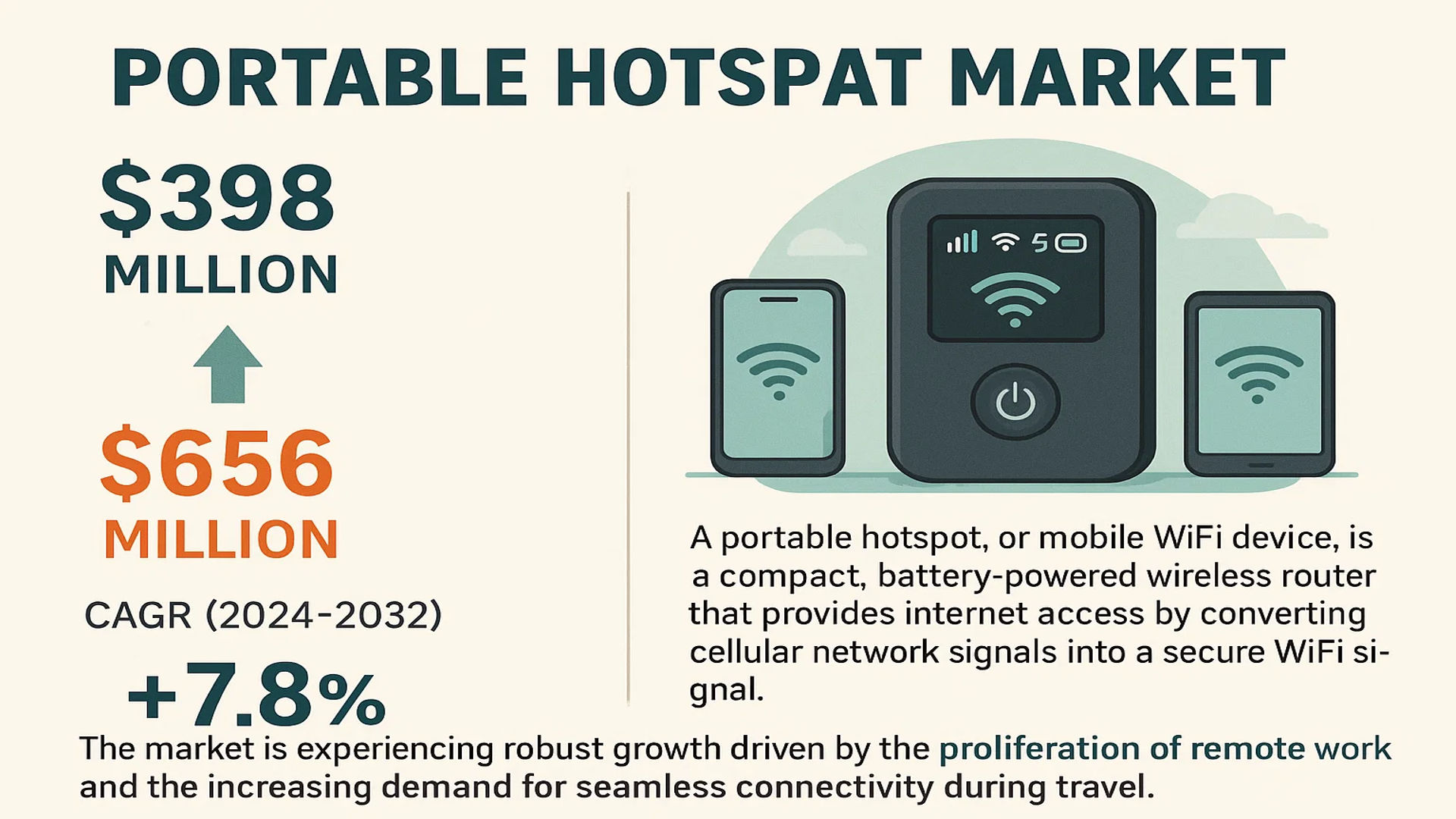
The global Portable Hotspot Market was valued at 398 million in 2024 and is projected to reach US$ 656 million by 2032, at a CAGR of 7.8% during the forecast period.
A portable hotspot, also known as a mobile WiFi device, is a compact, battery-powered wireless router that provides internet access by converting cellular network signals—from 4G, 4G LTE, or 5G networks—into a secure WiFi signal. This enables multiple devices such as smartphones, laptops, and tablets to connect to the internet simultaneously, offering a flexible and convenient solution for users on the move. These devices are particularly essential for mobile professionals, travelers, and remote workers who require reliable, high-speed connectivity outside of traditional fixed broadband environments.
The market is experiencing robust growth driven by the proliferation of remote work and the increasing demand for seamless connectivity during travel. Furthermore, the ongoing global rollout of 5G infrastructure is significantly enhancing the performance and appeal of these devices, offering users faster speeds and lower latency. Key industry players such as Huawei, NETGEAR, and TP-Link continue to innovate, introducing devices with extended battery life, enhanced security features, and support for advanced network standards to capture a larger market share and meet evolving consumer demands.
MARKET DYNAMICS
MARKET DRIVERS
Rise of Remote Work Culture Accelerates Portable Hotspot Adoption
The global shift toward remote and hybrid work models continues to fuel demand for portable hotspots, with over 40% of the global workforce now operating remotely at least part-time. This transformation requires reliable, high-speed internet connectivity outside traditional office environments, making portable hotspots indispensable tools for professionals. Enterprises increasingly provide these devices to ensure seamless productivity, particularly for field personnel, sales teams, and remote employees. The ability to maintain secure, stable connections during video conferences, large file transfers, and cloud-based collaborations drives consistent market growth. Furthermore, the integration of advanced security protocols in modern portable hotspots addresses corporate cybersecurity concerns, making them preferred solutions over public Wi-Fi networks.
Expansion of Global Tourism and Business Travel Enhances Market Penetration
International travel and tourism have rebounded significantly, with global tourist arrivals exceeding 1.3 billion annually, creating substantial demand for portable connectivity solutions. Travelers increasingly rely on portable hotspots to avoid expensive international roaming charges while maintaining constant internet access for navigation, translation services, and social sharing. Business travelers particularly benefit from these devices for uninterrupted work during transit and in locations with unreliable Wi-Fi. The market has responded with region-specific data plans and multi-network compatibility features, allowing seamless connectivity across borders. This trend is further amplified by the growing digital nomad movement, where professionals combine work with travel, requiring robust mobile internet solutions for extended periods abroad.
5G Network Deployment Creates New Performance Benchmarks
The ongoing global rollout of 5G networks represents a transformative driver for portable hotspot adoption. 5G-capable devices can deliver download speeds exceeding 1 Gbps, latency under 10 milliseconds, and support for numerous connected devices simultaneously. This performance level enables applications previously limited to fixed broadband, including augmented reality presentations, 4K video streaming, and real-time cloud computing. Network operators worldwide have invested over $200 billion in 5G infrastructure, creating the necessary ecosystem for high-performance portable hotspots. The technology particularly benefits sectors requiring massive data transmission, such as media production, emergency services, and telemedicine, where portable 5G hotspots provide critical connectivity solutions.
Furthermore, device manufacturers have introduced compact, power-efficient 5G hotspots with extended battery life, addressing previous limitations while delivering enterprise-grade performance. These advancements position portable hotspots as viable alternatives to traditional fixed-line internet connections in various scenarios.
MARKET RESTRAINTS
High Data Costs and Subscription Limitations Restrict Widespread Adoption
Despite technological advancements, expensive data plans remain a significant barrier to portable hotspot market expansion. Many mobile operators impose data caps and throttle speeds after certain usage thresholds, limiting the practicality of hotspots for data-intensive applications. Consumers and businesses often find that unlimited data plans come with hidden restrictions or premium pricing, making continuous hotspot usage economically challenging. In emerging markets, where price sensitivity is particularly acute, these cost structures significantly slow adoption rates. The situation is further complicated by complex international roaming policies, where travelers face unexpectedly high charges despite purchasing supposedly global data packages.
Battery Life and Performance Limitations Hinder User Experience
Portable hotspots face inherent limitations in battery capacity and thermal management, particularly with 5G connectivity. High-speed data transmission consumes substantial power, often limiting continuous usage to 6-8 hours despite manufacturers’ claims. This creates practical challenges for users requiring all-day connectivity without access to power sources. Additionally, performance consistency varies significantly based on network congestion, signal strength, and environmental factors. Users in crowded areas or moving vehicles frequently experience connectivity drops and speed fluctuations, reducing reliability for mission-critical applications. These technical constraints particularly affect professional users who depend on stable connections for video conferencing, large uploads, and real-time collaboration.
Other Restraints
Network Coverage Disparities
Significant variations in network quality and coverage between urban and rural areas create inconsistent user experiences. While urban centers enjoy robust 5G coverage, many rural and remote locations still struggle with basic 4G connectivity, limiting the utility of portable hotspots in these regions. This geographical digital divide affects both consumer and enterprise adoption patterns.
Device Compatibility Issues
The proliferation of frequency bands and network technologies across different regions creates compatibility challenges. Travelers often discover their devices lack support for local network bands, resulting in suboptimal performance despite purchasing region-specific SIM cards or data plans.
MARKET CHALLENGES
Intense Competition from Alternative Connectivity Solutions Pressures Market Position
Portable hotspots face growing competition from embedded connectivity solutions in smartphones, tablets, and laptops. Most modern devices feature native tethering capabilities that provide similar functionality without requiring separate hardware or subscriptions. Mobile network operators increasingly promote smartphone-based hotspot features as part of standard plans, reducing the value proposition of dedicated devices. Additionally, the expansion of public Wi-Fi networks in urban areas, transportation hubs, and commercial establishments provides free alternative connectivity, particularly for light users. This competitive landscape forces portable hotspot manufacturers to demonstrate clear advantages in security, reliability, and performance to justify additional hardware investments.
Other Challenges
Security Vulnerabilities
Portable hotspots present attractive targets for cyber attacks due to their mobile nature and frequent use on unsecured networks. Device manufacturers must continuously address vulnerabilities through firmware updates and enhanced encryption protocols, but many users neglect these updates, leaving systems exposed.
Regulatory Compliance Complexities
Differing telecommunications regulations across countries create compliance challenges for manufacturers and service providers. Spectrum allocation variations, device certification requirements, and data privacy laws necessitate customized approaches for different markets, increasing development and operational costs.
MARKET OPPORTUNITIES
Enterprise Digital Transformation Initiatives Create New Application Scenarios
Corporate digital transformation projects present significant growth opportunities for portable hotspot manufacturers. Businesses increasingly deploy these devices for IoT connectivity, temporary site installations, emergency backup systems, and mobile point-of-sale solutions. The manufacturing sector utilizes industrial-grade hotspots for equipment monitoring and maintenance in areas without fixed connectivity. Retail establishments employ them for pop-up stores and outdoor events requiring immediate payment processing capabilities. These enterprise applications typically involve larger orders, longer device lifecycles, and premium service contracts, creating higher-margin opportunities compared to consumer markets. Manufacturers developing specialized solutions for vertical industries can capture substantial market share while establishing long-term customer relationships.
Integration with Emerging Technologies Opens New Revenue Streams
The convergence of portable hotspots with edge computing, artificial intelligence, and advanced security features creates innovative product opportunities. Smart hotspots with built-in threat detection, automated network optimization, and predictive connectivity management offer differentiated value propositions. Integration with cloud services enables seamless switching between cellular and satellite connectivity, ensuring uninterrupted service in remote locations. These technological enhancements allow manufacturers to move beyond basic connectivity toward comprehensive mobile productivity solutions. The growing demand for always-connected automotive systems, smart city infrastructure, and remote healthcare monitoring further expands potential applications beyond traditional mobile computing uses.
Additionally, partnerships between hotspot manufacturers and cloud service providers create bundled offerings that simplify deployment and management for enterprise customers. These collaborations often include centralized device management platforms, automated software updates, and integrated security services, providing complete connectivity solutions rather than standalone devices.
PORTABLE HOTSPOT MARKET TRENDS
5G Integration and Enhanced Connectivity Driving Market Evolution
The global portable hotspot market is undergoing a significant transformation, primarily driven by the widespread integration of 5G technology. This advancement is not merely an incremental upgrade but a fundamental shift that enhances data transmission speeds, reduces latency, and supports a higher density of connected devices. While 4G and 4G LTE technologies currently dominate the market, accounting for over 75% of device shipments in 2024, the adoption of 5G-capable hotspots is accelerating rapidly. This transition is crucial for supporting data-intensive applications such as high-definition video conferencing, cloud-based gaming, and real-time collaborative tools, which are becoming standard in both commercial and personal environments. Furthermore, the expansion of 5G network infrastructure by telecommunications providers globally is creating a more robust ecosystem for these devices to operate efficiently, thereby expanding their utility and appeal across diverse user segments.
Other Trends
Rise of Remote and Hybrid Work Models
The sustained shift towards remote and hybrid work models continues to be a powerful catalyst for the portable hotspot market. With an estimated 35% of the global workforce engaging in some form of remote work as of 2024, the demand for reliable, high-speed internet access outside traditional office settings has surged. Portable hotspots provide a critical solution for professionals requiring seamless connectivity during travel, at client sites, or in home offices with inadequate broadband. Enterprises are increasingly provisioning these devices to their employees to ensure productivity and operational continuity, recognizing that network reliability directly impacts business outcomes. This trend is further amplified in regions with underdeveloped fixed broadband infrastructure, where mobile internet solutions become indispensable for economic participation and professional mobility.
Product Innovation and Intensifying Market Competition
Manufacturers are engaged in fierce competition, driving a cycle of continuous product innovation aimed at differentiating their offerings and capturing market share. Key areas of focus include extending battery life beyond 12 hours of continuous use, reducing device size and weight for enhanced portability, and incorporating multi-carrier SIM support for improved network flexibility and coverage. Security features have also become a paramount concern, leading to the integration of advanced encryption protocols, VPN support, and user authentication mechanisms to protect against data breaches. This competitive landscape benefits consumers through better product choices and pricing, but it pressures manufacturers to constantly innovate while managing costs. The market is also witnessing a trend towards ecosystem integration, with hotspots becoming part of broader IoT and smart device networks, further embedding their role in the connected digital lifestyle.
COMPETITIVE LANDSCAPE
Key Industry Players
Companies Strive to Strengthen their Product Portfolio to Sustain Competition
The global portable hotspot market exhibits a semi-consolidated competitive structure, characterized by the presence of multinational telecommunications giants, specialized networking equipment manufacturers, and emerging regional players. This dynamic is driven by continuous technological evolution, particularly the transition from 4G to 5G, and increasing demand from both commercial and personal user segments. Market leadership is often determined by a combination of technological innovation, global distribution networks, and strategic carrier partnerships.
Huawei Technologies Co., Ltd. maintains a formidable position in the market, leveraging its extensive expertise in telecommunications infrastructure and consumer devices. The company’s strength stems from its vertically integrated supply chain, allowing for competitive pricing, and its early investment in 5G technology, which has resulted in a portfolio of advanced 5G portable hotspots. Its global reach, though occasionally challenged by geopolitical factors, ensures a significant market share across Asia, Europe, and other regions.
Similarly, NETGEAR, Inc. and TP-Link Corporation have secured substantial market positions. NETGEAR’s Nighthawk series of mobile hotspots is widely recognized for its high performance and reliability, catering especially to power users and business professionals in North America and Europe. TP-Link’s strategy focuses on offering cost-effective solutions without compromising on essential features, making it a popular choice in price-sensitive markets and among personal users globally.
Furthermore, these leading companies are actively engaged in growth initiatives beyond mere product launches. Strategic partnerships with mobile network operators (MNOs) are crucial, as they often lead to devices being bundled with data plans, thereby driving adoption. Investments in research and development are heavily focused on enhancing battery life, improving thermal management for 5G devices, and integrating advanced security features like VPN passthrough and enhanced encryption to address growing user concerns over data privacy.
Meanwhile, other key players like D-Link Corporation and ZTE Corporation are strengthening their market presence by targeting specific niches and expanding their geographical footprint. D-Link has been successful in the small and medium business segment with robust devices offering enterprise-grade management features. ZTE, with strong roots in the Chinese market, is increasingly focusing on international expansion, offering a range of devices that support a wide array of network bands to ensure compatibility across different countries.
List of Key Portable Hotspot Companies Profiled
- Huawei Technologies Co., Ltd. (China)
- D-Link Corporation (Taiwan)
- TP-Link Corporation (China)
- NETGEAR, Inc. (U.S.)
- ZTE Corporation (China)
- Shangzan Wifi (China)
Segment Analysis:
By Type
5G Segment Leads Due to Superior Speed and Low Latency for High-Demand Applications
The market is segmented based on type into:
- 4G
- 4G LTE
- 5G
- Dual-band (2.4GHz & 5GHz)
- Others
By Application
Commercial Use Segment Dominates Owing to Rising Remote Work and Enterprise Mobility Needs
The market is segmented based on application into:
- Commercial Use
- Personal Use
- Government & Public Safety
- Education
- Others
By End User
Enterprise Sector Holds Largest Share Driven by Corporate Mobility and Secure Connectivity Requirements
The market is segmented based on end user into:
- Enterprises
- Individual Consumers
- Educational Institutions
- Government Agencies
- Others
By Distribution Channel
Online Retail Gains Traction Due to Convenience and Wider Product Selection
The market is segmented based on distribution channel into:
- Online Retail
- Offline Retail
- Direct Sales
- Telecom Operators
- Others
Regional Analysis: Portable Hotspot Market
Asia-Pacific
The Asia-Pacific region dominates the global portable hotspot market, accounting for approximately 45% of global revenue share in 2024. This leadership position is driven by massive mobile workforce populations, extensive tourism infrastructure, and rapid 5G network deployment. China and India serve as primary growth engines, with China’s Ministry of Industry and Information Technology reporting over 2.8 million 5G base stations deployed by early 2024. The region’s manufacturing hub status enables competitive pricing, with local brands like Huawei and ZTE capturing significant market share. While urban centers show strong adoption of 5G-capable devices, rural areas continue to rely on 4G LTE models due to infrastructure gaps. The growing digital nomad culture across Southeast Asian countries further fuels demand for reliable mobile connectivity solutions.
North America
North America represents a mature yet steadily growing market characterized by high consumer spending power and advanced network infrastructure. The United States accounts for approximately 85% of regional market value, driven by robust enterprise adoption for remote work solutions and frequent business travel. Major carriers like Verizon and T-Mobile offer integrated hotspot plans with their cellular services, creating a competitive ecosystem. The region shows particularly strong demand for 5G-capable devices, with consumers prioritizing network speed and reliability over price sensitivity. Recent infrastructure investments through federal programs have expanded network coverage in rural areas, creating new growth opportunities. However, market growth faces headwinds from increasing smartphone tethering capabilities and improving public WiFi availability in urban centers.
Europe
Europe’s portable hotspot market is characterized by stringent data protection regulations and high environmental consciousness among consumers. The EU’s General Data Protection Regulation (GDPR) has driven manufacturers to implement enhanced security features in their devices. Western European nations, particularly Germany, France, and the UK, show strong adoption in both commercial and personal segments, with the business travel sector accounting for approximately 40% of regional revenue. The market demonstrates distinct preference for eco-friendly products with longer battery life and energy-efficient operation. Eastern European countries are experiencing faster growth rates due to improving network infrastructure and increasing mobile workforce adoption. The region’s well-developed tourism industry, particularly in Mediterranean countries, provides consistent seasonal demand for rental and short-term usage devices.
South America
South America presents emerging opportunities driven by improving mobile network coverage and growing digitalization efforts. Brazil dominates the regional market, accounting for nearly 60% of portable hotspot sales, followed by Argentina and Chile. The market remains primarily focused on 4G LTE devices due to cost considerations and gradual 5G rollout. Economic volatility and currency fluctuations continue to challenge market stability, affecting consumer purchasing power and import costs. However, government initiatives to expand internet access in remote areas and growing freelance economy are creating sustained demand. The region shows particular potential for mid-range devices balancing performance and affordability, with local carriers increasingly offering bundled data plans to stimulate adoption.
Middle East & Africa
The Middle East & Africa region represents the smallest but fastest-growing market segment, projected to expand at a CAGR of 9.2% through 2032. Gulf Cooperation Council (GCC) countries, particularly UAE and Saudi Arabia, lead adoption due to high per capita income, extensive business travel, and advanced network infrastructure. The African market remains largely untapped, though countries like South Africa, Nigeria, and Kenya are showing increasing demand driven by mobile banking expansion and growing digital entrepreneurship. Market growth faces challenges from limited network coverage in rural areas and economic constraints across many African nations. The region shows distinct preference for durable devices with long battery life and robust connectivity features suited to challenging environmental conditions.
Report Scope
This market research report provides a comprehensive analysis of the global and regional Portable Hotspot markets, covering the forecast period 2025–2032. It offers detailed insights into market dynamics, technological advancements, competitive landscape, and key trends shaping the industry.
Key focus areas of the report include:
- Market Size & Forecast: Historical data and future projections for revenue, unit shipments, and market value across major regions and segments.
- Segmentation Analysis: Detailed breakdown by product type, technology, application, and end-user industry to identify high-growth segments and investment opportunities.
- Regional Outlook: Insights into market performance across North America, Europe, Asia-Pacific, Latin America, and the Middle East & Africa, including country-level analysis where relevant.
- Competitive Landscape: Profiles of leading market participants, including their product offerings, R&D focus, manufacturing capacity, pricing strategies, and recent developments such as mergers, acquisitions, and partnerships.
- Technology Trends & Innovation: Assessment of emerging technologies, integration of AI/IoT, semiconductor design trends, fabrication techniques, and evolving industry standards.
- Market Drivers & Restraints: Evaluation of factors driving market growth along with challenges, supply chain constraints, regulatory issues, and market-entry barriers.
- Stakeholder Analysis: Insights for component suppliers, OEMs, system integrators, investors, and policymakers regarding the evolving ecosystem and strategic opportunities.
Primary and secondary research methods are employed, including interviews with industry experts, data from verified sources, and real-time market intelligence to ensure the accuracy and reliability of the insights presented.
FREQUENTLY ASKED QUESTIONS:
What is the current market size of Global Portable Hotspot Market?
-> Portable Hotspot Market was valued at 398 million in 2024 and is projected to reach US$ 656 million by 2032, at a CAGR of 7.8% during the forecast period.
Which key companies operate in Global Portable Hotspot Market?
-> Key players include Huawei, D-Link, TP-Link, NETGEAR, ZTE, and Shangzan Wifi, among others.
What are the key growth drivers?
-> Key growth drivers include mobile office and remote work trends, rising tourism demand, advances in mobile network technology (5G deployment), and increased product innovation.
Which region dominates the market?
-> Asia-Pacific is the fastest-growing region, while North America remains a dominant market.
What are the emerging trends?
-> Emerging trends include integration of 5G technology, enhanced security features, longer battery life devices, and flexible data plan offerings.

Get Sample Report PDF for Exclusive Insights
Report Sample Includes
- Table of Contents
- List of Tables & Figures
- Charts, Research Methodology, and more...