Polymer Resettable Fuses Market Insights
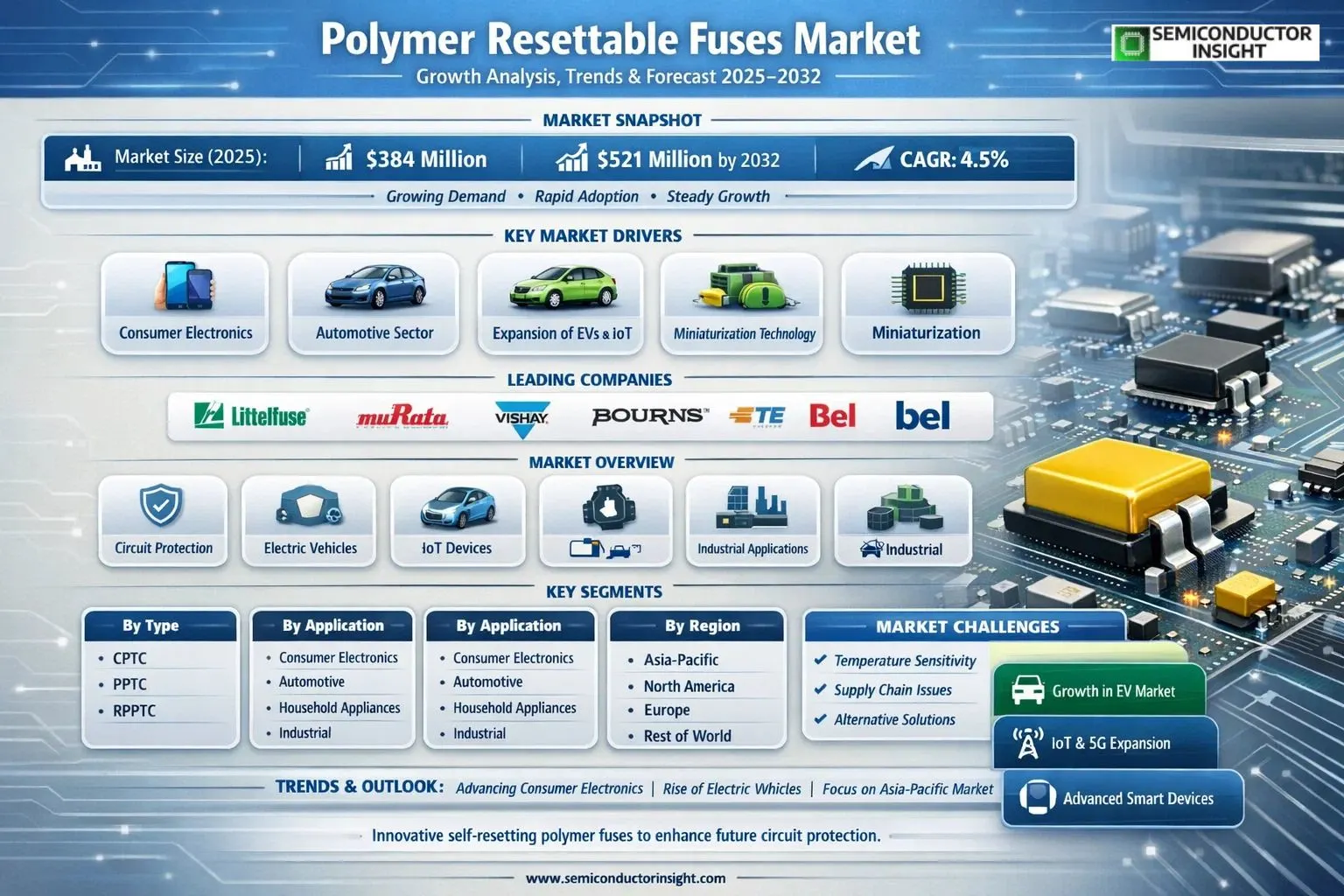
Global Polymer Resettable Fuses market size was valued at USD 384 million in 2025. The market is projected to reach USD 521 million by 2032, exhibiting a CAGR of 4.5% during the forecast period.
Polymer resettable fuses are overcurrent protection devices based on polymer materials. When the current in the circuit exceeds the preset value, the self-resetting fuse will heat up quickly and its resistance value increases sharply, thus limiting the current passage and protecting the circuit from overcurrent damage. Once the fault is removed and the temperature drops, the self-resetting fuse will automatically return to a low resistance state and resume normal operation. Polymer resettable fuses provide reliable overcurrent protection for circuits, ensuring the safe and stable operation of equipment.
Polymer Resettable Fuses Market is experiencing steady growth due to rising demand for circuit protection in consumer electronics, automotive, and industrial applications. Furthermore, the expansion of electric vehicles and IoT devices heightens the need for resettable safeguards over traditional fuses. Advancements in polymer formulations enable smaller footprints and faster response times, boosting adoption. Key players like Littelfuse, Murata Manufacturing, Vishay Intertechnology, Bourns, TE Connectivity, and Suzhou Walter Electronic lead with broad portfolios, driving innovation and market expansion through new product launches and enhanced performance features.
MARKET DRIVERS
Technological Advancements and Safety Demands
In Polymer Resettable Fuses Market, rapid growth in consumer electronics and automotive sectors is propelled by the need for reliable overcurrent protection. These devices, leveraging polymeric positive temperature coefficient materials, automatically reset after fault conditions, reducing downtime compared to traditional fuses. Global adoption has surged, with the market valued at approximately USD 1.2 billion in 2023, driven by stringent safety regulations like UL 1434.
Expansion in High-Growth Industries
The proliferation of electric vehicles (EVs) and renewable energy systems further accelerates demand for compact, high-performance polymer resettable fuses. Automotive applications alone account for over 30% of market share, benefiting from their ability to handle high inrush currents. Miniaturization trends in smartphones and wearables also contribute, as these fuses enable slimmer designs without compromising protection.
➤ In telecommunications infrastructure, polymer resettable fuses protect sensitive 5G equipment from surges, supporting a projected 6.5% CAGR through 2030.
Overall, increasing focus on circuit reliability amid rising electronic device penetration worldwide solidifies the pivotal role of Polymer Resettable Fuses Market in modern applications.
MARKET CHALLENGES
Performance Limitations Under Extremes
Polymer Resettable Fuses Market faces hurdles from inconsistent performance in extreme temperatures, where response times can vary by up to 20% outside -40°C to 85°C ranges. This impacts reliability in harsh environments like industrial automation and aerospace, prompting manufacturers to invest in advanced polymer formulations.Supply chain disruptions for specialized conductive polymers have intensified, with raw material costs fluctuating 15-20% annually, squeezing margins for key players.
Other Challenges
Competition from Alternatives
Traditional PTC thermistors and resettable SMD fuses offer lower upfront costs, capturing segments where reset cycles are infrequent, challenging market penetration in cost-sensitive regions like Southeast Asia.
MARKET RESTRAINTS
High Development and Certification Costs
Development expenses in Polymer Resettable Fuses Market remain a significant barrier, with R&D for low-resistance variants costing up to USD 5 million per product line. Extensive testing for automotive-grade certifications like AEC-Q200 delays market entry by 12-18 months.Market fragmentation due to diverse voltage and current ratings limits economies of scale, as manufacturers produce niche variants for specific applications in power supplies and battery management systems.Limited awareness among smaller electronics firms restrains broader adoption, particularly in emerging markets where one-time fuses dominate due to familiarity and lower education on resettable benefits.
MARKET OPPORTUNITIES
Emerging Applications in EVs and IoT
Polymer Resettable Fuses Market stands to gain from the EV boom, where battery protection circuits require fuses handling 100A+ surges; this segment could expand at 8% CAGR. IoT devices, projected to reach 30 billion units by 2030, demand ultra-low power fuses for prolonged battery life.5G infrastructure and smart grids present avenues for high-voltage polymer fuses, improving fault tolerance in distributed energy systems amid renewable integration.Strategic partnerships for custom solutions in consumer durables and medical devices further unlock growth, with Asia-Pacific leading at 40% regional share due to manufacturing hubs.
Polymer Resettable Fuses Market Trends
Growing Demand in Consumer Electronics
Polymer resettable fuses, leveraging polymer materials for overcurrent protection, are seeing heightened adoption in consumer electronics due to their ability to quickly limit excessive current and automatically reset after fault conditions. As devices become more compact and power-intensive, these fuses ensure circuit safety without manual replacement, aligning with trends toward reliable, maintenance-free components. Leading applications include smartphones, laptops, and portable gadgets where space constraints favor their surface-mount designs.
Other Trends
Expansion in Automotive Sector
The automotive industry drives Polymer Resettable Fuses Market growth through integration in electric vehicles and advanced driver-assistance systems, protecting sensitive electronics from surges and shorts. With rising electrification, fuses like CPTC and PPTC variants provide essential safeguards for battery management and infotainment systems, supporting safety standards amid increasing vehicle complexity.
Rising Focus on Asia-Pacific Markets
Asia, particularly China and Japan, emerges as a pivotal region for Polymer Resettable Fuses Market expansion, fueled by robust manufacturing of household appliances and consumer goods. Key players such as Littelfuse, Murata Manufacturing, and TE Connectivity intensify competition, innovating PPTC fuses for high-density applications. This shift reflects supply chain diversification and demand for cost-effective protection in emerging electronics hubs, alongside growth in household appliances like smart home devices.
Household appliances further bolster demand as energy-efficient models incorporate these fuses for overload protection, enhancing durability. Industry surveys highlight challenges like raw material fluctuations, yet opportunities arise from regulatory pushes for safer electronics globally. North America and Europe maintain steady uptake in industrial and telecom uses, with manufacturers like Bourns and Vishay advancing polymer formulations for faster response times. Overall, Polymer Resettable Fuses Market evolves with emphasis on miniaturization and multi-application versatility, positioning it for sustained relevance in diverse sectors.
COMPETITIVE LANDSCAPE
Key Industry Players
Leading Manufacturers and Strategic Positioning in Polymer Resettable Fuses Market
Polymer Resettable Fuses Market is dominated by a few established global leaders, with the top five players collectively holding a significant revenue share in 2025. Littelfuse stands out as the market frontrunner, leveraging its extensive portfolio of overcurrent protection devices and strong innovation in polymer-based positive temperature coefficient (PTC) and conductive polymer thick film (CPTC) technologies. Companies like Murata Manufacturing, Vishay Intertechnology, Bourns, and TE Connectivity further consolidate the competitive structure through vertical integration, robust R&D investments, and broad distribution networks. This oligopolistic landscape fosters intense rivalry, driving advancements in resettable fuse reliability for applications in consumer electronics, automotive, and industrial sectors, while the global market grows from $384 million in 2025 to a projected $521 million by 2032 at a 4.5% CAGR.
Beyond the leaders, a cadre of niche players contributes specialized solutions and regional strengths, enhancing market diversity. Firms such as Bel Fuse, AEM Components, Schurter, and Suzhou Walter Electronic focus on high-performance variants for automotive and household appliances, while Asian manufacturers like Wayon Electronics, Shenzhen Socay Electronics, and Fuzetec Technology excel in cost-effective production, capturing shares in emerging markets. These second-tier competitors often differentiate through customization, rapid prototyping, and compliance with stringent safety standards, challenging incumbents in high-volume segments like PPTC fuses. Recent mergers, acquisitions, and expansions underscore the dynamic environment, with ongoing innovations addressing challenges in miniaturization and high-current ratings.
List of Key Polymer Resettable Fuses Companies Profiled
- Littelfuse
- Murata Manufacturing
- Vishay Intertechnology
- Bourns
- Bel Fuse
- AEM Components
- Pico Electronics
- Schurter
- TE Connectivity
- Suzhou Walter Electronic
- Dongguan Reomax Electronic Technology
- ShenZhen GuanRuiDa Electronic Technology
- Wayon Electronics
- Shenzhen Socay Electronics
- Dongguan Ampfort Electronics
- Shenzhen JDT Fuse Industrial
- Winvast Technology
- Fuzetec Technology
- Conquer Electronics
Segment Analysis:
| Segment Category | Sub-Segments | Key Insights |
| By Type |
|
PPTC
|
| By Application |
|
Consumer Electronics
|
| By End User |
|
Consumer Electronics Manufacturers
|
| By Voltage Rating |
|
Low Voltage
|
| By Form Factor |
|
Surface Mount Devices (SMD)
|
Regional Analysis: Polymer Resettable Fuses Market
Asia-Pacific
The region’s dense cluster of fabrication facilities drives Polymer Resettable Fuses Market leadership, enabling seamless integration into assembly lines for consumer gadgets and industrial controls, with localized sourcing minimizing disruptions.
Explosive growth in portable devices and wearables fuels adoption, as polymer fuses offer resettable safety superior to traditional options, supporting compact designs prevalent in Asia-Pacific’s gadget innovation landscape.
Transition to electrified mobility demands robust protection in battery management, where these fuses excel in withstanding thermal cycles, aligning with Asia-Pacific’s dominance in vehicle electronics production.
5G rollout and data center builds necessitate reliable fusing solutions, with regional players customizing low-resistance variants for high-speed networks, reinforcing market strength.
North America
North America plays a crucial role in Polymer Resettable Fuses Market, emphasizing innovation and high-reliability applications. Tech giants in the U.S. and Canada integrate these fuses into data centers, aerospace, and medical devices, prioritizing precision overcurrent protection. Stringent safety standards drive demand for advanced materials offering wide operating ranges. Automotive electrification, particularly in premium electric models, incorporates fuses for battery packs and powertrains. Research institutions collaborate with manufacturers to develop next-generation fuses resistant to extreme conditions. Supply chain resilience focuses on diversified sourcing amid global shifts, supporting steady market expansion.
Europe
Europe’s Polymer Resettable Fuses Market thrives on regulatory compliance and industrial automation. Countries like Germany and France lead in adopting fuses for machinery, renewable energy inverters, and smart grids, valuing their resettable nature for maintenance efficiency. Automotive manufacturers emphasize fuses in hybrid systems, aligning with emission norms. Sustainability pushes for eco-friendly polymers, fostering R&D in biodegradable variants. Cross-border collaborations enhance standardization, ensuring interoperability in interconnected systems across the region.
South America
South America witnesses emerging growth in Polymer Resettable Fuses Market, propelled by infrastructure upgrades and consumer electronics penetration. Brazil and Argentina prioritize fuses in power supplies and appliances amid electrification efforts. Cost-sensitive markets favor affordable, durable options for residential and light industrial use. Automotive assembly plants adopt them for entry-level vehicles, while renewable projects in solar and wind integrate fuses for fault protection, laying foundations for broader adoption.
Middle East & Africa
In the Middle East & Africa, Polymer Resettable Fuses Market gains traction through oil & gas, telecom expansions, and urbanization. Gulf nations deploy fuses in harsh-environment controls and smart city projects, seeking heat-resistant designs. African markets focus on affordable protection for off-grid solar and mobile charging stations. Regional partnerships with Asian suppliers bridge technology gaps, supporting infrastructure builds and fostering gradual market maturation.
Report Scope
This market research report provides a comprehensive analysis of Polymer Resettable Fuses Market, covering the forecast period 2025–2032. It offers detailed insights into market dynamics, technological advancements, competitive landscape, and key trends shaping the industry.
Key focus areas of the report include:
- Market Overview: The report begins with an overview outlining its current market scenario, key growth indicators, and industry transformation drivers. It discusses macroeconomic factors, demand–supply balance, regulatory landscape, and the strategic role of polymer resettable fuses in powering advancements across industries such as consumer electronics, household appliances, automotive, and others.
- Market Size & Forecast: Historical data and future projections for revenue, unit shipments, and market value across major regions and segments.
- Segmentation Analysis: Detailed breakdown by product type, technology, application, and end-user industry to identify high-growth segments and investment opportunities.
- Regional Insights: Insights into market performance across North America, Europe, Asia-Pacific, Latin America, and the Middle East & Africa, including country-level analysis where relevant.
- Competitive Landscape: Profiles of leading market participants, including their product offerings, R&D focus, manufacturing capacity, pricing strategies, and recent developments such as mergers, acquisitions, and partnerships.
- Technology Trends & Innovation: Assessment of emerging technologies, integration of AI/IoT, semiconductor design trends, fabrication techniques, and evolving industry standards.
- Market Drivers & Restraints: Evaluation of factors driving market growth along with challenges, supply chain constraints, regulatory issues, and market-entry barriers.
- Stakeholder Insights: Insights for component suppliers, OEMs, system integrators, investors, and policymakers regarding the evolving ecosystem and strategic opportunities.
Primary and secondary research methods are employed, including interviews with industry experts, data from verified sources, and real-time market intelligence to ensure the accuracy and reliability of the insights presented.
FREQUENTLY ASKED QUESTIONS:
What is the current market size of Polymer Resettable Fuses Market?
-> Polymer Resettable Fuses Market was valued at USD 384 million in 2025 and is expected to reach USD 521 million by 2032, at a CAGR of 4.5% during the forecast period.
Which key companies operate in Polymer Resettable Fuses Market?
-> Key players include Littelfuse, Murata Manufacturing, Vishay Intertechnology, Bourns, Bel Fuse, AEM Components, Pico Electronics, Schurter, TE Connectivity, Suzhou Walter Electronic, among others.
What are the key growth drivers?
-> Key growth drivers include rising demand for overcurrent protection in consumer electronics, household appliances, automotive, and other applications.
Which region dominates the market?
-> Asia dominates the market, led by major countries such as China, Japan, and South Korea, while North America holds significant share with the U.S. market.
What are the emerging trends?
-> Emerging trends include advancements in CPTC and PPTC types, product segments by application in electronics and automotive, and focus on reliable self-resetting polymer fuse technologies.

Get Sample Report PDF for Exclusive Insights
Report Sample Includes
- Table of Contents
- List of Tables & Figures
- Charts, Research Methodology, and more...