Polymer electrolytic capacitor for automotive 48V mild‑hybrid Market Insights
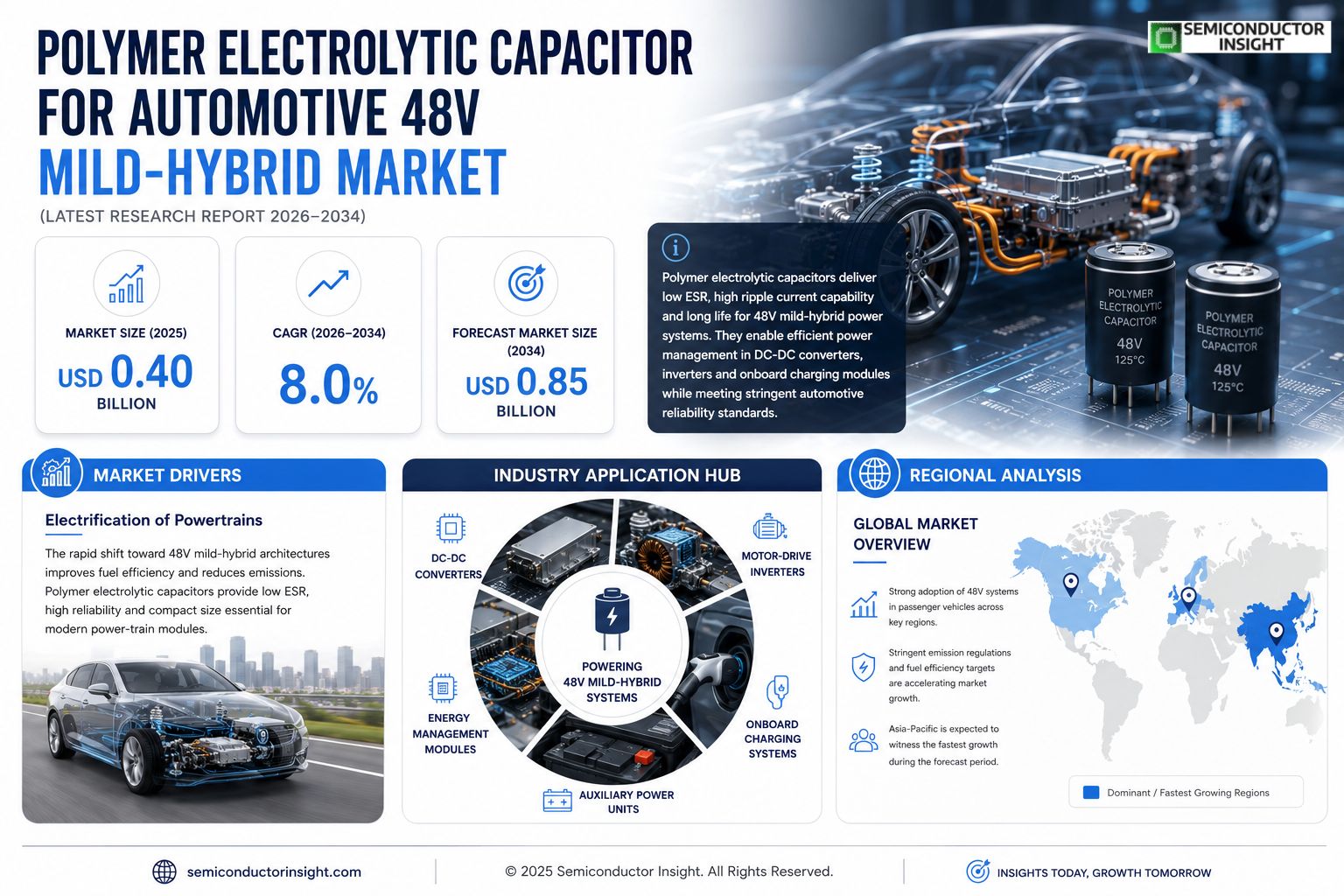
Polymer electrolytic capacitor for automotive 48V mild‑hybrid market size was valued at USD 0.40 billion in 2025. The market is projected to grow from USD 0 44 billion in 2026 to USD 0 85 billion by 2034, exhibiting a CAGR of 8 % during the forecast period.
Polymer electrolytic capacitors are solid‑state devices that combine a conductive Polymer electrolyte with an aluminum anode and cathode foil. They deliver low ESR, high ripple current capability, and long life,attributes essential for the high‑voltage (48 V) power‑train modules found in mild‑hybrid vehicles. Their compact form factor enables integration into DC‑DC converters, motor‑drive inverters, and onboard charging systems while meeting stringent automotive reliability standards such as AEC‑Q200.The market is experiencing rapid growth because vehicle manufacturers are accelerating the rollout of 48 V architectures to improve fuel efficiency and meet stricter CO₂ regulations. Furthermore, advances in Polymer chemistry are reducing part costs and extending temperature ranges, making these capacitors attractive for mass production. Key players,including KEMET Corporation, Panasonic Corporation, Vishay Intertechnology and AVX Corp.,are expanding capacity and launching new product families tailored for the mild‑hybrid segment.
MARKET DRIVERS
Electrification of Powertrains
The rapid shift toward 48V mild‑hybrid architectures in passenger vehicles drives demand for high‑reliability components. Polymer electrolytic capacitor for automotive 48V mild-hybrid Market benefits from superior ESR performance, enabling faster voltage regulation and improved fuel efficiency. OEMs are integrating these capacitors into DC‑DC converters to meet stricter emission standards.
Advances in Material Science
Recent breakthroughs in Polymer electrolytes have increased operating temperature ranges to 125 °C, reducing the need for additional cooling hardware. This cost‑effective thermal tolerance gives manufacturers a competitive edge and accelerates volume production of mild‑hybrid modules.
➤ “The adoption rate of 48V systems is projected to exceed 60 % of new vehicle launches by 2028, directly boosting capacitor shipments.”
In addition, the convergence of electric‑assist technologies with advanced driver‑assistance systems (ADAS) creates a synergistic effect, raising the overall market size for Polymer electrolytic solutions in the automotive sector.
MARKET CHALLENGES
Stringent Reliability Standards
Automakers demand failure rates below 10⁻⁶ cycles for safety‑critical applications. Achieving such reliability under high‑vibration environments requires rigorous testing, which increases development costs for suppliers.
Other Challenges
Supply Chain Volatility
Fluctuations in raw Polymer material availability can delay production schedules, affecting the ability to meet the accelerating rollout of mild‑hybrid models.
MARKET RESTRAINTS
Cost Sensitivity
While Polymer electrolytic capacitors offer performance advantages, their per‑unit cost remains higher than traditional aluminum electrolytics. Price‑sensitive OEMs may limit adoption to premium vehicle segments, constraining overall market penetration.
MARKET OPPORTUNITIES
Integration with Energy‑Storage Modules
The emergence of integrated power modules that combine DC‑DC conversion with energy‑storage functions opens a new avenue for Polymer electrolytic capacitors. By embedding capacitors within compact modules, manufacturers can reduce vehicle weight and simplify wiring, creating a sizable growth niche for Polymer electrolytic capacitor for automotive 48V mild-hybrid Market.
Polymer electrolytic capacitor for automotive 48V mild-hybrid Market Trends
Accelerated Adoption of 48V Architectures
Polymer electrolytic capacitor for automotive 48V mild-hybrid Market is being reshaped by a swift shift toward 48 V electrical systems in passenger vehicles. OEMs view the 48 V platform as a cost‑effective bridge between conventional 12 V architectures and full‑electric drivetrains, allowing modest improvements in fuel efficiency while meeting tighter CO₂ emission standards. As a result, demand for solid‑state capacitors with low equivalent series resistance (ESR) and high ripple current capability has risen sharply. These components are now integral to DC‑DC converters, motor‑drive inverters, and onboard charging modules, where space constraints and reliability requirements are especially stringent.
Other Trends
Advances in Polymer Chemistry
Recent breakthroughs in Polymer electrolyte formulations have extended the operating temperature window of Polymer electrolytic capacitor for automotive 48V mild-hybrid Market, enabling reliable performance up to 125 °C. Reduced part costs stem from higher conductivity Polymers that lower internal resistance, which in turn improves efficiency and heat dissipation in power‑train modules. The longer lifespan of these capacitors aligns with automotive service intervals, reducing total cost of ownership for manufacturers and end‑users alike. These material improvements also support higher voltage margins, giving system designers greater flexibility when integrating power electronics.
Supply Chain Expansion and New Product Launches
Key suppliers,including KEMET, Panasonic, Vishay, and AVX,have announced capacity expansions and introduced product families specifically engineered for the mild‑hybrid segment. Investment in dedicated wafer lines and automated assembly has shortened lead times, while modular design approaches allow manufacturers to customize capacitance and voltage ratings without extensive redesign. Collaborative programs with vehicle makers are accelerating qualification cycles, ensuring that new capacitor generations meet automotive standards such as AEC‑Q200. This coordinated effort is reducing time‑to‑market for next‑generation 48 V hybrids and supporting the broader electrification roadmap.
Overall, Polymer electrolytic capacitor for automotive 48V mild-hybrid Market is converging on a trajectory of steady growth driven by regulatory pressure, technological maturation, and strategic alignment among component vendors and automakers. The combination of lower cost, higher temperature tolerance, and robust reliability is cementing these capacitors as a cornerstone of the emerging 48 V power‑train ecosystem.
COMPETITIVE LANDSCAPE
Key Industry Players
Polymer electrolytic capacitor for automotive 48V mild‑hybrid market
The market is currently dominated by a handful of multinational capacitor manufacturers that have leveraged their existing automotive-grade product lines to address the emerging 48‑V mild‑hybrid segment. KEMET Corporation, Panasonic Corporation, Vishay Intertechnology and AVX Corp. collectively control the majority of volume shipments, driven by their extensive production capacity, established supply chains, and aggressive product‑launch cycles that align with OEM adoption timelines. These leaders supply low‑ESR, high‑ripple‑current Polymer electrolytic capacitors that meet AEC‑Q200 reliability standards, enabling integration into DC‑DC converters and inverter modules. Their market structure is characterized by tiered offerings,standard series for cost‑sensitive models and premium high‑temperature families for performance‑oriented vehicles,ensuring coverage across the full spectrum of 48‑V architectures.Beyond the primary tier, a diverse set of niche players contributes specialized capabilities that enhance competition and innovation. Companies such as Murata Manufacturing, Taiyo Yuden, TDK, Nichicon, Cornell Dubilier, Samsung Electro‑Mechanics, ROHM Semiconductor, EPCOS (TDK), Tai‑E‑Ming, and Vishay‑BC Components focus on high‑frequency performance, miniaturization, or extreme temperature ranges, targeting premium‑segment hybrids and emerging electric‑assist platforms. Their agility in Polymer chemistry advances and close collaborations with automotive OEMs allow them to capture market share in specific applications, such as on‑board charging and motor‑drive inverter modules, thereby enriching the overall ecosystem.
List of Key Polymer Electrolytic Capacitor Companies Profiled
- KEMET Corporation
- Panasonic Corporation
- Vishay Intertechnology
- AVX Corp.
- Murata Manufacturing
- Taiyo Yuden
- TDK Corporation
- Nichicon Corporation
- Cornell Dubilier
- Samsung Electro‑Mechanics
- ROHM Semiconductor
- EPCOS (TDK)
- Tai‑E‑Ming
- Vishay‑BC Components
Segment Analysis:
| Segment Category | Sub-Segments | Key Insights |
| By Type |
|
Solid‑Polymer electrolytic capacitors
|
| By Application |
|
Motor‑drive inverters
|
| By End User |
|
OEMs integrating 48 V systems
|
| By Functional Requirement |
|
High ripple‑current handling
|
| By Vehicle Architecture |
|
48 V mild‑hybrid platforms
|
Regional Analysis: Polymer electrolytic capacitor for automotive 48V mild-hybrid Market
North America
Europe
European manufacturers are leveraging stringent UNECE regulations to accelerate mild‑hybrid adoption, especially in Germany and France. Automakers prioritize Polymer electrolytic capacitors for their low ESR and long‑term stability, supporting advanced driver‑assistance systems. Collaborative projects between automotive clusters and capacitor producers foster technology sharing, while EU funding for low‑carbon mobility strengthens market confidence. The region’s emphasis on sustainability and vehicle efficiency fuels steady demand for reliable 48 V components.
Asia‑Pacific
Asia‑Pacific experiences rapid growth as Chinese and Japanese OEMs expand their mild‑hybrid line‑ups. Government subsidies and ambitious electrification roadmaps encourage the integration of Polymer electrolytic capacitors to meet high‑performance requirements. Local capacitor manufacturers are scaling production capacity, benefiting from lower material costs and a large engineering talent pool. Market dynamics are shaped by fast‑track vehicle certification processes and increasing consumer awareness of fuel‑saving technologies.
South America
In South America, Brazil leads the transition toward 48 V architectures, driven by regional emission standards and growing demand for hybrid commercial vehicles. While overall market size remains modest, strategic partnerships with North American capacitor suppliers enable technology transfer and local assembly. Consumer interest in fuel‑efficient vehicles supports gradual adoption, and emerging legislation hints at broader mild‑hybrid uptake in the coming years.
Middle East & Africa
The Middle East & Africa region shows nascent interest, with United Arab Emirates and South Africa exploring mild‑hybrid concepts for luxury and public‑transport fleets. Infrastructure development and oil‑price volatility motivate stakeholders to consider Polymer electrolytic capacitors for improved energy management. Although market penetration is early, collaborative pilots with capacitor firms suggest a foundation for future growth as regional sustainability goals evolve.
Report Scope
This market research report provides a comprehensive analysis of the Polymer electrolytic capacitor for automotive 48V mild-hybrid Market , covering the forecast period 2026–2034. It offers detailed insights into market dynamics, technological advancements, competitive landscape, and key trends shaping the industry.
Key focus areas of the report include:
- Market Overview: The report begins with an overview outlining its current market scenario, key growth indicators, and industry transformation drivers. It discusses macroeconomic factors, demand–supply balance, regulatory landscape, and the strategic role of semiconductors in powering advancements across industries such as automotive, telecommunications, consumer electronics, and industrial automation.
- Market Size & Forecast: Historical data and future projections for revenue, unit shipments, and market value across major regions and segments.
- Segmentation Analysis: Detailed breakdown by product type, technology, application, and end-user industry to identify high-growth segments and investment opportunities.
- Regional Insights: Insights into market performance across North America, Europe, Asia-Pacific, Latin America, and the Middle East & Africa, including country-level analysis where relevant.
- Competitive Landscape: Profiles of leading market participants, including their product offerings, R&D focus, manufacturing capacity, pricing strategies, and recent developments such as mergers, acquisitions, and partnerships.
- Technology Trends & Innovation: Assessment of emerging technologies, integration of AI/IoT, semiconductor design trends, fabrication techniques, and evolving industry standards.
- Market Drivers & Restraints: Evaluation of factors driving market growth along with challenges, supply chain constraints, regulatory issues, and market-entry barriers.
- Stakeholder Insights: Insights for component suppliers, OEMs, system integrators, investors, and policymakers regarding the evolving ecosystem and strategic opportunities.
Primary and secondary research methods are employed, including interviews with industry experts, data from verified sources, and real-time market intelligence to ensure the accuracy and reliability of the insights presented.
FREQUENTLY ASKED QUESTIONS:
What is the current market size of Polymer electrolytic capacitor for automotive 48V mild-hybrid Market?
-> Polymer electrolytic capacitor for automotive 48V mild-hybrid Market was valued at USD 0.40 billion in 2025 and is expected to reach USD 0.85 billion by 2034.
Which key companies operate in Polymer electrolytic capacitor for automotive 48V mild-hybrid Market?
-> Key players include KEMET Corporation, Panasonic Corporation, Vishay Intertechnology, and AVX Corp.
What are the key growth drivers?
-> Key growth drivers include the acceleration of 48 V vehicle architectures, stricter CO₂ emission regulations, and advances in Polymer chemistry that lower part costs and extend temperature ranges.
Which region dominates the market?
-> Region information is not disclosed in the provided data.
What are the emerging trends?
-> Emerging trends include advances in Polymer chemistry reducing costs, wider operating temperature ranges, and the launch of new product families specifically designed for mild‑hybrid power‑train modules.
Get Sample Report PDF for Exclusive Insights
Report Sample Includes
- Table of Contents
- List of Tables & Figures
- Charts, Research Methodology, and more...