PLC-Based Motion Controllers Market, Trends, Business Strategies 2025-2032

PLC-Based Motion Controllers Market size was valued at US$ 4.1 billion in 2024 and is projected to reach US$ 7.6 billion by 2032, at a CAGR of 7.9% during the forecast period 2025-2032.


PDF Icon Download Sample Report PDF
  • Quick Dispatch

    All Orders

  • Secure Payment

    100% Secure Payment

Price range: $1,500.00 through $4,250.00

Clear

MARKET INSIGHTS

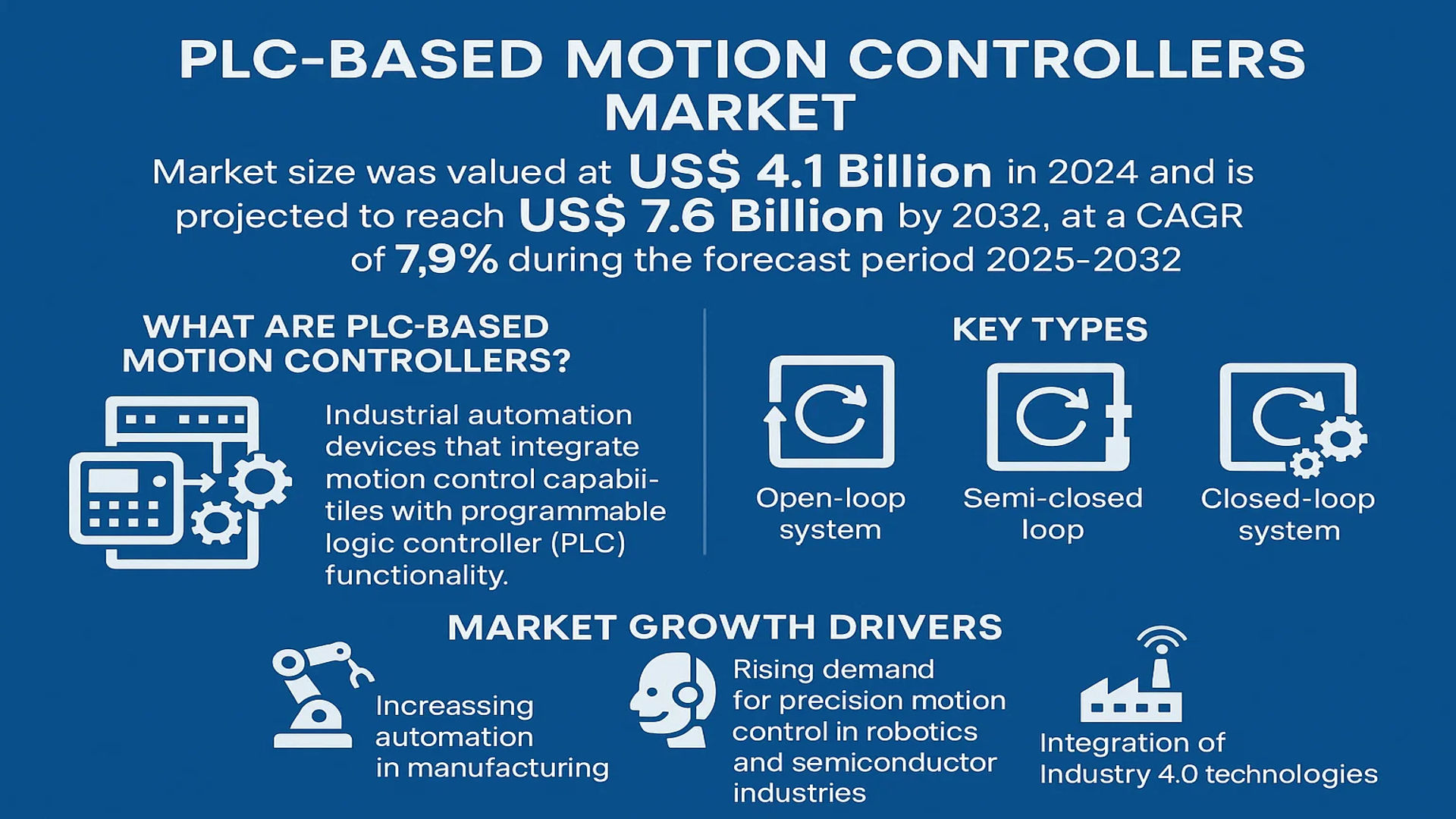
The global PLC-Based Motion Controllers Market size was valued at US$ 4.1 billion in 2024 and is projected to reach US$ 7.6 billion by 2032, at a CAGR of 7.9% during the forecast period 2025-2032.

PLC-Based Motion Controllers are industrial automation devices that integrate motion control capabilities with programmable logic controller (PLC) functionality. These controllers are designed to precisely manage the movement of motors, actuators, and other mechanical components in industrial applications. Key types include open-loop, semi-closed loop, and closed-loop systems, each offering different levels of precision and feedback mechanisms.

The market growth is driven by increasing automation in manufacturing, rising demand for precision motion control in robotics and semiconductor industries, and the integration of Industry 4.0 technologies. However, high implementation costs and technical complexities remain challenges. Key players like Siemens, Mitsubishi Electric, and Omron are expanding their portfolios with advanced motion control solutions to meet diverse industrial needs.
PLC-Based Motion Controllers Market

MARKET DYNAMICS

MARKET DRIVERS

Rapid Industrial Automation to Fuel Demand for PLC-Based Motion Controllers

The global push towards industrial automation across manufacturing sectors is significantly driving the adoption of PLC-based motion controllers. These devices serve as the backbone for precision motion control in automated systems, enabling complex operations in industries ranging from automotive to electronics. The manufacturing sector’s transition to Industry 4.0 standards, which emphasizes interconnectivity and smart technology, has increased the need for sophisticated motion control solutions. PLC-based controllers offer the perfect combination of programmability and reliability that modern automated production lines require.

Recent data indicates that over 60% of new industrial equipment installations now incorporate some form of programmable motion control. This trend is particularly strong in Asia-Pacific regions where manufacturing output continues to expand rapidly. The ability of PLC-based systems to integrate with existing industrial networks while providing precise motion control makes them indispensable in today’s automated factories.

Growing Robotics Sector Creates New Applications for Motion Control

The robotics industry’s explosive growth presents significant opportunities for PLC-based motion controller manufacturers. Industrial robots, collaborative robots (cobots), and automated guided vehicles all rely on precise motion control systems to function effectively. PLC-based controllers are particularly well-suited for these applications due to their robustness, real-time performance, and ability to handle complex motion profiles.

In the past three years, robotic installations have grown at a compound annual rate exceeding 12%, with projections indicating this growth will accelerate as labor shortages persist in many regions. The demand for more sophisticated robotic applications requiring multi-axis control and seamless integration with other factory systems further boosts the need for advanced PLC-based motion solutions. Leading manufacturers continue to develop specialized motion controllers optimized for robotic applications, creating new revenue streams in this high-growth sector.

Energy Efficiency Mandates Drive Technological Advancements

Increasing global focus on energy efficiency in industrial operations is spurring innovation in PLC-based motion control technology. Modern motion controllers now incorporate advanced algorithms that optimize energy consumption while maintaining performance. These developments align with stringent energy regulations being implemented across major manufacturing economies, particularly in Europe and North America.

Recent product launches showcase motion controllers capable of reducing energy consumption by up to 30% compared to previous generations, achieved through innovative power management features and dynamic response adjustments. As sustainability becomes a core consideration for industrial equipment purchases, these energy-efficient solutions gain competitive advantage, driving market growth. The ability to demonstrate measurable energy savings gives manufacturers an important differentiator in an increasingly competitive marketplace.

MARKET RESTRAINTS

High Implementation Costs Limit Adoption Among SMEs

While PLC-based motion controllers offer significant performance benefits, their relatively high implementation costs create barriers for small and medium-sized enterprises. The total cost of ownership includes not just the controller hardware but also integration services, programming expertise, and ongoing maintenance. For many smaller operations, these expenses can represent a substantial portion of their capital equipment budget, making alternative solutions more attractive despite their limitations.

The need for specialized technical personnel to implement and maintain these systems further adds to operational costs. Many smaller manufacturers face challenges in recruiting and retaining staff with the necessary skills to fully utilize advanced motion control capabilities. This skills gap particularly affects operations in regions with limited access to technical training programs.

Complexity of System Integration Presents Technical Challenges

As industrial automation systems grow more sophisticated, integrating PLC-based motion controllers with other plant equipment becomes increasingly complex. The proliferation of communication protocols and industrial networks, while providing flexibility, also creates compatibility challenges. Many facilities operate mixed-vendor environments where achieving seamless integration requires significant customization and troubleshooting.

This complexity extends to software configuration, where motion control programs must account for mechanical system characteristics, safety requirements, and process variables. The learning curve for programming sophisticated motion profiles can be steep, and errors in implementation may lead to equipment damage or production downtime. These technical hurdles sometimes deter potential adopters from implementing advanced motion control solutions even when they would benefit their operations.

MARKET CHALLENGES

Cybersecurity Threats Require Continuous Investment in Protection

The growing connectivity of industrial control systems, including PLC-based motion controllers, exposes them to increasingly sophisticated cybersecurity threats. As these devices become network-connected to enable remote monitoring and predictive maintenance capabilities, they also become potential entry points for malicious actors. Addressing these vulnerabilities requires ongoing investment in security features and firmware updates from manufacturers.

Industrial facilities face the challenge of implementing robust security measures without compromising system performance or creating unnecessary complexity for operators. The need to maintain compatibility with legacy systems while implementing modern security protocols presents particular difficulties. Recent incidents have demonstrated that cyberattacks on industrial control systems can have severe consequences, making this an area of persistent concern for both manufacturers and end-users.

Other Challenges

Technology Convergence Pressures
The boundaries between traditional PLCs, motion controllers, and industrial PCs continue to blur, creating product positioning challenges for manufacturers. Customers increasingly expect single devices that combine all these capabilities, forcing companies to adapt their product strategies while maintaining reliability and performance.

Supply Chain Vulnerabilities
Global semiconductor shortages have highlighted the vulnerability of motion controller production to supply chain disruptions. The specialized components required for high-performance motion control systems often have limited sourcing options, making production planning difficult during periods of component scarcity.

MARKET OPPORTUNITIES

Emerging Markets Present Significant Growth Potential

Developing economies in Asia, Latin America, and Africa offer substantial growth opportunities as their manufacturing sectors modernize. Many facilities in these regions are transitioning from manual or basic automated systems to more sophisticated solutions, creating demand for cost-effective motion control technologies. While price sensitivity remains high in these markets, manufacturers can capitalize on the need for reliable automation solutions that support industrial growth.

Strategic partnerships with local distributors and system integrators help international manufacturers navigate these markets effectively. Tailoring solutions to meet the specific requirements of emerging market customers, including robust designs for challenging operating environments and simplified interfaces for less-experienced operators, can provide competitive advantages.

Expansion of Electric Vehicle Manufacturing Creates New Applications

The rapid growth of electric vehicle production worldwide is generating demand for specialized motion control solutions. EV manufacturing involves unique processes such as battery assembly and electric motor production that require high-precision motion control. PLC-based systems capable of handling the specific requirements of these applications, including cleanroom compatibility and integration with specialized tooling, represent a significant growth area.

Major automotive manufacturers are making substantial investments in new production facilities dedicated to electric vehicles, with each facility requiring dozens or hundreds of motion control systems. This sector’s anticipated growth over the next decade creates a sustained opportunity for motion controller providers who can offer solutions optimized for EV production requirements.

PLC-BASED MOTION CONTROLLERS MARKET TRENDS

Integration of Industry 4.0 and Smart Manufacturing Drives Market Expansion

The rapid adoption of Industry 4.0 technologies has significantly influenced the demand for PLC-based motion controllers, particularly in automated manufacturing environments. These controllers play a pivotal role in smart factories by enabling precise motion control, real-time monitoring, and seamless integration with IoT-enabled systems. The global PLC-based motion controllers market, valued at US$ million in 2024, is projected to grow at a CAGR of % through 2032, driven by increasing automation in sectors such as automotive, semiconductors, and processing machinery. The rise of predictive maintenance and AI-driven optimization further reinforces the role of these controllers in minimizing downtime and improving operational efficiency.

Other Trends

Rising Demand for Closed-Loop Controllers

Closed-loop PLC-based motion controllers are gaining traction due to their superior accuracy in high-precision applications like robotics and CNC machining. Unlike open-loop systems, closed-loop variants offer real-time feedback correction, reducing errors in positioning and speed control. Industries such as semiconductor manufacturing and medical device production increasingly rely on these controllers to meet stringent quality standards. The shift toward Industry 4.0-compliant solutions has further accelerated investments in advanced motion control technologies.

Growth in Robotics and Collaborative Automation

The robotics sector has emerged as a major driver for PLC-based motion controllers, particularly in applications requiring synchronized multi-axis control. Collaborative robots (cobots), which work alongside human operators, demand flexible and responsive motion control solutions. PLC-based systems enable seamless communication between robotic arms and peripheral equipment, facilitating complex assembly and packaging tasks. With the global robotics market expanding rapidly, the demand for high-performance motion controllers is expected to surge, particularly in Asia-Pacific, where industrial automation investments are growing at an unprecedented rate.

Adoption in Emerging Economies

Emerging markets, particularly in Asia and Latin America, are witnessing accelerated adoption of PLC-based motion controllers due to increasing industrialization and government initiatives supporting automation. Countries like China and India are investing heavily in upgrading manufacturing infrastructure, driving the need for reliable motion control solutions. However, cost sensitivity in these regions favors mid-range PLC-based controllers that balance performance and affordability. Meanwhile, established markets like North America and Europe continue to prioritize advanced, high-speed controllers for complex industrial applications.

COMPETITIVE LANDSCAPE

Key Industry Players

Market Leaders Focus on Innovation and Strategic Partnerships to Maintain Dominance

The global PLC-Based Motion Controllers market exhibits a moderately concentrated competitive structure, dominated by established automation and industrial control system providers. According to recent market analysis, the top five companies collectively accounted for over 45% of global market share in 2024, demonstrating the influence of key industry players. Siemens AG leads this competitive space, leveraging its comprehensive automation ecosystem and strong manufacturing sector penetration across Europe and North America.

Mitsubishi Electric and Omron Corporation follow closely, particularly in the Asia-Pacific region where they benefit from localized manufacturing and established distribution networks. Their competitive positioning has been strengthened by continuous investments in high-precision motion control technologies, particularly for semiconductor and robotics applications. These companies reported year-on-year revenue growth of 7-12% in their industrial automation segments for fiscal year 2023.

Meanwhile, Schneider Electric and ABB are aggressively expanding their PLC motion controller portfolios through strategic acquisitions and partnerships. Schneider’s 2023 acquisition of a specialized motion control software developer significantly enhanced its closed-loop control capabilities. ABB’s recent collaboration with multiple robotics manufacturers demonstrates the growing importance of integrated motion solutions in factory automation.

Notably, the market also features several strong regional players, with Delta Electronics and Shenzhen Vector gaining substantial traction in Asian markets through cost-competitive offerings tailored for mid-range industrial applications. Market observers note that competition is intensifying as companies balance hardware innovation with software capabilities, particularly in areas like predictive maintenance and AI-driven motion optimization.

List of Key PLC-Based Motion Controller Companies Profiled

Segment Analysis:

By Type

Closed Loop Segment Leads the Market Due to Precision and Feedback Control Advantages

The market is segmented based on type into:

  • Open Loop
  • Semi-Closed Loop
  • Closed Loop

By Application

Processing Machinery Application Segment Dominates Due to Manufacturing Automation Growth

The market is segmented based on application into:

  • Robot
  • Semiconductor
  • Processing Machinery
  • Others

By Control Method

Digital Control Segment Gains Traction With Industry 4.0 Adoption

The market is segmented based on control method into:

  • Analog Control
  • Digital Control

By End-User Industry

Automotive Industry Represents Significant Market Share Due to Production Line Automation

The market is segmented based on end-user industry into:

  • Automotive
  • Electronics
  • Food & Beverage
  • Pharmaceuticals
  • Others

Regional Analysis: PLC-Based Motion Controllers Market

Asia-Pacific
The Asia-Pacific region dominates the global PLC-based motion controllers market, driven by rapid industrialization, automation adoption, and manufacturing expansion in countries like China, Japan, and India. China leads due to its robust semiconductor and robotics industries, accounting for over 35% of regional demand. The region benefits from cost-effective manufacturing and government initiatives like China’s “Made in China 2025,” which prioritizes smart manufacturing. However, supply chain disruptions and geopolitical tensions pose challenges for technology integration. The market is projected to grow at a CAGR of 10.2% through 2032, fueled by increasing use in robotics and processing machinery.

North America
North America remains a key innovator in PLC-based motion controller technology, with the U.S. holding a 68% share of the regional market. Strong demand arises from advanced manufacturing sectors, particularly semiconductor production and automotive automation. The Infrastructure Investment and Jobs Act has indirectly stimulated market growth by boosting industrial modernization. Strict quality standards and emphasis on Industry 4.0 integration drive adoption of closed-loop systems, though higher costs limit penetration in small and medium enterprises. Major players like Emerson and Rockwell Automation continue to introduce energy-efficient solutions to meet sustainability goals.

Europe
Europe’s mature industrial base sustains steady demand for high-precision motion controllers, with Germany and Italy leading adoption. The region emphasizes technical sophistication, particularly in machine tools and packaging equipment. EU regulations on energy efficiency and machine safety standards compel manufacturers to upgrade older systems. While growth is slower than in Asia (projected at 6.8% CAGR), the market benefits from strong R&D investments and cross-industry collaborations. Challenges include aging infrastructure in Eastern Europe and competitive pricing pressure from Asian manufacturers.

South America
The South American market shows moderate but uneven growth, with Brazil representing nearly half of regional demand. Food processing and mining equipment drive most applications, though economic volatility restricts capital investment in automation. Local manufacturers favor cost-effective open-loop systems, while multinational corporations implement advanced solutions. Infrastructure limitations and import dependencies hinder market expansion, though trade agreements show potential for increased technology transfer. The market remains opportunity-driven, with growth pockets in Argentina’s agricultural machinery sector.

Middle East & Africa
This emerging market demonstrates increasing interest in industrial automation, particularly in UAE and Saudi Arabia as they diversify from oil dependence. Government initiatives like Saudi Vision 2030 support factory automation, creating demand for motion control systems. However, the market faces hurdles including limited technical expertise and reliance on imported components. South Africa shows promise in mining applications, while North African nations gradually adopt these technologies in textile manufacturing. Overall growth remains constrained by infrastructure gaps but presents long-term potential.

Report Scope

This market research report provides a comprehensive analysis of the global PLC-Based Motion Controllers market, covering the forecast period 2024–2032. It offers detailed insights into market dynamics, technological advancements, competitive landscape, and key trends shaping the industry.

Key focus areas of the report include:

  • Market Size & Forecast: Historical data and future projections for revenue, unit shipments, and market value across major regions and segments. The global PLC-Based Motion Controllers market was valued at US$ 4.1 billion in 2024 and is projected to reach US$ 7.6 billion by 2032, growing at a CAGR of 7.9%.
  • Segmentation Analysis: Detailed breakdown by product type (Open Loop, Semi Closed Loop, Closed Loop), application (Robot, Semiconductor, Processing Machinery, Others), and end-user industry to identify high-growth segments and investment opportunities.
  • Regional Outlook: Insights into market performance across North America, Europe, Asia-Pacific, Latin America, and the Middle East & Africa, with Asia-Pacific emerging as the fastest-growing region due to industrial automation adoption.
  • Competitive Landscape: Profiles of leading market participants, including Siemens, Mitsubishi Electric, Omron, and Schneider Electric, covering their product portfolios, market share (top 5 companies hold over 35% share), and strategic initiatives.
  • Technology Trends & Innovation: Assessment of Industry 4.0 integration, smart manufacturing solutions, and advanced motion control algorithms driving market evolution.
  • Market Drivers & Restraints: Analysis of factors such as industrial automation demand, robotics adoption, and supply chain challenges impacting market growth.
  • Stakeholder Analysis: Strategic insights for automation solution providers, system integrators, and manufacturing enterprises regarding technology adoption and market positioning.

The research employs rigorous primary and secondary methodologies, including expert interviews, company financial analysis, and validated market intelligence to ensure data accuracy.

FREQUENTLY ASKED QUESTIONS:

What is the current market size of Global PLC-Based Motion Controllers Market?

->PLC-Based Motion Controllers Market size was valued at US$ 4.1 billion in 2024 and is projected to reach US$ 7.6 billion by 2032, at a CAGR of 7.9% during the forecast period 2025-2032.

Which key companies operate in Global PLC-Based Motion Controllers Market?

-> Key players include Siemens, Mitsubishi Electric, Omron, Schneider Electric, ABB, and Emerson, collectively holding significant market share.

What are the key growth drivers?

-> Primary growth drivers include rising industrial automation, increasing robotics adoption, and demand for precision motion control across manufacturing sectors.

Which region dominates the market?

-> Asia-Pacific leads in market growth, driven by China’s manufacturing expansion, while Europe maintains technological leadership in advanced motion control solutions.

What are the emerging trends?

-> Emerging trends include integration with IIoT platforms, AI-enabled motion control, and compact modular controller designs for flexible automation solutions.

PLC-Based Motion Controllers Market, Trends, Business Strategies 2025-2032

Get Sample Report PDF for Exclusive Insights

Report Sample Includes

  • Table of Contents
  • List of Tables & Figures
  • Charts, Research Methodology, and more...

PDF Icon Download Sample Report PDF

Download Sample Report

Table of Content

1 Introduction to Research & Analysis Reports
1.1 PLC-Based Motion Controllers Market Definition
1.2 Market Segments
1.2.1 Segment by Type
1.2.2 Segment by Application
1.3 Global PLC-Based Motion Controllers Market Overview
1.4 Features & Benefits of This Report
1.5 Methodology & Sources of Information
1.5.1 Research Methodology
1.5.2 Research Process
1.5.3 Base Year
1.5.4 Report Assumptions & Caveats
2 Global PLC-Based Motion Controllers Overall Market Size
2.1 Global PLC-Based Motion Controllers Market Size: 2024 VS 2032
2.2 Global PLC-Based Motion Controllers Market Size, Prospects & Forecasts: 2020-2032
2.3 Global PLC-Based Motion Controllers Sales: 2020-2032
3 Company Landscape
3.1 Top PLC-Based Motion Controllers Players in Global Market
3.2 Top Global PLC-Based Motion Controllers Companies Ranked by Revenue
3.3 Global PLC-Based Motion Controllers Revenue by Companies
3.4 Global PLC-Based Motion Controllers Sales by Companies
3.5 Global PLC-Based Motion Controllers Price by Manufacturer (2020-2025)
3.6 Top 3 and Top 5 PLC-Based Motion Controllers Companies in Global Market, by Revenue in 2024
3.7 Global Manufacturers PLC-Based Motion Controllers Product Type
3.8 Tier 1, Tier 2, and Tier 3 PLC-Based Motion Controllers Players in Global Market
3.8.1 List of Global Tier 1 PLC-Based Motion Controllers Companies
3.8.2 List of Global Tier 2 and Tier 3 PLC-Based Motion Controllers Companies
4 Sights by Product
4.1 Overview
4.1.1 Segment by Type – Global PLC-Based Motion Controllers Market Size Markets, 2024 & 2032
4.1.2 Open Loop
4.1.3 Semi Closed Loop
4.1.4 Closed Loop
4.2 Segment by Type – Global PLC-Based Motion Controllers Revenue & Forecasts
4.2.1 Segment by Type – Global PLC-Based Motion Controllers Revenue, 2020-2025
4.2.2 Segment by Type – Global PLC-Based Motion Controllers Revenue, 2026-2032
4.2.3 Segment by Type – Global PLC-Based Motion Controllers Revenue Market Share, 2020-2032
4.3 Segment by Type – Global PLC-Based Motion Controllers Sales & Forecasts
4.3.1 Segment by Type – Global PLC-Based Motion Controllers Sales, 2020-2025
4.3.2 Segment by Type – Global PLC-Based Motion Controllers Sales, 2026-2032
4.3.3 Segment by Type – Global PLC-Based Motion Controllers Sales Market Share, 2020-2032
4.4 Segment by Type – Global PLC-Based Motion Controllers Price (Manufacturers Selling Prices), 2020-2032
5 Sights by Application
5.1 Overview
5.1.1 Segment by Application – Global PLC-Based Motion Controllers Market Size, 2024 & 2032
5.1.2 Robot
5.1.3 Semiconductor
5.1.4 Processing Machinery
5.1.5 Others
5.2 Segment by Application – Global PLC-Based Motion Controllers Revenue & Forecasts
5.2.1 Segment by Application – Global PLC-Based Motion Controllers Revenue, 2020-2025
5.2.2 Segment by Application – Global PLC-Based Motion Controllers Revenue, 2026-2032
5.2.3 Segment by Application – Global PLC-Based Motion Controllers Revenue Market Share, 2020-2032
5.3 Segment by Application – Global PLC-Based Motion Controllers Sales & Forecasts
5.3.1 Segment by Application – Global PLC-Based Motion Controllers Sales, 2020-2025
5.3.2 Segment by Application – Global PLC-Based Motion Controllers Sales, 2026-2032
5.3.3 Segment by Application – Global PLC-Based Motion Controllers Sales Market Share, 2020-2032
5.4 Segment by Application – Global PLC-Based Motion Controllers Price (Manufacturers Selling Prices), 2020-2032
6 Sights by Region
6.1 By Region – Global PLC-Based Motion Controllers Market Size, 2024 & 2032
6.2 By Region – Global PLC-Based Motion Controllers Revenue & Forecasts
6.2.1 By Region – Global PLC-Based Motion Controllers Revenue, 2020-2025
6.2.2 By Region – Global PLC-Based Motion Controllers Revenue, 2026-2032
6.2.3 By Region – Global PLC-Based Motion Controllers Revenue Market Share, 2020-2032
6.3 By Region – Global PLC-Based Motion Controllers Sales & Forecasts
6.3.1 By Region – Global PLC-Based Motion Controllers Sales, 2020-2025
6.3.2 By Region – Global PLC-Based Motion Controllers Sales, 2026-2032
6.3.3 By Region – Global PLC-Based Motion Controllers Sales Market Share, 2020-2032
6.4 North America
6.4.1 By Country – North America PLC-Based Motion Controllers Revenue, 2020-2032
6.4.2 By Country – North America PLC-Based Motion Controllers Sales, 2020-2032
6.4.3 United States PLC-Based Motion Controllers Market Size, 2020-2032
6.4.4 Canada PLC-Based Motion Controllers Market Size, 2020-2032
6.4.5 Mexico PLC-Based Motion Controllers Market Size, 2020-2032
6.5 Europe
6.5.1 By Country – Europe PLC-Based Motion Controllers Revenue, 2020-2032
6.5.2 By Country – Europe PLC-Based Motion Controllers Sales, 2020-2032
6.5.3 Germany PLC-Based Motion Controllers Market Size, 2020-2032
6.5.4 France PLC-Based Motion Controllers Market Size, 2020-2032
6.5.5 U.K. PLC-Based Motion Controllers Market Size, 2020-2032
6.5.6 Italy PLC-Based Motion Controllers Market Size, 2020-2032
6.5.7 Russia PLC-Based Motion Controllers Market Size, 2020-2032
6.5.8 Nordic Countries PLC-Based Motion Controllers Market Size, 2020-2032
6.5.9 Benelux PLC-Based Motion Controllers Market Size, 2020-2032
6.6 Asia
6.6.1 By Region – Asia PLC-Based Motion Controllers Revenue, 2020-2032
6.6.2 By Region – Asia PLC-Based Motion Controllers Sales, 2020-2032
6.6.3 China PLC-Based Motion Controllers Market Size, 2020-2032
6.6.4 Japan PLC-Based Motion Controllers Market Size, 2020-2032
6.6.5 South Korea PLC-Based Motion Controllers Market Size, 2020-2032
6.6.6 Southeast Asia PLC-Based Motion Controllers Market Size, 2020-2032
6.6.7 India PLC-Based Motion Controllers Market Size, 2020-2032
6.7 South America
6.7.1 By Country – South America PLC-Based Motion Controllers Revenue, 2020-2032
6.7.2 By Country – South America PLC-Based Motion Controllers Sales, 2020-2032
6.7.3 Brazil PLC-Based Motion Controllers Market Size, 2020-2032
6.7.4 Argentina PLC-Based Motion Controllers Market Size, 2020-2032
6.8 Middle East & Africa
6.8.1 By Country – Middle East & Africa PLC-Based Motion Controllers Revenue, 2020-2032
6.8.2 By Country – Middle East & Africa PLC-Based Motion Controllers Sales, 2020-2032
6.8.3 Turkey PLC-Based Motion Controllers Market Size, 2020-2032
6.8.4 Israel PLC-Based Motion Controllers Market Size, 2020-2032
6.8.5 Saudi Arabia PLC-Based Motion Controllers Market Size, 2020-2032
6.8.6 UAE PLC-Based Motion Controllers Market Size, 2020-2032
7 Manufacturers & Brands Profiles
7.1 Siemens
7.1.1 Siemens Company Summary
7.1.2 Siemens Business Overview
7.1.3 Siemens PLC-Based Motion Controllers Major Product Offerings
7.1.4 Siemens PLC-Based Motion Controllers Sales and Revenue in Global (2020-2025)
7.1.5 Siemens Key News & Latest Developments
7.2 Mitsubishi Electric
7.2.1 Mitsubishi Electric Company Summary
7.2.2 Mitsubishi Electric Business Overview
7.2.3 Mitsubishi Electric PLC-Based Motion Controllers Major Product Offerings
7.2.4 Mitsubishi Electric PLC-Based Motion Controllers Sales and Revenue in Global (2020-2025)
7.2.5 Mitsubishi Electric Key News & Latest Developments
7.3 Omron
7.3.1 Omron Company Summary
7.3.2 Omron Business Overview
7.3.3 Omron PLC-Based Motion Controllers Major Product Offerings
7.3.4 Omron PLC-Based Motion Controllers Sales and Revenue in Global (2020-2025)
7.3.5 Omron Key News & Latest Developments
7.4 Emerson
7.4.1 Emerson Company Summary
7.4.2 Emerson Business Overview
7.4.3 Emerson PLC-Based Motion Controllers Major Product Offerings
7.4.4 Emerson PLC-Based Motion Controllers Sales and Revenue in Global (2020-2025)
7.4.5 Emerson Key News & Latest Developments
7.5 Advanced Micro Controls
7.5.1 Advanced Micro Controls Company Summary
7.5.2 Advanced Micro Controls Business Overview
7.5.3 Advanced Micro Controls PLC-Based Motion Controllers Major Product Offerings
7.5.4 Advanced Micro Controls PLC-Based Motion Controllers Sales and Revenue in Global (2020-2025)
7.5.5 Advanced Micro Controls Key News & Latest Developments
7.6 Schneider Electric
7.6.1 Schneider Electric Company Summary
7.6.2 Schneider Electric Business Overview
7.6.3 Schneider Electric PLC-Based Motion Controllers Major Product Offerings
7.6.4 Schneider Electric PLC-Based Motion Controllers Sales and Revenue in Global (2020-2025)
7.6.5 Schneider Electric Key News & Latest Developments
7.7 ABB
7.7.1 ABB Company Summary
7.7.2 ABB Business Overview
7.7.3 ABB PLC-Based Motion Controllers Major Product Offerings
7.7.4 ABB PLC-Based Motion Controllers Sales and Revenue in Global (2020-2025)
7.7.5 ABB Key News & Latest Developments
7.8 LS Electric
7.8.1 LS Electric Company Summary
7.8.2 LS Electric Business Overview
7.8.3 LS Electric PLC-Based Motion Controllers Major Product Offerings
7.8.4 LS Electric PLC-Based Motion Controllers Sales and Revenue in Global (2020-2025)
7.8.5 LS Electric Key News & Latest Developments
7.9 Panasonic
7.9.1 Panasonic Company Summary
7.9.2 Panasonic Business Overview
7.9.3 Panasonic PLC-Based Motion Controllers Major Product Offerings
7.9.4 Panasonic PLC-Based Motion Controllers Sales and Revenue in Global (2020-2025)
7.9.5 Panasonic Key News & Latest Developments
7.10 Delta Electronics
7.10.1 Delta Electronics Company Summary
7.10.2 Delta Electronics Business Overview
7.10.3 Delta Electronics PLC-Based Motion Controllers Major Product Offerings
7.10.4 Delta Electronics PLC-Based Motion Controllers Sales and Revenue in Global (2020-2025)
7.10.5 Delta Electronics Key News & Latest Developments
7.11 National Instruments
7.11.1 National Instruments Company Summary
7.11.2 National Instruments Business Overview
7.11.3 National Instruments PLC-Based Motion Controllers Major Product Offerings
7.11.4 National Instruments PLC-Based Motion Controllers Sales and Revenue in Global (2020-2025)
7.11.5 National Instruments Key News & Latest Developments
7.12 ACS Motion Control
7.12.1 ACS Motion Control Company Summary
7.12.2 ACS Motion Control Business Overview
7.12.3 ACS Motion Control PLC-Based Motion Controllers Major Product Offerings
7.12.4 ACS Motion Control PLC-Based Motion Controllers Sales and Revenue in Global (2020-2025)
7.12.5 ACS Motion Control Key News & Latest Developments
7.13 ICP DAS
7.13.1 ICP DAS Company Summary
7.13.2 ICP DAS Business Overview
7.13.3 ICP DAS PLC-Based Motion Controllers Major Product Offerings
7.13.4 ICP DAS PLC-Based Motion Controllers Sales and Revenue in Global (2020-2025)
7.13.5 ICP DAS Key News & Latest Developments
7.14 Shenzhen Vector
7.14.1 Shenzhen Vector Company Summary
7.14.2 Shenzhen Vector Business Overview
7.14.3 Shenzhen Vector PLC-Based Motion Controllers Major Product Offerings
7.14.4 Shenzhen Vector PLC-Based Motion Controllers Sales and Revenue in Global (2020-2025)
7.14.5 Shenzhen Vector Key News & Latest Developments
8 Global PLC-Based Motion Controllers Production Capacity, Analysis
8.1 Global PLC-Based Motion Controllers Production Capacity, 2020-2032
8.2 PLC-Based Motion Controllers Production Capacity of Key Manufacturers in Global Market
8.3 Global PLC-Based Motion Controllers Production by Region
9 Key Market Trends, Opportunity, Drivers and Restraints
9.1 Market Opportunities & Trends
9.2 Market Drivers
9.3 Market Restraints
10 PLC-Based Motion Controllers Supply Chain Analysis
10.1 PLC-Based Motion Controllers Industry Value Chain
10.2 PLC-Based Motion Controllers Upstream Market
10.3 PLC-Based Motion Controllers Downstream and Clients
10.4 Marketing Channels Analysis
10.4.1 Marketing Channels
10.4.2 PLC-Based Motion Controllers Distributors and Sales Agents in Global
11 Conclusion
12 Appendix
12.1 Note
12.2 Examples of Clients
12.3 DisclaimerList of Tables
Table 1. Key Players of PLC-Based Motion Controllers in Global Market
Table 2. Top PLC-Based Motion Controllers Players in Global Market, Ranking by Revenue (2024)
Table 3. Global PLC-Based Motion Controllers Revenue by Companies, (US$, Mn), 2020-2025
Table 4. Global PLC-Based Motion Controllers Revenue Share by Companies, 2020-2025
Table 5. Global PLC-Based Motion Controllers Sales by Companies, (K Units), 2020-2025
Table 6. Global PLC-Based Motion Controllers Sales Share by Companies, 2020-2025
Table 7. Key Manufacturers PLC-Based Motion Controllers Price (2020-2025) & (US$/Unit)
Table 8. Global Manufacturers PLC-Based Motion Controllers Product Type
Table 9. List of Global Tier 1 PLC-Based Motion Controllers Companies, Revenue (US$, Mn) in 2024 and Market Share
Table 10. List of Global Tier 2 and Tier 3 PLC-Based Motion Controllers Companies, Revenue (US$, Mn) in 2024 and Market Share
Table 11. Segment by Type – Global PLC-Based Motion Controllers Revenue, (US$, Mn), 2024 & 2032
Table 12. Segment by Type – Global PLC-Based Motion Controllers Revenue (US$, Mn), 2020-2025
Table 13. Segment by Type – Global PLC-Based Motion Controllers Revenue (US$, Mn), 2026-2032
Table 14. Segment by Type – Global PLC-Based Motion Controllers Sales (K Units), 2020-2025
Table 15. Segment by Type – Global PLC-Based Motion Controllers Sales (K Units), 2026-2032
Table 16. Segment by Application – Global PLC-Based Motion Controllers Revenue, (US$, Mn), 2024 & 2032
Table 17. Segment by Application – Global PLC-Based Motion Controllers Revenue, (US$, Mn), 2020-2025
Table 18. Segment by Application – Global PLC-Based Motion Controllers Revenue, (US$, Mn), 2026-2032
Table 19. Segment by Application – Global PLC-Based Motion Controllers Sales, (K Units), 2020-2025
Table 20. Segment by Application – Global PLC-Based Motion Controllers Sales, (K Units), 2026-2032
Table 21. By Region – Global PLC-Based Motion Controllers Revenue, (US$, Mn), 2025-2032
Table 22. By Region – Global PLC-Based Motion Controllers Revenue, (US$, Mn), 2020-2025
Table 23. By Region – Global PLC-Based Motion Controllers Revenue, (US$, Mn), 2026-2032
Table 24. By Region – Global PLC-Based Motion Controllers Sales, (K Units), 2020-2025
Table 25. By Region – Global PLC-Based Motion Controllers Sales, (K Units), 2026-2032
Table 26. By Country – North America PLC-Based Motion Controllers Revenue, (US$, Mn), 2020-2025
Table 27. By Country – North America PLC-Based Motion Controllers Revenue, (US$, Mn), 2026-2032
Table 28. By Country – North America PLC-Based Motion Controllers Sales, (K Units), 2020-2025
Table 29. By Country – North America PLC-Based Motion Controllers Sales, (K Units), 2026-2032
Table 30. By Country – Europe PLC-Based Motion Controllers Revenue, (US$, Mn), 2020-2025
Table 31. By Country – Europe PLC-Based Motion Controllers Revenue, (US$, Mn), 2026-2032
Table 32. By Country – Europe PLC-Based Motion Controllers Sales, (K Units), 2020-2025
Table 33. By Country – Europe PLC-Based Motion Controllers Sales, (K Units), 2026-2032
Table 34. By Region – Asia PLC-Based Motion Controllers Revenue, (US$, Mn), 2020-2025
Table 35. By Region – Asia PLC-Based Motion Controllers Revenue, (US$, Mn), 2026-2032
Table 36. By Region – Asia PLC-Based Motion Controllers Sales, (K Units), 2020-2025
Table 37. By Region – Asia PLC-Based Motion Controllers Sales, (K Units), 2026-2032
Table 38. By Country – South America PLC-Based Motion Controllers Revenue, (US$, Mn), 2020-2025
Table 39. By Country – South America PLC-Based Motion Controllers Revenue, (US$, Mn), 2026-2032
Table 40. By Country – South America PLC-Based Motion Controllers Sales, (K Units), 2020-2025
Table 41. By Country – South America PLC-Based Motion Controllers Sales, (K Units), 2026-2032
Table 42. By Country – Middle East & Africa PLC-Based Motion Controllers Revenue, (US$, Mn), 2020-2025
Table 43. By Country – Middle East & Africa PLC-Based Motion Controllers Revenue, (US$, Mn), 2026-2032
Table 44. By Country – Middle East & Africa PLC-Based Motion Controllers Sales, (K Units), 2020-2025
Table 45. By Country – Middle East & Africa PLC-Based Motion Controllers Sales, (K Units), 2026-2032
Table 46. Siemens Company Summary
Table 47. Siemens PLC-Based Motion Controllers Product Offerings
Table 48. Siemens PLC-Based Motion Controllers Sales (K Units), Revenue (US$, Mn) and Average Price (US$/Unit) & (2020-2025)
Table 49. Siemens Key News & Latest Developments
Table 50. Mitsubishi Electric Company Summary
Table 51. Mitsubishi Electric PLC-Based Motion Controllers Product Offerings
Table 52. Mitsubishi Electric PLC-Based Motion Controllers Sales (K Units), Revenue (US$, Mn) and Average Price (US$/Unit) & (2020-2025)
Table 53. Mitsubishi Electric Key News & Latest Developments
Table 54. Omron Company Summary
Table 55. Omron PLC-Based Motion Controllers Product Offerings
Table 56. Omron PLC-Based Motion Controllers Sales (K Units), Revenue (US$, Mn) and Average Price (US$/Unit) & (2020-2025)
Table 57. Omron Key News & Latest Developments
Table 58. Emerson Company Summary
Table 59. Emerson PLC-Based Motion Controllers Product Offerings
Table 60. Emerson PLC-Based Motion Controllers Sales (K Units), Revenue (US$, Mn) and Average Price (US$/Unit) & (2020-2025)
Table 61. Emerson Key News & Latest Developments
Table 62. Advanced Micro Controls Company Summary
Table 63. Advanced Micro Controls PLC-Based Motion Controllers Product Offerings
Table 64. Advanced Micro Controls PLC-Based Motion Controllers Sales (K Units), Revenue (US$, Mn) and Average Price (US$/Unit) & (2020-2025)
Table 65. Advanced Micro Controls Key News & Latest Developments
Table 66. Schneider Electric Company Summary
Table 67. Schneider Electric PLC-Based Motion Controllers Product Offerings
Table 68. Schneider Electric PLC-Based Motion Controllers Sales (K Units), Revenue (US$, Mn) and Average Price (US$/Unit) & (2020-2025)
Table 69. Schneider Electric Key News & Latest Developments
Table 70. ABB Company Summary
Table 71. ABB PLC-Based Motion Controllers Product Offerings
Table 72. ABB PLC-Based Motion Controllers Sales (K Units), Revenue (US$, Mn) and Average Price (US$/Unit) & (2020-2025)
Table 73. ABB Key News & Latest Developments
Table 74. LS Electric Company Summary
Table 75. LS Electric PLC-Based Motion Controllers Product Offerings
Table 76. LS Electric PLC-Based Motion Controllers Sales (K Units), Revenue (US$, Mn) and Average Price (US$/Unit) & (2020-2025)
Table 77. LS Electric Key News & Latest Developments
Table 78. Panasonic Company Summary
Table 79. Panasonic PLC-Based Motion Controllers Product Offerings
Table 80. Panasonic PLC-Based Motion Controllers Sales (K Units), Revenue (US$, Mn) and Average Price (US$/Unit) & (2020-2025)
Table 81. Panasonic Key News & Latest Developments
Table 82. Delta Electronics Company Summary
Table 83. Delta Electronics PLC-Based Motion Controllers Product Offerings
Table 84. Delta Electronics PLC-Based Motion Controllers Sales (K Units), Revenue (US$, Mn) and Average Price (US$/Unit) & (2020-2025)
Table 85. Delta Electronics Key News & Latest Developments
Table 86. National Instruments Company Summary
Table 87. National Instruments PLC-Based Motion Controllers Product Offerings
Table 88. National Instruments PLC-Based Motion Controllers Sales (K Units), Revenue (US$, Mn) and Average Price (US$/Unit) & (2020-2025)
Table 89. National Instruments Key News & Latest Developments
Table 90. ACS Motion Control Company Summary
Table 91. ACS Motion Control PLC-Based Motion Controllers Product Offerings
Table 92. ACS Motion Control PLC-Based Motion Controllers Sales (K Units), Revenue (US$, Mn) and Average Price (US$/Unit) & (2020-2025)
Table 93. ACS Motion Control Key News & Latest Developments
Table 94. ICP DAS Company Summary
Table 95. ICP DAS PLC-Based Motion Controllers Product Offerings
Table 96. ICP DAS PLC-Based Motion Controllers Sales (K Units), Revenue (US$, Mn) and Average Price (US$/Unit) & (2020-2025)
Table 97. ICP DAS Key News & Latest Developments
Table 98. Shenzhen Vector Company Summary
Table 99. Shenzhen Vector PLC-Based Motion Controllers Product Offerings
Table 100. Shenzhen Vector PLC-Based Motion Controllers Sales (K Units), Revenue (US$, Mn) and Average Price (US$/Unit) & (2020-2025)
Table 101. Shenzhen Vector Key News & Latest Developments
Table 102. PLC-Based Motion Controllers Capacity of Key Manufacturers in Global Market, 2023-2025 (K Units)
Table 103. Global PLC-Based Motion Controllers Capacity Market Share of Key Manufacturers, 2023-2025
Table 104. Global PLC-Based Motion Controllers Production by Region, 2020-2025 (K Units)
Table 105. Global PLC-Based Motion Controllers Production by Region, 2026-2032 (K Units)
Table 106. PLC-Based Motion Controllers Market Opportunities & Trends in Global Market
Table 107. PLC-Based Motion Controllers Market Drivers in Global Market
Table 108. PLC-Based Motion Controllers Market Restraints in Global Market
Table 109. PLC-Based Motion Controllers Raw Materials
Table 110. PLC-Based Motion Controllers Raw Materials Suppliers in Global Market
Table 111. Typical PLC-Based Motion Controllers Downstream
Table 112. PLC-Based Motion Controllers Downstream Clients in Global Market
Table 113. PLC-Based Motion Controllers Distributors and Sales Agents in Global Market

List of Figures
Figure 1. PLC-Based Motion Controllers Product Picture
Figure 2. PLC-Based Motion Controllers Segment by Type in 2024
Figure 3. PLC-Based Motion Controllers Segment by Application in 2024
Figure 4. Global PLC-Based Motion Controllers Market Overview: 2024
Figure 5. Key Caveats
Figure 6. Global PLC-Based Motion Controllers Market Size: 2024 VS 2032 (US$, Mn)
Figure 7. Global PLC-Based Motion Controllers Revenue: 2020-2032 (US$, Mn)
Figure 8. PLC-Based Motion Controllers Sales in Global Market: 2020-2032 (K Units)
Figure 9. The Top 3 and 5 Players Market Share by PLC-Based Motion Controllers Revenue in 2024
Figure 10. Segment by Type – Global PLC-Based Motion Controllers Revenue, (US$, Mn), 2024 & 2032
Figure 11. Segment by Type – Global PLC-Based Motion Controllers Revenue Market Share, 2020-2032
Figure 12. Segment by Type – Global PLC-Based Motion Controllers Sales Market Share, 2020-2032
Figure 13. Segment by Type – Global PLC-Based Motion Controllers Price (US$/Unit), 2020-2032
Figure 14. Segment by Application – Global PLC-Based Motion Controllers Revenue, (US$, Mn), 2024 & 2032
Figure 15. Segment by Application – Global PLC-Based Motion Controllers Revenue Market Share, 2020-2032
Figure 16. Segment by Application – Global PLC-Based Motion Controllers Sales Market Share, 2020-2032
Figure 17. Segment by Application -Global PLC-Based Motion Controllers Price (US$/Unit), 2020-2032
Figure 18. By Region – Global PLC-Based Motion Controllers Revenue, (US$, Mn), 2025 & 2032
Figure 19. By Region – Global PLC-Based Motion Controllers Revenue Market Share, 2020 VS 2024 VS 2032
Figure 20. By Region – Global PLC-Based Motion Controllers Revenue Market Share, 2020-2032
Figure 21. By Region – Global PLC-Based Motion Controllers Sales Market Share, 2020-2032
Figure 22. By Country – North America PLC-Based Motion Controllers Revenue Market Share, 2020-2032
Figure 23. By Country – North America PLC-Based Motion Controllers Sales Market Share, 2020-2032
Figure 24. United States PLC-Based Motion Controllers Revenue, (US$, Mn), 2020-2032
Figure 25. Canada PLC-Based Motion Controllers Revenue, (US$, Mn), 2020-2032
Figure 26. Mexico PLC-Based Motion Controllers Revenue, (US$, Mn), 2020-2032
Figure 27. By Country – Europe PLC-Based Motion Controllers Revenue Market Share, 2020-2032
Figure 28. By Country – Europe PLC-Based Motion Controllers Sales Market Share, 2020-2032
Figure 29. Germany PLC-Based Motion Controllers Revenue, (US$, Mn), 2020-2032
Figure 30. France PLC-Based Motion Controllers Revenue, (US$, Mn), 2020-2032
Figure 31. U.K. PLC-Based Motion Controllers Revenue, (US$, Mn), 2020-2032
Figure 32. Italy PLC-Based Motion Controllers Revenue, (US$, Mn), 2020-2032
Figure 33. Russia PLC-Based Motion Controllers Revenue, (US$, Mn), 2020-2032
Figure 34. Nordic Countries PLC-Based Motion Controllers Revenue, (US$, Mn), 2020-2032
Figure 35. Benelux PLC-Based Motion Controllers Revenue, (US$, Mn), 2020-2032
Figure 36. By Region – Asia PLC-Based Motion Controllers Revenue Market Share, 2020-2032
Figure 37. By Region – Asia PLC-Based Motion Controllers Sales Market Share, 2020-2032
Figure 38. China PLC-Based Motion Controllers Revenue, (US$, Mn), 2020-2032
Figure 39. Japan PLC-Based Motion Controllers Revenue, (US$, Mn), 2020-2032
Figure 40. South Korea PLC-Based Motion Controllers Revenue, (US$, Mn), 2020-2032
Figure 41. Southeast Asia PLC-Based Motion Controllers Revenue, (US$, Mn), 2020-2032
Figure 42. India PLC-Based Motion Controllers Revenue, (US$, Mn), 2020-2032
Figure 43. By Country – South America PLC-Based Motion Controllers Revenue Market Share, 2020-2032
Figure 44. By Country – South America PLC-Based Motion Controllers Sales, Market Share, 2020-2032
Figure 45. Brazil PLC-Based Motion Controllers Revenue, (US$, Mn), 2020-2032
Figure 46. Argentina PLC-Based Motion Controllers Revenue, (US$, Mn), 2020-2032
Figure 47. By Country – Middle East & Africa PLC-Based Motion Controllers Revenue, Market Share, 2020-2032
Figure 48. By Country – Middle East & Africa PLC-Based Motion Controllers Sales, Market Share, 2020-2032
Figure 49. Turkey PLC-Based Motion Controllers Revenue, (US$, Mn), 2020-2032
Figure 50. Israel PLC-Based Motion Controllers Revenue, (US$, Mn), 2020-2032
Figure 51. Saudi Arabia PLC-Based Motion Controllers Revenue, (US$, Mn), 2020-2032
Figure 52. UAE PLC-Based Motion Controllers Revenue, (US$, Mn), 2020-2032
Figure 53. Global PLC-Based Motion Controllers Production Capacity (K Units), 2020-2032
Figure 54. The Percentage of Production PLC-Based Motion Controllers by Region, 2024 VS 2032
Figure 55. PLC-Based Motion Controllers Industry Value Chain
Figure 56. Marketing Channels