Plastic Machine Controllers Market Insights
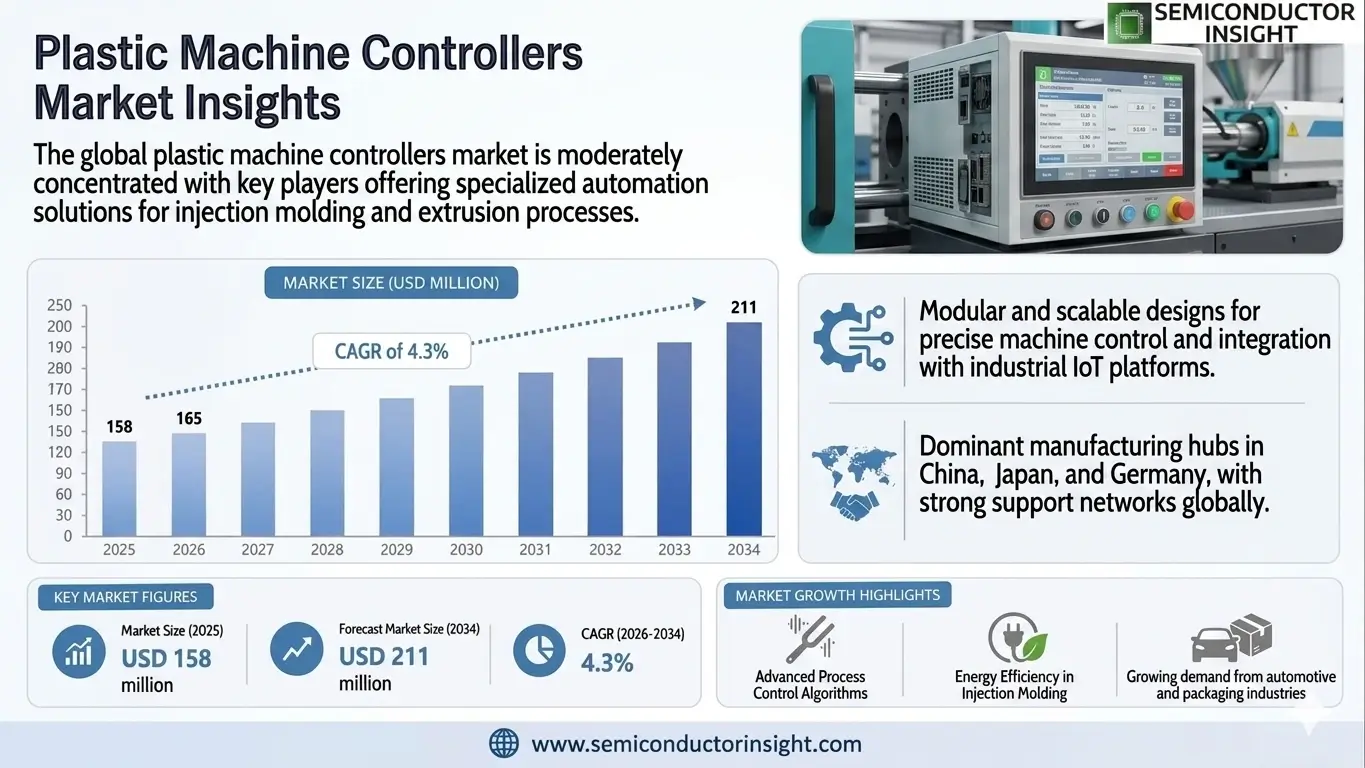
Global Plastic Machine Controllers market size was valued at USD 158 million in 2025. The market is projected to grow from USD 165 million in 2026 to USD 211 million by 2034, exhibiting a CAGR of 4.3% during the forecast period.
Plastic machine controllers are specialized control systems designed to manage the operational processes of plastic processing machinery, including injection molding machines, extruders, and blow molding machines. These controllers ensure production stability and product consistency by precisely regulating parameters such as temperature, pressure, speed, and position. As a critical component in automated manufacturing, they enhance efficiency while minimizing human error and energy consumption.
MARKET DRIVERS
Increasing Automation in Plastic Manufacturing
The plastic machine controllers market is experiencing significant growth due to the rising adoption of automation in plastic manufacturing processes. Over 65% of plastic processing plants have upgraded to automated controllers in the past five years to enhance precision and reduce material waste. This shift is driving demand for advanced plastic machine controllers with real-time monitoring capabilities.
Energy Efficiency Regulations
Stringent energy efficiency standards across major manufacturing regions are accelerating the replacement of older hydraulic systems with energy-efficient plastic machine controllers. Modern controllers can reduce energy consumption by up to 30% compared to conventional systems, making them essential for compliance with environmental regulations.
➤ Global smart factory initiative is expected to drive 28% annual growth in premium plastic machine controller sales through 2028.
Technological advancements in IoT-enabled controllers are creating new growth avenues, with the Asia-Pacific region accounting for nearly 45% of new installations last year.
MARKET CHALLENGES
High Initial Investment Costs
The adoption of advanced plastic machine controllers faces barriers due to the substantial capital expenditure required for system upgrades. Small and medium-sized manufacturers often struggle to justify the ROI, with premium controller systems costing 2-3 times more than basic models.
Other Challenges
Skilled Labor Shortage
The plastic machine controllers market faces constraints from the lack of trained technicians capable of programming and maintaining sophisticated controller systems. Industry surveys indicate nearly 40% of plants experience downtime due to controller-related technical issues.
MARKET RESTRAINTS
Slow Retrofit Rates in Mature Markets
Established manufacturing facilities in North America and Europe show reluctance to replace fully functional legacy systems, creating a bottleneck for plastic machine controller sales. The average replacement cycle remains at 7-10 years despite technological advancements, particularly for injection molding applications.
MARKET OPPORTUNITIES
Emerging Economies Show Strong Growth Potential
The plastic machine controllers market is finding significant opportunities in developing nations establishing new manufacturing capacities. Countries like India, Vietnam, and Mexico are implementing smart manufacturing practices from inception, creating demand for high-performance plastic machine controllers in greenfield projects.
Industry 4.0 Integration
Integration with Industry 4.0 ecosystems presents the most substantial opportunity, with predictive maintenance features generating particular interest. Over 60% of new plastic machine controller installations now include AI-driven analytics capabilities, commanding 15-20% price premiums over standard models.
Plastic Machine Controllers Market Trends
Increasing Demand for Automated Plastic Processing Equipment
The Plastic Machine Controllers market is witnessing steady growth driven by expanding adoption in injection molding, extrusion, and blow molding applications. Manufacturers are prioritizing precision control systems to improve production efficiency and product consistency. Advanced controllers now integrate real-time monitoring for parameters like temperature, pressure, and position.
Other Trends
Asia-Pacific Emerges as Key Manufacturing Hub
China, Japan, and Southeast Asian nations are leading the regional demand for plastic machine controllers due to expanding plastics processing industries. Major manufacturers are establishing local production facilities and R&D centers to cater to this growing market, with portable controllers gaining traction.
Integration of IoT and Smart Factory Capabilities
Modern plastic machine controllers increasingly incorporate IoT connectivity for remote monitoring and predictive maintenance. Industry leaders are developing cloud-based solutions that enable data collection from multiple machines, facilitating production optimization across facilities. This trend aligns with broader Industry 4.0 adoption in manufacturing sectors.
Energy Efficiency Requirements Drive Innovation
Regulatory pressures and sustainability initiatives are prompting development of energy-optimized controllers. New systems automatically adjust power consumption based on operational parameters, reducing overall energy use in plastic processing plants without compromising output quality.
Competitive Landscape and Technological Advancements
The market features established players like KEBA, Yaskawa Electric, and Mitsubishi Electric competing through technological differentiation. Recent developments include multi-axis synchronization controllers and AI-assisted parameter optimization, particularly for complex plastic processing applications.
COMPETITIVE LANDSCAPEKey Industry Players
Global Plastic Machine Controllers Market Dominated by Automation Specialists
Global plastic machine controllers market is moderately concentrated with the top five players accounting for a significant revenue share. KEBA GmbH leads the market with its advanced automation solutions for injection molding machines, followed closely by Yaskawa Electric and B&R Automation. These established players dominate through continuous R&D investments in intelligent control systems, energy efficiency solutions, and IoT integration for plastic processing machinery.
Niche specialists like Arcuchi and LNC Technology have gained traction in Asian markets with cost-effective controllers tailored for mid-sized plastic processing units. Regional players such as Ningbo Techmation Technologies demonstrate strong presence in China’s rapidly growing plastics industry. Meanwhile, industrial automation giants like Mitsubishi Electric and Omron maintain technological leadership through comprehensive controller portfolios serving diverse plastic processing applications.
List of Key Plastic Machine Controllers Companies Profiled
- KEBA GmbH
- Yaskawa Electric Corporation
- B&R Automation (ABB Group)
- Arcuchi Control Systems
- Mitsubishi Electric Corporation
- Omron Corporation
- LNC Technology Co., Ltd.
- Arico Technology
- Ningbo Techmation Technologies Co., Ltd.
- Siemens AG
- Fanuc Corporation
- Rockwell Automation
- Wittmann Battenfeld Group
- Toshiba Machine
- Haitian International
Segment Analysis:
| Segment Category | Sub-Segments | Key Insights |
| By Type |
|
Portable Controllers are gaining traction due to their mobility advantages in large-scale plastic processing plants.
|
| By Application |
|
Injection Molding Machines dominate controller requirements due to complex process parameters.
|
| By End User |
|
Automotive Parts Manufacturers represent the most demanding controller users.
|
| By Automation Level |
|
Smart Controllers with AI Capabilities show the strongest growth trajectory.
|
| By Control Method |
|
Electric Control Systems are gaining preference over traditional hydraulic systems.
|
Regional Analysis: Plastic Machine Controllers Market
Asia-Pacific
China’s Manufacturing Leadership
China’s vast plastics processing industry generates consistent demand for both entry-level and advanced machine controllers. Local manufacturers emphasize integration capabilities with existing production lines while foreign players focus on premium automation solutions. The government’s “Made in China 2025” initiative accelerates adoption of intelligent control systems.
India’s Growth Potential
India’s burgeoning packaging sector drives plastic machine controller demand, with emphasis on flexible production systems. Local manufacturers prefer modular controllers that accommodate frequent product changeovers. Government incentives under the Production Linked Incentive scheme support domestic controller manufacturing capacity expansion.
Japanese Technological Edge
Japan maintains strong presence in high-performance controllers for precision plastic molding applications. Local manufacturers integrate AI-based process optimization and predictive maintenance features. The mature market focuses on controller upgrades and replacement cycles rather than new installations.
Southeast Asian Expansion
Thailand, Vietnam, and Indonesia emerge as important markets due to shifting manufacturing bases. Controller demand grows for both injection molding and extrusion applications. Regional players emphasize multi-language interfaces and simplified operation modes to accommodate diverse workforce skill levels.
Europe
Europe maintains steady demand for advanced plastic machine controllers, particularly in Germany’s automotive components sector and Italy’s packaging machinery industry. Strict energy efficiency regulations drive adoption of next-generation controllers with power optimization features. Western European markets prioritize connectivity standards while Eastern Europe focuses on cost-competitive solutions. The circular economy push influences controller development for recycled material processing capabilities.
North America
The North American market values reliability and after-sales support in plastic machine controllers. U.S. manufacturers invest in controllers enabling quick production changeovers to address customized product demand. Canada sees growing adoption in medical device manufacturing applications. Regional players emphasize cybersecurity features in networked control systems amid rising digital transformation trends.
Middle East & Africa
GCC countries drive regional demand through investments in plastic product manufacturing infrastructure. Turkish manufacturers serve as important controller suppliers to neighboring markets. South Africa’s packaging industry shows steady growth in controller adoption. The region demonstrates preference for ruggedized controllers capable of operating in high-temperature environments.
Latin America
Brazil and Mexico remain key Latin American markets for plastic machine controllers. Local manufacturers balance price sensitivity with growing demand for basic automation features. The food packaging sector generates consistent demand while industrial applications show potential for higher-value controllers. Currency fluctuations impact equipment import decisions in the region.
Report Scope
This market research report provides a comprehensive analysis of the Plastic Machine Controllers Market, covering the forecast period 2026–2034. It offers detailed insights into market dynamics, technological advancements, competitive landscape, and key trends shaping the industry.
Key focus areas of the report include:
- Market Overview: The report begins with an overview outlining its current market scenario, key growth indicators, and industry transformation drivers. It discusses macroeconomic factors, demand–supply balance, regulatory landscape, and the strategic role of plastic machine controllers in powering advancements across industries such as plastics manufacturing, packaging, automotive components, and industrial automation.
- Market Size & Forecast: Historical data and future projections for revenue, unit shipments, and market value across major regions and segments.
- Segmentation Analysis: Detailed breakdown by product type, technology, application, and end-user industry to identify high-growth segments and investment opportunities.
- Regional Insights: Insights into market performance across North America, Europe, Asia-Pacific, Latin America, and the Middle East & Africa, including country-level analysis where relevant.
- Competitive Landscape: Profiles of leading market participants, including their product offerings, R&D focus, manufacturing capacity, pricing strategies, and recent developments such as mergers, acquisitions, and partnerships.
- Technology Trends & Innovation: Assessment of emerging technologies, integration of automation/IoT, design trends, and evolving industry standards.
- Market Drivers & Restraints: Evaluation of factors driving market growth along with challenges, supply chain constraints, regulatory issues, and market-entry barriers.
- Stakeholder Insights: Insights for component suppliers, OEMs, system integrators, investors, and policymakers regarding the evolving ecosystem and strategic opportunities.
Primary and secondary research methods are employed, including interviews with industry experts, data from verified sources, and real-time market intelligence to ensure the accuracy and reliability of the insights presented.
FREQUENTLY ASKED QUESTIONS:
What is the current market size of Plastic Machine Controllers Market?
-> Plastic Machine Controllers Market was valued at USD 158 million in 2025 and is expected to reach USD 211 million by 2034.
What is the projected CAGR for this market?
-> The market is projected to grow at a CAGR of 4.3% during the forecast period (2025-2034).
Which key companies operate in Plastic Machine Controllers Market?
-> Key players include Arcuchi, KEBA, Yaskawa Electric, B&R Automation, LNC Technology, Arico Technology, Ningbo Techmation technologies, Mitsubishi Electric, and Omron, among others.
What are the key application segments?
-> Major applications include Injection Molding Machines, Extruder Machines, Blow Molding Machines, and others.
Which region dominates the market?
-> Asia is projected to be the fastest-growing region, with China expected to reach significant market size.

Get Sample Report PDF for Exclusive Insights
Report Sample Includes
- Table of Contents
- List of Tables & Figures
- Charts, Research Methodology, and more...
 Download Sample Report PDF