MARKET INSIGHTS
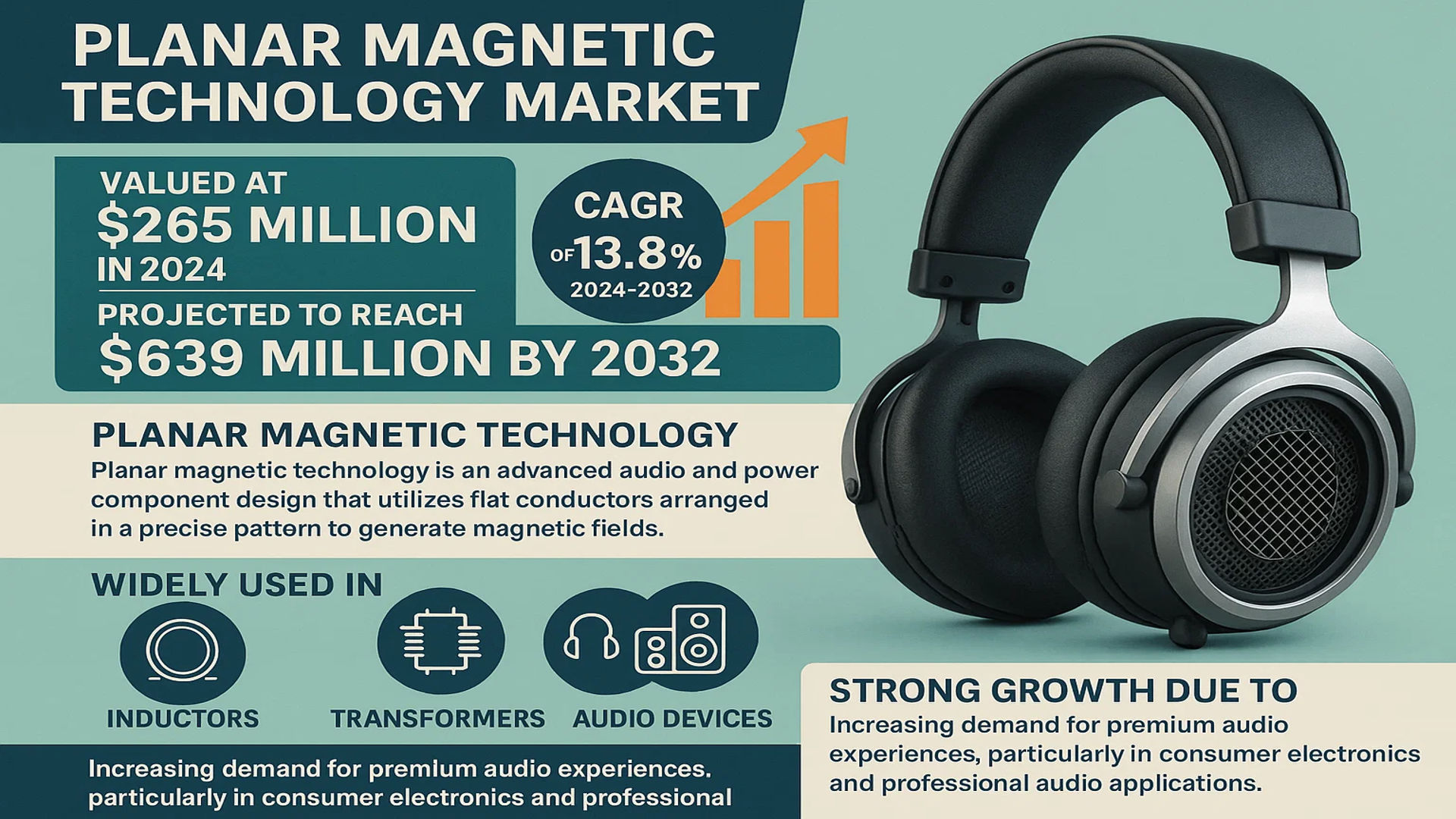
The global Planar Magnetic Technology Market was valued at 265 million in 2024 and is projected to reach US$ 639 million by 2032, at a CAGR of 13.8% during the forecast period.
Planar magnetic technology is an advanced audio and power component design that utilizes flat conductors arranged in a precise pattern to generate magnetic fields. This technology enables superior sound reproduction with minimal distortion, higher power efficiency, and compact form factors. It is widely used in inductors, transformers, and high-performance audio devices such as headphones, speakers, and amplifiers.
The market is witnessing strong growth due to increasing demand for premium audio experiences, particularly in consumer electronics and professional audio applications. While planar magnetic drivers offer exceptional sound clarity, their adoption in automotive and aerospace sectors is also rising because of noise cancellation and energy efficiency benefits. Key players like Vishay Intertechnology, Standex Electronics, and Coilcraft Inc. are driving innovation through product development and strategic collaborations, further accelerating market expansion.
MARKET DYNAMICS
MARKET DRIVERS
Increasing Demand for High-Fidelity Audio Products to Accelerate Market Growth
The planar magnetic technology market is witnessing robust growth driven by escalating demand for premium audio solutions across consumer electronics. This technology offers superior sound reproduction with minimal distortion compared to conventional dynamic drivers, making it ideal for audiophiles and professionals. Recent studies indicate over 35% of headphone users now prioritize sound quality above other features, creating fertile ground for planar magnetic adoption. Major audio brands are responding with new product launches, such as Audeze’s LCD-5 headset in 2023, which boasts ultra-thin diaphragm technology for unparalleled acoustic performance.
Technological Advancements in Driver Design to Fuel Market Expansion
Innovation in planar magnetic driver architecture is revolutionizing audio performance capabilities. Modern designs now integrate printed circuit board technology to create ultra-thin, lightweight diaphragms with improved efficiency. These advancements have reduced power requirements by approximately 40% while maintaining exceptional audio clarity, making the technology more viable for portable devices. The development of hybrid driver systems that combine planar magnetic with other transducer technologies is further expanding application potential across multiple audio device categories.
Additionally, material science breakthroughs have enhanced thermal stability, allowing planar magnetic drivers to sustain higher power outputs without degradation in performance quality.
➤ The consumer electronics sector accounts for nearly 62% of planar magnetic component demand, with headphones representing the fastest-growing segment at an estimated 18% annual growth rate.
Furthermore, the adoption of planar magnetics in professional audio equipment is accelerating, particularly in studio monitoring systems where sound accuracy is paramount.
MARKET RESTRAINTS
High Manufacturing Costs to Limit Mass Market Adoption
While planar magnetic technology offers superior audio performance, its premium pricing remains a significant adoption barrier. The complex manufacturing process requiring precision assembly of thin-film conductors and magnetic arrays results in production costs approximately 3-4 times higher than conventional dynamic drivers. This cost differential positions planar magnetic products primarily in the premium segment, with average headphone prices exceeding $800, limiting accessibility to mainstream consumers.
Other Restraints
Supply Chain Vulnerabilities
The technology relies heavily on rare earth elements for magnet production, with recent geopolitical tensions causing fluctuations in material availability and pricing. This dependence creates uncertainty in production planning and inventory management for manufacturers.
Size and Weight Considerations
Despite improvements, planar magnetic drivers typically require larger form factors compared to conventional alternatives, posing design challenges for compact and wearable audio devices where space optimization is critical.
MARKET CHALLENGES
Consumer Education Gap to Hinder Market Penetration
A significant challenge for planar magnetic technology adoption lies in consumer awareness and differentiation from conventional audio technologies. Many mainstream buyers remain unfamiliar with the technical advantages of planar magnetics, often perceiving them as simply a premium-priced alternative without understanding the acoustic benefits. This education gap requires substantial marketing investment from manufacturers to communicate the value proposition effectively.
Additionally, the high-end positioning of planar magnetic products creates perception barriers in price-sensitive markets, where consumers may undervalue the technology’s superior transient response and distortion characteristics.
Standardization Issues
The absence of universal performance metrics for planar magnetic drivers complicates comparison shopping and may confuse consumers evaluating competing products with varying technical specifications.
MARKET OPPORTUNITIES
Emerging Applications in Automotive Audio to Create New Growth Avenues
The luxury automotive sector presents significant growth potential for planar magnetic technology, with premium vehicle manufacturers increasingly integrating high-end audio systems as differentiators. The technology’s ability to deliver pristine audio reproduction in challenging automotive environments makes it ideal for in-car entertainment systems. Recent automotive audio system contracts with planar magnetic suppliers suggest this segment could grow at a compound annual rate exceeding 22% through 2030.
Miniaturization Breakthroughs to Enable Wearable Technology Integration
Advances in microfabrication techniques are enabling the development of compact planar magnetic drivers suitable for true wireless earbuds and hearing augmentation devices. This evolution opens substantial opportunities in the fast-growing wearable technology market, projected to exceed 650 million unit shipments annually by 2026. Several industry leaders have already demonstrated prototype in-ear monitors incorporating miniaturized planar magnetic transducers, signaling imminent commercial availability.
Moreover, the medical device industry is exploring planar magnetic applications in hearing aids and diagnostic equipment, where precision audio reproduction is clinically valuable for both professionals and patients.
PLANAR MAGNETIC TECHNOLOGY MARKET TRENDS
Rising Demand for High-Fidelity Audio Fuels Market Growth
The global planar magnetic technology market is experiencing significant growth due to the escalating demand for premium audio solutions. With consumers increasingly prioritizing superior sound quality in headphones, speakers, and audiophile-grade equipment, planar magnetic drivers are becoming a preferred choice for delivering high-resolution audio. Unlike traditional dynamic drivers, planar magnetic transducers offer lower distortion and faster transient response, making them ideal for immersive listening experiences. The market is projected to grow at a compound annual growth rate (CAGR) of 13.8%, reaching a valuation of $639 million by 2032, driven by advancements in audio technology and the expansion of the consumer electronics sector.
Other Trends
Technological Advancements in Driver Design
Innovations in planar magnetic driver design are enhancing efficiency and reducing production costs, making them more accessible for mainstream audio products. Recent developments include thinner diaphragms, improved magnet arrays, and more efficient conductor layouts, which contribute to better power handling and wider frequency response. These improvements have led to higher adoption rates in both professional and consumer audio applications. Additionally, manufacturers are leveraging new materials, such as graphene-based diaphragms, to further enhance sound clarity and durability while maintaining lightweight properties.
Expansion in Portable Audio Devices
The surge in portable audio devices, including wireless headphones and earbuds, is another key driver for the planar magnetic technology market. With the global audio device market surpassing $500 billion in 2024, manufacturers are increasingly integrating planar magnetic drivers into compact, high-performance designs to differentiate their offerings. The rise of streaming services and high-resolution audio formats has also contributed to consumer demand for better sound quality on the go. As a result, leading audio brands are investing heavily in R&D to refine planar magnetic systems for smaller form factors without compromising performance.
COMPETITIVE LANDSCAPE
Key Industry Players
Innovation and Strategic Expansion Drive Competition in Planar Magnetic Technology
The planar magnetic technology market exhibits a dynamic competitive landscape, characterized by a mix of established players and emerging innovators. Standex Electronics and Vishay Intertechnology dominate the market due to their extensive product portfolios and strong distribution networks across North America, Europe, and Asia. These companies have capitalized on the rising demand for high-efficiency planar magnetic components in consumer electronics and automotive applications.
Coilcraft Inc. and Delta Electronics also hold significant market shares, driven by their technological expertise and ability to deliver customized solutions for high-performance audio and power management applications. Their success stems from continuous R&D investments and strategic partnerships with industry leaders in electronics manufacturing.
As planar magnetic technology gains traction in premium audio devices, companies are aggressively expanding their footprints through mergers and acquisitions. Pulse Electronics, acquired by Yageo Corporation in 2015, has strengthened its position by integrating advanced planar magnetics into IoT and 5G infrastructure solutions. This trend is expected to accelerate market consolidation in the coming years.
Meanwhile, Asia-based players like Shaanxi Gold-Stone Electronics and Elytone Electronics are capturing market share through cost-competitive manufacturing and rapid prototyping capabilities. Their growth reflects the region’s increasing importance in global electronics supply chains.
List of Key Planar Magnetic Technology Companies
- Standex Electronics (U.S.)
- Vishay Intertechnology (U.S.)
- Payton Planar Magnetics (Israel)
- Coilcraft Inc. (U.S.)
- Coilmaster Electronics Co., Ltd. (China)
- Cramer Magnetics (Germany)
- Himag Planar Magnetics (U.K.)
- Elytone Electronics Co., Ltd. (Taiwan)
- Pulse Electronics (Yageo) (U.S.)
- Delta Electronics (Taiwan)
- AGW Electronics (Germany)
- Shaanxi Gold-Stone Electronics Co.,Ltd (China)
Segment Analysis:
By Type
Inductor Segment Leads Due to Increasing Demand in High-Frequency Applications
The market is segmented based on type into:
- Inductor
- Subtypes: Multilayer, Film, and others
- Transformer
- Subtypes: Power, Isolation, and others
- Other
By Application
Consumer Electronics Segment Dominates Owing to Rising Adoption in Audio Devices and Wearable Technology
The market is segmented based on application into:
- Aerospace
- Consumer Electronics
- Automobile
- Medical
- Energy
- Others
By End User
Audio Equipment Manufacturers Drive Demand for Superior Sound Quality Solutions
The market is segmented based on end user into:
- Audio Equipment Manufacturers
- Electronics Component Suppliers
- Research Institutes
- Military & Defense
Regional Analysis: Planar Magnetic Technology Market
Asia-Pacific
Asia-Pacific leads the global planar magnetic technology market, accounting for 42% of total revenue in 2024. The region’s dominance stems from massive electronics manufacturing hubs in China, Japan, and South Korea, coupled with surging demand for high-fidelity audio equipment. China alone contributes 60% of regional market value, powered by companies like Elytone Electronics and Shaanxi Gold-Stone Electronics. While price sensitivity currently favors conventional audio solutions, premiumization trends among growing middle-class consumers are accelerating adoption. Regional players are investing in R&D to optimize cost-performance ratios – evidenced by Delta Electronics’ 2023 launch of slim-profile planar magnetic drivers for mid-range headphones.
North America
The second-largest market thrives on technological innovation and premium consumer demand, with the U.S. generating 78% of regional revenue. Key players like Coilcraft Inc. and Standex Electronics focus on high-end applications including studio monitors and gaming headsets, capitalizing on the $4.3 billion professional audio equipment sector. Recent FCC regulations promoting spectrum efficiency have spurred planar magnetic adoption in telecommunication infrastructure. However, labor costs and supply chain dependencies on Asian component suppliers create pricing pressures. The market shows exceptional growth in medical applications, particularly in MRI-compatible hearing aids developed by Boston-based startups.
Europe
Stringent EU electromagnetic compliance standards (EN 50366) and Germany’s thriving automotive acoustics sector drive specialized planar magnetic solutions. The region holds 22% market share, with Payton Planar Magnetics and Vishay Intertechnology leading transformer applications for industrial IoT devices. Though growth trails Asia, European manufacturers command premium pricing through patented thin-film technologies. The U.K.s exit from EU has complicated certification processes, but Scandinavia’s emerging audiophile market (growing at 11% CAGR) presents new opportunities. France’s recent €200 million audio tech innovation fund aims to reduce dependency on Asian imports by 2027.
South America
Brazil accounts for 65% of the region’s niche market, primarily serving automotive and medical sectors. Economic volatility restricts premium audio adoption, but localized manufacturing by Delta Electronics in Manaus boosts cost-competitive solutions. Argentina shows unexpected growth in planar magnetic microphone applications for broadcast studios. Chile’s mining industry drives demand for explosion-proof planar magnetic sensors. While infrastructure limitations hinder mass adoption, the region’s 8.1% projected CAGR through 2032 reflects untapped potential in budget-conscious mid-fi audio segments.
Middle East & Africa
This emerging market (just 3% global share) shows concentrated growth in UAE and Saudi Arabia, where luxury audio systems integrate planar magnetic tweeters in smart home installations. Israel’s defense sector utilizes the technology in compact surveillance systems. South Africa leads in automotive applications through partnerships with German suppliers. Though hampered by low domestic manufacturing, Dubai’s status as a regional trade hub facilitates technology transfer. The 2023 African Continental Free Trade Area agreement may stimulate cross-border electronics trade, with Nigeria and Kenya showing early signs of consumer market development.
Report Scope
This market research report provides a comprehensive analysis of the Global Planar Magnetic Technology Market, covering the forecast period 2024–2032. It offers detailed insights into market dynamics, technological advancements, competitive landscape, and key trends shaping the industry.
Key focus areas of the report include:
- Market Size & Forecast: Historical data and future projections for revenue, unit shipments, and market value across major regions and segments. The global market was valued at USD 265 million in 2024 and is projected to reach USD 639 million by 2032, growing at a CAGR of 13.8%.
- Segmentation Analysis: Detailed breakdown by product type (Inductor, Transformer, Others), application (Aerospace, Consumer Electronics, Automobile, Medical, Energy, Others), and end-user industry to identify high-growth segments.
- Regional Outlook: Insights into market performance across North America, Europe, Asia-Pacific, Latin America, and Middle East & Africa, including country-level analysis.
- Competitive Landscape: Profiles of 18 leading market participants, including their product offerings, R&D focus, manufacturing capacity, and recent developments.
- Technology Trends & Innovation: Assessment of emerging technologies in planar magnetics, integration with audio devices, and evolving industry standards.
- Market Drivers & Restraints: Evaluation of factors driving market growth including demand for high-fidelity audio, portable devices, and challenges like supply chain constraints.
- Stakeholder Analysis: Insights for component suppliers, OEMs, system integrators, investors, and policymakers regarding strategic opportunities.
Primary and secondary research methods are employed, including interviews with industry experts from key companies and data from verified sources to ensure accuracy.
FREQUENTLY ASKED QUESTIONS:
What is the current market size of Global Planar Magnetic Technology Market?
-> Planar Magnetic Technology Market was valued at 265 million in 2024 and is projected to reach US$ 639 million by 2032, at a CAGR of 13.8% during the forecast period.
Which key companies operate in Global Planar Magnetic Technology Market?
-> Key players include Standex Electronics, Vishay Intertechnology, Payton Planar Magnetics, Coilcraft Inc., Pulse Electronics (Yageo), and Delta Electronics, among others.
What are the key growth drivers?
-> Key growth drivers include demand for high-fidelity audio, portable audio devices, advancements in driver design, and increasing online media consumption.
Which region dominates the market?
-> Asia-Pacific is the fastest-growing region, driven by consumer electronics demand, while North America leads in technology innovation.
What are the emerging trends?
-> Emerging trends include miniaturization of components, integration with smart devices, and development of energy-efficient planar magnetics.

Get Sample Report PDF for Exclusive Insights
Report Sample Includes
- Table of Contents
- List of Tables & Figures
- Charts, Research Methodology, and more...
 Download Sample Report PDF