Pipeline Liquid Level Sensor Market Insights
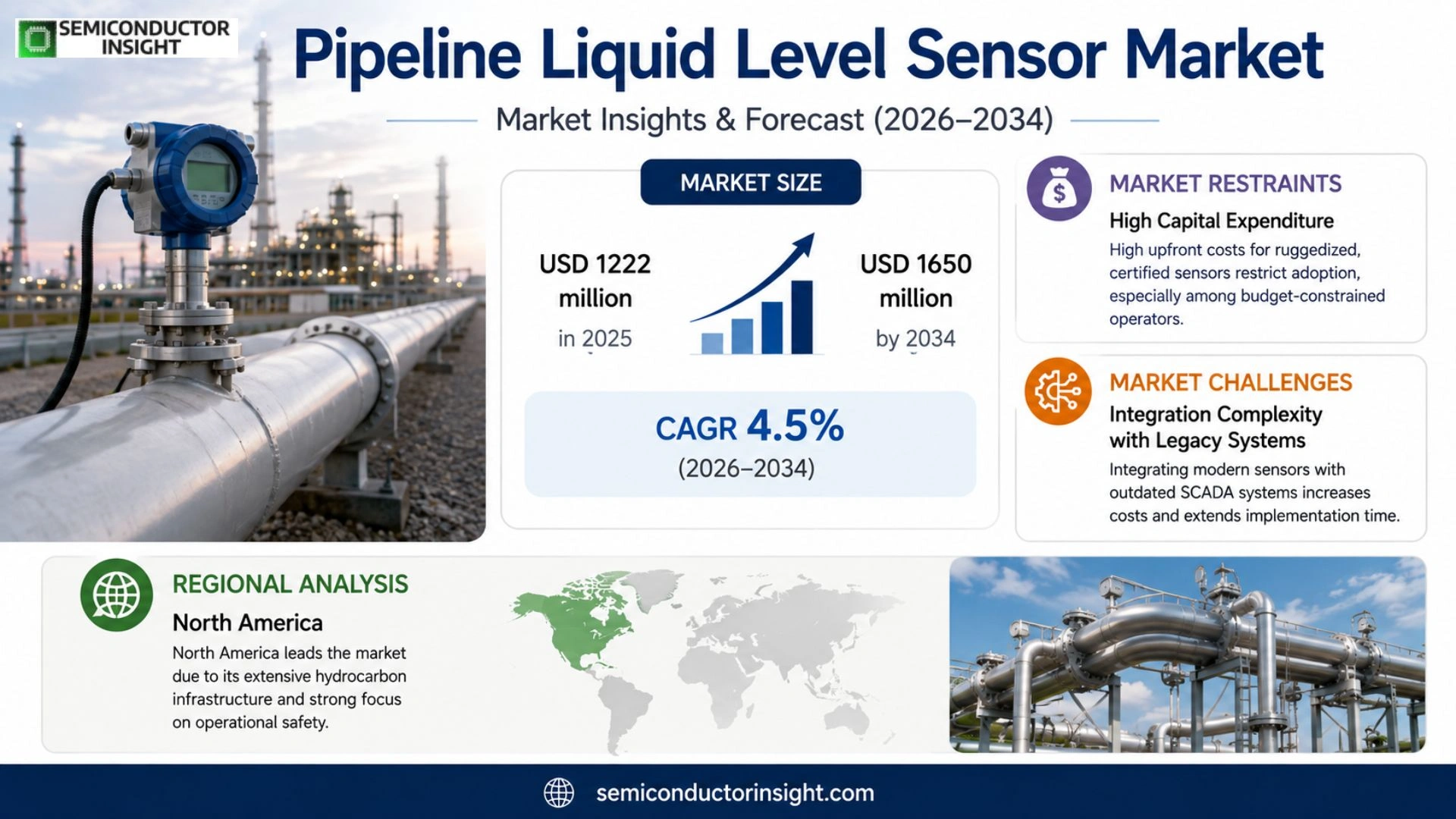
Pipeline Liquid Level Sensor market size was valued at USD 1222 million in 2025 and is expected to reach USD 1650 million by 2034, reflecting a CAGR of 4.5% over the forecast period.
Pipeline Liquid Level Sensor measures liquid height inside pipelines using advanced detection technology. It typically consists of a probe that senses level changes and a controller that transmits data to monitoring systems; the configuration suits diverse pipeline applications across industries.
Growth stems from wider adoption of industrial automation, where smart factories require continuous real‑time monitoring for safety and efficiency. Additionally, heightened focus on equipment protection in petrochemical and water‑treatment sectors, together with IoT integration enabling remote diagnostics, fuels demand for reliable sensors.
MARKET DRIVERS
Regulatory Pressure for Continuous Monitoring
Governments worldwide have tightened safety and environmental standards for fluid transport, prompting operators to adopt real‑time level detection. In Pipeline Liquid Level Sensor Market, firms that can certify compliance gain a competitive edge, because non‑conformity now translates into fines, production shut‑downs, or reputational damage. This regulatory drift forces investment in higher‑accuracy transducers and data‑logging infrastructure.
Advances in Wireless Telemetry
Recent breakthroughs in low‑power LoRaWAN and cellular‑backhaul modules allow sensors to transmit data without costly cabling. As a result, operators can retrofit aging pipelines and still achieve end‑to‑end visibility. Pipeline Liquid Level Sensor Market benefits from these wireless gains, because deployment timelines shrink and maintenance crews spend less time on trenching activities.
➤ “Wireless integration reduces OPEX by up to 30 % while preserving measurement fidelity,” notes a senior engineer at a leading mid‑stream firm.
Beyond compliance and connectivity, the shift toward predictive maintenance fuels demand for sensors that provide granular trend data. Companies that embed analytics engines directly at the edge can turn raw level readings into actionable alerts, turning a simple measurement into a strategic asset within Pipeline Liquid Level Sensor Market.
MARKET CHALLENGES
Integration Complexity with Legacy Systems
Many mid‑stream operators still rely on SCADA platforms installed a decade ago, which were not designed for modern digital sensor streams. Aligning new level sensors with these entrenched architectures often requires custom middleware, inflating project budgets and extending implementation cycles. The friction discourages some firms from upgrading, slowing overall market momentum.
Other Challenges
Cost Sensitivity
Even though sensor prices have fallen, the total cost of ownership,including installation, calibration, and cybersecurity hardening,remains a hurdle for smaller players. When capital is limited, firms may defer sensor projects in favor of more immediate operational fixes, curtailing the pace of market adoption.
MARKET RESTRAINTS
High Capital Expenditure
Deploying a network of high‑precision level sensors across extensive pipeline miles demands substantial upfront investment. The expense of ruggedized housings, explosion‑proof ratings, and certifications for hazardous zones deters budget‑constrained operators, especially in regions where oil and gas margins are under pressure. This financial barrier limits the speed at which Pipeline Liquid Level Sensor Market can expand.
MARKET OPPORTUNITIES
Emerging Applications in Renewable Energy Pipelines
As green hydrogen and bio‑fuel transport corridors gain traction, they require level‑monitoring solutions that can cope with new fluid chemistries and stricter safety regimes. Vendors that tailor sensor coatings and diagnostic algorithms for these emerging carriers stand to capture a fresh segment of Pipeline Liquid Level Sensor Market, driving growth beyond traditional oil and gas applications.
Pipeline Liquid Level Sensor Market Trends
Industrial Automation Fuels Sensor Uptake
The market recorded a valuation of roughly $1.22 billion in 2025, with unit shipments estimated at 3.45 million and an average selling price near $387. Profitability remains healthy, as gross margins sit between 25 % and 40 %. Two forces dominate this environment: global manufacturers are embedding liquid‑level detection into smart‑factory lines, and end‑users in petrochemicals, water‑treatment and other process‑intensive sectors are tightening safety and equipment‑protection requirements. These dynamics generate consistent demand for sensors that combine real‑time reporting with rugged reliability. As factories pursue tighter process control, the need for precise, low‑latency level data has moved from an optional upgrade to a baseline capability, reinforcing a steady rise in market volume over the forecast horizon.
Other Trends
Component Sourcing and Cost Pressures
The upstream tier supplies piezoelectric ceramics, infrared modules, ASIC chips and precision tubing, all of which influence final‑product pricing. Recent years have seen a concerted push toward domestic substitution of high‑performance sensing chips, a move that reshapes cost structures and competitive positioning. While the shift can lower exposure to import volatility, it also forces sensor manufacturers to absorb R&D expenses associated with qualifying new components. Consequently, margin pressure is evident, prompting firms to explore modular designs and volume‑based procurement to safeguard profitability. This cost‑management imperative is especially pronounced as the market edges toward the $1.65 billion mark forecast for 2034.
IoT Integration Expands Functional Scope
Embedding Internet‑of‑Things connectivity transforms a traditional level detector into a platform for remote monitoring and predictive maintenance. Data streams from sensors now feed analytics engines that flag abnormal trends before a pump failure occurs, delivering tangible downtime savings. For equipment OEMs, this creates a revenue‑enhancing service layer, while plant operators gain actionable insights that sharpen process efficiency. The broadened functionality also opens new verticals,environmental monitoring stations and advanced medical devices are beginning to adopt pipeline‑level sensing for fluid management. Companies that can marry rugged sensor hardware with seamless cloud interfaces are poised to capture incremental market share as end‑users pursue digital‑first strategies.
COMPETITIVE LANDSCAPE
Key Industry Players
Pipeline Liquid Level Sensor Competitive Overview
Endress+Hauser commands the upper tier of the market, leveraging a deep portfolio of ultrasonic and capacitance‑based level instruments that integrate seamlessly with its broader process automation suite. The company’s global engineering network and long‑standing relationships with petrochemical and water‑treatment operators create a barrier to entry for newcomers. Its ability to bundle sensors with advanced analytics platforms has translated into higher average contract values and a steady stream of retrofit projects, reinforcing a market structure where a handful of OEMs capture the bulk of high‑margin projects while a constellation of smaller firms competes on price and niche applications.
Beyond the industry leader, a second tier of manufacturers such as Siemens, ABB, KROHNE, Yokogawa, and Emerson differentiate themselves through specialized transducer technologies or strong regional footholds. Companies like NIVELCO and VEGA focus on robust pressure‑type sensors tailored for harsh environments, whereas Magnetrol and HAWK Measurement Systems cultivate niche markets in oil‑field pipelines and remote monitoring. This tier adds depth to the competitive landscape, offering customers alternatives that balance performance, cost, and service support across diverse geographic and application segments.
List of Key Pipeline Liquid Level Sensor Companies Profiled
- Endress+Hauser
- Siemens
- ABB
- KROHNE
- Yokogawa
- NIVELCO
- VEGA
- Emerson
- Honeywell
- AMETEK
- Magnetrol
- HAWK Measurement Systems
- Pepperl+Fuchs
- Schneider Electric
- OMEGA
Segment Analysis:
| Segment Category | Sub-Segments | Key Insights |
| By Type |
|
Capacitive Sensors
|
| By Application |
|
Industrial Process Control
|
| By End User |
|
Petrochemical Plants
|
| By Technology Integration |
|
IoT‑Enabled Smart Sensors
|
| By Market Drivers |
|
Safety and Predictive Maintenance
|
Regional Analysis: Pipeline Liquid Level Sensor Market
North America
State‑level mandates on pipeline integrity have accelerated adoption of level sensors with real‑time reporting. Compliance teams view these devices as essential audit tools, prompting faster procurement cycles and deeper integration with SCADA systems.
Advances in low‑power electronics and edge analytics enable sensors to process data locally, reducing bandwidth demands. This convergence supports remote monitoring of isolated well sites and reduces on‑site staffing pressures.
Recent disruptions have encouraged manufacturers to relocate critical component production to North American facilities, shortening lead times and enhancing after‑sales service responsiveness.
Vendors are bundling installation, calibration, and predictive‑maintenance contracts, turning sensor sales into recurring revenue streams and fostering longer customer relationships.
Europe
European operators are guided by the EU’s Water Framework Directive, which emphasizes early detection of fluid anomalies. National pipelines in the United Kingdom and Germany are retrofitting legacy gauges with wireless level sensors to meet cross‑border reporting standards. The market is further shaped by a strong emphasis on sustainability; firms prefer sensors built from recyclable materials and powered by energy‑harvesting technologies. Collaborative research programs funded by the European Commission encourage standardization of communication protocols, facilitating easier integration for multinational energy groups.
Asia‑Pacific
In Asia‑Pacific, rapid expansion of petrochemical complexes in China, India, and Southeast Asia creates a fertile environment for sensor adoption. Unlike mature markets, many projects are greenfield, allowing manufacturers to embed digital monitoring from the outset. However, divergent regulatory frameworks mean that multinational suppliers must navigate a patchwork of safety certifications. Local manufacturers are gaining credibility by aligning with global quality standards, while joint‑venture models help foreign players tap into regional distribution networks and adapt firmware to local fluid chemistries.
South America
South American countries such as Brazil and Argentina are modernizing aging pipeline networks to reduce non‑technical losses. Government incentives for infrastructure upgrades have opened financing avenues for sensor deployments, especially in remote inland basins where manual inspection is costly. Companies are focusing on ruggedized designs that tolerate high humidity and temperature swings typical of the region. Partnerships with local engineering firms accelerate field trials, allowing rapid feedback loops that refine sensor calibration for the region’s heterogeneous crude blends.
Middle East & Africa
The Middle East & Africa region combines vast hydrocarbon reserves with challenging desert and offshore environments. Operators prioritize sensors that can survive extreme temperature gradients and saline exposure. In the Gulf Cooperation Council, the push toward digital oil fields drives integration of level sensors with broader asset‑management platforms. African nations, meanwhile, are leveraging international development funds to enhance pipeline safety, with a growing appetite for modular sensor packages that can be deployed quickly in remote locations.
Report Scope
This market research report provides a comprehensive analysis of the Pipeline Liquid Level Sensor Market , covering the forecast period 2026–2034. It offers detailed insights into market dynamics, technological advancements, competitive landscape, and key trends shaping the industry.
Key focus areas of the report include:
- Market Overview: The report begins with an overview outlining its current market scenario, key growth indicators, and industry transformation drivers. It discusses macroeconomic factors, demand–supply balance, regulatory landscape, and the strategic role of semiconductors in powering advancements across industries such as automotive, telecommunications, consumer electronics, and industrial automation.
- Market Size & Forecast: Historical data and future projections for revenue, unit shipments, and market value across major regions and segments.
- Segmentation Analysis: Detailed breakdown by product type, technology, application, and end-user industry to identify high-growth segments and investment opportunities.
- Regional Insights: Insights into market performance across North America, Europe, Asia-Pacific, Latin America, and the Middle East & Africa, including country-level analysis where relevant.
- Competitive Landscape: Profiles of leading market participants, including their product offerings, R&D focus, manufacturing capacity, pricing strategies, and recent developments such as mergers, acquisitions, and partnerships.
- Technology Trends & Innovation: Assessment of emerging technologies, integration of AI/IoT, semiconductor design trends, fabrication techniques, and evolving industry standards.
- Market Drivers & Restraints: Evaluation of factors driving market growth along with challenges, supply chain constraints, regulatory issues, and market-entry barriers.
- Stakeholder Insights: Insights for component suppliers, OEMs, system integrators, investors, and policymakers regarding the evolving ecosystem and strategic opportunities.
Primary and secondary research methods are employed, including interviews with industry experts, data from verified sources, and real-time market intelligence to ensure the accuracy and reliability of the insights presented.
FREQUENTLY ASKED QUESTIONS:
What is the current market size of Pipeline Liquid Level Sensor Market?
-> Pipeline Liquid Level Sensor market is expected to reach USD 1650 million by 2034, reflecting a CAGR of 4.5% over the forecast period.
Which key companies operate in Pipeline Liquid Level Sensor Market?
-> Key players include Endress+Hauser, Siemens, ABB, KROHNE, Yokogawa, NIVELCO, VEGA, Emerson, Honeywell, AMETEK, Magnetrol, HAWK Measurement Systems, Pepperl+Fuchs, Schneider Electric, Berthold Technologies, OMEGA, Madison.
What are the key growth drivers?
-> Key growth drivers include accelerated adoption of industrial automation, smart factories demanding real‑time monitoring, production safety and equipment protection requirements in petrochemicals and water treatment, and integration of IoT and big‑data analytics enabling remote monitoring and predictive maintenance.
Which region dominates the market?
-> The reference does not specify a dominant region for Pipeline Liquid Level Sensor market.
What are the emerging trends?
-> Emerging trends include smart sensor integration with IoT platforms, predictive maintenance capabilities, and increased focus on high‑performance, high‑reliability sensing chips to replace imported components.

Get Sample Report PDF for Exclusive Insights
Report Sample Includes
- Table of Contents
- List of Tables & Figures
- Charts, Research Methodology, and more...
 Download Sample Report PDF