MARKET INSIGHTS
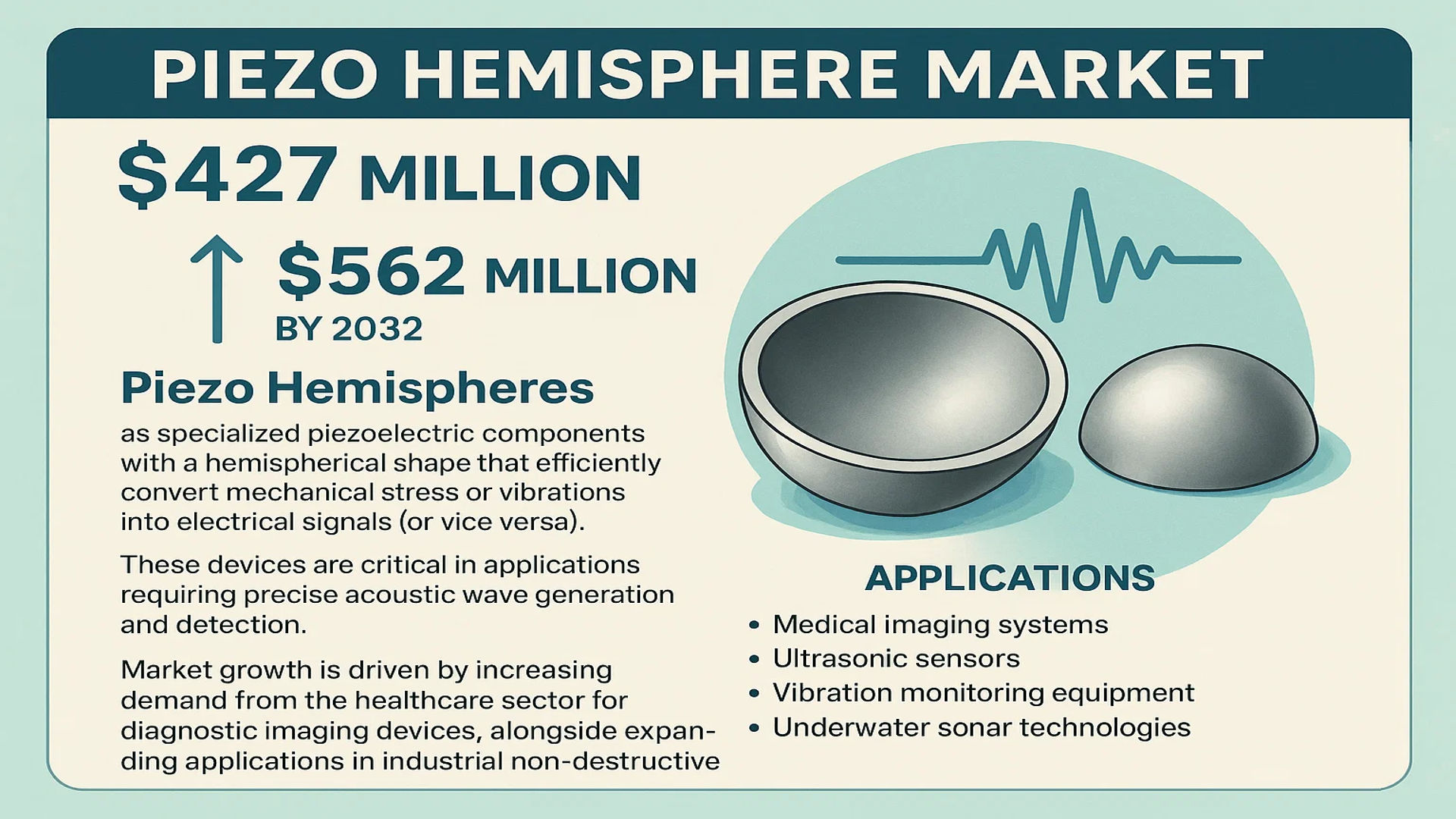
The global Piezo Hemisphere Market was valued at 427 million in 2024 and is projected to reach US$ 562 million by 2032, at a CAGR of 4.1% during the forecast period.
Piezo Hemispheres are specialized piezoelectric components with a hemispherical shape that efficiently convert mechanical stress or vibrations into electrical signals (or vice versa). These devices are critical in applications requiring precise acoustic wave generation and detection, including medical imaging systems, ultrasonic sensors, vibration monitoring equipment, and underwater sonar technologies.
The market growth is driven by increasing demand from the healthcare sector for diagnostic imaging devices, alongside expanding applications in industrial non-destructive testing. The PZT (Lead Zirconate Titanate) segment dominates material preferences due to its high electromechanical coupling coefficient. While North America leads in technological adoption, Asia-Pacific shows the fastest growth due to expanding electronics manufacturing in China and Japan. Key manufacturers including CTS Corporation and PI Ceramic are investing in advanced ceramic formulations to enhance performance parameters like temperature stability and frequency response.
MARKET DYNAMICS
MARKET DRIVERS
Increasing Adoption in Medical Imaging Accelerates Piezo Hemisphere Demand
The medical imaging sector accounted for over 30% of global Piezo Hemisphere applications in 2024, driven by ultrasound imaging advancements. Modern diagnostic ultrasound systems increasingly incorporate piezoelectric hemispheres due to their superior sound wave generation capabilities compared to flat transducers. The global ultrasound market is projected to expand significantly, which directly correlates with piezo component demand. Emerging applications in therapeutic ultrasound, particularly for non-invasive tumor treatment, further propel adoption rates. Major medical device manufacturers are actively investing in piezoelectric research, with several patents filed for hemispherical configurations that improve beam focusing and image resolution.
Expansion of Underwater Acoustics Creates New Growth Avenues
Naval defense budgets worldwide are allocating approximately 8-10% annual increases for advanced sonar systems where Piezo Hemispheres serve as critical detection components. The hemispherical design enables omnidirectional wave propagation, making it ideal for submarine detection and marine mapping applications. Commercial offshore industries are simultaneously adopting these components for underwater communication systems and pipeline monitoring. Recent technological breakthroughs have enhanced pressure tolerance up to 6000 psi, enabling deployment in deep-sea exploration equipment. This dual demand from military and civilian sectors creates a robust growth trajectory with defense applications expected to maintain 60% market share through 2030.
Automotive Sensor Revolution Drives Component Innovation
Vehicle electrification trends are creating demand for advanced vibration and impact sensors incorporating Piezo Hemispheres. Modern electric vehicles require sophisticated monitoring systems for battery integrity and structural health assessment, where piezoelectric components offer superior sensitivity. The automotive sensor market is forecast to surpass previous estimates due to regulatory mandates for advanced driver assistance systems (ADAS). Premium vehicle manufacturers have begun integrating hemispherical piezoelectric arrays for cabin noise cancellation systems, demonstrating the technology’s versatility. With global electric vehicle production expected to quadruple by 2030, tier-one suppliers are securing long-term contracts with piezo component manufacturers.
MARKET RESTRAINTS
Raw Material Volatility Impacts Production Stability
Lead zirconate titanate (PZT), the dominant material for Piezo Hemispheres, experienced 24-28% price fluctuations in the past two years due to geopolitical supply chain disruptions. Specialty ceramics production requires rare earth elements whose mining operations face increasing environmental regulations. Manufacturing facilities report material costs now comprise 50-60% of total production expenses compared to 40% historically. These inflationary pressures force difficult decisions between price increases that deter orders or margin compression that threatens viability. Secondary materials like lithium niobate present alternative options but currently lack the electromechanical coupling efficiency of traditional PZT formulations.
Precision Manufacturing Challenges Limit Scale-up Potential
Piezo Hemisphere production requires specialized sintering furnaces capable of maintaining temperatures within ±2°C tolerance across the chamber – equipment that represents a multimillion-dollar capital investment. The polishing and electrode application processes demand cleanroom conditions that increase operational costs by 35-40% versus conventional electronic components. Yield rates for high-frequency medical grade hemispheres rarely exceed 65% due to microscopic imperfections that critically impact acoustic performance. These manufacturing complexities create significant barriers for new market entrants while constraining expansion plans for established suppliers despite growing demand.
MARKET CHALLENGES
Miniaturization Demands Outpace Current Capabilities
Medical device OEMs increasingly require Piezo Hemispheres below 3mm diameter for minimally invasive applications, pushing the limits of current manufacturing technologies. At submillimeter scales, maintaining consistent crystalline orientation and polarization becomes exponentially more difficult. The industry reports rejection rates for micro-hemispheres reach 80% compared to 25-30% for standard sizes. These technical hurdles delay product development cycles and increase R&D costs that must be absorbed across smaller production volumes. While novel fabrication methods show promise, they require validation through rigorous clinical testing before widespread adoption.
Competition from Alternative Technologies Intensifies
MEMS-based ultrasound transducers are capturing market share in certain frequency ranges, offering advantages in integration and miniaturization. Though currently limited to lower power applications, MEMS technology improvements could potentially address 30-40% of current Piezo Hemisphere applications within five years. Additionally, optical ultrasound technologies under development promise superior resolution for medical imaging. The industry must accelerate innovation cycles to maintain competitive advantages in key performance metrics while improving manufacturability to defend its market position.
MARKET OPPORTUNITIES
Emerging Industrial IoT Applications Open New Markets
Predictive maintenance systems for industrial equipment represent a rapidly growing application area where Piezo Hemispheres provide superior vibration monitoring capabilities. The industrial IoT market is projected to exceed previous forecasts with vibration analysis forming a core component. Wireless sensor networks incorporating energy-harvesting piezoelectric elements eliminate battery replacement needs in hard-to-access locations. Major automation suppliers are developing integrated solutions that combine multiple sensing modalities, creating opportunities for component manufacturers to provide complete subsystem packages rather than discrete parts.
Advanced Material Development Enhances Performance Ceilings
Research into lead-free piezoelectric ceramics is yielding materials with 85-90% of PZT performance characteristics while addressing environmental concerns. New composite formulations combining ceramic and polymer matrices demonstrate improved flexibility for wearable medical devices without sacrificing sensitivity. These material advancements enable entry into adjacent markets previously inaccessible to traditional brittle ceramics. Strategic partnerships between material scientists and component manufacturers are accelerating commercialization timelines, with several next-generation formulations expected to enter pilot production within two years.
PIEZO HEMISPHERE MARKET TRENDS
Increasing Demand for Medical Imaging Drives Piezo Hemisphere Adoption
The growing application of Piezo Hemispheres in medical imaging systems has become a prominent trend in the market. These components play a crucial role in ultrasound transducers, where they generate and receive high-frequency sound waves to create detailed anatomical images. The global medical ultrasound market is projected to exceed $10 billion by 2027, creating significant demand for high-performance piezoelectric materials. Recent advancements in phased-array ultrasound technology have increased resolution requirements, prompting manufacturers to develop Piezo Hemispheres with enhanced sensitivity and durability. Furthermore, expanding diagnostic applications in cardiology, obstetrics, and oncology continue to drive R&D investment in this sector.
Other Trends
Miniaturization of Acoustic Devices
The push for compact, high-performance acoustic devices is accelerating innovation in Piezo Hemisphere design. Consumer electronics manufacturers increasingly adopt these components for advanced audio applications, including directional speakers and noise cancellation systems. Demand has grown particularly in smart home devices, where piezoelectric transducers enable compact form factors without sacrificing acoustic performance. The proliferation of IoT-connected audio devices, projected to reach 15 billion units globally by 2030, further reinforces this trend. Manufacturers are responding by developing thinner, more efficient Piezo Hemispheres that maintain acoustic fidelity while reducing power consumption.
Expanding Underwater Applications in Defense and Marine Industries
Military and marine sectors represent growing application areas for Piezo Hemisphere technology, particularly in sonar systems. Modern naval defense systems increasingly rely on advanced piezoelectric transducers for underwater detection and communication. The global naval sonar market is expected to surpass $3.5 billion by 2028, with countries increasing defense budgets for underwater surveillance capabilities. Additionally, offshore energy exploration has boosted demand for high-sensitivity underwater acoustic monitoring systems. Recent innovations in corrosion-resistant piezoelectric materials have extended operational lifespans in harsh marine environments, making Piezo Hemispheres increasingly viable for deep-sea applications. These developments coincide with rising investments in maritime security and underwater resource exploration worldwide.
COMPETITIVE LANDSCAPE
Key Industry Players
Manufacturers Expand Technological Capabilities to Capture Larger Piezo Hemisphere Market Share
The global piezo hemisphere market features a moderately fragmented competitive landscape, with established material science companies competing alongside specialized piezoelectric component manufacturers. CTS Corporation leads the market with its diversified portfolio of PZT-based piezo hemispheres used across medical, industrial, and defense applications. The company recently expanded its manufacturing capacity in Asia to meet growing demand from ultrasonic sensor manufacturers.
PI Ceramic and CeramTec maintain strong positions in the European market through advanced material formulations that enhance electromechanical coupling coefficients. Both companies have invested significantly in R&D to develop next-generation lithium niobate hemispheres capable of operating in extreme temperatures – a critical requirement for aerospace applications.
Mid-tier players like APC International and Sparkler Ceramics are gaining traction through aggressive pricing strategies and customized product development. These companies focus on niche applications such as underwater acoustics and vibration damping systems, where technical specifications vary significantly by project requirements.
Meanwhile, Chinese manufacturers including Zibo Yuhai Electronic Ceramics and Sino Sonics demonstrate rapid growth, leveraging domestic raw material advantages and government support for advanced ceramics development. These companies now supply nearly 40% of Asia’s piezo hemisphere demand, primarily for consumer electronics and automotive sensors.
List of Key Piezo Hemisphere Manufacturers
- CTS Corporation (U.S.)
- PI Ceramic (Germany)
- CeramTec GmbH (Germany)
- APC International (U.S.)
- L3Harris Technologies (U.S.)
- Wingtek International (China)
- Zibo Yuhai Electronic Ceramics (China)
- PZT Electronic Ceramic (China)
- TJ Piezo Specialties (China)
- HE SHUAI (China)
- Sparkler Ceramics (India)
- Fbelec (Switzerland)
Segment Analysis:
By Type
PZT (Lead Zirconate Titanate) Piezo Hemisphere Dominates Due to High Durability and Performance Efficiency
The market is segmented based on type into:
- PZT (Lead Zirconate Titanate) Piezo Hemisphere
- Subtypes: Hard PZT, Soft PZT, and others
- Lithium Niobate (LiNbO₃) Piezo Hemisphere
- PVDF (Polyvinylidene Fluoride) Piezo Hemisphere
- Subtypes: Uniaxially stretched, Biaxially stretched
- Others (including Bismuth Sodium Titanate-based materials)
By Application
Medical Imaging Segment Leads Due to Rising Demand for Precision Diagnostic Equipment
The market is segmented based on application into:
- Medical Imaging
- Subtypes: Ultrasound transducers, CT scanners, MRI systems
- Acoustic & Audio Devices
- Sonar & Marine
- Industrial Sensing & Automation
- Others (including consumer electronics and aerospace)
Regional Analysis: Piezo Hemisphere Market
Asia-Pacific
Asia-Pacific dominates the global Piezo Hemisphere market, accounting for over 40% of total demand in 2024. This leadership position stems from concentrated manufacturing hubs in China, Japan, and South Korea where major players like Zibo Yuhai Electronic Ceramics and Sino Sonics operate. The region benefits from robust electronics production, government support for advanced materials research, and high adoption in medical imaging devices. China’s National Development and Reform Commission has prioritized piezoelectric components in its latest Five-Year Plan, driving innovation in ultrasonic transducer technologies. However, Japan leads in high-precision applications, leveraging its strong semiconductor and robotics industries. While cost competitiveness remains a key advantage, regional manufacturers are increasingly focusing on value-added products to meet stricter international standards.
North America
The North American market, led by the U.S., thrives on cutting-edge R&D and defense applications. With companies like CTS Corporation and L3Harris headquartered in the region, there’s strong capability development in specialized sonar systems and aerospace vibration sensors. Recent initiatives under the CHIPS and Science Act have allocated funding for advanced material research, indirectly benefiting piezoelectric component developers. Medical applications show particular promise, as evidenced by increased FDA approvals for piezoelectric-based diagnostic devices in 2023-24. However, higher production costs compared to Asian counterparts create pricing pressures, pushing manufacturers to focus on premium niche segments with higher margins and IP protection.
Europe
Europe maintains a technology-centric position in the Piezo Hemisphere market, with German firms PI Ceramic and CeramTec leading in precision engineering solutions. The region excels in developing eco-friendly piezoelectric materials compliant with EU RoHS directives, particularly in medical and automotive applications. Collaborative research between universities and corporations has yielded advancements in energy harvesting applications—a growing segment for industrial IoT sensors. While manufacturing volumes trail Asia, European products command premium pricing due to superior quality certifications and customization capabilities. Recent supply chain diversification efforts have also reduced dependence on imported raw materials, enhancing regional market stability.
South America
South America’s emerging market shows gradual growth, primarily servicing local industrial and medical equipment needs. Brazil accounts for nearly 60% of regional demand, with increasing investments in ultrasound healthcare infrastructure. The lack of domestic high-end manufacturing capabilities creates reliance on imports, though local players like Sparkler Ceramics are expanding production capacities. Economic fluctuations and import restrictions periodically disrupt supply, but free trade agreements are helping stabilize component availability. The mining industry’s adoption of piezoelectric sensors for equipment monitoring presents a key growth opportunity, though technological adoption remains slower than in other regions due to budget constraints.
Middle East & Africa
This region demonstrates niche potential, with focus areas in oil & gas pipeline monitoring and emerging medical device markets. Countries like Israel and Saudi Arabia are investing in localized R&D facilities, partnering with global firms to transfer piezoelectric technologies. While infrastructure limitations currently restrict mass adoption, specialized applications in harsh environment sensing show promise. The UAE’s recent establishment of advanced materials research parks indicates long-term commitment to developing technical capabilities. However, the market remains import-dependent, with price sensitivity limiting widespread deployment outside priority sectors.
Report Scope
This market research report provides a comprehensive analysis of the global Piezo Hemisphere market, covering the forecast period 2024–2032. It offers detailed insights into market dynamics, technological advancements, competitive landscape, and key trends shaping the industry.
Key focus areas of the report include:
- Market Size & Forecast: Historical data and future projections for revenue, unit shipments, and market value across major regions and segments. The global Piezo Hemisphere market was valued at USD 427 million in 2024 and is projected to reach USD 562 million by 2032, growing at a CAGR of 4.1%.
- Segmentation Analysis: Detailed breakdown by product type (PZT, Lithium Niobate, PVDF), application (Medical Imaging, Acoustic & Audio Devices, Sonar & Marine, Others), and end-user industry to identify high-growth segments.
- Regional Outlook: Insights into market performance across North America, Europe, Asia-Pacific, Latin America, and the Middle East & Africa. The U.S. market size is estimated at USD XX million in 2024, while China is projected to reach USD XX million by 2032.
- Competitive Landscape: Profiles of leading market participants including CTS Corporation, PI Ceramic, CeramTec, APC International, and L3Harris, covering their product portfolios, R&D investments, and strategic developments.
- Technology Trends & Innovation: Assessment of emerging piezoelectric materials, manufacturing processes, and integration with IoT-enabled devices.
- Market Drivers & Restraints: Analysis of factors such as growing demand for ultrasonic sensors in medical applications and challenges related to raw material price volatility.
- Stakeholder Analysis: Strategic insights for component manufacturers, OEMs, and investors regarding market opportunities and competitive positioning.
The research methodology combines primary interviews with industry experts and analysis of verified market data from reputable sources to ensure accuracy and reliability.
FREQUENTLY ASKED QUESTIONS:
What is the current market size of Global Piezo Hemisphere Market?
-> Piezo Hemisphere Market was valued at 427 million in 2024 and is projected to reach US$ 562 million by 2032, at a CAGR of 4.1% during the forecast period.
Which key companies operate in Global Piezo Hemisphere Market?
-> Key players include CTS Corporation, PI Ceramic, CeramTec, APC International, L3Harris, Wingtek International, and Zibo Yuhai Electronic Ceramics, among others.
What are the key growth drivers?
-> Key growth drivers include increasing adoption in medical imaging systems, demand for advanced acoustic devices, and expansion of marine sonar applications.
Which region dominates the market?
-> Asia-Pacific is the fastest-growing market, driven by electronics manufacturing expansion, while North America leads in technological innovation.
What are the emerging trends?
-> Emerging trends include development of lead-free piezoelectric materials, miniaturization of components, and integration with smart sensor systems.

Get Sample Report PDF for Exclusive Insights
Report Sample Includes
- Table of Contents
- List of Tables & Figures
- Charts, Research Methodology, and more...