MARKET INSIGHTS
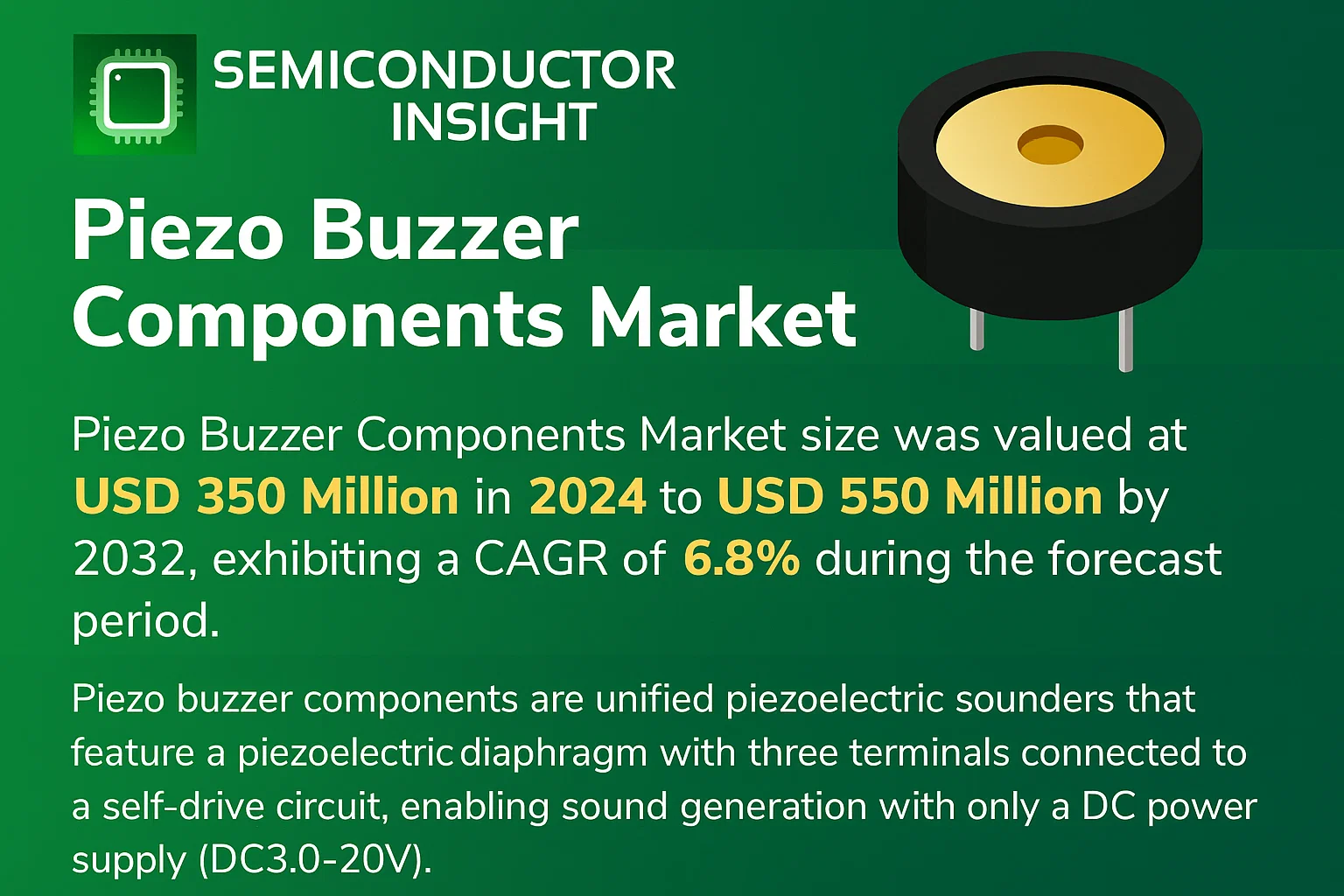
Global Piezo Buzzer Components Market size was valued at USD 350 million in 2024 to USD 550 million by 2032, exhibiting a CAGR of 6.8% during the forecast period.
Piezo buzzer components are unified piezoelectric sounders that feature a piezoelectric diaphragm with three terminals connected to a self-drive circuit, enabling sound generation with only a DC power supply (DC3.0-20V). These components utilize specially designed resonant systems that make them suitable for applications requiring large sound volumes across various electronic devices and industrial equipment.
The market is experiencing steady growth driven by several key factors, including increasing demand across automotive electronics applications, expanding use in home appliances, and growing adoption in alarm systems. Furthermore, the rising integration of electronic notification systems across multiple industries contributes significantly to market expansion. China represents the leading regional market for piezo buzzer components, accounting for approximately 35% of global demand, followed by Japan at around 25%. Major industry players include Murata, TDK, Kingstate Electronics, DB Products Limited, and Cui Inc., with the top three manufacturers collectively holding about 20% market share. These companies continue to innovate their product portfolios while expanding their global manufacturing and distribution networks.
MARKET DRIVERS
Rising Demand from the Automotive Industry
Global expansion of the automotive sector, particularly in electric and autonomous vehicles, is a primary driver for piezo buzzer components. These components are essential for safety alerts, turn signals, and electronic warning systems. The trend towards increased vehicle electrification demands reliable, low-power acoustic devices, directly boosting market growth.
Proliferation of Consumer Electronics and Smart Devices
The surge in consumer electronics, including smartphones, wearables, and smart home appliances, continues to fuel demand. Piezo buzzers provide compact, efficient audible feedback for notifications and user interfaces. The miniaturization of electronic devices and the Internet of Things (IoT) expansion further solidify their role in modern gadgets.
Furthermore, stringent government regulations mandating safety alarms in industrial equipment and public infrastructure projects create a steady, non-discretionary demand for these components across various global markets.
MARKET CHALLENGES
Intense Price Competition and Commoditization
The market faces significant price pressure due to high competition, particularly from manufacturers in the Asia-Pacific region. Many piezo buzzer products are becoming commoditized, leading to shrinking profit margins for companies that do not differentiate through advanced features or customization.
Other Challenges
Acoustic Limitations in Noisy Environments
Standard piezo buzzers can struggle with sufficient sound pressure levels in high-ambient-noise industrial settings, requiring more advanced and costly solutions, which can limit their adoption in certain applications.
Supply Chain Vulnerabilities
Reliance on specific raw materials and electronic components makes the market susceptible to supply chain disruptions, as witnessed during recent global chip shortages, affecting production timelines and costs.
MARKET RESTRAINTS
Competition from Alternative Technologies
The growth of the piezo buzzer market is restrained by the availability of competing audio technologies. Electromagnetic buzzers and advanced audio speakers offering wider frequency ranges and richer sound quality are increasingly preferred for applications requiring complex audio signals, limiting the market share for basic piezo components.
Technical Limitations for High-Fidelity Audio
Piezo buzzers are inherently limited in their ability to reproduce low-frequency sounds and complex tones. This technical constraint hinders their adoption in applications where high-fidelity audio or voice prompts are required, such as in advanced medical devices or premium consumer electronics.
MARKET OPPORTUNITIES
Expansion in Healthcare and Medical Devices
The healthcare sector presents significant growth opportunities, especially for devices requiring reliable, low-power auditory alerts. The increasing use of portable medical devices, patient monitors, and diagnostic equipment globally drives the need for compact and dependable piezo buzzer components.
Innovation in Smart City Infrastructure
The development of smart cities worldwide opens new avenues for piezo buzzers in applications like public announcement systems, crosswalk signals, and IoT-enabled sensors. Their durability and low energy consumption make them ideal for large-scale, long-term deployments in urban infrastructure projects.
Piezo Buzzer Components Market Trends
Sustained Global Growth Fueled by Automotive and Consumer Electronics
Global Piezo Buzzer Components Market is on a steady growth trajectory, projected to expand from a valuation of USD 350 million in 2024 to USD 550 million by 2032, representing a compound annual growth rate (CAGR) of 6.8%. This sustained demand is primarily driven by their integration into a widening array of electronic applications. The fundamental advantage of piezo buzzers, which unify a piezoelectric diaphragm with a self-drive circuit to generate sound from a simple DC power supply, makes them indispensable for audio signaling. Their suitability for designs requiring high sound volumes, achieved through resonant systems, underpins their market penetration.
Other Trends
Asia-Pacific as the Dominant Production and Consumption Hub
The geographical concentration of the market is a defining trend, with the Asia-Pacific region leading global production and consumption. China alone accounts for approximately 35% of Global market, supported by its extensive electronics manufacturing infrastructure. Japan follows as the second-largest market, holding a share of about 25%. This regional dominance is further solidified by the presence of key manufacturers in these countries, creating a robust supply chain that serves both domestic and international demand for components used in automotive electronics, home appliances, and alarms.
Market Segments Demonstrating Strong Application Diversity
The market is segmented by type into Active and Passive Piezo Buzzers, and by application into several key areas. The application segmentation reveals diverse demand drivers. The Automotive Electronics segment is a major consumer, utilizing buzzers for alerts and warnings. The Home Appliances segment uses them in products like microwaves and washing machines, while the Alarm and Timer segments represent steady, application-specific demand. The competitive landscape is fragmented, with the top three manufacturers collectively accounting for roughly 20% of the market, indicating the presence of numerous players. Leading companies include Murata, TDK, and Kingstate Electronics.
Technological Refinement and Capacity Expansion
A key trend among manufacturers is the focus on technological refinement to improve sound quality, reduce power consumption, and enhance reliability. Concurrently, capacity expansion, particularly in the Asia-Pacific region, is underway to meet the growing global demand. As industries continue to automate and incorporate more user-interface feedback, the demand for reliable and cost-effective audio indicators is expected to remain strong, ensuring the positive market momentum continues throughout the forecast period.
COMPETITIVE LANDSCAPE
Key Industry Players
A Concentrated Market with Global Leaders and Regional Specialists
Global Piezo Buzzer Components Market is characterized by the presence of established multinational electronics component manufacturers alongside specialized regional players. The competitive landscape is moderately concentrated, with the top three manufacturers accounting for approximately 20% of Global market share. Leading the market are Japanese electronics giants Murata and TDK, who leverage their extensive experience in piezoelectric materials and strong global supply chains to serve a wide range of industries, including automotive electronics and home appliances. These players compete on the basis of product reliability, technological innovation, and large-scale production capabilities.
Beyond the top-tier leaders, the market features a significant number of other key manufacturers that hold important positions in specific geographic regions or application niches. Companies such as Kingstate Electronics and DB Products Limited have built strong reputations for quality and service. Many of these players are based in Asia, particularly in China and Taiwan, capitalizing on the region’s manufacturing ecosystem to offer cost-competitive solutions for applications like alarms, toys, and timers. This allows them to effectively serve diverse customer needs and compete for market share. The competitive dynamics are further shaped by ongoing efforts to miniaturize components, enhance sound output, and improve energy efficiency.
List of Key Piezo Buzzer Components Companies Profiled
- Murata
- TDK
- Kingstate Electronics
- Db Products Limited
- Cui Inc.
- Sonitron
- Huayu Electronics
- Hunston Electronics
- Ariose
- Hitpoint
- Kepo Electronics
- Soberton
- Kingwei Electronic Co., LTD
Segment Analysis:
| Segment Category | Sub-Segments | Key Insights |
| By Type |
|
Active Piezo Buzzers represent the leading segment, primarily due to their integrated self-drive oscillating circuit that simplifies design requirements for manufacturers. This inherent ease of use, requiring only a simple DC power supply for operation, makes them a preferred choice for a vast range of standard applications, thereby driving broader adoption and higher volume production across multiple industries seeking reliable and straightforward audible alert solutions. |
| By Application |
|
Automotive Electronics is the dominant application segment, fueled by the increasing electronic content per vehicle and stringent safety regulations mandating audible alerts for systems like seatbelt reminders, key-in-ignition warnings, and turn signals. The demand for robust, reliable, and compact components that can withstand harsh automotive environments positions piezo buzzers as a critical component, with growth further supported by trends in electric and autonomous vehicles. |
| By End User |
|
OEMs (Original Equipment Manufacturers) constitute the leading end-user segment, as the majority of piezo buzzers are integrated directly into products during the initial manufacturing process. This dominance is driven by the need for cost-effective, volume-produced components that meet specific design and performance specifications for everything from vehicles and appliances to industrial equipment, creating a stable and high-volume demand stream directly from manufacturers. |
| By Sound Output Level |
|
Standard Output buzzers are the leading segment, as they satisfy the performance requirements for the widest array of common applications, offering a balanced combination of audibility, power consumption, and cost. Their versatility makes them suitable for most consumer electronics, household appliances, and basic industrial notifications where extreme volume is not a primary concern, securing their position as the mainstream product offering from manufacturers. |
| By Mounting Type |
|
PCB Mount is the predominant mounting type, favored for its compatibility with automated assembly processes and its space-efficient design that integrates directly onto printed circuit boards. This aligns with the industry-wide trend towards miniaturization and automated manufacturing, making PCB mount buzzers the standard choice for high-volume electronic products where reliability, cost, and streamlined production are paramount considerations for design engineers. |
Regional Analysis: Piezo Buzzer Components Market
The region’s unparalleled manufacturing infrastructure provides a seamless supply chain for piezo buzzer components, from raw piezoelectric ceramic materials to final assembly. This integrated ecosystem ensures rapid production cycles and cost efficiencies that are difficult to match elsewhere, making it the primary global sourcing destination.
Strong demand from key sectors like consumer electronics, automotive (especially for dashboard alerts and EV notifications), and home appliances fuels market growth. The high rate of product innovation and short replacement cycles in these industries ensure a constant and evolving demand for advanced piezo buzzer solutions.
Leading electronics firms and dedicated component manufacturers in the region are at the forefront of developing buzzers with improved sound pressure levels, lower power consumption, and smaller form factors. This continuous R&D effort keeps the region’s products aligned with global trends towards miniaturization and energy efficiency.
Supportive government policies promoting electronics manufacturing and technological exports, combined with significant foreign direct investment, create a favorable business environment. This support helps local manufacturers scale operations and maintain a competitive edge in Global market for piezo buzzer components.
North America
The North American market for piezo buzzer components is characterized by high demand for advanced, reliable components primarily driven by the automotive, medical device, and industrial control sectors. The region’s focus is on high-value applications where performance, durability, and compliance with stringent regulatory standards are paramount. There is significant integration of piezo buzzers in sophisticated systems like automotive infotainment and safety alerts, advanced medical equipment for patient monitoring, and complex industrial machinery. While manufacturing is less concentrated than in Asia-Pacific, the region boasts strong R&D capabilities, leading to demand for customized and application-specific buzzer solutions with enhanced features.
Europe
Europe maintains a mature and stable market for piezo buzzer components, with demand strongly linked to its robust automotive industry, industrial automation, and high-quality consumer goods. German and French automotive manufacturers, in particular, are key drivers, requiring buzzers for a wide range of vehicle alerts and systems. The market is influenced by strict European Union regulations concerning product safety, electromagnetic compatibility, and environmental standards, which shape the specifications of components used. There is a notable trend towards sourcing components that offer high reliability and longevity, with a growing interest in buzzers for smart building applications and energy-efficient home appliances.
South America
The South American market for piezo buzzers is in a developing phase, with growth potential linked to the gradual expansion of its industrial and consumer electronics sectors. Brazil and Argentina are the primary markets, driven by local manufacturing of appliances, automotive assembly, and alarm systems. The market is price-sensitive, with a significant portion of demand met by imported components, particularly from Asia. Growth is steady but can be influenced by regional economic volatility. The focus is often on standard, cost-effective buzzer solutions for basic alert and notification functions in consumer products and industrial applications.
Middle East & Africa
This region represents a smaller but growing segment of Global piezo buzzer market. Demand is primarily driven by infrastructure development, the expansion of the consumer electronics retail sector, and industrial projects, particularly in the Gulf Cooperation Council countries and South Africa. Key applications include security systems, household appliances, and automotive aftermarket parts. The market is characterized by a high reliance on imports, with distribution channels playing a critical role. Growth is tied to economic diversification efforts and increasing urbanization, which are expected to slowly boost demand for electronic components over the longer term.
Report Scope
This market research report provides a comprehensive analysis of the Piezo Buzzer Components Market, covering the forecast period 2025–2032. It offers detailed insights into market dynamics, technological advancements, competitive landscape, and key trends shaping the industry.
Key focus areas of the report include:
- Market Overview: The report begins with an overview outlining its current market scenario, key growth indicators, and industry transformation drivers. It discusses macroeconomic factors, demand–supply balance, regulatory landscape, and the strategic role of semiconductors in powering advancements across industries such as automotive, telecommunications, consumer electronics, and industrial automation.
- Market Size & Forecast: Historical data and future projections for revenue, unit shipments, and market value across major regions and segments.
- Segmentation Analysis: Detailed breakdown by product type, technology, application, and end-user industry to identify high-growth segments and investment opportunities.
- Regional Insights: Insights into market performance across North America, Europe, Asia-Pacific, Latin America, and the Middle East & Africa, including country-level analysis where relevant.
- Competitive Landscape: Profiles of leading market participants, including their product offerings, R&D focus, manufacturing capacity, pricing strategies, and recent developments such as mergers, acquisitions, and partnerships.
- Technology Trends & Innovation: Assessment of emerging technologies, integration of AI/IoT, semiconductor design trends, fabrication techniques, and evolving industry standards.
- Market Drivers & Restraints: Evaluation of factors driving market growth along with challenges, supply chain constraints, regulatory issues, and market-entry barriers.
- Stakeholder Insights: Insights for component suppliers, OEMs, system integrators, investors, and policymakers regarding the evolving ecosystem and strategic opportunities.
Primary and secondary research methods are employed, including interviews with industry experts, data from verified sources, and real-time market intelligence to ensure the accuracy and reliability of the insights presented.
FREQUENTLY ASKED QUESTIONS:
What is the current market size of Piezo Buzzer Components Market?
-> Global Piezo Buzzer Components Market was valued at USD 350 million in 2024 and is projected to reach USD 550 million by 2032, growing at a CAGR of 6.8% during the forecast period.
Which key companies operate in Piezo Buzzer Components Market?
-> Key players include Murata, TDK, Kingstate Electronics, DB Products Limited, Cui Inc., Huayu Electronics, and Hitpoint, among others. The top three manufacturers account for about 20% of the market.
What are the key growth drivers?
-> Key growth drivers include widespread application across automotive electronics, home appliances, alarms, and toys, along with demand for reliable, self-driven sound generation components.
Which region dominates the market?
-> China is the leading market, accounting for about 35% of Global market, followed by Japan at approximately 25%.
What are the emerging trends?
-> Emerging trends include development of piezo buzzers with higher sound volumes, integration into smart devices, and advancements in resonant system design.

Get Sample Report PDF for Exclusive Insights
Report Sample Includes
- Table of Contents
- List of Tables & Figures
- Charts, Research Methodology, and more...
 Download Sample Report PDF