Photonics IC Market Insights
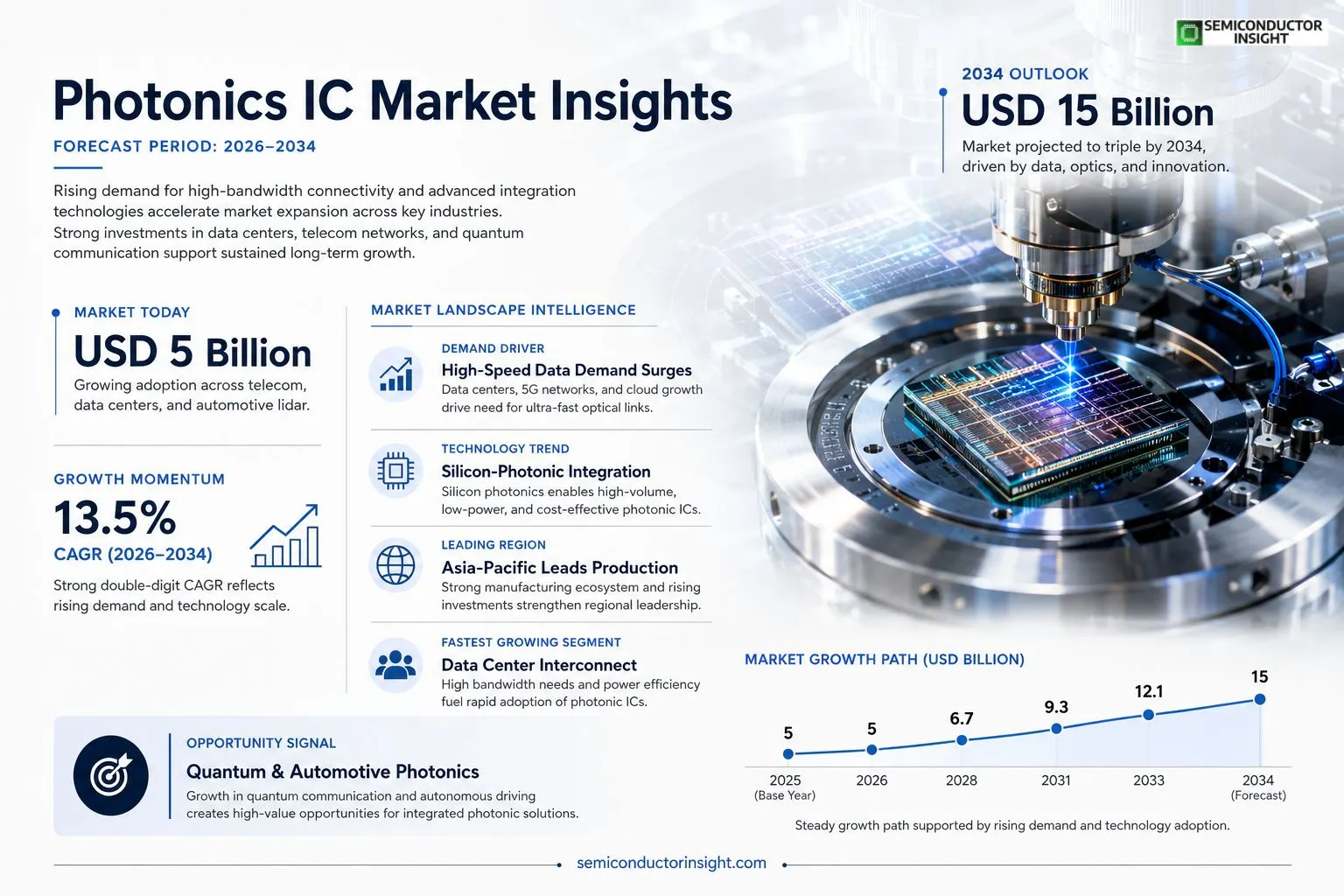
Global photonic integrated circuits market size was valued at USD 5 billion in 2025. The market is projected to grow from USD 5 billion in 2026 to USD 15 billion by 2034, exhibiting a CAGR of approximately 13½% during the forecast period.
Photonic integrated circuits (PICs) are semiconductor devices that integrate multiple optical components,such as lasers, modulators, detectors and waveguides,onto a single chip. By consolidating these functions, PICs enable high‑speed data transmission while reducing power consumption and form factor.The market is accelerating because telecom operators are expanding fiber‑optic networks, data‑center traffic is soaring, and autonomous‑vehicle lidar systems demand compact optics. Moreover, government funding for quantum‑communication research fuels adoption. Recent collaborations illustrate this momentum; for example, in March 2024 Intel partnered with Acacia Communications to co‑develop next‑generation silicon‑photonic transceivers. Key players such as Lumentum Holdings, Cisco Systems and II‑VI Incorporated continue broadening their PIC portfolios.
MARKET DRIVERS
Growing Demand for High‑Speed Data Transmission
Photonics IC Market is being propelled by the surge in bandwidth requirements for cloud computing, 5G networks, and data‑center interconnects. Companies are investing heavily in silicon photonics platforms that enable multi‑terabit per second transmission while reducing power consumption.
Advancements in Integration Technologies
Recent breakthroughs in heterogeneous integration allow optical components to be combined with advanced CMOS processes, shortening time‑to‑market and lowering unit costs. This technical synergy boosts adoption across telecommunications, automotive LiDAR, and quantum‑computing sectors.
➤ Analysts project a compound annual growth rate of approximately 15% for Photonics IC Market through 2030, driven primarily by data‑center expansion.
In addition, government initiatives supporting photonic research and the rollout of smart‑city infrastructures further reinforce the market’s upward trajectory.
Overall, the convergence of performance‑driven demand and scalable manufacturing processes creates a robust foundation for sustained growth.
MARKET CHALLENGES
High Capital Expenditure for Foundry Upgrades
Developing state‑of‑the‑art photonic ICs requires substantial investment in specialized lithography equipment and clean‑room facilities. Smaller players often lack the necessary financial resources, leading to market concentration among a few large foundries.
Other Challenges
Supply Chain Complexity
The reliance on rare‑earth materials and precision‑polished wafers introduces vulnerabilities, especially when geopolitical tensions affect material availability.
Design Ecosystem Maturity
While design automation tools are improving, the ecosystem for photonic circuit layout remains fragmented, resulting in longer development cycles and higher validation costs.
MARKET RESTRAINTS
Standardization Gaps
The absence of universally accepted standards for optical interfaces hampers interoperability, causing OEMs to hesitate before committing to large‑scale deployments.Furthermore, variations in packaging techniques across regions create additional barriers to seamless integration with existing electronic systems.These technical and regulatory constraints slow the overall adoption rate of photonic IC solutions.
MARKET OPPORTUNITIES
Emerging Applications in Autonomous Vehicles
Autonomous driving platforms require compact, low‑latency optical transceivers for sensor fusion and high‑definition mapping. Photonics IC Market stands to capture significant share by delivering integrated solutions that meet automotive reliability standards.Another promising avenue lies in quantum communication, where photonic chips can facilitate secure data exchange over long distances, opening up new revenue streams for early entrants.Investors and manufacturers that align their R&D roadmaps with these high‑growth niches are well‑positioned to benefit from the upcoming wave of photonic innovation.
Photonics IC Market Trends
Rising Demand from Data‑Center and Telecom Networks
Photonics IC Market is being reshaped by the rapid expansion of fiber‑optic backbone networks and the surge in data‑center traffic. Telecom operators are deploying higher‑capacity wavelength‑division multiplexing (WDM) architectures, which rely on integrated laser arrays and modulators to maximize spectral efficiency. At the same time, hyperscale data‑center operators are adopting photonic interconnects to overcome electrical bottlenecks, achieving lower latency and power consumption per bit. These dynamics create a compelling incentive for manufacturers to integrate multiple optical functions onto a single chip, simplifying system design and reducing bill‑of‑materials. The trend is reinforced by the need for scalable solutions that can support the projected growth in cloud services, edge computing, and 5G backhaul, all of which demand high‑speed, low‑power optical links.
Other Trends
Silicon‑Photonic Integration Accelerates
Silicon‑photonic platforms are gaining traction as the preferred technology for mass‑producing photonic integrated circuits. Recent collaborations, such as the March 2024 partnership between Intel and Acacia Communications, illustrate the industry’s focus on co‑developing next‑generation silicon‑photonic transceivers. These devices combine on‑chip lasers, modulators, and waveguides in a CMOS‑compatible process, enabling high‑volume manufacturing while maintaining performance parity with indium‑phosphide solutions. Leading players like Lumentum Holdings, Cisco Systems, and II‑VI Incorporated are expanding their portfolios to include fully integrated transceiver modules that support multiple data‑rate standards. The shift toward silicon‑based integration shortens time‑to‑market, reduces capital expenditures for foundries, and opens opportunities for new entrants to innovate in packaging and testing.
Quantum‑Communication Funding Spurs Adoption
Government investment in quantum‑communication research is another catalyst for Photonics IC Market. National programs are allocating resources to develop secure, quantum‑key‑distribution (QKD) links, which require highly stable, low‑noise photonic components. The resulting demand is prompting vendors to design specialized PICs with integrated single‑photon detectors and ultra‑low‑loss waveguides. As pilot projects transition to operational networks, the ecosystem around quantum‑ready photonic chips is expanding, encouraging cross‑industry collaboration between telecom operators, semiconductor foundries, and academic institutions. This momentum not only diversifies the application portfolio of photonic integrated circuits but also reinforces the strategic importance of the market in next‑generation secure communications.
COMPETITIVE LANDSCAPEKey Industry Players
Photonic Integrated Circuits (PIC) Competitive Overview
Photonics IC Market is presently anchored by a handful of large, vertically‑integrated suppliers that command the majority of silicon‑photonic foundry capacity and system‑level design expertise. Intel leads the segment with its silicon‑photonic platform that serves data‑center interconnects, leveraging the 2024 partnership with Acacia Communications to accelerate next‑generation transceiver volumes. Lumentum Holdings follows as a dominant source of high‑performance lasers and modulators, capitalising on its extensive telecom customer base and recent expansion into quantum‑photonic components. Cisco Systems, through its acquisition of optical‑network assets, integrates PICs into its coherent optical portfolio, reinforcing its position in carrier‑grade infrastructure. II‑VI Incorporated rounds out the top tier, offering a broad wafer‑fab and packaging suite that addresses both telecom and defense markets, while NeoPhotonics supplies niche high‑speed coherent modules for submarine cable systems. This concentration of capabilities creates a high entry barrier for new entrants, steering competition toward technology differentiation, strategic alliances, and volume‑driven cost reductions.Beyond the core leaders, a diverse set of niche innovators enrich the ecosystem with specialised IP and fab services. Acacia Communications, now partially integrated with Intel, continues to commercialise low‑latency coherent modules for enterprise networking. STMicroelectronics and NTT Electronics provide complementary foundry and assembly services that support custom PIC designs for automotive lidar and quantum‑communication prototypes. Broadcom extends its data‑center portfolio with silicon‑photonic switching ASICs, while Fujitsu leverages its silicon‑photonics R&D for high‑speed computing accelerators. CREE (Wolfspeed) contributes indium‑phosphide laser sources, and GlobalFoundries offers a multi‑project wafer service targeting early‑stage silicon‑photonic startups. Emerging players such as A*Semiconductor and Infinera focus on specialised wavelength‑division multiplexing (WDM) engines, while Mellanox (Nvidia) integrates PICs into high‑bandwidth interconnects for AI workloads. Collectively, these firms drive incremental innovation, address vertical‑specific requirements, and expand the overall market addressable size.
List of Key Photonics IC Companies Profiled
- Intel
- Lumentum Holdings
- Cisco Systems
- II‑VI Incorporated
- NeoPhotonics
- Acacia Communications
- STMicroelectronics
- NTT Electronics
- Broadcom
- Fujitsu
- CREE (Wolfspeed)
- GlobalFoundries
- A*Semiconductor
- Infinera
- Mellanox (Nvidia)
Segment Analysis:
| Segment Category | Sub-Segments | Key Insights |
| By Type |
|
Silicon Photonics dominates due to its inherent compatibility with mature CMOS manufacturing, enabling scalable and cost‑effective production; it offers high integration density that supports complex optical functions on a single chip; the platform benefits from a broad ecosystem of design tools and foundry services that accelerate time‑to‑market. |
| By Application |
|
Data Center Interconnect is the leading application because it demands ultra‑high bandwidth while emphasizing power efficiency; photonic ICs enable compact transceiver modules that reduce footprint and simplify cable management; the drive for modular, plug‑and‑play solutions aligns with the rapid scaling of cloud infrastructures. |
| By End User |
|
Cloud Service Providers drive adoption by seeking dense, energy‑savvy optical links for server farms; they prioritize solutions that lower total cost of ownership while supporting continuous scaling; the need for reliable, low‑latency connectivity reinforces interest in integrated photonic modules. |
| By Technology Platform |
|
Multi‑Function Integration Platforms attract attention because they combine both passive routing and active modulation in a single die, delivering greater design flexibility; they enable co‑integration of lasers, detectors, and electronic drivers, which shortens development cycles; the approach supports emerging applications such as quantum communication where diverse functions must coexist tightly. |
| By Market Driver |
|
Demand for Low Power Consumption shapes the market as customers seek to curb operational expenses and thermal footprints; integration reduces interconnect losses and enables smarter power management; this driver fuels investment in silicon‑photonic designs that reconcile performance with stringent energy budgets. |
Regional Analysis: North America
North America
The telecommunications sector is a significant consumer of Photonics ICs, utilizing them for high-speed optical communication systems. The ongoing expansion of 5G networks and the increasing demand for bandwidth are propelling growth in this segment.
Data centers are rapidly adopting Photonics ICs to enhance data transfer speeds and reduce energy consumption. The increasing volume of data being generated and processed necessitates the use of more efficient photonic solutions.
The medical device industry utilizes Photonics ICs in various applications, including diagnostics, imaging, and therapeutic devices. The demand for miniaturized and high-precision photonic components is driving innovation in this sector.
Various industrial applications, such as sensing, spectroscopy, and laser systems, are increasingly leveraging Photonics ICs for enhanced performance and efficiency.
Europe
Europe presents a robust and diversified market for Photonics IC Market. The region boasts strong technological expertise and a well-established manufacturing base, particularly in countries like Germany, France, and the United Kingdom. Photonics IC Market in Europe is driven by a similar set of end-use industries as North America, including telecommunications, data centers, automotive, and industrial automation.
Asia-Pacific
Asia-Pacific is poised to be the fastest-growing market for Photonics IC Market globally. Driven by rapid industrialization, increasing investments in infrastructure, and a burgeoning electronics sector, the region offers significant opportunities for growth. Countries like China, Japan, and South Korea are key players in this market, with strong domestic manufacturing capabilities and a growing demand for advanced photonic solutions. The growth in the Asia-Pacific region is particularly robust in the telecommunications and consumer electronics segments.
South America
South America represents a relatively smaller but growing market for Photonics IC Market. The increasing investments in telecommunications infrastructure and the expanding electronics industry are driving demand for photonic solutions in countries like Brazil and Chile. The region presents opportunities for niche applications, particularly in areas such as optical sensing and industrial automation.
Middle East & Africa
The Middle East & Africa region offers significant growth potential for Photonics IC Market, driven by ambitious infrastructure development plans and increasing investments in telecommunications and energy sectors. Countries like Saudi Arabia and the United Arab Emirates are witnessing rapid growth in their digital infrastructure, leading to increased demand for photonic solutions. The region presents opportunities for both established players and new entrants.
Report Scope
This market research report provides a comprehensive analysis of the Photonics IC Market , covering the forecast period 2026–2034. It offers detailed insights into market dynamics, technological advancements, competitive landscape, and key trends shaping the industry.
Key focus areas of the report include:
- Market Overview: The report begins with an overview outlining its current market scenario, key growth indicators, and industry transformation drivers. It discusses macroeconomic factors, demand–supply balance, regulatory landscape, and the strategic role of semiconductors in powering advancements across industries such as automotive, telecommunications, consumer electronics, and industrial automation.
- Market Size & Forecast: Historical data and future projections for revenue, unit shipments, and market value across major regions and segments.
- Segmentation Analysis: Detailed breakdown by product type, technology, application, and end-user industry to identify high-growth segments and investment opportunities.
- Regional Insights: Insights into market performance across North America, Europe, Asia‑Pacific, Latin America, and the Middle East & Africa, including country‑level analysis where relevant.
- Competitive Landscape: Profiles of leading market participants, including their product offerings, R&D focus, manufacturing capacity, pricing strategies, and recent developments such as mergers, acquisitions, and partnerships.
- Technology Trends & Innovation: Assessment of emerging technologies, integration of AI/IoT, semiconductor design trends, fabrication techniques, and evolving industry standards.
- Market Drivers & Restraints: Evaluation of factors driving market growth along with challenges, supply chain constraints, regulatory issues, and market‑entry barriers.
- Stakeholder Insights: Insights for component suppliers, OEMs, system integrators, investors, and policymakers regarding the evolving ecosystem and strategic opportunities.
Primary and secondary research methods are employed, including interviews with industry experts, data from verified sources, and real‑time market intelligence to ensure the accuracy and reliability of the insights presented.
FREQUENTLY ASKED QUESTIONS:
What is the current market size of Photonics IC Market?
-> Photonics IC Market was valued at USD 5 billion in 2025 and is expected to reach USD 15 billion by 2034.
Which key companies operate in Photonics IC Market?
-> Key players include Lumentum Holdings, Cisco Systems, II‑VI Incorporated, Intel, and Acacia Communications, among others.
What are the key growth drivers?
-> Key growth drivers include telecom operators expanding fiber‑optic networks, soaring data‑center traffic, autonomous‑vehicle lidar demand, and government funding for quantum‑communication research.
Which region dominates the market?
-> The market is global with significant activity and adoption across all major regions.
What are the emerging trends?
-> Emerging trends include silicon‑photonic transceiver collaborations (e.g., Intel‑Acacia), quantum‑communication research funding, and increasing integration of multiple optical functions onto single chips.

Get Sample Report PDF for Exclusive Insights
Report Sample Includes
- Table of Contents
- List of Tables & Figures
- Charts, Research Methodology, and more...
 Download Sample Report PDF