Key Statistics
Key Takeaways
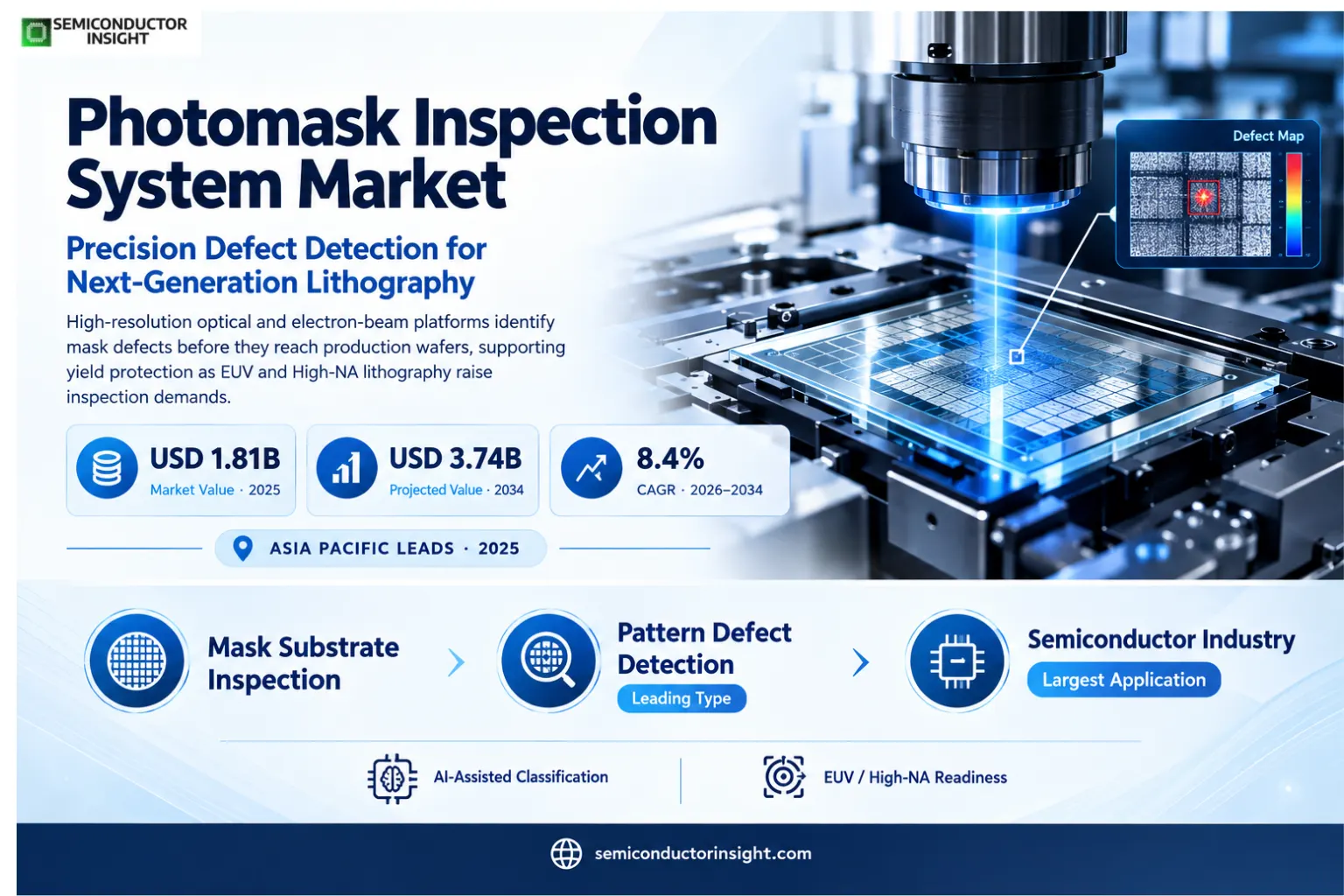
- Market scale: Photomask Inspection System was valued at USD 1.81 billion in 2025 and is projected to reach USD 3.74 billion by 2034, with a 8.4% CAGR over 2026–2034.
- Mask Pattern Defect Detection Equipment leads by type because pattern integrity directly determines whether a production mask can safely enter high-value wafer exposure.
- Semiconductor Industry is the largest application because advanced logic and memory masks carry the tightest defect budgets and highest economic cost of an escaped defect.
- Asia Pacific is the largest regional market, while Asia Pacific has the strongest incremental growth profile.
- Growth driver: EUV and advanced-node lithography increase inspection sensitivity, automation and defect-classification requirements
- Restraint: High equipment cost, long qualification cycles and dependence on precision optical and electron-beam subsystems constrain adoption
Photomask Inspection System Market Overview
Photomask Inspection System market was valued at USD 1.81 billion in 2025 and is projected to reach USD 3.74 billion by 2034, expanding at a 8.4% CAGR during 2026–2034. Asia Pacific leads the market in 2025.
Photomask inspection systems are high-resolution metrology platforms that find and classify defects on mask blanks and patterned reticles before those defects can transfer to production wafers. The category includes optical and electron-beam inspection, review software, image-comparison algorithms, precision stages and automation interfaces that connect inspection results to repair and manufacturing workflows.
Demand rises as lithography becomes less tolerant of small defects. EUV and High-NA EUV development add multilayer, imaging and data-analysis requirements, while AI-assisted classification helps users manage very large inspection datasets without a proportional increase in manual review.
The purchasing decision is driven by sensitivity, throughput, nuisance suppression, recipe stability, service response and integration with existing review and repair infrastructure. Asia Pacific leads because it combines the world’s densest concentration of wafer fabs, mask shops and display manufacturing.
Segment Analysis: By Type
By type, the market is segmented into Mask Substrate Defect Detection Equipment, Mask Pattern Defect Detection Equipment. Mask Pattern Defect Detection Equipment holds the leading position.
| Type | Market role | Commercial position |
|---|---|---|
| Mask Substrate Defect Detection Equipment | Inspects blanks, films and substrate surfaces before pattern acceptance. | Essential upstream quality gate for mask blanks and EUV-related substrates. |
| Mask Pattern Defect Detection Equipment | Inspects patterned reticles for random, repeating and printable defects. | Largest segment because every advanced mask must be cleared before high-value wafer exposure. |
Commercial implications by type
Pattern inspection carries high software and compute value because users must distinguish yield-relevant defects from nuisance signals quickly. Substrate inspection remains essential earlier in the flow, but pattern-defect tools face the strongest pressure for sensitivity, data throughput and automated classification.
Segment Analysis: By Application
By application, the market is segmented into Semiconductor Industry, Flat Panel Display Industry, Others. Semiconductor Industry is the largest demand pool.
| Application | Demand characteristics |
|---|---|
| Semiconductor Industry | Largest application; advanced logic, memory and specialty semiconductor masks require rigorous inspection before release. |
| Flat Panel Display Industry | Large-area masks require high-throughput inspection with sensitivity to fine pattern defects across broad fields. |
| Others | Photonics, MEMS and research applications create smaller but technically differentiated requirements. |
By Downstream Customer
| Downstream Customer | Commercial relevance |
|---|---|
| Mask Shops | High utilization, fast defect disposition and integration with repair workflows drive purchasing. |
| Mask Blank Manufacturers | Surface and embedded defect detection protect downstream mask yield. |
| Semiconductor Fabs | Incoming inspection and process-control use protects wafer yield. |
| Others | Research and specialty users value flexible recipes and multiple mask formats. |
By Substrate Material
| Substrate Material | Commercial relevance |
|---|---|
| Quartz Glass Substrate | Mainstream mask substrate with strong optical and dimensional stability. |
| Chromium-Plated Mask Substrate | Important for mature lithography and display applications. |
| Others | Specialty substrates support EUV, photonics and research use cases. |
Regional Analysis
Asia Pacific leads the market because the region contains a large share of semiconductor fabrication, mask production and advanced display capacity. Asia Pacific is positioned for the strongest incremental growth.
How does regional demand differ across the Photomask Inspection System market?
Regional purchasing follows the location of mask shops and advanced fabs rather than end-device consumption. Asia Pacific is capacity-led, North America is technology-development intensive, Europe is anchored by lithography and precision optics, and the smaller regions participate through specialty fabs and research infrastructure.
| Region | Position | Growth outlook | Demand profile | Supplier selection |
|---|---|---|---|---|
| Asia Pacific | Largest | Highest | Fab and mask-shop expansion | Sensitivity, service reach, localization |
| North America | Second | Strong | R&D and advanced-node | Technology depth and software |
| Europe | Third | Moderate | Lithography and specialty fabs | Precision and lifecycle |
| South America | Smaller | Selective | Research-led | Cost and support |
| Middle East & Africa | Emerging | Project-led | Strategic investment | Training and support |
Competitive Landscape
Competition is concentrated among companies with deep expertise in semiconductor inspection, precision optics, electron-beam systems and defect-analysis software.
KLA, Lasertec and other established metrology vendors compete on defect sensitivity, throughput, advanced mask capability and service coverage. Software is increasingly strategic because classification and root-cause analysis determine how efficiently users convert inspection data into manufacturing decisions.
Qualification history creates switching friction. Mask shops and fabs evaluate recipe portability, calibration stability, field service and integration with review and repair tools alongside headline resolution.
Regional entrants can compete in mature-node and localized applications, but leading-edge EUV inspection requires sustained investment in optics, sensors, stages, algorithms and application engineering.
| Competitive tier | Representative participants | Competitive focus |
|---|---|---|
| Tier 1 | KLA, Lasertec, Applied Materials | Advanced mask inspection, defect analytics and global service |
| Tier 2 | Carl Zeiss, NuFlare, Advantest | Specialized optics, electron-beam and adjacent inspection |
| Regional / specialist | Visionoptech, MaskTech, Nanotech Instruments | Localized and niche platforms |
Companies Profiled
KLA Corp., Applied Materials, Lasertec Ltd., Carl Zeiss AG, Advantest Corp., Visionoptech Co., Ltd., NuFlare Corp., MaskTech, Nanotech Instruments
Production Capacity Analysis
Capacity is constrained more by precision optics, high-stability stages, detectors, electron-beam components and specialist application engineering than by assembly floor space.
Inspection platforms require optical and mechanical assemblies that remain stable at nanometer-scale tolerances. Qualified upstream components and application engineering can therefore set delivery pace.
The installed base creates a parallel service-capacity requirement for calibration, preventive maintenance, software upgrades and rapid troubleshooting, particularly in dense Asian fab clusters.
Market Dynamics
The market combines cyclical semiconductor capital spending with a secular increase in inspection intensity per advanced mask.
Leading-edge mask inspection follows technology transitions even when broader fab spending slows, while mature-node customers can extend installed tools through upgrades. This creates a two-speed market differentiated by process complexity and utilization.
Market Drivers
Drivers Impact Analysis
| Driver | Impact | Commercial mechanism |
|---|---|---|
| EUV and High-NA EUV adoption | High | New mask architectures and tighter defect budgets require more sensitive inspection and stronger review workflows. |
| AI-assisted defect classification | High | Machine-learning methods reduce manual review and help separate yield-relevant defects from nuisance signals. |
| Advanced logic and memory capacity | High | Leading-edge fabs and mask shops require more inspection as pattern density and economic loss per defect increase. |
| Display and specialty masks | Medium | High-resolution displays and specialty photonics broaden demand beyond mainstream semiconductor masks. |
EUV and High-NA EUV adoption
New mask architectures and tighter defect budgets require more sensitive inspection and stronger review workflows.
AI-assisted defect classification
Machine-learning methods reduce manual review and help separate yield-relevant defects from nuisance signals.
Advanced logic and memory capacity
Leading-edge fabs and mask shops require more inspection as pattern density and economic loss per defect increase.
Display and specialty masks
High-resolution displays and specialty photonics broaden demand beyond mainstream semiconductor masks.
Market Restraints
Restraints Impact Analysis
| Restraint | Impact | Commercial mechanism |
|---|---|---|
| High capital cost | High | Advanced optical and electron-beam tools carry large acquisition, facility and service costs. |
| Long qualification cycles | High | Customers require extensive repeatability and process matching before production use. |
| Specialized component dependence | Medium | Precision optics, stages and detectors can constrain deliveries. |
| Mature-node life extension | Medium | Customers can upgrade installed tools when requirements do not justify full replacement. |
High capital cost
Advanced optical and electron-beam tools carry large acquisition, facility and service costs.
Long qualification cycles
Customers require extensive repeatability and process matching before production use.
Specialized component dependence
Precision optics, stages and detectors can constrain deliveries.
Mature-node life extension
Customers can upgrade installed tools when requirements do not justify full replacement.
Market Opportunities
High-NA EUV mask inspection
Next-generation lithography creates premium demand for new sensitivity, imaging and review capabilities.
Integrated inspection-review-repair
Closed workflows can reduce mask cycle time and improve defect disposition consistency.
AI-driven nuisance suppression
Better classification can increase tool productivity without proportional operator growth.
Regional equipment localization
Local engineering, spare parts and support can win business in markets seeking greater supply autonomy.
Supply Chain Analysis
Precision lenses, sensors, electron-beam components
Stages, vibration control, vacuum, compute
Inspection platform, software, calibration
Qualification, production control, repair loop
Optics and sensing
Optical quality, detector noise, electron-beam performance and stage accuracy determine the achievable defect floor.
System integration
OEMs combine optics, motion, compute and software into calibrated platforms with production recipes.
Distribution and service
Direct technical selling dominates because installation and uptime support are part of the product proposition.
End-use operations
Customers monetize inspection through avoided yield loss, faster mask release and stronger process control.
Recent Developments
2026 — SEMI photomask technology tracking
SEMI continues to track supplier, technology and mask-usage trends. Source
2025 — High-NA EUV process development
Intel described higher imaging contrast and smaller printable features with High-NA EUV. Source
2023 — 3 nm EUV photomask process
DNP announced a photomask manufacturing process supporting 3 nm EUV lithography. Source
Report Scope & Segmentation
| Attribute | Coverage |
|---|---|
| Market | Photomask Inspection System |
| Base Year | 2025 |
| Estimated Year | 2026 |
| Forecast Period | 2026–2034 |
| 2025 Market Size | USD 1.81 billion |
| 2026 Estimated Size | USD 1.97 billion |
| 2034 Forecast Size | USD 3.74 billion |
| CAGR | 8.4% (2026–2034) |
| By Type | Mask Substrate Defect Detection Equipment, Mask Pattern Defect Detection Equipment |
| By Application | Semiconductor Industry, Flat Panel Display Industry, Others |
| By Downstream Customer | Mask Shops, Mask Blank Manufacturers, Semiconductor Fabs, Others |
| By Substrate Material | Quartz Glass Substrate, Chromium-Plated Mask Substrate, Others |
| Regions | North America, Europe, Asia Pacific, South America, Middle East & Africa |
| Companies Profiled | KLA Corp., Applied Materials, Lasertec Ltd., Carl Zeiss AG, Advantest Corp., Visionoptech Co., Ltd., NuFlare Corp., MaskTech, Nanotech Instruments |
Frequently Asked Questions
What is the Photomask Inspection System market size in 2025?
The market is valued at USD 1.81 billion in 2025.
What is the projected Photomask Inspection System market size by 2034?
The market is projected to reach USD 3.74 billion by 2034.
What is the CAGR from 2026 to 2034?
The market is expected to expand at a 8.4% CAGR.
Which region leads the Photomask Inspection System market?
Asia Pacific is the largest market in 2025.
What is the leading type?
Mask Pattern Defect Detection Equipment is the leading type.
What is the leading application?
Semiconductor Industry is the largest application segment.
What is a major growth driver?
EUV and advanced-node lithography increase inspection sensitivity, automation and defect-classification requirements.
What is a major restraint?
High equipment cost, long qualification cycles and dependence on precision optical and electron-beam subsystems constrain adoption.
Where are the strongest opportunities?
High-NA EUV, AI-driven nuisance filtering and integrated review-repair workflows.
Which companies are active in the market?
KLA Corp., Applied Materials, Lasertec Ltd., Carl Zeiss AG, Advantest Corp., Visionoptech Co., Ltd., NuFlare Corp., MaskTech.
Research Sources & Evidence Base
View primary and industry evidence used in this overview
- SEMI: Photomask Characterization Report — Photomask supplier, technology and market context.
- Intel Foundry: High NA EUV opens a new frontier in chipmaking — High-NA EUV imaging context.
- Dai Nippon Printing: 3 nm EUV photomask process — Advanced photomask process evidence.

Get Sample Report PDF for Exclusive Insights
Report Sample Includes
- Table of Contents
- List of Tables & Figures
- Charts, Research Methodology, and more...
 Download Sample Report PDF