Photoelectric Slot Sensors Market Insights
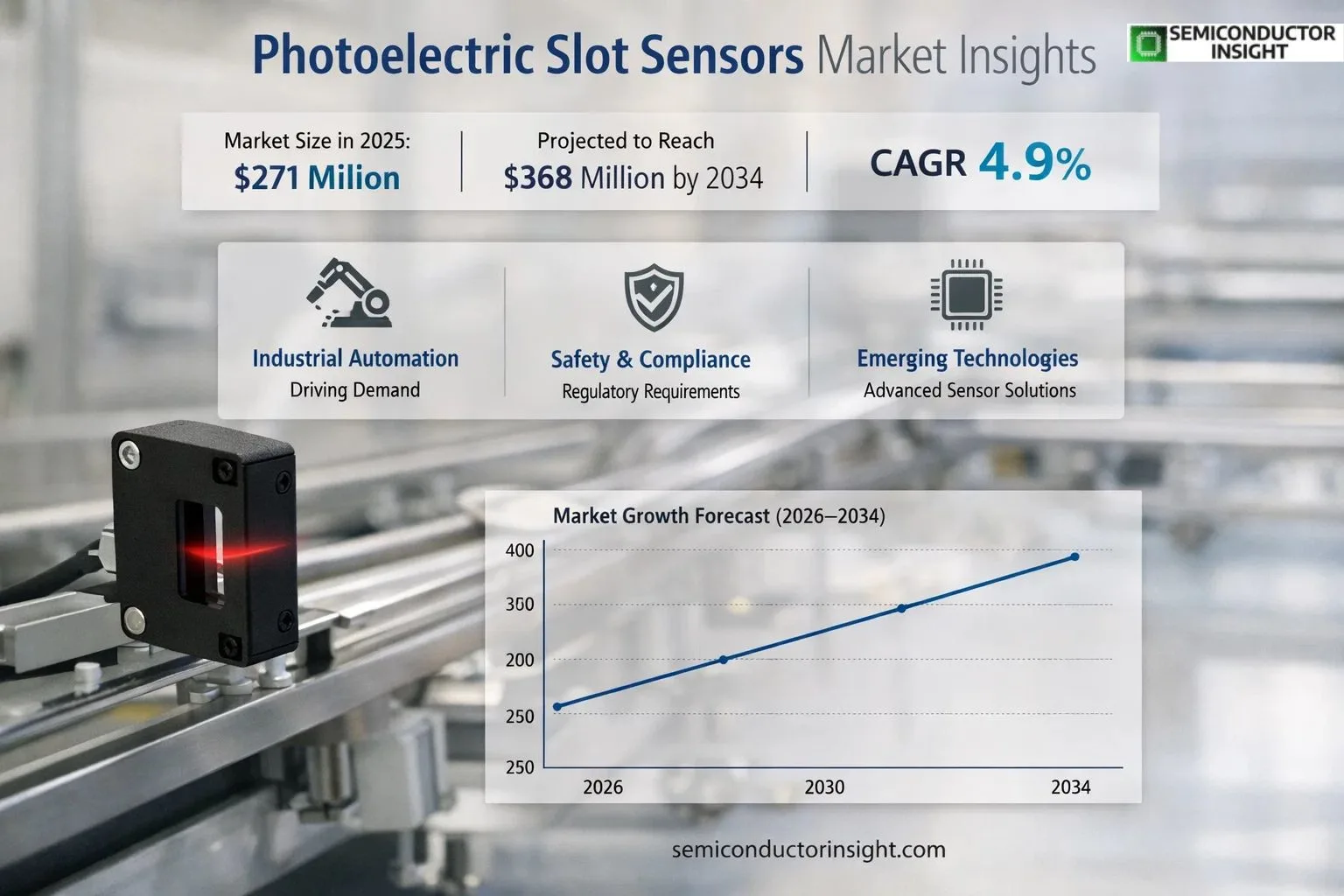
Global photoelectric slot sensors market size was valued at USD 271 million in 2025. The market is projected to grow from USD 285 million in 2026 to USD 368 million by 2034, exhibiting a CAGR of 4.9% during the forecast period.
Photoelectric slot sensors, also known as photoelectric sensors or photoelectric slot detectors, are devices based on Photoelectric principle used to detect the presence or movement of objects within a specific path. These sensors typically consist of a transmitter and a receiver—the transmitter emits a light beam that is either blocked or reflected by an object, and the receiver detects this change to determine the object’s position or motion.
The market growth is driven by increasing automation across industries such as manufacturing, logistics, and packaging. Additionally, advancements in sensor technology, including improved accuracy and durability, are contributing to wider adoption. Key players like Pepperl+Fuchs, Omron, and Panasonic continue to innovate with compact designs and enhanced connectivity features for Industry 4.0 applications.
MARKET DRIVERS
Increasing Automation Across Industries
Global push towards industrial automation is a primary driver for Photoelectric Slot Sensors Market. These sensors play a critical role in automated production lines, packaging systems, and material handling equipment by providing accurate object detection. The manufacturing sector accounts for approximately 42% of total photoelectric sensor demand globally, with slot-type sensors being preferred for their compact design and high reliability.
Stringent Safety Regulations
Regulatory mandates for machine safety across North America and Europe are accelerating photoelectric slot sensor adoption. Industries are upgrading to compliant safety systems featuring these sensors to meet OSHA and ISO 13849 standards. The market has grown by an average of 6.8% annually since 2020 in compliance-driven sectors like automotive and pharmaceuticals.
➤ Photoelectric slot sensors demonstrate 99.5% detection accuracy in high-speed applications, making them indispensable for modern automation
Advancements in sensor technology, including enhanced resistance to environmental factors and improved optical designs, are further propelling market growth. Manufacturers are introducing IP67-rated slot sensors capable of withstanding harsh industrial environments.
MARKET CHALLENGES
High Competition from Alternative Technologies
While photoelectric slot sensors dominate specific applications, they face competition from inductive and capacitive proximity sensors in certain environments. Alternative technologies account for nearly 30% of the overall industrial sensor market, particularly in metal detection applications where photoelectric sensors have limitations.
Other Challenges
Precision Alignment Requirements
Photoelectric slot sensors require precise alignment between emitter and receiver, increasing installation complexity compared to other sensor types. This can lead to higher setup costs and potential maintenance challenges in vibration-heavy environments.
MARKET RESTRAINTS
Cost Sensitivity in Emerging Markets
Price sensitivity in developing economies presents a significant restraint for Photoelectric Slot Sensors Market. While industrial automation adoption is growing, many small and medium enterprises prioritize lower-cost alternatives over premium photoelectric solutions. This is particularly evident in Asia-Pacific regions outside Japan and South Korea.
MARKET OPPORTUNITIES
Industry 4.0 Integration
The transition to Industry 4.0 presents substantial growth prospects for Photoelectric Slot Sensors Market. Smart factories are increasingly incorporating these sensors into IIoT systems, with demand growing at 8.2% CAGR for network-capable models. Integration with PLCs and cloud-based monitoring systems enhances their value proposition in connected manufacturing environments.
Photoelectric Slot Sensors Market Trends
Industrial Automation Drives Market Growth
Photoelectric Slot Sensors market is experiencing steady growth due to increasing demand in industrial automation applications. Key sectors such as manufacturing, logistics, and packaging are adopting these sensors for precise object detection in automated production lines. The transition towards Industry 4.0 standards is accelerating the integration of photoelectric slot sensors in smart factory environments.
Other Trends
Technological Advancements in Sensing Range
Manufacturers are developing photoelectric slot sensors with extended sensing ranges and improved immunity to ambient light interference. New models feature adjustable sensitivity settings and enhanced environmental resistance, making them suitable for harsh industrial conditions. Smart sensor variants with IO-Link connectivity are gaining traction for predictive maintenance applications.
Compact Design Requirements
The market is seeing increased demand for miniaturized photoelectric slot sensors to accommodate space-constrained machinery designs. Leading manufacturers are responding with compact housings that maintain detection performance while reducing footprint. This trend aligns with the growing need for dense sensor placement in modern automation systems.
Regional Market Developments
Asia-Pacific is emerging as a high-growth region for photoelectric slot sensors, driven by expanding manufacturing activities in China and Southeast Asia. North America and Europe maintain strong demand from established industrial sectors, with particular emphasis on safety-related applications. Emerging economies are seeing increased adoption in material handling and packaging operations.
Application-Specific Sensor Variants
Vendors are introducing specialized photoelectric slot sensors tailored for specific industries such as food processing, pharmaceutical manufacturing, and automotive assembly. These models feature materials and certifications compliant with industry regulations, including IP69K ratings for washdown environments and ATEX approvals for explosive atmospheres.
COMPETITIVE LANDSCAPE
Key Industry Players
Global Photoelectric Slot Sensors Market Dominated by Automation Leaders
Photoelectric slot sensors market is led by established industrial automation giants like Pepperl+Fuchs and Omron, which collectively hold significant market share. These companies benefit from extensive product portfolios, global distribution networks, and strong R&D capabilities in sensor technology. The top five players currently account for approximately XX% of global market revenue, demonstrating moderate concentration in this specialized segment.
Several European and Asian manufacturers such as Balluff, Wenglor, and Leuze have emerged as strong niche players, particularly in precision industrial applications. Chinese manufacturers like Shanghai Lanbao Sensing Technology are gaining traction in domestic markets through cost-competitive offerings. Technological differentiation remains critical, with leaders investing in IP67-rated sensors, miniature designs, and enhanced connectivity features for Industry 4.0 applications.
List of Key Photoelectric Slot Sensors Companies Profiled
- Pepperl+Fuchs
- Omron
- Sensotek
- Panasonic
- Banner Engineering
- Ifm Electronic
- Contrinex
- Balluff
- Wenglor
- Leuze
- Shanghai Lanbao Sensing Technology
- Wuxi Rihuan Sensor
- Keyence
- SICK AG
- Autonics
Segment Analysis:
| Segment Category | Sub-Segments | Key Insights |
| By Type |
|
Photoelectric Sensors dominate due to their high precision and reliability in object detection.
|
| By Application |
|
Automated Production Lines represent the most strategic application segment.
|
| By End User |
|
Manufacturing Sector drives maximum adoption.
|
| By Detection Range |
|
Medium Range Sensors offer optimal balance for most applications.
|
| By Beam Type |
|
Infrared Sensors dominate industrial applications.
|
Regional Analysis: Photoelectric Slot Sensors Market
Asia-Pacific
China’s “Made in China 2025” initiative drives unprecedented demand for photoelectric slot sensors in automated production lines. The country’s extensive electronics manufacturing base requires precise object detection for quality control processes, creating opportunities for sensor manufacturers to develop customized solutions.
Japanese companies pioneer advanced photoelectric slot sensor technologies featuring enhanced environmental resistance and miniature form factors. The country’s robotics industry sets global standards for sensor integration in collaborative robot applications and high-speed assembly systems.
South Korea’s thriving semiconductor industry creates specialized requirements for photoelectric slot sensors capable of operating in cleanroom environments. Sensor manufacturers focus on developing contamination-resistant models with extended service life for wafer fabrication equipment.
India’s growing automotive and pharmaceutical sectors present new avenues for photoelectric slot sensor adoption. Local manufacturers increasingly automate packaging lines and material handling systems, requiring reliable slot sensors for position verification and object counting applications.
North America
North America maintains strong photoelectric slot sensor demand driven by advanced manufacturing modernization initiatives and reshoring trends. The region sees increasing adoption in food processing applications where hygienic sensor designs prevent product contamination. Canadian mining equipment manufacturers integrate ruggedized slot sensors for vehicle positioning systems in harsh environments. The United States leads in research and development of smart sensors with integrated diagnostics for predictive maintenance capabilities.
Europe
European manufacturers emphasize energy-efficient photoelectric slot sensors to align with sustainability directives. Germany’s automotive industry utilizes high-speed slot sensors for robotic welding cell applications requiring millimeter-level precision. The region witnesses growing adoption in pharmaceutical packaging lines where sensor reliability directly impacts regulatory compliance. Eastern European countries show increasing demand as local manufacturers upgrade legacy equipment with modern sensing solutions.
South America
South America experiences steady growth in photoelectric slot sensor applications within agricultural equipment and food processing sectors. Brazil leads regional adoption with expanding automotive production requiring precise component positioning systems. Mining operations in Chile and Peru implement slot sensors for conveyor belt monitoring and equipment safety systems. Local manufacturers prioritize cost-effective solutions with easy maintenance features.
Middle East & Africa
The Middle East focuses on photoelectric slot sensor integration within oil and gas processing equipment requiring explosion-proof designs. African manufacturers gradually adopt automation technologies, with South Africa leading in sensor implementation for packaging and material handling applications. Infrastructure development projects drive demand for construction equipment incorporating durable slot sensors for vehicle safety systems.
Report Scope
This market research report provides a comprehensive analysis of Photoelectric Slot Sensors Market, covering the forecast period 2026–2034. It offers detailed insights into market dynamics, technological advancements, competitive landscape, and key trends shaping the industry.
Key focus areas of the report include:
- Market Overview: The report begins with an overview outlining its current market scenario, key growth indicators, and industry transformation drivers. It discusses macroeconomic factors, demand–supply balance, regulatory landscape, and the strategic role of semiconductors in powering advancements across industries such as automotive, telecommunications, consumer electronics, and industrial automation.
- Market Size & Forecast: Historical data and future projections for revenue, unit shipments, and market value across major regions and segments.
- Segmentation Analysis: Detailed breakdown by product type, technology, application, and end-user industry to identify high-growth segments and investment opportunities.
- Regional Insights: Insights into market performance across North America, Europe, Asia-Pacific, Latin America, and the Middle East & Africa, including country-level analysis where relevant.
- Competitive Landscape: Profiles of leading market participants, including their product offerings, R&D focus, manufacturing capacity, pricing strategies, and recent developments such as mergers, acquisitions, and partnerships.
- Technology Trends & Innovation: Assessment of emerging technologies, integration of AI/IoT, semiconductor design trends, fabrication techniques, and evolving industry standards.
- Market Drivers & Restraints: Evaluation of factors driving market growth along with challenges, supply chain constraints, regulatory issues, and market-entry barriers.
- Stakeholder Insights: Insights for component suppliers, OEMs, system integrators, investors, and policymakers regarding the evolving ecosystem and strategic opportunities.
Primary and secondary research methods are employed, including interviews with industry experts, data from verified sources, and real-time market intelligence to ensure the accuracy and reliability of the insights presented.
FREQUENTLY ASKED QUESTIONS:
What is the current market size of Photoelectric Slot Sensors Market?
-> Photoelectric Slot Sensors Market was valued at USD 271 million in 2025 and is expected to reach USD 368 million by 2034.
What is the projected CAGR for Photoelectric Slot Sensors Market?
-> The market is projected to grow at a CAGR of 4.9% during the forecast period 2026-2034.
Which key companies operate in Photoelectric Slot Sensors Market?
-> Key players include Pepperl+Fuchs, Omron, Sensotek, Panasonic, Banner Engineering, Ifm Electronic, Contrinex, Balluff, Wenglor, Leuze, among others.
Which segment dominates Photoelectric Slot Sensors market?
-> Photoelectric segment is expected to grow significantly during the forecast period across major regions.
What are the key applications of Photoelectric Slot Sensors?
-> Major applications include Automated Production Line, Material Handling, Safety Protection, and other industrial uses.

Get Sample Report PDF for Exclusive Insights
Report Sample Includes
- Table of Contents
- List of Tables & Figures
- Charts, Research Methodology, and more...
 Download Sample Report PDF