Market Insights
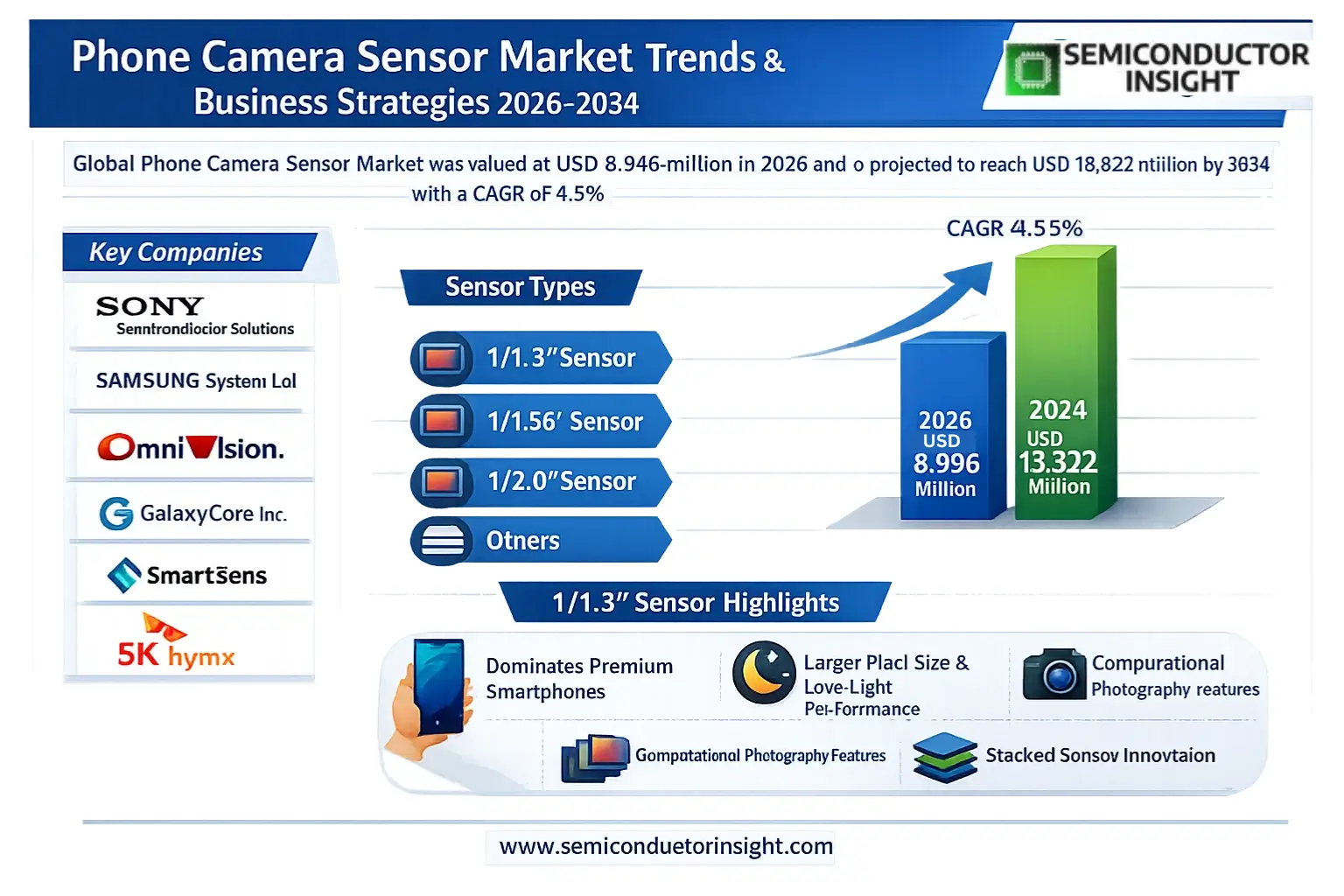
Global Phone Camera Sensor Market was valued at USD 8,996 million in 2026 and is projected to reach USD 13,822 million by 2034, exhibiting a CAGR of 4.5% during the forecast period.
A phone camera sensor, typically a CMOS Image Sensor (CIS), is the core component that converts optical signals into electrical charges at the pixel array and outputs digital image data through readout circuits. These sensors enable high-quality imaging despite smartphone constraints such as limited space, power consumption, and thermal dissipation. They also support advanced functionalities like QR scanning, facial recognition, and computational photography.
The market growth is driven by increasing demand for high-resolution mobile photography, multi-camera setups in smartphones, and advancements in computational imaging. Key players such as Sony, Samsung, and OmniVision dominate the industry with innovations in stacked sensor architectures and improved low-light performance. In 2026, global production capacity reached approximately 3.5 billion units with an average selling price of USD 3.12 per sensor.
MARKET DRIVERS
Growing Demand for High-Quality Mobile Photography
The increasing consumer preference for smartphone cameras with superior image quality is accelerating the Phone Camera Sensor Market. Over 78% of smartphone users now prioritize camera performance when making purchase decisions, driving manufacturers to adopt advanced sensor technologies. The rise of social media platforms emphasizing visual content further fuels this demand.
Technological Advancements in Sensor Design
Innovations such as periscope zoom sensors, large pixel sizes (up to 2.4μm), and multi-camera setups are transforming mobile photography. Manufacturers are investing heavily in R&D to develop sensors with improved low-light performance and faster autofocus capabilities, pushing the Phone Camera Sensor Market forward.
Integration of AI-powered computational photography features is creating additional demand for specialized sensors capable of supporting these advanced functionalities.
MARKET CHALLENGES
High Development Costs and Supply Chain Constraints
Phone Camera Sensor Market faces significant R&D expenditure requirements, with leading manufacturers investing over USD 500 million annually in sensor development. Complex manufacturing processes and specialized materials contribute to high production costs that challenge smaller players.
Other Challenges
Thermal Management Issues in Compact Designs
As sensor pixel sizes shrink and resolutions increase, managing heat dissipation in smartphone camera modules becomes increasingly difficult, potentially affecting image quality and sensor longevity.
MARKET RESTRAINTS
Smartphone Market Saturation in Developed Regions
Mature markets are experiencing slower smartphone replacement cycles (now averaging 3.2 years), which directly impacts the Phone Camera Sensor Market growth. This restraint is partially offset by increasing adoption in emerging markets where smartphone penetration continues to rise.
MARKET OPPORTUNITIES
Emerging Applications in AR/VR and 3D Sensing
Phone Camera Sensor Market is expanding beyond traditional photography into augmented reality and depth-sensing applications. Sensors enabling facial recognition, LiDAR scanning, and AR experiences present significant growth opportunities, with the 3D sensing segment expected to grow at 22% CAGR through 2030.
Phone Camera Sensor Market Trends
Rising Demand for Advanced Imaging in Smartphones
Global Phone Camera Sensor Market is projected to grow from USD 8,996 million in 2026 to USD 13,822 million by 2034, at a CAGR of 4.5%. This growth is driven by increasing consumer demand for high-quality smartphone photography, computational imaging, and video capabilities. Leading manufacturers are focusing on stacked sensor architectures, improved low-light performance, and faster readout speeds to meet these demands.
Other Trends
Transition to Multi-Camera Systems
Smartphone brands are adopting multi-camera setups with specialized sensors for main, ultra-wide, telephoto, and depth sensing. This trend drives demand for sensor diversification, with telephoto and ultra-wide sensors showing the fastest growth at 8.2% CAGR. Manufacturers are optimizing pixel pitch and dynamic range to ensure consistency across camera modules.
Computational Photography Integration
Phone camera sensors are increasingly designed to support AI-powered computational photography. Features like multi-frame HDR, night mode, and real-time segmentation require sensors with faster readout speeds (up to 120fps) and advanced noise reduction. This has led to tighter integration between sensors, ISPs, and neural processing units in flagship smartphones.
Pixel Technology Evolution
The industry is shifting from megapixel escalation to balanced sensor designs, prioritizing larger pixel sizes (1.4µm-2.4µm) for improved light capture. Back-illuminated and quad-pixel technologies now account for 68% of premium smartphone sensors, enabling better low-light performance without increasing module thickness.
Supply Chain and Manufacturing Trends
With annual production reaching 3.5 billion units, sensor manufacturers are investing in wafer-level packaging and testing automation to maintain 30-40% gross margins. Sony dominates with 42% market share, followed by Samsung at 28%, while Chinese suppliers like OmniVision and GalaxyCore are gaining traction in mid-range segments with cost-optimized solutions.
COMPETITIVE LANDSCAPE
Key Industry Players
Phone Camera Sensor Market Dominated by Tier-1 Semiconductor Leaders
Sony Semiconductor Solutions leads the Phone Camera Sensor Market with over 40% revenue share, leveraging its proprietary stacked CMOS technology and deep integration with flagship smartphone brands. Samsung System LSI follows closely with advanced ISOCELL sensors and vertical integration advantages across the Samsung ecosystem. The market exhibits an oligopolistic structure where these top two players control nearly 70% of global supply, competing primarily on pixel technology, readout speeds, and system-level imaging pipelines.
Several Chinese manufacturers like OmniVision (now owned by Will Semiconductor), GalaxyCore, and SmartSens have gained significant traction in mid-range smartphone segments through cost-competitive BSI and stacked sensor solutions. Emerging players such as SK Hynix and STMicroelectronics are focusing on niche segments like ultra-wide and 3D sensing applications, while Himax and ON Semiconductor cater to specialized low-power and automotive-adjacent markets.
List of Key Phone Camera Sensor Companies Profiled
- Sony Semiconductor Solutions
- Samsung System LSI
- OmniVision Technologies
- GalaxyCore Inc.
- SmartSens Technology
- SK Hynix
- STMicroelectronics
- Himax Technologies
- ON Semiconductor
- PixArt Imaging
- ams OSRAM
- Panasonic
- Tower Semiconductor
- Canon
- Sharp
Segment Analysis:
| Segment Category | Sub-Segments | Key Insights |
| By Type |
|
1/1.3″ Sensor dominates premium smartphone models with superior light capture capability.
|
| By Application |
|
Main Camera remains the most critical imaging component in smartphone photography.
|
| By End User |
|
Flagship Smartphones lead camera sensor innovation and adoption.
|
| By Resolution |
|
48-50MP has become the sweet spot for most smartphone applications.
|
| By Technology |
|
Stacked CIS represents the most significant architectural advancement.
|
Regional Analysis: Phone Camera Sensor Market
China’s dense electronics manufacturing clusters enable cost-effective phone camera sensor production. Shenzhen’s supply chain ecosystem allows rapid prototyping and mass production scaling. Domestic brands like Huawei and Xiaomi drive demand for customized high-end sensors with proprietary imaging technologies.
Japanese manufacturers lead in sensor precision and quality, with Sony controlling major market share. Continuous breakthroughs in pixel isolation and phase detection autofocus originate from Japan’s specialized semiconductor fabs. Local partnerships enable technology transfers to regional manufacturers.
Samsung’s vertical integration gives South Korea advantages in sensor-processor co-development. Research focuses on computational photography integration with sensors. Korean brands pioneer under-display camera technologies that influence global phone camera sensor design trends.
Emerging smartphone adoption in Indonesia, Vietnam creates opportunities for mid-range sensor solutions. Local assembly plants attract component manufacturers. Regional trade agreements facilitate technology transfers and component sourcing for camera sensor production.
North America
North America’s Phone Camera Sensor Market thrives on premium device demand and computational photography advancements. The U.S. hosts key design centers developing next-generation sensor architectures. Strong patent portfolios and university research partnerships enable breakthroughs in quantum dot sensors and AI-enhanced imaging. High consumer willingness to pay drives adoption of sophisticated multi-sensor arrays. Competitive carrier upgrade cycles sustain replacement demand. Regulatory focus on privacy influences under-display camera sensor development trends among manufacturers.
Europe
Europe maintains leadership in specialized industrial camera sensor applications adapting mobile technologies. German and French research institutions pioneer quantum image sensors with security applications. Stringent privacy regulations shape sensor development priorities, favoring hardware-based solutions. The region sees growing adoption of multi-spectral phone camera sensors for professional photography applications. Automotive collaborations explore mobile sensor adaptations for vehicle imaging systems.
South America
South America presents growth opportunities for cost-optimized phone camera sensor solutions. Brazil’s local assembly requirements drive regional supply chain development. Mid-range smartphone growth fuels demand for balanced performance sensors. Climate conditions create specific requirements for humidity-resistant sensor packaging. Increasing social media engagement boosts demand for improved selfie camera sensors across the region’s younger demographics.
Middle East & Africa
The Middle East shows strong demand for premium phone camera sensors luxury device segment. Africa’s market grows through affordable smartphones featuring optimized basic camera capabilities. Regional manufacturers focus on heat-tolerant sensor designs. Gulf countries invest in local phone manufacturing, creating opportunities for sensor suppliers. Religious tourism drives demand for specialized low-light and high-dynamic-range camera performance requirements.
Report Scope
This market research report provides a comprehensive analysis of the Phone Camera Sensor Market, covering the forecast period 2026–2034. It offers detailed insights into market dynamics, technological advancements, competitive landscape, and key trends shaping the industry.
Key focus areas of the report include:
- Market Overview: The report begins with an overview outlining its current market scenario, key growth indicators, and industry transformation drivers. It discusses macroeconomic factors, demand–supply balance, regulatory landscape, and the strategic role of semiconductors in powering advancements across industries such as consumer electronics, automotive, telecommunications, and industrial applications.
- Market Size & Forecast: Historical data and future projections for revenue, unit shipments, and market value across major regions and segments.
- Segmentation Analysis: Detailed breakdown by product type, resolution, pixel pitch, application, and end-user industry to identify high-growth segments and investment opportunities.
- Regional Insights: Insights into market performance across North America, Europe, Asia-Pacific, Latin America, and the Middle East & Africa, including country-level analysis where relevant.
- Competitive Landscape: Profiles of leading market participants, including their product offerings, R&D focus, manufacturing capacity, pricing strategies, and recent developments such as mergers, acquisitions, and partnerships.
- Technology Trends & Innovation: Assessment of emerging technologies, integration of AI/IoT, semiconductor design trends, fabrication techniques, and evolving industry standards.
- Market Drivers & Restraints: Evaluation of factors driving market growth along with challenges, supply chain constraints, regulatory issues, and market-entry barriers.
- Stakeholder Insights: Insights for component suppliers, OEMs, system integrators, investors, and policymakers regarding the evolving ecosystem and strategic opportunities.
Primary and secondary research methods are employed, including interviews with industry experts, data from verified sources, and real-time market intelligence to ensure the accuracy and reliability of the insights presented.
FREQUENTLY ASKED QUESTIONS:
What is the current market size of Phone Camera Sensor Market?
-> Phone Camera Sensor Market was valued at USD 8,996 million in 2026 and is projected to reach USD 13,822 million by 2034, exhibiting a CAGR of 4.5% during the forecast period.
Which key companies operate in Phone Camera Sensor Market?
-> Key players include Sony, Samsung, OmniVision, GalaxyCore, SmartSens, and Himax, among others.
What are the key growth drivers?
-> Key growth drivers include rising smartphone adoption, demand for high-quality mobile photography, advancements in computational photography, and integration of multi-camera systems in smartphones.
Which region dominates the market?
-> Asia is the largest market, driven by high smartphone production in China, South Korea, and emerging Southeast Asian markets.
What are the emerging trends?
-> Emerging trends include stacked sensor architectures, enhanced low-light performance, higher-resolution sensors, and integration with AI-powered computational photography.
Get Sample Report PDF for Exclusive Insights
Report Sample Includes
- Table of Contents
- List of Tables & Figures
- Charts, Research Methodology, and more...
 Download Sample Report PDF