Phase Shift Masks (PSM) Market Insights
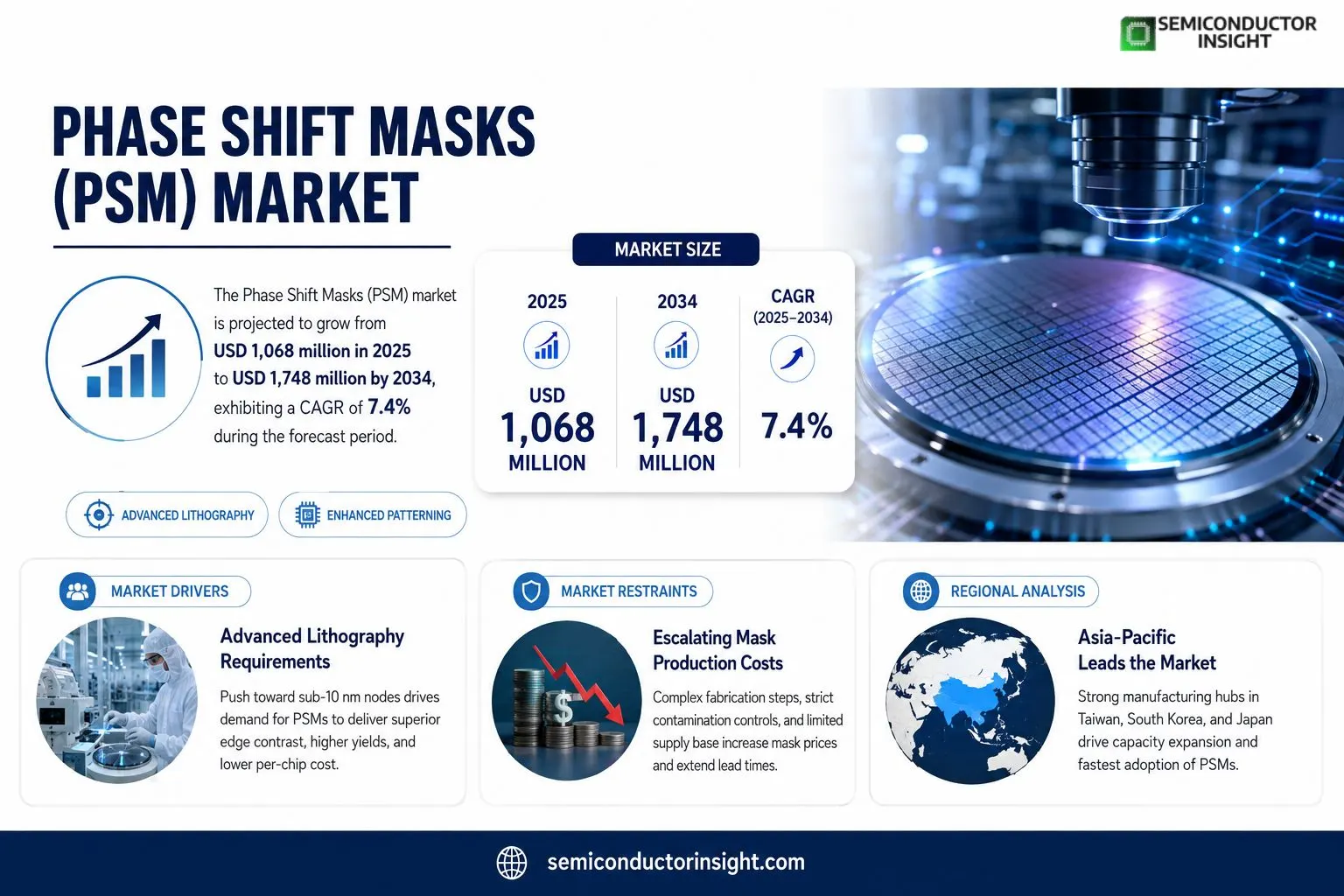
Phase Shift Masks (PSM) market size was valued at USD 1,068 million in 2025. The market is projected to reach USD 1,748 million by 2034, exhibiting a CAGR of 7.4% during the forecast period.
Phase Shift Masks (PSM) are high‑end photomask products used in advanced lithography. Rather than merely blocking light, they deliberately alter the optical phase and intensity distribution by embedding localized refractive‑index or transmittance variations on the mask substrate. This manipulation improves patterning resolution, edge contrast and depth of focus, helping semiconductor fabs and high‑definition display lines overcome narrowing process windows and yield‑control challenges.The technology finds application in both semiconductor manufacturingwhere companies such as Photronics employ embedded attenuated masks with a 6 % transmission MoSiON absorber for 248 nm and 193 nm wavelengthsand flat‑panel display productionwhere SK‑Electronics combines phase‑shift concepts with half‑tone or multi‑tone structures to cut exposure counts and streamline panel flow.
MARKET DRIVERS
Advanced Lithography Requirements
The relentless push toward sub‑10 nm nodes has forced semiconductor manufacturers to seek mask technologies that can sustain tighter critical‑dimension control. Phase Shift Masks (PSM) offer superior optical contrast, enabling finer pattern definition without resorting to costly multiple‑patterning steps. This technical advantage translates into higher wafer yields and lower per‑chip cost, prompting fabs to prioritize PSM adoption.
Regulatory and Design-For-Manufacturing Initiatives
Design‑for‑manufacturing (DFM) guidelines issued by leading foundries now embed PSM compatibility as a baseline criterion for high‑volume production. As these guidelines become embedded in standard design flows, design houses are compelled to integrate PSM early in the layout phase, creating a downstream demand pull for mask suppliers.
➤ Customers that integrate PSM into their design cycle report up to a 12 % reduction in defect density compared with conventional binary masks.
Beyond technical merit, the ecosystem surrounding PSMspanning simulation tools, metrology services, and qualified mask blankshas matured. This depth of support reduces time‑to‑market for new products, making PSM an attractive choice for manufacturers facing aggressive product launch windows.
MARKET CHALLENGES
Escalating Mask Production Costs
While PSM delivers performance gains, the fabrication of phase‑shifted features demands additional process steps and stricter contamination controls. These factors inflate the per‑mask price relative to conventional binary masks, creating budgetary pressure for mid‑size fabs that operate on thin margins.
Other Challenges
Supply Chain Complexity
The need for high‑purity quartz substrates and precision etch equipment ties PSM production to a limited pool of vendors. Any disruptionwhether from raw‑material shortages or equipment lead‑timescan cascade into longer order cycles for chip makers.
MARKET RESTRAINTS
Transition to Alternative Lithographic Techniques
The emergence of extreme‑ultraviolet (EUV) lithography presents a structural hurdle for PSM. EUV’s ability to pattern sub‑5 nm features without the need for phase shifting reduces the strategic imperative for PSM in leading‑edge fabs. Companies that have already committed sizable capital to EUV may deprioritize further investment in PSM infrastructure.
MARKET OPPORTUNITIES
Hybrid Mask Solutions for Mid‑Range Nodes
There is a growing niche for hybrid mask decks that combine PSM patterns with conventional binary areas. This approach leverages the contrast benefits of PSM where it matters most while containing overall mask cost. Suppliers that can streamline the integration workflow stand to capture a segment of the mid‑range node market that seeks performance without the expense of full‑scale PSM adoption.
Phase Shift Masks (PSM) Market Trends
Advancements in Lithography Driving Phase Shift Mask Adoption
The transition to sub‑20 nm node architectures has compelled semiconductor fabs to seek optical solutions that preserve critical dimension fidelity while extending depth of focus. Phase Shift Masks (PSM) answer this need by engineering localized phase offsets, which sharpen edge contrast and suppress line‑edge roughness without resorting to higher exposure doses. Modern implementationsparticularly embedded attenuated designs employing a 6 % transmission MoSiON absorberhave demonstrated measurable yield uplift on 193 nm and 248 nm platforms. This technical edge has encouraged wafer fabs and integrated device manufacturers to embed PSM specifications early in process qualification, thereby converting a once‑optional enhancement into a standard design rule for advanced logic and memory chips. The ripple effect extends to mask shops, which now allocate dedicated production lines to maintain the stringent defect‑control metrics that PSM demands, reinforcing a feedback loop of capability investment across the supply chain.
Other Trends
Supply Chain Consolidation and Service Differentiation
Beyond the core photomask fabrication, the ecosystem surrounding Phase Shift Masks has coalesced around a few vertically integrated players. Japanese firms such as DNP, TOPPAN, and HOYA have leveraged decades of precision glass and coating expertise to offer complete blank‑to‑finished solutions, including rapid recertification, defect repair, and data‑linked order platforms. Meanwhile, Photronics in the United States differentiates through a service‑centric model that bundles cleaning, metrology verification, and collaborative design support, helping customers shave lead time during technology transitions. This concentration of capabilities creates high entry barriers, incentivizing long‑term contracts and engendering customer lock‑in. For emerging regional manufacturers, the strategic focus is shifting from price competition to the ability to source high‑quality blanks and deliver turnkey mask services that align with localized fab expansion initiatives.
Emerging Applications in Display and Advanced Packaging
Flat‑panel display producers are exploiting the phase‑control attributes of PSM to trim exposure counts in half‑tone and multi‑tone mask stacks, a move that shortens panel processing cycles and improves uniformity across large glass substrates. Simultaneously, the rise of heterogeneous integration and advanced packaging calls for fine‑pitch interconnect patterns where depth‑of‑focus margins are razor‑thin. By applying phase‑shift techniques, mask suppliers can generate sharper image contrast without resorting to higher numerical aperture tools, thus enabling cost‑effective scaling of package‑level features. These cross‑industry demands anchor Phase Shift Masks (PSM) Market in both semiconductor and display domains, positioning it as a pivotal enabler for the next wave of high‑resolution, high‑performance electronic products.
COMPETITIVE LANDSCAPE
Key Industry Players
Phase‑Shift Mask Market – Competitive Overview 2024‑2034
Photronics dominates the high‑end segment by offering embedded attenuated phase‑shift masks for 248 nm and 193 nm lithography, coupled with a full suite of defect‑repair, dry‑etch, and verification services. Its vertically integrated model reduces lead‑time variability for major semiconductor fabs and creates a lock‑in effect through data‑linked ordering platforms. Japanese incumbents such as DNP and HOYA complement this structure by supplying ultra‑pure blank masks that serve as the substrate for phase‑shift structures, thereby controlling a critical upstream cost lever. The concentration of expertise within a handful of firms raises entry barriers, and the resulting customer‑lock‑in amplifies the strategic importance of service breadth and reliability over pure price competition.Beyond the tier‑1 leaders, a cluster of specialized players is shaping niche demand. TOPPAN pursues next‑generation EUV‑compatible phase‑shift designs that address peripheral reflection, while SK‑Electronics leverages half‑tone and multi‑tone concepts to compress exposure steps in large‑glass display production. S&S Tech supplies phase‑shift‑ready blanks for both high‑NA EUV and advanced lithography, creating a complementary supply chain link. Chinese‑based China Resources Microelectronics and Taiwan Mask (TMS) are accelerating local substitution through aggressive capex in dry‑etch and OPC modules, positioning themselves for domestic fab mandates. Smaller innovators such as Nitto Denko and Mitsubishi Materials contribute proprietary coating chemistries that improve transmission control, adding another dimension to competitive differentiation. Collectively, these firms compete on speed of technology rollout, depth of collaborative engineering, and the ability to deliver integrated mask‑plus‑service solutions.
List of Key Phase Shift Masks Companies Profiled
- Photronics
- DNP
- HOYA
- TOPPAN
- SK‑Electronics Co., Ltd.
- S&S Tech
- China Resources Microelectronics
- Taiwan Mask (TMS)
- Nitto Denko
- Mitsubishi Materials
- ASML Mask Solutions
- Foundries Mask Division
Segment Analysis:
| Segment Category | Sub-Segments | Key Insights |
| By Type |
|
Advanced Lithography Enablers
|
| By Application |
|
Application‑Driven Differentiators
|
| By End User |
|
Customer‑Centric Value Chain
|
| By Technology Integration |
|
Strategic Technology Themes
|
| By Service Offering |
|
Service‑Centric Competitive Edge
|
Regional Analysis: Phase Shift Masks (PSM) Market
North America
A dense network of universities, national labs, and private R&D centers fuels continuous mask design refinements. The proximity of these actors allows rapid prototyping, which shortens the lead time from concept to production-ready PSMs, reinforcing the region’s competitive edge.
Integrated logistics and a diversified supplier base mitigate disruptions. By maintaining multiple sources for critical photoresist chemicals and mask blanks, manufacturers can sustain output even under geopolitical pressures.
Tier‑1 foundries prioritize PSMs to meet aggressive roadmap milestones, while fabless designers increasingly request PSM‑compatible design kits, accelerating the diffusion of mask technology across product lines.
Favorable export‑control policies and clear intellectual‑property frameworks reduce entry barriers for new entrants, encouraging fresh investments that broaden the competitive landscape of Phase Shift Masks (PSM) Market.
Europe
European semiconductor hubs, particularly in Germany and the Netherlands, are leveraging PSMs to sustain their leadership in high‑volume manufacturing. Industry consortia such as IMEC and the European Technology Platform have emphasized mask‑centric research, aligning standards across the bloc. This coordination reduces fragmentation and enables manufacturers to adopt uniform PSM processes, which in turn lowers per‑wafer cost. Additionally, the region’s strong emphasis on sustainability drives interest in mask solutions that minimize material waste, a consideration that differentiates European offerings in tenders.
Asia‑Pacific
The Asia‑Pacific cluster, anchored by Taiwan, South Korea, and Japan, is rapidly scaling capacity to meet the explosive demand for smartphone and high‑performance computing chips. While the region traditionally relied on multi‑patterning, recent fab upgrades are integrating PSMs to cut cycle times. Government incentives aimed at advanced lithography have spurred local mask makers to invest in next‑generation production lines, narrowing the technology gap with North America. However, supply‑chain concentration on a handful of mask vendors introduces vulnerability, prompting some foundries to explore strategic partnerships with overseas mask suppliers.
South America
South America remains an emerging arena for Phase Shift Masks (PSM) Market, with Brazil and Chile leading modest pilot projects. The primary driver is the desire to attract foreign fab investments by showcasing readiness for advanced lithography. Local academia is beginning to offer specialized photolithography curricula, laying the groundwork for a skilled workforce. Although volume remains limited, early adoption signals a long‑term ambition to integrate the region into the mask supply network.
Middle East & Africa
In the Middle East and Africa, market activity centers on technology transfer initiatives and joint ventures with established mask producers. The United Arab Emirates’ strategic vision to become a semiconductor hub has spurred investments in clean‑room infrastructure capable of handling PSMs. African nations, while still nascent, are focusing on talent development programs that could support future downstream services, such as mask inspection and repair, positioning the region as a potential niche player in the broader ecosystem.
Report Scope
This market research report provides a comprehensive analysis of the Phase Shift Masks (PSM) Market , covering the forecast period 2026–2034. It offers detailed insights into market dynamics, technological advancements, competitive landscape, and key trends shaping the industry.
Key focus areas of the report include:
- Market Overview: The report begins with an overview outlining its current market scenario, key growth indicators, and industry transformation drivers. It discusses macroeconomic factors, demand–supply balance, regulatory landscape, and the strategic role of semiconductors in powering advancements across industries such as automotive, telecommunications, consumer electronics, and industrial automation.
- Market Size & Forecast: Historical data and future projections for revenue, unit shipments, and market value across major regions and segments.
- Segmentation Analysis: Detailed breakdown by product type, technology, application, and end-user industry to identify high-growth segments and investment opportunities.
- Regional Insights: Insights into market performance across North America, Europe, Asia-Pacific, Latin America, and the Middle East & Africa, including country-level analysis where relevant.
- Competitive Landscape: Profiles of leading market participants, including their product offerings, R&D focus, manufacturing capacity, pricing strategies, and recent developments such as mergers, acquisitions, and partnerships.
- Technology Trends & Innovation: Assessment of emerging technologies, integration of AI/IoT, semiconductor design trends, fabrication techniques, and evolving industry standards.
- Market Drivers & Restraints: Evaluation of factors driving market growth along with challenges, supply chain constraints, regulatory issues, and market-entry barriers.
- Stakeholder Insights: Insights for component suppliers, OEMs, system integrators, investors, and policymakers regarding the evolving ecosystem and strategic opportunities.
Primary and secondary research methods are employed, including interviews with industry experts, data from verified sources, and real-time market intelligence to ensure the accuracy and reliability of the insights presented.
FREQUENTLY ASKED QUESTIONS:
What is the current market size of Phase Shift Masks (PSM) Market?
-> Phase Shift Masks (PSM) Market was valued at USD 1068 million in 2025 and is expected to reach USD 1748 million by 2034, growing at a CAGR of 7.4% during the forecast period.
Which key companies operate in Phase Shift Masks (PSM) Market?
-> Key players include Photronics, DNP, Toppan, HOYA, China Resources Microelectronics, SK‑Electronics, and S&S Tech, among others.
What are the key growth drivers?
-> Key growth drivers include advancements in semiconductor lithography, rising demand for high‑resolution displays, and supportive government initiatives such as the U.S. CHIPS program and European Chips Act.
Which region dominates the market?
-> Asia holds the largest share, driven by strong manufacturing bases in China, Japan, and South Korea, while also showing the fastest growth rate.
What are the emerging trends?
-> Emerging trends include high‑NA EUV‑compatible phase‑shift masks, multi‑tone and half‑tone mask designs, and increasing localisation of the mask supply chain.
Get Sample Report PDF for Exclusive Insights
Report Sample Includes
- Table of Contents
- List of Tables & Figures
- Charts, Research Methodology, and more...