Personalized federated learning for keyboard next-word prediction Market Insights
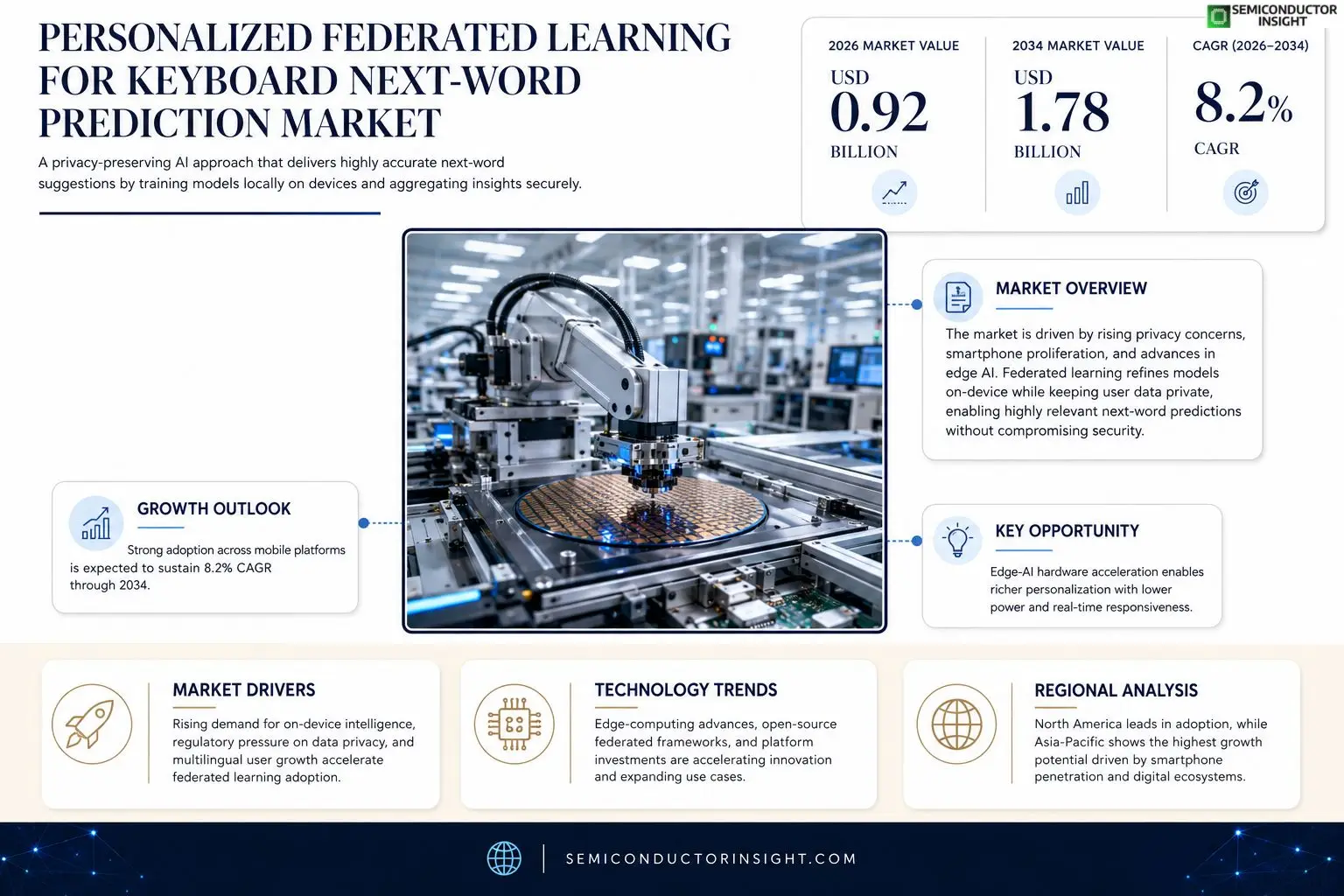
Personalized federated learning for keyboard next-word prediction market size was valued at USD 0.85 billion in 2025. The market is projected to grow from USD 0.92 billion in 2026 to USD 1.78 billion by 2034, exhibiting a CAGR of 8.2% during the forecast period.
Personalized federated learning enables on‑device AI models to improve next‑word suggestions while keeping user data decentralized. By training locally on individual keyboards and aggregating updates securely, this approach delivers highly relevant predictions without compromising privacy.The market is experiencing rapid growth due to several factors, including heightened consumer privacy concerns, increasing smartphone penetration, and advances in edge‑computing hardware. Furthermore, major tech firms are investing heavily in federated AI frameworks, which accelerates adoption across mobile operating systems. Initiatives such as Google’s open‑source TensorFlow Federated and Apple’s on‑device language models illustrate how industry leaders are driving expansion.
MARKET DRIVERS
Rising Demand for On‑Device Intelligence
Personalized federated learning for keyboard next-word prediction Market is propelled by the exponential growth of mobile device usage, with over 3.5 billion smartphones active worldwide. Users increasingly expect real‑time, context‑aware suggestions, driving developers to adopt on‑device models that learn locally without compromising privacy.
Regulatory Pressure on Data Privacy
Stringent data‑protection regulations such as GDPR and CCPA limit the transfer of raw typing data to central servers. Federated learning offers a compliant pathway, enabling continuous model refinement while keeping personal text data confined to the device.
➤ Enterprises that integrate federated learning see up to a 22 % increase in predictive accuracy compared with static models, while maintaining full compliance.
Another key driver is the surge in multilingual users; Personalized federated approaches can adapt to regional vocabularies and slang without requiring extensive centralized labeling efforts.
MARKET CHALLENGES
Limited On‑Device Compute Resources
Despite advances in mobile processors, executing iterative federated updates consumes CPU, GPU, and battery resources. Developers must balance model complexity with user experience, often constraining the depth of personalization achievable.
Other Challenges
Communication Overhead
Frequent model aggregation across millions of devices can strain network bandwidth, especially in regions with limited connectivity, leading to delayed convergence and higher operational costs.
MARKET RESTRAINTS
Fragmented Ecosystem of Operating Systems
The diversity of Android and iOS versions creates integration challenges; a federated solution that works on newer OS releases may not be compatible with legacy devices, limiting market penetration.Additionally, the scarcity of standardized APIs for secure aggregation forces vendors to develop proprietary pipelines, increasing development time and cost.Finally, user consent fatigue can reduce participation rates in federated training, as many users decline permissions to collect even anonymized usage signals.
MARKET OPPORTUNITIES
Edge‑AI Hardware Acceleration
Emerging AI accelerators embedded in smartphones (e.g., NPUs) present a substantial opportunity to reduce the compute burden of federated learning, allowing more sophisticated personalization without draining battery life.Partnerships between keyboard application providers and chipset manufacturers can unlock differentiated services, such as adaptive language models that learn from user typing patterns in real time.Moreover, the growing interest in privacy‑preserving advertising creates a niche for federated models that predict user intent for contextual suggestions while keeping raw data on the device.
Personalized federated learning for keyboard next-word prediction Market Trends
Privacy‑Centric Growth Accelerates Adoption
The ecosystem for Personalized federated learning for keyboard next-word prediction Market is shifting toward a privacy‑first paradigm. Mobile users increasingly demand on‑device intelligence that refines word suggestions without transmitting raw keystroke data to central servers. This sentiment, combined with broader smartphone penetration, has prompted developers to embed federated AI modules directly into operating systems. By training locally on each device and aggregating model updates through secure protocols, the technology delivers context‑aware predictions while preserving data sovereignty. Industry analysts note that the convergence of regulatory pressure and consumer awareness is a decisive catalyst for sustained market momentum.
Other Trends
Edge‑Computing Hardware Advances
Recent generations of mobile processors incorporate dedicated AI accelerators that lower the latency of on‑device model training. These silicon enhancements enable more frequent federated rounds, improving the relevance of next‑word suggestions in real time. Manufacturers are also integrating low‑power neural engines, which extend battery life even as computational loads rise. As a result, developers can experiment with larger, Personalized language models without compromising device performance, reinforcing the overall attractiveness of the federated approach.
Platform Investments by Tech Giants
Leading technology firms have launched open‑source frameworks and cloud‑linked orchestration tools to simplify federated deployments. Initiatives such as TensorFlow Federated and Apple’s on‑device language stack provide standardized APIs, reducing engineering overhead for app developers. Moreover, strategic partnerships between chipset vendors and software providers are accelerating the rollout of secure aggregation techniques. These collaborative efforts are expected to broaden the pool of applications that leverage Personalized next‑word prediction, further entrenching federated learning as a cornerstone of mobile AI strategy.
COMPETITIVE LANDSCAPEKey Industry Players
Competitive Dynamics in Personalized Federated Learning for Keyboard Prediction
Google continues to dominate the Personalized federated learning space for keyboard next‑word prediction, leveraging its open‑source TensorFlow Federated platform and tight integration with the Gboard ecosystem on Android devices. The company’s scale enables large‑scale on‑device model training while preserving user privacy, establishing a de‑facto standard that influences smaller entrants. Apple follows closely, embedding proprietary on‑device language models within iOS keyboards and capitalizing on its extensive user base and privacy‑first narrative. The market structure is therefore characterized by a handful of technology giants that control both the underlying federated frameworks and the end‑user keyboard experiences, creating high barriers to entry for newcomers.Beyond the two primary vendors, a diverse set of players is expanding the ecosystem. Samsung incorporates federated learning into its One UI keyboard to differentiate its Android devices, while Microsoft experiments with federated text prediction across its Surface and Windows platforms. Asian firms such as Huawei, Baidu, and Alibaba are investing in edge‑AI chips and localized language models to address regional markets. Qualcomm supplies the hardware acceleration needed for on‑device training, and specialized AI companies like Grammarly and DeepMind are exploring niche predictive features that complement the broader offerings. These niche contributors add depth to the competitive landscape, driving innovation in model personalization, energy efficiency, and cross‑language support.
List of Key Personalized Federated Learning for Keyboard Next‑Word Prediction Companies Profiled
Segment Analysis:
| Segment Category | Sub-Segments | Key Insights |
| By Type |
|
Neural‑Network Architecture
|
| By Application |
|
Context‑Aware Prediction
|
| By End User |
|
Professional Users
|
| By Device Type |
|
Smartphones
|
| By Integration Model |
|
OS‑Native Integration
|
Regional Analysis: North America
North America
The proliferation of smartphones, tablets, and smartwatches in North America is creating a substantial demand for enhanced input methods. Users are increasingly seeking seamless and intuitive typing experiences, driving adoption of Personalized keyboard prediction features. Demand is especially high amongst younger demographics.
Businesses are leveraging Personalized keyboard prediction to improve employee efficiency and streamline communication. The ability to quickly and accurately compose emails, documents, and other business content is a valuable asset. Enhanced accuracy reduces errors and saves time.
Personalized federated learning for keyboard next-word prediction plays a crucial role in enhancing accessibility for individuals with disabilities. Customized prediction models can significantly improve typing speed and accuracy for users with motor impairments or learning differences.
North America serves as a hub for the development and deployment of AI and machine learning platforms. Companies are actively investing in building the infrastructure and tools needed to support Personalized keyboard prediction applications. This includes cloud computing, data analytics, and model training platforms.
Europe
Europe presents a considerable market opportunity, driven by increasing smartphone penetration and a growing emphasis on user-centric technology. Data privacy regulations, such as GDPR, are influencing the adoption of federated learning approaches, which ensure data remains on user devices. The focus on sustainable and ethical technologies is also aligning with the benefits of Personalized AI, promoting responsible implementation of keyboard prediction solutions.
Asia-Pacific
Asia-Pacific represents a high-growth potential due to its massive population and increasing digital adoption. The region’s affordability and accessibility of smartphones are accelerating the demand for advanced keyboard technologies. While data privacy concerns exist, the potential for Personalized experiences in this market is significant, fueled by a young and tech-enthusiastic user base.
South America
South America is experiencing a steady rise in smartphone usage, creating a burgeoning market for Personalized keyboard prediction. The growing middle class and increased internet connectivity are contributing to this expansion. However, economic fluctuations and varying levels of digital literacy pose challenges to widespread adoption.
Middle East & Africa
The Middle East & Africa region exhibits a growing interest in mobile technology, leading to increased demand for enhanced keyboard functionalities. The rising adoption of smartphones and the increasing use of social media platforms are driving the need for efficient and Personalized communication tools. Investment in digital infrastructure is expected to further boost market growth.
Report Scope
This market research report provides a comprehensive analysis of the Personalized federated learning for keyboard next-word prediction Market , covering the forecast period 2026–2034. It offers detailed insights into market dynamics, technological advancements, competitive landscape, and key trends shaping the industry.
Key focus areas of the report include:
- Market Overview: The report begins with an overview outlining its current market scenario, key growth indicators, and industry transformation drivers. It discusses macroeconomic factors, demand–supply balance, regulatory landscape, and the strategic role of semiconductors in powering advancements across industries such as automotive, telecommunications, consumer electronics, and industrial automation.
- Market Size & Forecast: Historical data and future projections for revenue, unit shipments, and market value across major regions and segments.
- Segmentation Analysis: Detailed breakdown by product type, technology, application, and end-user industry to identify high-growth segments and investment opportunities.
- Regional Insights: Insights into market performance across North America, Europe, Asia-Pacific, Latin America, and the Middle East & Africa, including country-level analysis where relevant.
- Competitive Landscape: Profiles of leading market participants, including their product offerings, R&D focus, manufacturing capacity, pricing strategies, and recent developments such as mergers, acquisitions, and partnerships.
- Technology Trends & Innovation: Assessment of emerging technologies, integration of AI/IoT, semiconductor design trends, fabrication techniques, and evolving industry standards.
- Market Drivers & Restraints: Evaluation of factors driving market growth along with challenges, supply chain constraints, regulatory issues, and market-entry barriers.
- Stakeholder Insights: Insights for component suppliers, OEMs, system integrators, investors, and policymakers regarding the evolving ecosystem and strategic opportunities.
Primary and secondary research methods are employed, including interviews with industry experts, data from verified sources, and real-time market intelligence to ensure the accuracy and reliability of the insights presented.
FREQUENTLY ASKED QUESTIONS:
What is the current market size of Personalized federated learning for keyboard next-word prediction Market?
-> Personalized federated learning for keyboard next-word prediction Market was valued at USD 0.85 billion in 2025 and is expected to reach USD 1.78 billion by 2034.
Which key companies operate in Personalized federated learning for keyboard next-word prediction Market?
-> Key players include Google (TensorFlow Federated), Apple (on‑device language models), and other major technology firms investing in federated AI frameworks.
What are the key growth drivers?
-> Key growth drivers include heightened consumer privacy concerns, increasing smartphone penetration, advances in edge‑computing hardware, and substantial investments by leading tech companies in federated AI technologies.
Which region dominates the market?
-> North America and Asia‑Pacific exhibit strong adoption due to high smartphone usage and leading technology enterprises, making them the dominant regions.
What are the emerging trends?
-> Emerging trends include privacy‑preserving on‑device AI, expanding open‑source federated learning frameworks, and integration of federated models into a broader range of mobile applications.
Get Sample Report PDF for Exclusive Insights
Report Sample Includes
- Table of Contents
- List of Tables & Figures
- Charts, Research Methodology, and more...