MARKET INSIGHTS
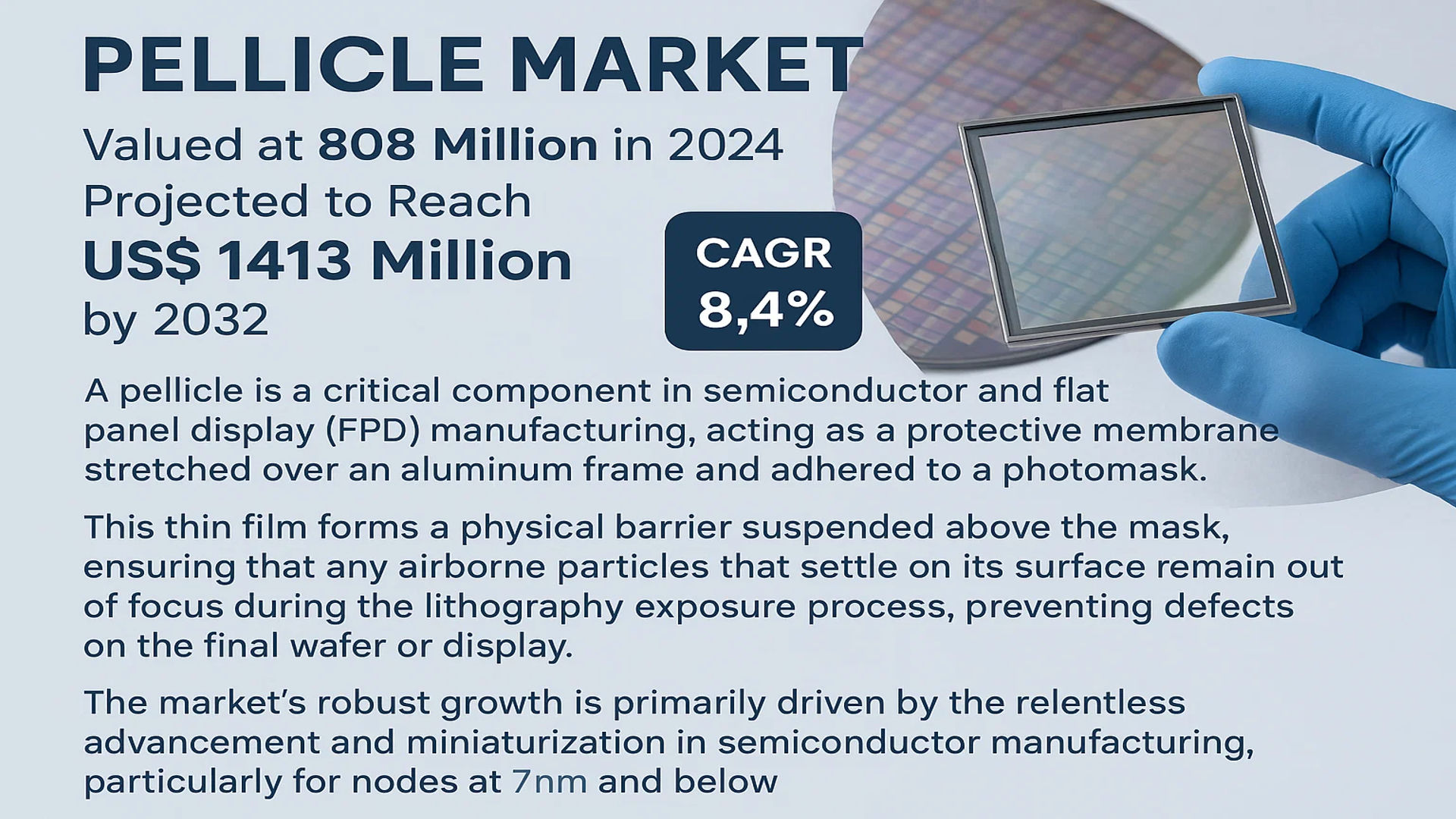
The global Pellicle Market was valued at 808 million in 2024 and is projected to reach US$ 1413 million by 2032, at a CAGR of 8.4% during the forecast period.
A pellicle is a critical component in semiconductor and flat panel display (FPD) manufacturing, acting as a protective membrane stretched over an aluminum frame and adhered to a photomask. This thin film forms a physical barrier suspended above the mask, ensuring that any airborne particles that settle on its surface remain out of focus during the lithography exposure process, thereby preventing defects on the final wafer or display. This technology is indispensable for maintaining high production yields and superior chip quality.
The market’s robust growth is primarily driven by the relentless advancement and miniaturization in semiconductor manufacturing, particularly for nodes at 7nm and below. The surge in demand for high-performance computing, artificial intelligence chips, and the expansion of the FPD industry further propels this growth. The market is highly consolidated, with the top three players—Mitsui Chemicals, Shin-Etsu, and FINE SEMITECH—commanding a collective revenue share of approximately 85.67% in 2023. Asia dominates the global landscape, accounting for the largest market share, fueled by massive semiconductor fabrication investments in China, Taiwan, and South Korea.
MARKET DYNAMICS
MARKET DRIVERS
Accelerated Semiconductor Miniaturization Driving Pellicle Demand
The relentless push toward semiconductor miniaturization represents the primary driver for pellicle market growth. As chip manufacturers transition to advanced nodes below 7nm, the requirement for defect-free photomasks becomes increasingly critical. The semiconductor industry’s migration to extreme ultraviolet lithography (EUVL) technology, which operates at 13.5nm wavelength, has created unprecedented demand for specialized pellicles capable of withstanding high-energy exposure while maintaining optical transparency. The global semiconductor equipment market, valued at over $100 billion annually, directly influences pellicle consumption patterns. With foundries investing approximately $20 billion annually in new fabrication facilities, the corresponding demand for photomasks and protective pellicles continues to escalate. This technological evolution necessitates pellicles with thickness variations controlled within 0.5nm and defect densities below 0.001 particles/cm², driving both technical innovation and market expansion.
Expanding Flat Panel Display Manufacturing Boosting Market Growth
The global display industry’s rapid expansion, particularly in organic light-emitting diode (OLED) and micro-LED technologies, represents another significant growth driver for the pellicle market. The flat panel display sector, which consumes approximately 25% of global pellicle production, requires increasingly sophisticated photomask protection as pixel densities approach 1000 pixels per inch. The transition to Generation 10.5 and larger display substrates, measuring 2940×3370mm, necessitates correspondingly larger pellicles with uniform optical properties across expanded surface areas. This scaling challenge has driven innovation in membrane materials and frame design, with leading manufacturers developing pellicles capable of maintaining <98% transmittance while providing effective particulate protection. The display industry’s compound annual growth rate of approximately 6-8% directly translates to increased pellicle consumption, particularly across Asian manufacturing hubs where over 85% of global display production occurs.
Furthermore, the integration of advanced lithography techniques in display manufacturing, including multi-patterning approaches, has increased photomask usage rates and consequently boosted pellicle replacement cycles. The average semiconductor fabrication facility utilizes between 5,000-10,000 photomasks simultaneously, each requiring periodic pellicle replacement every 12-18 months due to optical degradation and particulate accumulation.
➤ For instance, leading semiconductor manufacturers report that pellicle-related yield improvements can reduce wafer scrap rates by 2-3%, representing annual savings exceeding $50 million per high-volume fabrication facility.
Additionally, the emergence of advanced packaging technologies, including 2.5D and 3D integration schemes, has created new application segments for pellicles in back-end semiconductor processes, further expanding market opportunities beyond traditional front-end lithography applications.
MARKET CHALLENGES
Extreme Technical Requirements and Manufacturing Complexities Constraining Market Expansion
The pellicle market faces significant challenges related to increasingly stringent technical specifications required for advanced semiconductor nodes. The transition to EUV lithography has introduced extraordinary material science challenges, as traditional polymer-based pellicles cannot withstand the high-energy radiation without rapid degradation. EUV pellicles require specialized silicon-based membranes with thickness controlled to within 50nm and must maintain >90% transmittance while surviving power densities exceeding 500W/mm². The manufacturing yield for these advanced pellicles remains below 30% at most production facilities, creating supply constraints and elevating costs. Additionally, the requirement for near-perfect particulate control necessitates Class 1 cleanroom environments, increasing capital expenditure requirements by approximately 40% compared to conventional pellicle production facilities.
Other Challenges
Material Limitations and Thermal Management Issues
Current pellicle materials face fundamental limitations in thermal and mechanical stability. During EUV exposure, temperatures can reach 600°C, causing membrane distortion and changes in optical properties. The thermal expansion mismatch between membrane materials and aluminum frames creates stress concentrations that limit operational lifetimes. These material challenges have prevented widespread adoption of pellicles in high-power EUV systems, with approximately 60% of EUV lithography operations currently running without pellicle protection despite the increased risk of photomask contamination.
Supply Chain Vulnerabilities and Geopolitical Factors
The highly specialized nature of pellicle manufacturing creates supply chain vulnerabilities, with over 80% of production capacity concentrated among three primary suppliers. Geopolitical tensions and trade restrictions have further complicated material sourcing, particularly for specialized coating materials and high-purity aluminum substrates. These factors have led to price increases of 15-20% over the past two years and extended delivery times from 8 to 16 weeks for advanced pellicle products.
MARKET RESTRAINTS
High Capital Investment and Specialized Expertise Limiting Market Participation
The pellicle manufacturing industry requires substantial capital investment in specialized equipment and cleanroom facilities, creating significant barriers to entry. Establishing a production line capable of manufacturing advanced EUV pellicles requires investment exceeding $200 million, with equipment lead times extending beyond 24 months. This high capital requirement has limited the number of viable market participants to only six established global manufacturers. The industry also faces a critical shortage of specialized engineers with expertise in thin-film deposition, precision metrology, and semiconductor materials science. The retirement of experienced technical staff combined with insufficient new talent entering the field has created a knowledge gap that restrains production capacity expansion. Current workforce analysis indicates a deficit of approximately 300 qualified engineers across the global pellicle industry, constraining manufacturers’ ability to scale production despite growing market demand.
Furthermore, the extensive qualification processes required by semiconductor manufacturers create additional market restraints. New pellicle products typically require 12-18 months of qualification testing before volume adoption, during which manufacturers must maintain production capacity without revenue generation. This extended qualification cycle, combined with the rapid pace of lithography technology evolution, creates financial pressure that discourages new market entrants and limits innovation among existing players.
MARKET OPPORTUNITIES
Emerging Applications in Advanced Packaging and Heterogeneous Integration Creating New Growth Frontiers
The rapid evolution of advanced packaging technologies presents substantial growth opportunities for the pellicle market. The adoption of fan-out wafer-level packaging (FOWLP), 2.5D interposers, and 3D integration schemes requires sophisticated lithography processes that utilize photomasks protected by specialized pellicles. The advanced packaging market, growing at approximately 8% annually, represents a potential addressable market expansion of $120-150 million for pellicle manufacturers. Particularly promising is the development of tailored pellicle solutions for through-silicon via (TSV) formation and redistribution layer patterning, where unique material requirements and process conditions create opportunities for product differentiation. The integration of compound semiconductors and photonic devices with silicon substrates further expands application possibilities, requiring pellicles optimized for non-standard wavelengths and exposure conditions.
Additionally, the emergence of quantum computing and neuromorphic computing architectures creates new opportunities for specialized pellicle applications. These emerging technologies utilize unconventional lithography approaches that often operate at non-standard wavelengths or require unique mask protection schemes. The development of pellicles capable of supporting these novel lithography methods represents a potential growth segment that could account for 5-7% of market revenue by 2030. The increasing adoption of multi-beam mask writers and other advanced mask fabrication technologies also drives demand for corresponding pellicle innovations, particularly in the area of defect inspection and metrology compatibility.
Moreover, the ongoing expansion of semiconductor manufacturing capacity globally, particularly in North America and Europe following recent semiconductor independence initiatives, creates substantial opportunities for market geographic diversification. The commitment of over $200 billion in new semiconductor fabrication investment outside traditional Asian manufacturing hubs will necessitate local pellicle supply chains, reducing logistics costs and improving supply security for end-users while creating new market access opportunities for manufacturers.
PELLICLE MARKET TRENDS
Advanced Semiconductor Node Proliferation Driving Market Evolution
The relentless push towards smaller semiconductor process nodes represents the most significant trend shaping the pellicle market. As the industry accelerates its adoption of sub-7nm and sub-5nm technologies, the technical requirements for photomask protection have become exponentially more stringent. The global pellicle market, valued at 808 million in 2024, is projected to reach 1413 million by 2032, reflecting a compound annual growth rate of 8.4%, largely fueled by these advanced manufacturing needs. In extreme ultraviolet lithography (EUVL), which operates at a wavelength of approximately 13.5nm, traditional pellicle materials are inadequate, necessitating the development of specialized thin films that can withstand the high-energy environment while maintaining exceptional transparency. This technological arms race has compelled manufacturers to invest heavily in research and development, particularly in physical vapor deposition (PVD) and chemical vapor deposition (CVD) techniques that can produce films with near-perfect uniformity and minimal defects. The semiconductor segment dominates pellicle consumption, accounting for approximately 74.17% of the global market in 2023, with this share expected to increase as foundries continue their transition to more advanced nodes.
Other Trends
Geographic Manufacturing Concentration and Supply Chain Dynamics
Asia’s dominance in semiconductor manufacturing has created a corresponding concentration in the pellicle market, with the region accounting for over 78% of global consumption. This geographic shift presents both opportunities and challenges for market participants. While China, Taiwan, and South Korea continue to expand their semiconductor manufacturing capabilities, driving increased local demand for pellicles, this concentration also creates supply chain vulnerabilities that became apparent during recent global disruptions. The market remains highly consolidated, with the top three companies controlling approximately 85.67% of global revenue in 2023, creating both pricing power for established players and significant barriers to entry for new competitors. This consolidation is particularly evident in the advanced materials segment, where only a handful of companies possess the technical expertise to produce pellicles that meet the rigorous specifications required for EUVL applications. Furthermore, regional government initiatives supporting domestic semiconductor production, particularly in China, are creating new demand centers that manufacturers must strategically address.
Material Innovation and Performance Enhancement
Material science breakthroughs represent another critical trend, as pellicle manufacturers race to develop films that can meet the increasingly demanding requirements of next-generation lithography. The transition from deep ultraviolet (DUV) to extreme ultraviolet (EUV) lithography has been particularly challenging, requiring completely new material systems that can achieve both high transmission rates and exceptional durability. Current EUV pellicles typically achieve transmission rates between 82% and 88%, but research focuses on pushing this beyond 90% to improve process efficiency and reduce wafer exposure times. Additionally, thermal and mechanical stability have become paramount concerns, as EUV pellicles must withstand significant heat loads without deformation or degradation. The industry has seen increased investment in nanocomposite materials and advanced coating technologies that can provide both the optical properties and structural integrity required for high-volume manufacturing. These material advancements are not limited to EUV applications, as improvements in conventional pellicles for quartz and soda masks continue to enhance yield and reduce contamination-related defects across all semiconductor manufacturing segments.
COMPETITIVE LANDSCAPE
Key Industry Players
Companies Strive to Strengthen their Product Portfolio to Sustain Competition
The competitive landscape of the global pellicle market is highly concentrated, dominated by a handful of specialized manufacturers with significant technological expertise. The market structure is characterized by high barriers to entry due to the complex manufacturing processes and stringent quality requirements, particularly for advanced semiconductor nodes. In 2023, the top three players collectively commanded approximately 85.67% of the global market revenue, underscoring the oligopolistic nature of this critical semiconductor supply chain component.
MITSUI Chemicals stands as the undisputed market leader, leveraging its extensive chemical expertise and global manufacturing footprint. The company’s dominance stems from its comprehensive product portfolio that serves both quartz and soda mask applications, along with its strong relationships with major semiconductor foundries. Their continuous investment in R&D for EUV pellicle technology positions them at the forefront of next-generation lithography solutions.
Shin-Etsu Chemical and FINE SEMITECH maintain significant market positions through their technological specialization and regional strengths. Shin-Etsu’s advantage lies in its vertical integration capabilities and materials science expertise, while FINE SEMITECH has carved a strong niche in the Asian market, particularly serving the growing semiconductor manufacturing base in South Korea and China. Both companies have demonstrated consistent innovation in pellicle membrane materials and frame design technologies.
These leading players are actively pursuing capacity expansion and technological advancement to maintain their competitive edge. The ongoing transition to more advanced process nodes, particularly below 7nm, has accelerated R&D investments in EUV-compatible pellicles that can withstand the unique challenges of extreme ultraviolet lithography. This technological race is further intensifying competition among the top players.
Meanwhile, Micro Lithography Inc. (MLI) and S&S Tech are strengthening their market positions through specialized product offerings and strategic partnerships. MLI’s focus on high-performance pellicles for advanced packaging applications has created new growth avenues, while S&S Tech has expanded its customer base through competitive pricing and reliable delivery performance. Both companies are investing in manufacturing automation to improve yield and reduce production costs.
The competitive dynamics are further influenced by regional developments, particularly the expansion of semiconductor manufacturing capacity in Asia. Companies are establishing local production facilities and technical support centers in key markets like Taiwan, China, and South Korea to better serve the concentrated customer base in these regions.
List of Key Pellicle Manufacturing Companies Profiled
- MITSUI Chemicals, Inc. (Japan)
- Shin-Etsu Chemical Co., Ltd. (Japan)
- FINE SEMITECH Corporation (South Korea)
- Micro Lithography, Inc. (MLI) (U.S.)
- S&S Tech Co., Ltd. (South Korea)
- INKO Engineering Corporation (South Korea)
- NEPCO (Japan)
- Canatu Oy (Finland)
Segment Analysis:
By Type
Pellicle for Quartz Mask Segment Dominates the Market Due to its Critical Role in Advanced Semiconductor Lithography
The market is segmented based on type into:
- Pellicle for Quartz Mask
- Pellicle for Soda Mask
- EUV Pellicle
- Others
By Application
Semiconductor Segment Leads Due to High Adoption in Chip Manufacturing and Miniaturization Trends
The market is segmented based on application into:
- Semiconductor
- Flat Panel Display (FPD)
- Photovoltaics
- Others
By Material
Polymer-based Pellicles Hold Significant Market Share Due to Their Optical Properties and Cost-effectiveness
The market is segmented based on material into:
- Polymer-based Pellicles
- Silicon-based Pellicles
- Nitride-based Pellicles
- Others
By Technology Node
Sub-10nm Technology Node Segment Experiences Rapid Growth Driven by Advanced Chip Fabrication Requirements
The market is segmented based on technology node into:
- Above 28nm
- 10nm-28nm
- 7nm-10nm
- Below 7nm
Regional Analysis: Pellicle Market
Asia-Pacific
Asia-Pacific dominates the global pellicle market, accounting for the largest revenue share, driven by its concentration of semiconductor manufacturing giants. The region is home to major foundries and integrated device manufacturers in Taiwan (TSMC), South Korea (Samsung), and China (SMIC). This massive manufacturing base creates immense demand for advanced photomasks and their protective pellicles. The push toward more advanced process nodes, including 5nm, 3nm, and the ongoing development of 2nm technologies, necessitates the use of highly sophisticated pellicles, particularly for EUV lithography. While Japan remains a key supplier of materials and technology through companies like Shin-Etsu and Mitsui Chemicals, the consumption is heavily concentrated in the manufacturing hubs. Government initiatives, such as China’s significant investments in its domestic semiconductor industry to reduce import reliance, further fuel regional market growth. However, the market also faces challenges related to the technical complexity of producing pellicles that meet the extreme uniformity and thermal stability requirements for next-generation EUV processes.
North America
The North American market is characterized by strong demand from leading technology companies and semiconductor equipment designers, though it has a smaller manufacturing footprint compared to Asia. The region’s market is driven by research and development activities and the presence of key intellectual property holders. The United States is a hub for EUV lithography technology development, with companies like Intel driving the need for advanced pellicle solutions for their upcoming process nodes. Demand is primarily for high-performance pellicles used in both DUV and EUV applications, with a strong focus on innovation and overcoming the technical barriers associated with EUV pellicle transmission and durability. Stringent quality requirements and the need to protect multi-million dollar photomask investments are key market drivers. The recent CHIPS and Science Act, which allocates funding to bolster domestic semiconductor manufacturing, is expected to stimulate long-term demand for pellicles as new fabrication facilities become operational.
Europe
Europe holds a significant position in the global pellicle market, primarily as a center for advanced research and the development of lithography equipment, most notably through ASML, which is headquartered in the Netherlands. The region’s market is driven by the need for pellicles that are compatible with the latest EUV scanners. European research institutions and companies are at the forefront of solving key challenges, such as developing pellicle membranes that can withstand the high-power EUV light sources without degrading. Demand is also sustained by the presence of specialized semiconductor manufacturers and R&D centers focused on automotive and industrial applications. The market is characterized by a strong emphasis on collaboration between equipment manufacturers, material suppliers, and end-users to advance pellicle technology and ensure it keeps pace with the roadmap for lithography.
South America
The pellicle market in South America is nascent and represents a very small fraction of the global total. The region has limited semiconductor manufacturing infrastructure, which directly constrains demand for photomasks and their associated pellicles. Any demand that exists is typically for older technology nodes and is met through imports, primarily for applications in consumer electronics assembly and other downstream industries rather than front-end fabrication. Economic volatility and a lack of significant government investment in high-tech manufacturing sectors have historically hindered market development. Consequently, the adoption of advanced, state-of-the-art pellicles is extremely limited, with the market focusing on more cost-effective solutions for less critical applications.
Middle East & Africa
Similar to South America, the Middle East and Africa region has a minimal presence in the global pellicle market. The market is in its earliest stages of development, with virtually no local semiconductor fabrication capacity. Any market activity is related to downstream electronics manufacturing and maintenance, requiring basic pellicle products for legacy equipment. While some nations in the Middle East have launched initiatives to diversify their economies beyond natural resources into technology, building a competitive semiconductor industry requires decades of investment and expertise. Therefore, the pellicle market in this region is expected to remain a negligible part of the global landscape in the foreseeable future, with demand being met entirely through international supply chains.
Report Scope
This market research report provides a comprehensive analysis of the global and regional Pellicle markets, covering the forecast period 2025–2032. It offers detailed insights into market dynamics, technological advancements, competitive landscape, and key trends shaping the industry.
Key focus areas of the report include:
- Market Size & Forecast: Historical data and future projections for revenue, unit shipments, and market value across major regions and segments.
- Segmentation Analysis: Detailed breakdown by product type, technology, application, and end-user industry to identify high-growth segments and investment opportunities.
- Regional Outlook: Insights into market performance across North America, Europe, Asia-Pacific, Latin America, and the Middle East & Africa, including country-level analysis where relevant.
- Competitive Landscape: Profiles of leading market participants, including their product offerings, R&D focus, manufacturing capacity, pricing strategies, and recent developments such as mergers, acquisitions, and partnerships.
- Technology Trends & Innovation: Assessment of emerging technologies, integration of AI/IoT, semiconductor design trends, fabrication techniques, and evolving industry standards.
- Market Drivers & Restraints: Evaluation of factors driving market growth along with challenges, supply chain constraints, regulatory issues, and market-entry barriers.
- Stakeholder Analysis: Insights for component suppliers, OEMs, system integrators, investors, and policymakers regarding the evolving ecosystem and strategic opportunities.
Primary and secondary research methods are employed, including interviews with industry experts, data from verified sources, and real-time market intelligence to ensure the accuracy and reliability of the insights presented.
FREQUENTLY ASKED QUESTIONS:
What is the current market size of Global Pellicle Market?
->Pellicle Market was valued at 808 million in 2024 and is projected to reach US$ 1413 million by 2032, at a CAGR of 8.4% during the forecast period.
Which key companies operate in Global Pellicle Market?
-> Key players include MITSUI Chemical, Shin-Etsu, FINE SEMITECH, Micro Lithography Inc (MLI), S&S Tech, INKO, NEPCO, and Canatu, among others. The top three companies held a combined market share of 85.67% in 2023.
What are the key growth drivers?
-> Key growth drivers include advancements in semiconductor manufacturing, increasing demand for high-performance chips, expansion of the flat panel display (FPD) industry, and the critical role of pellicles in extreme ultraviolet lithography (EUVL) technology.
Which region dominates the market?
-> Asia-Pacific is the dominant market, with key contributions from China, Taiwan, South Korea, and Japan, driven by their strong semiconductor fabrication and electronics manufacturing ecosystems.
What are the emerging trends?
-> Emerging trends include development of advanced pellicles for EUV lithography, innovations in thin-film materials, increased R&D in defect-free manufacturing, and integration of Industry 4.0 technologies in production processes.

Get Sample Report PDF for Exclusive Insights
Report Sample Includes
- Table of Contents
- List of Tables & Figures
- Charts, Research Methodology, and more...