MARKET INSIGHTS
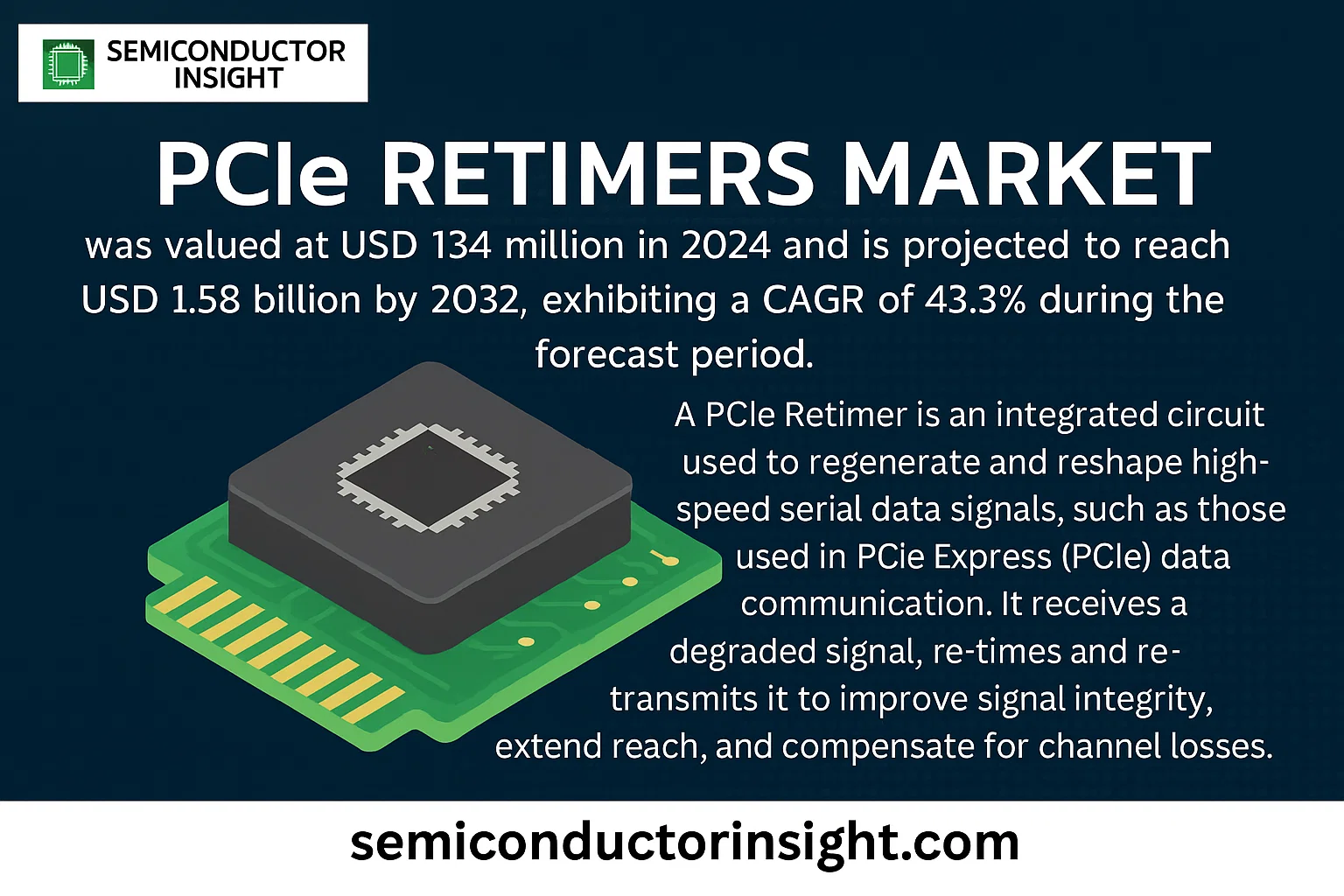
Global PCIe Retimers Market was valued at USD 134 million in 2024 and is projected to reach USD 1.58 billion by 2032, exhibiting a CAGR of 43.3% during the forecast period.
A PCIe Retimer is an integrated circuit used to regenerate and reshape high-speed serial data signals, such as those used in PCI Express (PCIe) data communication. It receives a degraded signal, re-times and re-transmits it to improve signal integrity, extend reach, and compensate for channel losses. This is particularly crucial in high-speed computing, data centers, and enterprise storage applications where signal integrity over longer distances (e.g., across backplanes or through cables) is critical. The growing demand for higher data rates (e.g., PCIe 4.0, 5.0, and upcoming 6.0) in data centers, AI servers, and high-performance computing is the primary driver for this market.
The Asia-Pacific region is the largest consumer, holding a market share of nearly 37%. North America is the second-largest consumer region. The market is relatively competitive, with Astera Labs, Renesas Electronics, Parade Technologies, Texas Instruments, Microchip Technology, and Montage Technology among the key players. These top six companies hold key technologies and patents and account for a combined market share of approximately 92%.
MARKET DRIVERS
Exponential Growth in Data-Centric Applications
The demand for PCIe Retimers is primarily fueled by the exponential growth in data-centric applications such as artificial intelligence (AI), machine learning (ML), high-performance computing (HPC), and hyperscale data centers. These applications require immense data throughput and low-latency communication between processors, accelerators, and storage. The transition to higher-speed PCIe standards, such as PCIe 5.0 and the emerging PCIe 6.0, is critical for supporting this bandwidth, and retimers are essential for signal integrity over longer physical channels within large-scale systems. Without retimers, the signal degradation at these high data rates would severely limit system design and performance.
Adoption of Accelerated Computing Architectures
The shift towards heterogeneous computing, which combines CPUs with specialized accelerators like GPUs, FPGAs, and SmartNICs, is a significant market driver. These accelerators are often located at a distance from the host CPU, necessitating robust signal integrity solutions. PCIe Retimers enable the flexible placement of these components by extending the reach of high-speed PCIe links, which is paramount for optimizing system layout and thermal management in dense server configurations.
➤ The global market for PCIe Retimers is projected to grow at a compound annual growth rate of over 25% in the coming years, driven by the relentless demand for higher bandwidth.
Furthermore, the deployment of next-generation networking and storage technologies, including Compute Express Link (CXL) which leverages the PCIe physical layer, creates an additional driver. CXL requires pristine signal integrity for cache-coherent memory pooling and sharing, directly increasing the need for advanced retimer solutions in modern data center architectures.
MARKET CHALLENGES
Complexity in Design and Integration
Integrating PCIe Retimers into system designs presents significant challenges. These components add complexity to the signal integrity analysis, power delivery network, and thermal design of a system. Designers must carefully model channel losses and ensure the retimer’s characteristics do not negatively impact the overall system’s bit error rate (BER). This requires specialized engineering expertise and sophisticated simulation tools, increasing both development time and cost.
Other Challenges
Power Consumption and Thermal Management
Retimers are active components that consume power, which contributes to the overall system power budget and generates heat. In power-constrained environments like hyper scalable data centers, every watt counts. Managing the additional heat dissipation from retimers in densely packed servers complicates thermal management strategies and can impact total cost of ownership.
Interoperability and Compliance Testing
Ensuring interoperability between retimers from different vendors and various host and endpoint devices is a major hurdle. Comprehensive compliance testing with PCI-SIG standards is rigorous and time-consuming. Any failure in interoperability can lead to significant project delays and increased costs, making vendor selection and qualification a critical and challenging process for system integrators.
MARKET RESTRAINTS
High Cost of Advanced Retimer Solutions
The advanced silicon and sophisticated design required for high-speed PCIe Retimers, especially for PCIe 5.0 and beyond, result in a relatively high component cost. This can act as a restraint, particularly for cost-sensitive market segments or applications where system designers may seek alternative, lower-cost solutions like redrivers (which offer limited reach) or may try to optimize the physical layout to avoid using a retimer altogether, potentially compromising performance.
Long and Uncertain Design Cycles
The development cycle for new server platforms that incorporate cutting-edge PCIe technology is long, often spanning multiple years. The timing of retimer product availability must align perfectly with these platform design windows. Any delays in the retimer supply chain or certification process can cause a bottleneck, restraining market growth as system launches may be postponed.
MARKET OPPORTUNITIES
Expansion into AI and Machine Learning Infrastructure
The massive investment in AI infrastructure represents a colossal opportunity for the PCIe Retimer market. AI training clusters rely on vast numbers of GPUs interconnected with high-speed links. As AI models grow larger, the demand for higher bandwidth and more robust interconnects will intensify, making retimers indispensable for scaling out these systems effectively and reliably.
Growth in Edge Computing and Automotive
Beyond traditional data centers, emerging applications in edge computing and advanced automotive systems (e.g., for autonomous driving platforms) present new growth frontiers. These environments require high-performance, rugged computing solutions where reliable data transmission over cables or backplanes is critical. PCIe Retimers can enable the robust interconnectivity needed in these demanding, non-traditional settings.
Transition to PCIe 6.0 and CXL 2.0/3.0
The upcoming industry-wide transition to PCIe 6.0, with its PAM-4 signaling and doubled bandwidth, and the evolution of the CXL standard will create a refresh cycle and a new wave of demand for retimers. These technologies will push the limits of signal integrity even further, solidifying the role of retimers as a critical enabling technology and opening up significant market opportunities for suppliers with cutting-edge solutions.
PCIe Retimers Market Trends
Explosive Market Growth Fueled by High-Speed Data Demands
The global PCIe Retimers market is undergoing a period of exceptional expansion, projected to grow from a value of $134 million in 2024 to an estimated $1582 million by 2032. This represents a remarkable compound annual growth rate (CAGR) of 43.3% during the forecast period. The primary driver of this growth is the escalating demand for higher data transfer speeds and signal integrity in complex server and storage system architectures. As data centers and high-performance computing applications push the limits of PCIe standards like 4.0 and the emerging 5.0, the physical limitations of PCB traces and cables become a significant bottleneck. PCIe Retimers are critical active components that regenerate and clean degraded signals, enabling reliable high-speed communication over longer distances and through various interconnects.
Other Trends
Dominance of the Asia-Pacific Region and Competitive Landscape
The Asia-Pacific region has solidified its position as the largest consumer of PCIe Retimers, commanding a market share of nearly 37%. This dominance is largely attributed to the region’s concentration of server and data center manufacturing, alongside robust technological adoption. North America follows as the second-largest market. The competitive landscape is characterized by a high degree of concentration among key technology leaders. The market is led by companies including Astera Labs, Renesas Electronics, Parade Technologies, Texas Instrument, Microchip Technology, and Montage Technology. The top six players collectively hold a commanding 92% market share, underpinned by their ownership of key technologies and essential patents, creating significant barriers to entry.
Technological Evolution and Application-Specific Adoption
The market is segmented by technology generation, including PCIe 3.0, 4.0, and the advanced 5.0 standards. The transition to newer, faster standards is a key trend, with PCIe 4.0 and 5.0 Retimers experiencing accelerated adoption to support bandwidth-intensive applications. In terms of application, servers represent the largest segment, driven by the need for scalable, high-performance computing infrastructure. Storage applications also constitute a major segment, where Retimers ensure data integrity across expanded storage area networks. The critical function of a Retimer is to receive a signal, extract and regenerate its digital component, effectively eliminating accumulated noise, jitter, and imperfections to create a fresh, reliable link in both directions, thus overcoming signal degradation caused by PCB/cable interconnects.
COMPETITIVE LANDSCAPE
Key Industry Players
A Highly Concentrated Market Led by a Handful of Innovators
The global PCIe Retimers market is relatively competitive and characterized by a high degree of concentration among a few key players who dominate the technological landscape. According to market analysis, the top six companies collectively command a significant 92% market share, underpinned by their ownership of critical technologies and patents. Astera Labs has emerged as a particularly prominent leader, widely recognized for its advanced semiconductor solutions designed for high-speed data centers. Renesas Electronics, Parade Technologies (a subsidiary of Parade Technologies, Ltd.), Texas Instruments, Microchip Technology, and Montage Technology are the other established leaders, forming the core of the market. These companies are driving innovation, particularly for the latest PCIe standards like PCIe 5.0 and the emerging PCIe 6.0, which are essential for next-generation servers and storage applications.
Beyond the dominant leaders, the market includes several other significant players that cater to niche segments or specific regional demands. These companies contribute to the competitive dynamics by offering specialized solutions and supporting the broader ecosystem. Their focus often lies on cost-optimized designs for specific applications or providing alternatives in the supply chain. The intense focus on research and development across the industry to support the exponential growth in data center bandwidth ensures that the competitive landscape remains dynamic, with continuous advancements in signal integrity and power efficiency being key differentiators.
List of Key PCIe Retimers Companies Profiled
- Astera Labs
- Renesas Electronics
- Parade Technologies
- Texas Instruments
- Microchip Technology
- Montage Technology
- Analog Devices, Inc.
- NXP Semiconductors
- Semtech Corporation
- Diodes Incorporated
- MaxLinear
- THine Electronics
- Lattice Semiconductor
- onsemi
Segment Analysis:
| Segment Category | Sub-Segments | Key Insights |
| By Type |
|
PCIe 5.0 and Others represents the leading technological frontier, driven by the escalating bandwidth demands of modern data centers and high-performance computing infrastructure. The transition to PCIe 5.0 offers a substantial leap in data transfer speeds, a critical enabler for emerging applications such as artificial intelligence, machine learning workloads, and advanced storage solutions. This newer generation commands significant market interest due to its necessity in overcoming signal integrity challenges over longer physical distances, which is a primary function of retimers. While PCIe 4.0 remains widely deployed in current systems, the forward momentum and product development are heavily concentrated on PCIe 5.0, establishing it as the segment with the most robust growth trajectory in the market. |
| By Application |
|
Servers constitute the dominant application segment, acting as the central nervous system for data processing and cloud services. The relentless expansion of cloud computing, hyperscale data centers, and enterprise server infrastructure fuels a continuous demand for PCIe retimers to ensure reliable, high-speed communication between CPUs, GPUs, accelerators, and various peripherals over complex backplanes and through connectors. This segment’s leadership is underpinned by the critical need for signal integrity in dense server architectures where maximizing data throughput is paramount. While storage applications are a significant and growing use case, especially with the adoption of NVMe-over-Fabric, the server segment’s vast installed base and its central role in digital transformation initiatives solidify its position as the primary driver of market volume. |
| By End User |
|
Cloud Service Providers are the leading end-user segment, characterized by their massive, scalable data center footprints that are continuously upgraded to support global internet traffic and on-demand computing resources. Their relentless pursuit of efficiency and performance to serve millions of customers makes them early and aggressive adopters of advanced PCIe technologies like retimers. These providers require the signal regeneration capabilities of retimers to maintain data integrity across expansive server racks and complex networking fabrics. Enterprise data centers represent a substantial market, driven by digitalization and in-house computing needs, while telecommunications is an emerging segment leveraging this technology for 5G infrastructure. However, the sheer scale and technological ambition of cloud service providers cement their leadership in driving demand. |
| By Host Interface |
|
Multi-Port Retimers are experiencing heightened demand as the preferred solution for maximizing connectivity and system density within space-constrained data center environments. This segment leads because it allows a single device to regenerate signals for multiple PCIe lanes simultaneously, which simplifies board design, reduces component count, and improves overall system reliability and power efficiency. Single-port retimers remain essential for specific point-to-point applications requiring dedicated signal integrity assurance. The emerging category of switch-integrated retimers combines signal regeneration with packet switching functionality, offering a highly integrated solution for complex system architectures, but multi-port retimers currently represent the optimal balance of performance, cost, and design flexibility for a wide range of high-speed computing applications. |
| By Form Factor |
|
On-Board (Embedded) form factors are the leading segment due to the prevailing design philosophy in modern server and storage hardware that prioritizes integration and space optimization. Embedding the retimer directly onto the main printed circuit board (PCB) provides the most reliable signal path, minimizes latency, and allows for a more compact and power-efficient system design, which is critical for high-density data center racks. Add-in cards offer valuable flexibility for upgrades and specific configurations but introduce additional connectors that can compromise signal integrity. Riser cards are specialized solutions for specific chassis layouts. The industry’s strong preference for fully integrated systems to achieve the highest performance and reliability standards ensures the dominance of the embedded on-board form factor in new server and storage platform designs. |
Regional Analysis: PCIe Retimers Market
The concentration of hyperscale data centers in North America is a primary driver. These facilities are at the forefront of deploying high-speed servers requiring PCIe retimers to overcome signal integrity challenges in complex system architectures, directly fueling market growth and technological advancement in the region.
North America’s leadership in artificial intelligence and high-performance computing research and deployment creates a robust demand environment. The need for high-bandwidth, low-latency interconnects to support GPU clusters and AI accelerators makes PCIe retimers a critical enabling technology for next-generation computing infrastructures.
The region is home to the world’s leading CPU, GPU, and ASIC designers, whose roadmaps aggressively push data rates. This forces rapid co-development and integration of advanced retimer solutions to ensure signal integrity across entire system platforms, creating a symbiotic relationship that accelerates market maturity.
North American OEMs and cloud service providers are typically the first to adopt new PCIe generations. This early adoption cycle ensures a steady stream of demand for retimers designed for the latest specifications, positioning the region as the initial and most significant market for new product generations.
Asia-Pacific
The Asia-Pacific region is the fastest-growing market for PCIe Retimers, propelled by massive investments in data center infrastructure, particularly in China, Japan, South Korea, and emerging hubs in Southeast Asia. This growth is fueled by the expanding digital economies, escalating cloud adoption by enterprises, and government initiatives promoting domestic technology capabilities. While initially a volume-driven market for established technologies, the region is rapidly advancing toward the adoption of cutting-edge PCIe standards to support local AI development and hyperscale data center expansions. The presence of major contract manufacturers and a growing base of local server OEMs creates a significant and increasingly sophisticated demand pipeline for retimer components.
Europe
Europe represents a significant and mature market for PCIe Retimers, characterized by strong demand from enterprise data centers, automotive and industrial automation sectors, and a growing focus on sovereign cloud initiatives. The market dynamics are influenced by stringent data governance regulations, which are driving investments in localized data infrastructure that require high-performance interconnects. European research institutions and automotive companies developing advanced driver-assistance systems (ADAS) also contribute to the demand for robust PCIe solutions. The adoption rate for new PCIe generations is steady and deliberate, with a focus on reliability and integration within complex industrial and enterprise systems.
South America
The PCIe Retimer market in South America is in a developing phase, with growth primarily centered around major economic centers in Brazil and Chile. The expansion is linked to the gradual modernization of enterprise IT infrastructure and the establishment of regional data centers by global cloud providers. Market adoption is currently focused on established PCIe standards that meet the needs of cost-conscious deployments. While the demand for advanced retimers for cutting-edge applications is limited compared to other regions, the long-term potential is tied to the overall digital transformation of the continent’s economies and increasing internet penetration.
Middle East & Africa
The Middle East & Africa region is an emerging market for PCIe Retimers, with growth hotspots in the Gulf Cooperation Council (GCC) countries and South Africa. Significant government-led investments in smart city projects, digitalization, and large-scale data center projects are creating the initial demand base. The market is currently characterized by deployments utilizing mature technology standards. However, ambitious national visions aimed at becoming regional tech hubs are expected to gradually drive the adoption of more advanced server architectures that will, in turn, require higher-performance PCIe retiming solutions in the future.
Report Scope
This market research report provides a comprehensive analysis of the PCIe Retimers Market , covering the forecast period 2025–2032. It offers detailed insights into market dynamics, technological advancements, competitive landscape, and key trends shaping the industry.
Key focus areas of the report include:
- Market Overview: The report begins with an overview outlining its current market scenario, key growth indicators, and industry transformation drivers. It discusses macroeconomic factors, demand–supply balance, regulatory landscape, and the strategic role of semiconductors in powering advancements across industries such as automotive, telecommunications, consumer electronics, and industrial automation.
- Market Size & Forecast: Historical data and future projections for revenue, unit shipments, and market value across major regions and segments.
- Segmentation Analysis: Detailed breakdown by product type, technology, application, and end-user industry to identify high-growth segments and investment opportunities.
- Regional Insights: Insights into market performance across North America, Europe, Asia-Pacific, Latin America, and the Middle East & Africa, including country-level analysis where relevant.
- Competitive Landscape: Profiles of leading market participants, including their product offerings, R&D focus, manufacturing capacity, pricing strategies, and recent developments such as mergers, acquisitions, and partnerships.
- Technology Trends & Innovation: Assessment of emerging technologies, integration of AI/IoT, semiconductor design trends, fabrication techniques, and evolving industry standards.
- Market Drivers & Restraints: Evaluation of factors driving market growth along with challenges, supply chain constraints, regulatory issues, and market-entry barriers.
- Stakeholder Insights: Insights for component suppliers, OEMs, system integrators, investors, and policymakers regarding the evolving ecosystem and strategic opportunities.
Primary and secondary research methods are employed, including interviews with industry experts, data from verified sources, and real-time market intelligence to ensure the accuracy and reliability of the insights presented.
FREQUENTLY ASKED QUESTIONS:
What is the current market size of PCIe Retimers Market?
-> PCIe Retimers Market was valued at USD 134 million in 2024 and is projected to reach USD 1.58 billion by 2032, exhibiting a CAGR of 43.3% during the forecast period..
Which key companies operate in PCIe Retimers Market?
-> Key players include Astera Labs, Renesas Electronics, Parade Technologies, Texas Instrument, Microchip Technology, and Montage Technology, among others. The top six companies hold a market share of approximately 92%.
What are the key growth drivers?
-> Key growth drivers include the increasing demand for high-speed data transfer, expansion of data centers, the need for signal integrity over longer distances in PCIe buses, and advancements in PCIe standards.
Which region dominates the market?
-> Asia-Pacific is the largest consumer region, with a market share of nearly 37%. North America is the second largest consumer region.
What are the emerging trends?
-> Emerging trends include the adoption of PCIe 5.0 and beyond, integration in servers and storage applications to overcome signal integrity challenges, and the development of advanced retimer ICs for complex system architectures.

Get Sample Report PDF for Exclusive Insights
Report Sample Includes
- Table of Contents
- List of Tables & Figures
- Charts, Research Methodology, and more...