Passive Optical LAN (POL) Market, Global Business Strategies 2025-2032

Passive Optical LAN (POL) Market was valued at USD 25,360 million in 2024 to USD 84,730 million by 2032, exhibiting a CAGR of 19.3% during the forecast period.

PDF Icon Download Sample Report PDF
  • Quick Dispatch

    All Orders

  • Secure Payment

    100% Secure Payment

Price range: $1,500.00 through $4,250.00

Clear

MARKET INSIGHTS

Global Passive Optical LAN (POL) Market was valued at USD 25,360 million in 2024 to USD 84,730 million by 2032, exhibiting a CAGR of 19.3% during the forecast period.

Passive Optical LAN (POL) is a fiber-optic local area network that utilizes passive optical splitters to distribute signals, eliminating the need for active components like switches and routers in the horizontal cabling. This architecture significantly reduces power consumption, physical space requirements, and maintenance costs while offering superior bandwidth and reliability compared to traditional copper-based LANs. POL is based on standardized Passive Optical Network (PON) technologies such as GPON and EPON.

The market is experiencing rapid growth due to several factors, including the escalating demand for high-bandwidth applications, the need for energy-efficient network solutions, and the growing adoption in large enterprise and campus environments. Additionally, the rising focus on simplifying network infrastructure and reducing total cost of ownership is contributing to market expansion. Initiatives by key players in the market are also expected to fuel growth through technological advancements and strategic deployments. For instance, major telecommunications providers and system integrators are increasingly promoting POL for smart buildings, government facilities, and educational campuses. Huawei Technologies Co., Ltd., ZTE Corporation, and Nokia (Alcatel-Lucent) are some of the key players that operate in the market with a wide range of portfolios.
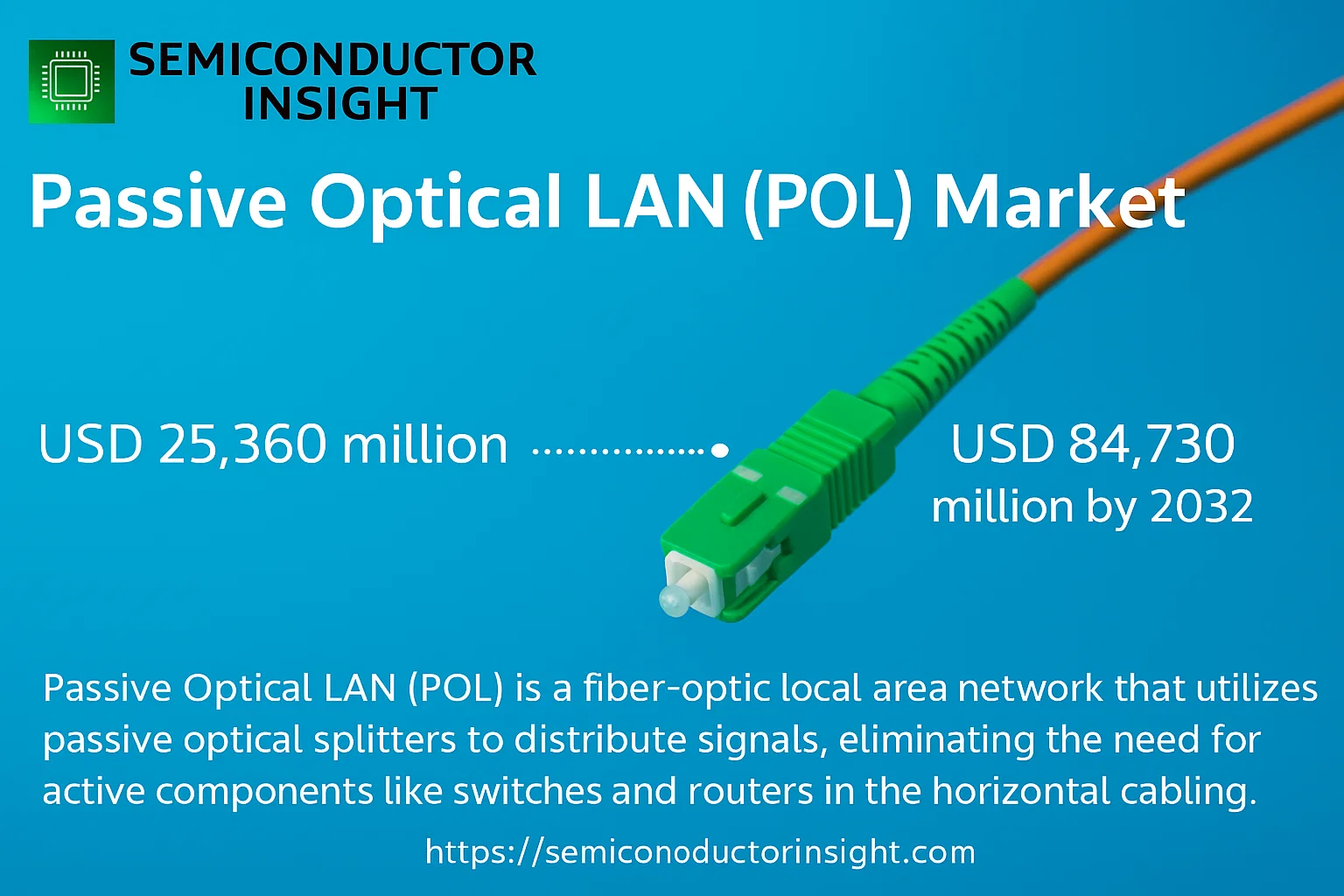
Passive Optical LAN (POL) Market Share-semiconductorinsight

MARKET DRIVERS

Accelerated Fiber Deployments and Bandwidth Demand

Global surge in data consumption, driven by high-definition video, cloud applications, and the Internet of Things (IoT), is creating unprecedented demand for high-bandwidth, low-latency network infrastructure. Passive Optical LAN (POL) technology, which utilizes fiber optic cables to deliver services directly to endpoints, is uniquely positioned to meet this demand. Its ability to support multi-gigabit speeds over long distances makes it an ideal solution for modern enterprise environments.

Rising Focus on Operational and Energy Efficiency

Organizations are increasingly prioritizing total cost of ownership (TCO) and sustainability. Compared to traditional copper-based LANs, POLs require significantly fewer active components, such as switches, leading to reduced power consumption and cooling needs. This streamlined architecture can lower energy costs by up to 50% and reduce the physical space required for network equipment, making it a compelling choice for new constructions and retrofits.

POL’s simplified architecture offers a future-proof platform capable of supporting evolving technologies without major infrastructure overhaul.

Furthermore, the convergence of data, voice, and video onto a single fiber infrastructure simplifies network management and reduces cabling complexity. This operational efficiency is a key driver for adoption in large-scale deployments across campuses, hospitals, and government buildings.

MARKET CHALLENGES

Initial Capital Investment and Legacy System Integration

A primary barrier to POL adoption is the perceived higher initial cost of optical network terminals (ONTs) and optical line terminals (OLTs) compared to traditional Ethernet switches. For organizations with extensive existing copper infrastructure, the cost of a complete rip-and-replace upgrade can be prohibitive, despite the long-term operational savings.

Other Challenges

Skill Gap in Fiber Optic Technology
The enterprise IT workforce is traditionally more familiar with copper-based Ethernet technologies. The specialized knowledge required for designing, installing, and maintaining fiber optic networks can create a skill gap, requiring additional training and potentially slowing deployment.

Limited Power over Ethernet (PoE) Capabilities
While solutions exist, delivering high-wattage Power over Ethernet (PoE/PoE+) over POL to devices like IP phones, wireless access points, and security cameras can be more complex than with traditional switches, posing a challenge for some deployments.

MARKET RESTRAINTS

Dominance of Established Copper-Based LAN Infrastructure

The widespread, deep-rooted installation of Category 5e/6/6a cabling in commercial buildings globally acts as a significant market restraint. The inertia of maintaining and incrementally upgrading existing systems often outweighs the incentive to invest in a new, unfamiliar technology like POL, particularly for small to medium-sized enterprises with limited capital budgets.

Perceived Technological Maturity and Vendor Lock-in

Potential adopters may perceive traditional Ethernet as a more mature and proven technology. Additionally, concerns about vendor lock-in can arise, as POL solutions from different manufacturers may not be fully interoperable, limiting flexibility for future procurement and potentially increasing long-term costs.

MARKET OPPORTUNITIES

Expansion in Smart Building and Campus Environments

The rapid growth of smart building technologies and large campus settings (corporate, educational, healthcare) presents a major opportunity. POL’s ability to provide high bandwidth over long distances with minimal equipment rooms aligns perfectly with the dense connectivity requirements of IoT sensors, building automation systems, and unified communications.

Adoption Driven by 5G Backhaul and FTTX Convergence

The deployment of 5G networks requires robust fiber backhaul. POL architecture can be leveraged to support small cell deployments in urban and enterprise environments. Furthermore, the convergence of Fiber-to-the-x (FTTX) services with enterprise POLs offers service providers an opportunity to deliver seamless connectivity from the wide area network directly to the end-user desk.
Passive Optical LAN (POL) Market Trends

Exponential Market Growth Driven by Efficiency and Cost-Savings

Global Passive Optical LAN (POL) Market is on a trajectory of significant expansion, with its valuation projected to surge from USD 25,360 million in 2024 to USD 84,730 million by 2032, representing a robust compound annual growth rate (CAGR) of 19.3%. This accelerated growth is fundamentally driven by the inherent advantages of POL technology. Based on Passive Optical Network (PON) technology, POL offers a highly reliable and interference-resistant media network. Its architecture simplifies infrastructure, leading to substantial reductions in both energy consumption and long-term maintenance costs. Businesses and institutions are increasingly adopting POL to future-proof their network infrastructure while achieving significant operational economies.

Other Trends

GPON Technology Dominance

Within the market segments, Gigabit-capable Passive Optical Network (GPON) technology holds a dominant position over Ethernet PON (EPON). This is largely due to GPON’s ability to deliver higher bandwidth over longer distances, making it the preferred choice for large-scale enterprise and campus-wide deployments, including those in the education and healthcare sectors.

Consolidated Vendor Landscape

The competitive landscape is characterized by a high degree of consolidation. The top three companies, including Huawei, ZTE, and Alcatel-Lucent, collectively command approximately 74% of the global market share. This concentration impacts pricing, innovation, and strategic partnerships, with these key players driving technological standards and deployment methodologies.

Regional Market Dynamics and Application-Specific Adoption

Geographically, Europe currently leads the global POL market, accounting for approximately 27% of the share, closely followed by North America at 26%. The adoption is strongest in key vertical applications such as Education, Healthcare, and Government. These sectors benefit immensely from POL’s scalability, high bandwidth capabilities for data-intensive applications, and enhanced security for sensitive information. The trend indicates a strategic shift away from traditional copper-based LANs towards fiber-optic solutions that can support digital transformation initiatives across various industries.

COMPETITIVE LANDSCAPE

Key Industry Players

A Market Dominated by Telecommunications Giants

Global Passive Optical LAN (POL) Market is characterized by a high level of concentration, with the top three players Huawei, ZTE, and Alcatel-Lucent (now part of Nokia) collectively commanding approximately 74% of the market share. These companies leverage their extensive experience and resources from the broader telecommunications infrastructure sector to dominate the POL space. Huawei stands as the undisputed leader, offering comprehensive GPON and EPON-based POL solutions that are widely deployed across various verticals, including education, healthcare, and government. Their global reach and strong R&D capabilities allow them to set industry standards and drive technological innovation.

Beyond the dominant players, the market includes a cohort of significant, specialized companies that cater to specific regional markets or niche applications. Players like Zhone Technologies and Tellabs (acquired by Marlin Equity Partners) have a strong legacy in optical access solutions. Global networking leaders such as Cisco and Commscope offer integrated POL solutions as part of their broader enterprise portfolio. Other important companies like Adtran, FiberHome, and Mitsubishi Electric provide competitive alternatives. Niche innovators, including companies like DASAN Zhone Solutions, Sumitomo Electric, and allied technology providers, focus on addressing specific enterprise needs and contribute to the market’s dynamism through specialized solutions and regional expertise.

List of Key Passive Optical LAN (POL) Companies Profiled

Segment Analysis:

Segment Category Sub-Segments Key Insights
By Type
  • GPON
  • EPON
GPON technology leads the market as it offers superior bandwidth capacity and efficiency for fiber-to-the-premises applications, making it highly suitable for enterprise and large-scale network deployments. The technology’s ability to support high-speed data, voice, and video services over long distances without active components provides significant operational advantages.
By Application
  • Education
  • Healthcare
  • Government
  • Industry
  • Others
Education is the most prominent application due to the high demand for robust, high-bandwidth networks across campuses to support digital learning, online resources, and administrative functions. The inherent reliability and cost-efficiency of POL solutions are critical for educational institutions managing extensive network infrastructures with limited maintenance resources.
By End User
  • Large Enterprises
  • Small and Medium Enterprises (SMEs)
  • Public Sector Organizations
Large Enterprises represent the dominant end-user segment, as they require scalable and future-proof network infrastructure to support their complex operations, large number of users, and data-intensive applications. The long-term cost savings and simplified network management offered by POL are particularly attractive for large-scale deployments.
By Component
  • Optical Line Terminal (OLT)
  • Optical Network Terminal/Unit (ONT/ONU)
  • Optical Splitters
Optical Network Terminal/Unit (ONT/ONU) is the leading component segment due to its role as the customer-premises equipment that connects end-user devices to the POL. The demand is driven by the proliferation of fiber connectivity and the need for reliable endpoints that can deliver high-speed services directly to users.
By Deployment
  • New Installations
  • Upgrades & Modernizations
  • Network Expansions
Network Expansions lead this category as existing enterprises and institutions increasingly choose POL to extend their legacy networks, drawn by the superior bandwidth, reduced cable clutter, and lower power requirements compared to traditional copper-based LANs, which facilitates seamless scaling.

Regional Analysis: Passive Optical LAN (POL) Market

Asia-Pacific

The Asia-Pacific region has emerged as the undisputed leader in the global Passive Optical LAN (POL) Market, driven by massive investments in digital infrastructure, rapid urbanization, and strong government initiatives promoting smart city development and broadband connectivity. Countries like China, Japan, and South Korea are at the forefront, with China’s “Broadband China” strategy creating a fertile ground for fiber optic solutions. A key dynamic is the region’s high-density urban environments, where the superior bandwidth and long-distance capabilities of POL are particularly advantageous for serving large campuses, commercial complexes, and multiple-dwelling units. Furthermore, the region’s manufacturing prowess and competitive supply chain for optical components have made POL solutions more cost-effective, accelerating adoption. The pressing need for future-proof, energy-efficient network infrastructure in new construction projects, combined with a keen focus on operational expenditure reduction, continues to fuel a robust and sustained market growth trajectory across the Asia-Pacific.

Governmental Digitalization Push
National digitalization agendas, particularly in China and Southeast Asia, are a primary catalyst. Large-scale public-sector projects for smart cities, education, and healthcare are specifying POL for its reliability and scalability, creating a high-volume demand that drives market maturity and vendor competition.
Demand for High-Density Connectivity
The proliferation of data-intensive applications, IoT devices, and the rapid rollout of 5G networks are straining traditional copper-based LANs. POL’s ability to deliver high bandwidth over long distances without signal degradation is seen as a critical solution for enterprise and multi-tenant environments.
Strong Manufacturing Ecosystem
A well-established and cost-competitive ecosystem for optical components (fibers, splitters, ONTs) within the region lowers the total cost of ownership for POL deployments. This local supply chain advantage is a significant barrier for competitors from other regions and speeds up implementation timelines.
Early Adopter Mindset
There is a notable willingness among enterprises and service providers in the Asia-Pacific to adopt new technologies that promise long-term operational benefits. This early adopter culture, combined with intense market competition, fosters innovation and drives the continuous evolution of POL offerings tailored to local needs.

North America
The North American POL market is characterized by steady growth, primarily fueled by the need for network modernization in enterprise and government sectors. High bandwidth demands from cloud computing, video conferencing, and unified communications are pushing organizations to seek more robust infrastructure. The market benefits from a strong focus on energy efficiency and reducing cabling complexity, especially in large facilities like corporate campuses, hospitals, and universities. While adoption is mature, it is more measured compared to Asia-Pacific, with a strong emphasis on standards compliance, security, and integrating POL with existing IT ecosystems. The competitive landscape includes both specialized fiber optic vendors and traditional network equipment providers expanding their portfolios.

Europe
Europe represents a significant and environmentally conscious market for POL, with growth driven by stringent energy efficiency regulations and green building initiatives. Countries like Germany, the UK, and France are leading adopters, particularly in the public sector, healthcare, and education. The market dynamics are influenced by a preference for future-proofing network investments and the alignment of POL’s low power consumption with the EU’s sustainability goals. A key trend is the retrofitting of historical buildings and campuses where POL’s minimal space requirements and reduced cabling are major advantages. However, market growth can be tempered by slower decision-making processes in large public projects and the presence of well-entrenched traditional LAN infrastructure.

South America
The POL market in South America is in a developing stage, showing promising growth potential driven by urban development and increasing internet penetration. Brazil is the largest market, with investments in infrastructure for large events and a growing IT sector creating opportunities. The primary market dynamic is cost sensitivity, which makes the long-term total cost of ownership benefits of POL appealing for new commercial and multi-dwelling unit constructions. Challenges include economic volatility impacting large capital expenditures and a less mature local supply chain for optical components compared to other regions. Adoption is currently concentrated in major urban centers and specific verticals like hospitality and education.

Middle East & Africa
The Middle East & Africa region presents a high-growth frontier for POL, largely driven by ambitious smart city and infrastructure projects, particularly in the Gulf Cooperation Council (GCC) countries like the UAE and Saudi Arabia. These greenfield projects provide an ideal scenario for deploying future-proof fiber optic LANs from the ground up. The market is characterized by a focus on building world-class, sustainable infrastructure. In Africa, growth is more nascent, with potential in specific sectors like telecommunications backhaul and large-scale commercial developments. A key dynamic is the partnership between international POL vendors and local entities to build capability and address the unique challenges of the region’s diverse climates and development stages.

Report Scope

This market research report provides a comprehensive analysis of the Passive Optical LAN (POL) Market, covering the forecast period 2025–2032. It offers detailed insights into market dynamics, technological advancements, competitive landscape, and key trends shaping the industry.

Key focus areas of the report include:

  • Market Overview: The report begins with an overview outlining its current market scenario, key growth indicators, and industry transformation drivers. It discusses macroeconomic factors, demand–supply balance, regulatory landscape, and the strategic role of semiconductors in powering advancements across industries such as automotive, telecommunications, consumer electronics, and industrial automation.
  • Market Size & Forecast: Historical data and future projections for revenue, unit shipments, and market value across major regions and segments.
  • Segmentation Analysis: Detailed breakdown by product type, technology, application, and end-user industry to identify high-growth segments and investment opportunities.
  • Regional Insights: Insights into market performance across North America, Europe, Asia-Pacific, Latin America, and the Middle East & Africa, including country-level analysis where relevant.
  • Competitive Landscape: Profiles of leading market participants, including their product offerings, R&D focus, manufacturing capacity, pricing strategies, and recent developments such as mergers, acquisitions, and partnerships.
  • Technology Trends & Innovation: Assessment of emerging technologies, integration of AI/IoT, semiconductor design trends, fabrication techniques, and evolving industry standards.
  • Market Drivers & Restraints: Evaluation of factors driving market growth along with challenges, supply chain constraints, regulatory issues, and market-entry barriers.
  • Stakeholder Insights: Insights for component suppliers, OEMs, system integrators, investors, and policymakers regarding the evolving ecosystem and strategic opportunities.

Primary and secondary research methods are employed, including interviews with industry experts, data from verified sources, and real-time market intelligence to ensure the accuracy and reliability of the insights presented.

FREQUENTLY ASKED QUESTIONS:

What is the current market size of Passive Optical LAN (POL) Market?

-> Passive Optical LAN (POL) Market was valued at USD 25,360 million in 2024 to USD 84,730 million by 2032, exhibiting a CAGR of 19.3% during the forecast period..

Which key companies operate in Passive Optical LAN (POL) Market?

-> Key players include Huawei, ZTE, Alcatel-Lucent, Zhone, Tellabs, Cisco, Commscope, among others. The top three companies occupied approximately 74% market share in 2024.

What are the key growth drivers?

-> Key growth drivers include the technology’s ability to avoid interference from external devices, improve network reliability, enable faster speeds, and save maintenance costs.

Which region dominates the market?

-> Europe is the largest Passive Optical LAN (POL) Market with about 27% market share, while North America is the follower, accounting for about 26% market share.

What are the emerging trends?

-> Emerging trends include the adoption of GPON and EPON technologies and the expansion of applications across Education, Healthcare, Government, and Industry sectors.

 

Passive Optical LAN (POL) Market, Global Business Strategies 2025-2032

Get Sample Report PDF for Exclusive Insights

Report Sample Includes

  • Table of Contents
  • List of Tables & Figures
  • Charts, Research Methodology, and more...

PDF Icon Download Sample Report PDF

Download Sample Report

Table of Content

1 Introduction to Research & Analysis Reports
1.1 Passive Optical LAN (POL) Market Definition
1.2 Market Segments
1.2.1 Segment by Type
1.2.2 Segment by Application
1.3 Global Passive Optical LAN (POL) Market Overview
1.4 Features & Benefits of This Report
1.5 Methodology & Sources of Information
1.5.1 Research Methodology
1.5.2 Research Process
1.5.3 Base Year
1.5.4 Report Assumptions & Caveats
2 Global Passive Optical LAN (POL) Overall Market Size
2.1 Global Passive Optical LAN (POL) Market Size: 2024 VS 2032
2.2 Global Passive Optical LAN (POL) Market Size, Prospects & Forecasts: 2020-2032
2.3 Global Passive Optical LAN (POL) Sales: 2020-2032
3 Company Landscape
3.1 Top Passive Optical LAN (POL) Players in Global Market
3.2 Top Global Passive Optical LAN (POL) Companies Ranked by Revenue
3.3 Global Passive Optical LAN (POL) Revenue by Companies
3.4 Global Passive Optical LAN (POL) Sales by Companies
3.5 Global Passive Optical LAN (POL) Price by Manufacturer (2020-2025)
3.6 Top 3 and Top 5 Passive Optical LAN (POL) Companies in Global Market, by Revenue in 2024
3.7 Global Manufacturers Passive Optical LAN (POL) Product Type
3.8 Tier 1, Tier 2, and Tier 3 Passive Optical LAN (POL) Players in Global Market
3.8.1 List of Global Tier 1 Passive Optical LAN (POL) Companies
3.8.2 List of Global Tier 2 and Tier 3 Passive Optical LAN (POL) Companies
4 Sights by Product
4.1 Overview
4.1.1 Segment by Type – Global Passive Optical LAN (POL) Market Size Markets, 2024 & 2032
4.1.2 GPON
4.1.3 EPON
4.2 Segment by Type – Global Passive Optical LAN (POL) Revenue & Forecasts
4.2.1 Segment by Type – Global Passive Optical LAN (POL) Revenue, 2020-2025
4.2.2 Segment by Type – Global Passive Optical LAN (POL) Revenue, 2026-2032
4.2.3 Segment by Type – Global Passive Optical LAN (POL) Revenue Market Share, 2020-2032
4.3 Segment by Type – Global Passive Optical LAN (POL) Sales & Forecasts
4.3.1 Segment by Type – Global Passive Optical LAN (POL) Sales, 2020-2025
4.3.2 Segment by Type – Global Passive Optical LAN (POL) Sales, 2026-2032
4.3.3 Segment by Type – Global Passive Optical LAN (POL) Sales Market Share, 2020-2032
4.4 Segment by Type – Global Passive Optical LAN (POL) Price (Manufacturers Selling Prices), 2020-2032
5 Sights by Application
5.1 Overview
5.1.1 Segment by Application – Global Passive Optical LAN (POL) Market Size, 2024 & 2032
5.1.2 Education
5.1.3 Healthcare
5.1.4 Government
5.1.5 Industry
5.2 Segment by Application – Global Passive Optical LAN (POL) Revenue & Forecasts
5.2.1 Segment by Application – Global Passive Optical LAN (POL) Revenue, 2020-2025
5.2.2 Segment by Application – Global Passive Optical LAN (POL) Revenue, 2026-2032
5.2.3 Segment by Application – Global Passive Optical LAN (POL) Revenue Market Share, 2020-2032
5.3 Segment by Application – Global Passive Optical LAN (POL) Sales & Forecasts
5.3.1 Segment by Application – Global Passive Optical LAN (POL) Sales, 2020-2025
5.3.2 Segment by Application – Global Passive Optical LAN (POL) Sales, 2026-2032
5.3.3 Segment by Application – Global Passive Optical LAN (POL) Sales Market Share, 2020-2032
5.4 Segment by Application – Global Passive Optical LAN (POL) Price (Manufacturers Selling Prices), 2020-2032
6 Sights by Region
6.1 By Region – Global Passive Optical LAN (POL) Market Size, 2024 & 2032
6.2 By Region – Global Passive Optical LAN (POL) Revenue & Forecasts
6.2.1 By Region – Global Passive Optical LAN (POL) Revenue, 2020-2025
6.2.2 By Region – Global Passive Optical LAN (POL) Revenue, 2026-2032
6.2.3 By Region – Global Passive Optical LAN (POL) Revenue Market Share, 2020-2032
6.3 By Region – Global Passive Optical LAN (POL) Sales & Forecasts
6.3.1 By Region – Global Passive Optical LAN (POL) Sales, 2020-2025
6.3.2 By Region – Global Passive Optical LAN (POL) Sales, 2026-2032
6.3.3 By Region – Global Passive Optical LAN (POL) Sales Market Share, 2020-2032
6.4 North America
6.4.1 By Country – North America Passive Optical LAN (POL) Revenue, 2020-2032
6.4.2 By Country – North America Passive Optical LAN (POL) Sales, 2020-2032
6.4.3 United States Passive Optical LAN (POL) Market Size, 2020-2032
6.4.4 Canada Passive Optical LAN (POL) Market Size, 2020-2032
6.4.5 Mexico Passive Optical LAN (POL) Market Size, 2020-2032
6.5 Europe
6.5.1 By Country – Europe Passive Optical LAN (POL) Revenue, 2020-2032
6.5.2 By Country – Europe Passive Optical LAN (POL) Sales, 2020-2032
6.5.3 Germany Passive Optical LAN (POL) Market Size, 2020-2032
6.5.4 France Passive Optical LAN (POL) Market Size, 2020-2032
6.5.5 U.K. Passive Optical LAN (POL) Market Size, 2020-2032
6.5.6 Italy Passive Optical LAN (POL) Market Size, 2020-2032
6.5.7 Russia Passive Optical LAN (POL) Market Size, 2020-2032
6.5.8 Nordic Countries Passive Optical LAN (POL) Market Size, 2020-2032
6.5.9 Benelux Passive Optical LAN (POL) Market Size, 2020-2032
6.6 Asia
6.6.1 By Region – Asia Passive Optical LAN (POL) Revenue, 2020-2032
6.6.2 By Region – Asia Passive Optical LAN (POL) Sales, 2020-2032
6.6.3 China Passive Optical LAN (POL) Market Size, 2020-2032
6.6.4 Japan Passive Optical LAN (POL) Market Size, 2020-2032
6.6.5 South Korea Passive Optical LAN (POL) Market Size, 2020-2032
6.6.6 Southeast Asia Passive Optical LAN (POL) Market Size, 2020-2032
6.6.7 India Passive Optical LAN (POL) Market Size, 2020-2032
6.7 South America
6.7.1 By Country – South America Passive Optical LAN (POL) Revenue, 2020-2032
6.7.2 By Country – South America Passive Optical LAN (POL) Sales, 2020-2032
6.7.3 Brazil Passive Optical LAN (POL) Market Size, 2020-2032
6.7.4 Argentina Passive Optical LAN (POL) Market Size, 2020-2032
6.8 Middle East & Africa
6.8.1 By Country – Middle East & Africa Passive Optical LAN (POL) Revenue, 2020-2032
6.8.2 By Country – Middle East & Africa Passive Optical LAN (POL) Sales, 2020-2032
6.8.3 Turkey Passive Optical LAN (POL) Market Size, 2020-2032
6.8.4 Israel Passive Optical LAN (POL) Market Size, 2020-2032
6.8.5 Saudi Arabia Passive Optical LAN (POL) Market Size, 2020-2032
6.8.6 UAE Passive Optical LAN (POL) Market Size, 2020-2032
7 Manufacturers & Brands Profiles
7.1 Huawei
7.1.1 Huawei Company Summary
7.1.2 Huawei Business Overview
7.1.3 Huawei Passive Optical LAN (POL) Major Product Offerings
7.1.4 Huawei Passive Optical LAN (POL) Sales and Revenue in Global (2020-2025)
7.1.5 Huawei Key News & Latest Developments
7.2 ZTE
7.2.1 ZTE Company Summary
7.2.2 ZTE Business Overview
7.2.3 ZTE Passive Optical LAN (POL) Major Product Offerings
7.2.4 ZTE Passive Optical LAN (POL) Sales and Revenue in Global (2020-2025)
7.2.5 ZTE Key News & Latest Developments
7.3 Alcatel-Lucent
7.3.1 Alcatel-Lucent Company Summary
7.3.2 Alcatel-Lucent Business Overview
7.3.3 Alcatel-Lucent Passive Optical LAN (POL) Major Product Offerings
7.3.4 Alcatel-Lucent Passive Optical LAN (POL) Sales and Revenue in Global (2020-2025)
7.3.5 Alcatel-Lucent Key News & Latest Developments
7.4 Zhone
7.4.1 Zhone Company Summary
7.4.2 Zhone Business Overview
7.4.3 Zhone Passive Optical LAN (POL) Major Product Offerings
7.4.4 Zhone Passive Optical LAN (POL) Sales and Revenue in Global (2020-2025)
7.4.5 Zhone Key News & Latest Developments
7.5 Tellabs
7.5.1 Tellabs Company Summary
7.5.2 Tellabs Business Overview
7.5.3 Tellabs Passive Optical LAN (POL) Major Product Offerings
7.5.4 Tellabs Passive Optical LAN (POL) Sales and Revenue in Global (2020-2025)
7.5.5 Tellabs Key News & Latest Developments
7.6 Cisco
7.6.1 Cisco Company Summary
7.6.2 Cisco Business Overview
7.6.3 Cisco Passive Optical LAN (POL) Major Product Offerings
7.6.4 Cisco Passive Optical LAN (POL) Sales and Revenue in Global (2020-2025)
7.6.5 Cisco Key News & Latest Developments
7.7 Commscope
7.7.1 Commscope Company Summary
7.7.2 Commscope Business Overview
7.7.3 Commscope Passive Optical LAN (POL) Major Product Offerings
7.7.4 Commscope Passive Optical LAN (POL) Sales and Revenue in Global (2020-2025)
7.7.5 Commscope Key News & Latest Developments
8 Global Passive Optical LAN (POL) Production Capacity, Analysis
8.1 Global Passive Optical LAN (POL) Production Capacity, 2020-2032
8.2 Passive Optical LAN (POL) Production Capacity of Key Manufacturers in Global Market
8.3 Global Passive Optical LAN (POL) Production by Region
9 Key Market Trends, Opportunity, Drivers and Restraints
9.1 Market Opportunities & Trends
9.2 Market Drivers
9.3 Market Restraints
10 Passive Optical LAN (POL) Supply Chain Analysis
10.1 Passive Optical LAN (POL) Industry Value Chain
10.2 Passive Optical LAN (POL) Upstream Market
10.3 Passive Optical LAN (POL) Downstream and Clients
10.4 Marketing Channels Analysis
10.4.1 Marketing Channels
10.4.2 Passive Optical LAN (POL) Distributors and Sales Agents in Global
11 Conclusion
12 Appendix
12.1 Note
12.2 Examples of Clients
12.3 DisclaimerList of Tables
Table 1. Key Players of Passive Optical LAN (POL) in Global Market
Table 2. Top Passive Optical LAN (POL) Players in Global Market, Ranking by Revenue (2024)
Table 3. Global Passive Optical LAN (POL) Revenue by Companies, (US$, Mn), 2020-2025
Table 4. Global Passive Optical LAN (POL) Revenue Share by Companies, 2020-2025
Table 5. Global Passive Optical LAN (POL) Sales by Companies, (K Units), 2020-2025
Table 6. Global Passive Optical LAN (POL) Sales Share by Companies, 2020-2025
Table 7. Key Manufacturers Passive Optical LAN (POL) Price (2020-2025) & (USD/Unit)
Table 8. Global Manufacturers Passive Optical LAN (POL) Product Type
Table 9. List of Global Tier 1 Passive Optical LAN (POL) Companies, Revenue (US$, Mn) in 2024 and Market Share
Table 10. List of Global Tier 2 and Tier 3 Passive Optical LAN (POL) Companies, Revenue (US$, Mn) in 2024 and Market Share
Table 11. Segment by Type – Global Passive Optical LAN (POL) Revenue, (US$, Mn), 2024 & 2032
Table 12. Segment by Type – Global Passive Optical LAN (POL) Revenue (US$, Mn), 2020-2025
Table 13. Segment by Type – Global Passive Optical LAN (POL) Revenue (US$, Mn), 2026-2032
Table 14. Segment by Type – Global Passive Optical LAN (POL) Sales (K Units), 2020-2025
Table 15. Segment by Type – Global Passive Optical LAN (POL) Sales (K Units), 2026-2032
Table 16. Segment by Application – Global Passive Optical LAN (POL) Revenue, (US$, Mn), 2024 & 2032
Table 17. Segment by Application – Global Passive Optical LAN (POL) Revenue, (US$, Mn), 2020-2025
Table 18. Segment by Application – Global Passive Optical LAN (POL) Revenue, (US$, Mn), 2026-2032
Table 19. Segment by Application – Global Passive Optical LAN (POL) Sales, (K Units), 2020-2025
Table 20. Segment by Application – Global Passive Optical LAN (POL) Sales, (K Units), 2026-2032
Table 21. By Region – Global Passive Optical LAN (POL) Revenue, (US$, Mn), 2025-2032
Table 22. By Region – Global Passive Optical LAN (POL) Revenue, (US$, Mn), 2020-2025
Table 23. By Region – Global Passive Optical LAN (POL) Revenue, (US$, Mn), 2026-2032
Table 24. By Region – Global Passive Optical LAN (POL) Sales, (K Units), 2020-2025
Table 25. By Region – Global Passive Optical LAN (POL) Sales, (K Units), 2026-2032
Table 26. By Country – North America Passive Optical LAN (POL) Revenue, (US$, Mn), 2020-2025
Table 27. By Country – North America Passive Optical LAN (POL) Revenue, (US$, Mn), 2026-2032
Table 28. By Country – North America Passive Optical LAN (POL) Sales, (K Units), 2020-2025
Table 29. By Country – North America Passive Optical LAN (POL) Sales, (K Units), 2026-2032
Table 30. By Country – Europe Passive Optical LAN (POL) Revenue, (US$, Mn), 2020-2025
Table 31. By Country – Europe Passive Optical LAN (POL) Revenue, (US$, Mn), 2026-2032
Table 32. By Country – Europe Passive Optical LAN (POL) Sales, (K Units), 2020-2025
Table 33. By Country – Europe Passive Optical LAN (POL) Sales, (K Units), 2026-2032
Table 34. By Region – Asia Passive Optical LAN (POL) Revenue, (US$, Mn), 2020-2025
Table 35. By Region – Asia Passive Optical LAN (POL) Revenue, (US$, Mn), 2026-2032
Table 36. By Region – Asia Passive Optical LAN (POL) Sales, (K Units), 2020-2025
Table 37. By Region – Asia Passive Optical LAN (POL) Sales, (K Units), 2026-2032
Table 38. By Country – South America Passive Optical LAN (POL) Revenue, (US$, Mn), 2020-2025
Table 39. By Country – South America Passive Optical LAN (POL) Revenue, (US$, Mn), 2026-2032
Table 40. By Country – South America Passive Optical LAN (POL) Sales, (K Units), 2020-2025
Table 41. By Country – South America Passive Optical LAN (POL) Sales, (K Units), 2026-2032
Table 42. By Country – Middle East & Africa Passive Optical LAN (POL) Revenue, (US$, Mn), 2020-2025
Table 43. By Country – Middle East & Africa Passive Optical LAN (POL) Revenue, (US$, Mn), 2026-2032
Table 44. By Country – Middle East & Africa Passive Optical LAN (POL) Sales, (K Units), 2020-2025
Table 45. By Country – Middle East & Africa Passive Optical LAN (POL) Sales, (K Units), 2026-2032
Table 46. Huawei Company Summary
Table 47. Huawei Passive Optical LAN (POL) Product Offerings
Table 48. Huawei Passive Optical LAN (POL) Sales (K Units), Revenue (US$, Mn) and Average Price (USD/Unit) & (2020-2025)
Table 49. Huawei Key News & Latest Developments
Table 50. ZTE Company Summary
Table 51. ZTE Passive Optical LAN (POL) Product Offerings
Table 52. ZTE Passive Optical LAN (POL) Sales (K Units), Revenue (US$, Mn) and Average Price (USD/Unit) & (2020-2025)
Table 53. ZTE Key News & Latest Developments
Table 54. Alcatel-Lucent Company Summary
Table 55. Alcatel-Lucent Passive Optical LAN (POL) Product Offerings
Table 56. Alcatel-Lucent Passive Optical LAN (POL) Sales (K Units), Revenue (US$, Mn) and Average Price (USD/Unit) & (2020-2025)
Table 57. Alcatel-Lucent Key News & Latest Developments
Table 58. Zhone Company Summary
Table 59. Zhone Passive Optical LAN (POL) Product Offerings
Table 60. Zhone Passive Optical LAN (POL) Sales (K Units), Revenue (US$, Mn) and Average Price (USD/Unit) & (2020-2025)
Table 61. Zhone Key News & Latest Developments
Table 62. Tellabs Company Summary
Table 63. Tellabs Passive Optical LAN (POL) Product Offerings
Table 64. Tellabs Passive Optical LAN (POL) Sales (K Units), Revenue (US$, Mn) and Average Price (USD/Unit) & (2020-2025)
Table 65. Tellabs Key News & Latest Developments
Table 66. Cisco Company Summary
Table 67. Cisco Passive Optical LAN (POL) Product Offerings
Table 68. Cisco Passive Optical LAN (POL) Sales (K Units), Revenue (US$, Mn) and Average Price (USD/Unit) & (2020-2025)
Table 69. Cisco Key News & Latest Developments
Table 70. Commscope Company Summary
Table 71. Commscope Passive Optical LAN (POL) Product Offerings
Table 72. Commscope Passive Optical LAN (POL) Sales (K Units), Revenue (US$, Mn) and Average Price (USD/Unit) & (2020-2025)
Table 73. Commscope Key News & Latest Developments
Table 74. Passive Optical LAN (POL) Capacity of Key Manufacturers in Global Market, 2023-2025 (K Units)
Table 75. Global Passive Optical LAN (POL) Capacity Market Share of Key Manufacturers, 2023-2025
Table 76. Global Passive Optical LAN (POL) Production by Region, 2020-2025 (K Units)
Table 77. Global Passive Optical LAN (POL) Production by Region, 2026-2032 (K Units)
Table 78. Passive Optical LAN (POL) Market Opportunities & Trends in Global Market
Table 79. Passive Optical LAN (POL) Market Drivers in Global Market
Table 80. Passive Optical LAN (POL) Market Restraints in Global Market
Table 81. Passive Optical LAN (POL) Raw Materials
Table 82. Passive Optical LAN (POL) Raw Materials Suppliers in Global Market
Table 83. Typical Passive Optical LAN (POL) Downstream
Table 84. Passive Optical LAN (POL) Downstream Clients in Global Market
Table 85. Passive Optical LAN (POL) Distributors and Sales Agents in Global Market

List of Figures
Figure 1. Passive Optical LAN (POL) Product Picture
Figure 2. Passive Optical LAN (POL) Segment by Type in 2024
Figure 3. Passive Optical LAN (POL) Segment by Application in 2024
Figure 4. Global Passive Optical LAN (POL) Market Overview: 2024
Figure 5. Key Caveats
Figure 6. Global Passive Optical LAN (POL) Market Size: 2024 VS 2032 (US$, Mn)
Figure 7. Global Passive Optical LAN (POL) Revenue: 2020-2032 (US$, Mn)
Figure 8. Passive Optical LAN (POL) Sales in Global Market: 2020-2032 (K Units)
Figure 9. The Top 3 and 5 Players Market Share by Passive Optical LAN (POL) Revenue in 2024
Figure 10. Segment by Type – Global Passive Optical LAN (POL) Revenue, (US$, Mn), 2024 & 2032
Figure 11. Segment by Type – Global Passive Optical LAN (POL) Revenue Market Share, 2020-2032
Figure 12. Segment by Type – Global Passive Optical LAN (POL) Sales Market Share, 2020-2032
Figure 13. Segment by Type – Global Passive Optical LAN (POL) Price (USD/Unit), 2020-2032
Figure 14. Segment by Application – Global Passive Optical LAN (POL) Revenue, (US$, Mn), 2024 & 2032
Figure 15. Segment by Application – Global Passive Optical LAN (POL) Revenue Market Share, 2020-2032
Figure 16. Segment by Application – Global Passive Optical LAN (POL) Sales Market Share, 2020-2032
Figure 17. Segment by Application -Global Passive Optical LAN (POL) Price (USD/Unit), 2020-2032
Figure 18. By Region – Global Passive Optical LAN (POL) Revenue, (US$, Mn), 2025 & 2032
Figure 19. By Region – Global Passive Optical LAN (POL) Revenue Market Share, 2020 VS 2024 VS 2032
Figure 20. By Region – Global Passive Optical LAN (POL) Revenue Market Share, 2020-2032
Figure 21. By Region – Global Passive Optical LAN (POL) Sales Market Share, 2020-2032
Figure 22. By Country – North America Passive Optical LAN (POL) Revenue Market Share, 2020-2032
Figure 23. By Country – North America Passive Optical LAN (POL) Sales Market Share, 2020-2032
Figure 24. United States Passive Optical LAN (POL) Revenue, (US$, Mn), 2020-2032
Figure 25. Canada Passive Optical LAN (POL) Revenue, (US$, Mn), 2020-2032
Figure 26. Mexico Passive Optical LAN (POL) Revenue, (US$, Mn), 2020-2032
Figure 27. By Country – Europe Passive Optical LAN (POL) Revenue Market Share, 2020-2032
Figure 28. By Country – Europe Passive Optical LAN (POL) Sales Market Share, 2020-2032
Figure 29. Germany Passive Optical LAN (POL) Revenue, (US$, Mn), 2020-2032
Figure 30. France Passive Optical LAN (POL) Revenue, (US$, Mn), 2020-2032
Figure 31. U.K. Passive Optical LAN (POL) Revenue, (US$, Mn), 2020-2032
Figure 32. Italy Passive Optical LAN (POL) Revenue, (US$, Mn), 2020-2032
Figure 33. Russia Passive Optical LAN (POL) Revenue, (US$, Mn), 2020-2032
Figure 34. Nordic Countries Passive Optical LAN (POL) Revenue, (US$, Mn), 2020-2032
Figure 35. Benelux Passive Optical LAN (POL) Revenue, (US$, Mn), 2020-2032
Figure 36. By Region – Asia Passive Optical LAN (POL) Revenue Market Share, 2020-2032
Figure 37. By Region – Asia Passive Optical LAN (POL) Sales Market Share, 2020-2032
Figure 38. China Passive Optical LAN (POL) Revenue, (US$, Mn), 2020-2032
Figure 39. Japan Passive Optical LAN (POL) Revenue, (US$, Mn), 2020-2032
Figure 40. South Korea Passive Optical LAN (POL) Revenue, (US$, Mn), 2020-2032
Figure 41. Southeast Asia Passive Optical LAN (POL) Revenue, (US$, Mn), 2020-2032
Figure 42. India Passive Optical LAN (POL) Revenue, (US$, Mn), 2020-2032
Figure 43. By Country – South America Passive Optical LAN (POL) Revenue Market Share, 2020-2032
Figure 44. By Country – South America Passive Optical LAN (POL) Sales, Market Share, 2020-2032
Figure 45. Brazil Passive Optical LAN (POL) Revenue, (US$, Mn), 2020-2032
Figure 46. Argentina Passive Optical LAN (POL) Revenue, (US$, Mn), 2020-2032
Figure 47. By Country – Middle East & Africa Passive Optical LAN (POL) Revenue, Market Share, 2020-2032
Figure 48. By Country – Middle East & Africa Passive Optical LAN (POL) Sales, Market Share, 2020-2032
Figure 49. Turkey Passive Optical LAN (POL) Revenue, (US$, Mn), 2020-2032
Figure 50. Israel Passive Optical LAN (POL) Revenue, (US$, Mn), 2020-2032
Figure 51. Saudi Arabia Passive Optical LAN (POL) Revenue, (US$, Mn), 2020-2032
Figure 52. UAE Passive Optical LAN (POL) Revenue, (US$, Mn), 2020-2032
Figure 53. Global Passive Optical LAN (POL) Production Capacity (K Units), 2020-2032
Figure 54. The Percentage of Production Passive Optical LAN (POL) by Region, 2024 VS 2032
Figure 55. Passive Optical LAN (POL) Industry Value Chain
Figure 56. Marketing Channels