Passenger Counting Camera for Bus Market Insights
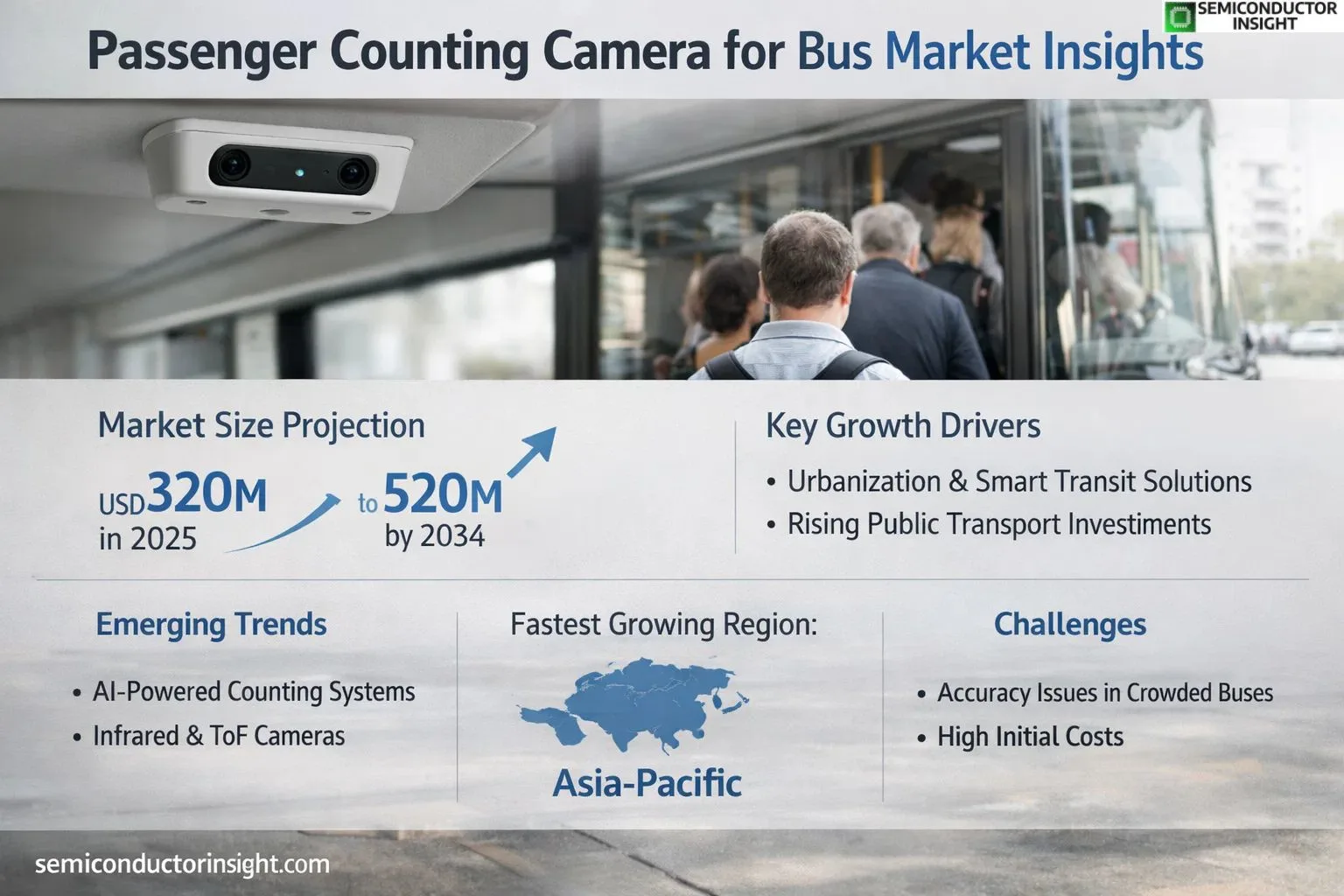
Global passenger counting camera for bus market size was valued at USD 320 million in 2025. The market is projected to grow from USD 350 million in 2026 to USD 520 million by 2034, exhibiting a CAGR of 5.1% during the forecast period.
Passenger counting cameras are advanced surveillance systems designed to accurately monitor and record the number of passengers boarding and alighting buses. These devices utilize technologies such as infrared sensors, time-of-flight imaging, and computer vision algorithms to provide real-time occupancy data. The systems are crucial for optimizing fleet management, improving operational efficiency, and enhancing passenger safety.
The market growth is driven by increasing urbanization, rising demand for smart public transportation solutions, and government initiatives promoting intelligent transport systems. Furthermore, the integration of IoT and AI-based analytics in passenger counting systems is creating new opportunities for market expansion. Key players such as Hikvision, Infodev Electronic Designers International Inc., and HELLA Aglaia Mobile Vision GmbH are actively investing in R&D to enhance accuracy and functionality of these systems.
MARKET DRIVERS
Rising Demand for Efficient Public Transportation
Global passenger counting camera for bus market is experiencing growth due to increasing urbanization and the need for optimized public transport systems. Cities worldwide are adopting smart mobility solutions, with AI-powered passenger counting cameras becoming essential for real-time occupancy monitoring and route optimization.
Government Regulations and Funding
Stringent government regulations mandating accurate ridership data collection and the availability of smart city funding programs are accelerating market adoption. Many transit authorities now require passenger counting systems as part of their modernization initiatives.
➤ Global market for intelligent transportation systems is projected to grow at 7.2% CAGR, with passenger counting solutions being a key component.
Integration with fare collection systems and the Internet of Things (IoT) is further driving demand for advanced passenger counting cameras for buses in both developed and developing markets.
MARKET CHALLENGES
Accuracy Concerns in Diverse Conditions
Despite technological advancements, passenger counting cameras face challenges in maintaining accuracy during peak hours, crowded conditions, and varying lighting environments. Differentiation between closely standing passengers remains a technical hurdle.
Other Challenges
Data Privacy Regulations
Implementing passenger counting systems requires compliance with evolving data protection laws across different regions, adding complexity to deployment.
Integration Complexity
Retrofitting older bus fleets with modern counting systems often requires significant modifications to existing infrastructure and vehicle wiring systems.
MARKET RESTRAINTS
High Initial Investment Costs
The significant upfront costs associated with deploying passenger counting camera systems across entire bus fleets often deter smaller transit operators. This includes not just hardware costs but also integration expenses and staff training requirements.
MARKET OPPORTUNITIES
Advancements in Computer Vision Technology
The integration of deep learning algorithms and 3D sensing capabilities in passenger counting cameras for buses presents significant growth opportunities. These technological improvements enable more precise counting and additional analytics features.
Passenger Counting Camera for Bus Market Trends
Adoption of Advanced Passenger Counting Technologies
The Passenger Counting Camera for Bus market is witnessing rapid adoption of advanced infrared (IR) and Time-of-Flight (ToF) camera technologies. These systems provide more accurate ridership data compared to traditional methods, with error rates below 5%. Transportation authorities are prioritizing these solutions to optimize route planning and fleet management.
Other Trends
Integration with Fleet Management Systems
Modern Passenger Counting Cameras are increasingly being integrated with intelligent transportation systems (ITS) and bus management platforms. This allows real-time passenger flow analysis, enabling operators to adjust schedules and capacity dynamically during peak hours.
Growing Demand in Public Transit Applications
Public bus systems account for over 60% of Passenger Counting Camera installations globally. Municipalities are investing in these systems to improve service quality and justify transit funding. The technology helps transportation agencies demonstrate system utilization and plan infrastructure improvements more effectively.
Emergence of AI-Based Counting Solutions
Leading manufacturers are incorporating machine learning algorithms to enhance counting accuracy in crowded conditions. These AI-enhanced systems can distinguish between boarding and alighting passengers even during peak congestion periods, with accuracy levels exceeding 98%.
Regional Growth Patterns
Asia-Pacific is showing the fastest adoption rate of Passenger Counting Cameras, driven by China’s smart city initiatives. European markets continue to lead in technological innovation, while North American transit agencies are prioritizing these solutions for COVID-19 recovery analysis and service optimization.
COMPETITIVE LANDSCAPE
Key Industry Players
Advanced Passenger Counting Systems Transforming Public Transit Analytics
Global passenger counting camera for bus market is dominated by established players with strong technological capabilities in infrared and time-of-flight camera systems. Stonkam Co.,Ltd and Hangzhou Hikvision Digital Technology Co., Ltd lead the market with their comprehensive solutions integrating AI-based counting algorithms with high-precision sensors. These top players focus on providing accurate passenger flow data, WiFi tracking integration, and cloud-based analytics platforms for transit operators.
Niche players like RCE systems s.r.o. and FootfallCam specialize in thermal imaging and 3D counting technologies, catering to specific regional markets. Emerging Asian manufacturers including Shenzhen Teswell Technology Co., Ltd and Xiamen Magnetic North Technology Co., Ltd are gaining market share through cost-effective solutions tailored for school bus and municipal transit applications. The competitive landscape features increasing partnerships between camera manufacturers and transit software providers to deliver end-to-end passenger analytics systems.
List of Key Passenger Counting Camera for Bus Companies Profiled
- Stonkam Co.,Ltd
- Hangzhou Hikvision Digital Technology Co., Ltd
- Shenzhen Teswell Technology Co., Ltd
- Xiamen Magnetic North Technology Co., Ltd
- RCE systems s.r.o.
- GIKEN TRASTEM CO.,LTD
- Highlight
- Busae
- FootfallCam
- Howen
- Hokevision
- Infodev Electronic Designers International Inc.
- Iris-GmbH Infrared & Intelligent Sensors
- Eurotech S.p.A.
- HELLA Aglaia Mobile Vision GmbH
- DILAX Intelcom GmbH
Segment Analysis:
| Segment Category | Sub-Segments | Key Insights |
| By Type |
|
Infrared (IR) Cameras dominate the market due to their reliable performance in low-light conditions and cost-effectiveness.
|
| By Application |
|
Public Bus segment shows strongest adoption due to growing smart city initiatives worldwide.
|
| By End User |
|
Municipal Transit Authorities are the primary adopters globally.
|
| By Technology Integration |
|
Integrated Fare Collection Systems are gaining prominence in modern transit solutions.
|
| By Installation Type |
|
Door-Mounted installations remain most preferred for their accuracy advantages.
|
Regional Analysis: Global Passenger Counting Camera for Bus Market
North America
North America’s FTA mandates and state-level transit data requirements create consistent demand for passenger counting cameras. Compliance needs push transit agencies toward advanced counting solutions with reporting capabilities.
Early adoption of 3D stereo-vision cameras and AI-based people counting algorithms gives North American operators superior accuracy. Integration with larger intelligent transport systems provides comprehensive mobility analytics.
Concentration of passenger counting specialists and surveillance technology firms creates competitive innovation. Local R&D centers focus on challenging use cases like crowded buses and complex boarding scenarios.
Growing emphasis on contactless transit post-pandemic accelerates camera adoption. Smart city projects prioritize passenger counting data for route optimization and service adjustments in real-time.
Europe
Europe represents the second-largest market for passenger counting cameras in buses, characterized by strong public transportation networks and EU funding for smart mobility. Countries like Germany, France, and the UK lead deployment of automated passenger counting systems, driven by urban transport efficiency goals. The region shows preference for modular counting solutions that integrate with existing ticketing systems. Strict GDPR compliance influences camera technology choices, with emphasis on data anonymization features. Scandinavian countries pioneer contactless counting methods with high accuracy requirements in low-light conditions.
Asia-Pacific
Asia-Pacific exhibits the fastest growth in bus passenger counting camera adoption, fueled by massive urban transport expansions. China’s smart city initiatives deploy counting cameras across municipal bus fleets, while Japan integrates them with precision scheduling systems. India’s rapid bus rapid transit (BRT) development creates new demand for affordable counting solutions. The region shows distinct preference for cost-effective cameras with basic functionality, though advanced systems gain traction in developed markets like Singapore and South Korea.
Middle East & Africa
The MEA region experiences growing interest in passenger counting technologies for modernizing public transport infrastructure. Gulf Cooperation Council countries lead adoption, installing cameras in metro-bus networks for data-driven operations. South Africa implements counting systems in major cities to optimize bus fleet utilization. Market growth is tempered by budget constraints in developing nations, though smart city projects in the UAE and Saudi Arabia showcase cutting-edge camera implementations.
South America
South America demonstrates moderate adoption of passenger counting cameras, primarily in Brazil’s and Chile’s urban bus systems. Cities like São Paulo integrate counting data with transit apps for real-time capacity information. Cost sensitivity drives preference for basic thermal sensor-based counters over advanced camera systems. The region shows potential with increasing smart transit investments in capital cities and BRT corridor expansions.
Report Scope
This market research report provides a comprehensive analysis of the Passenger Counting Camera for Bus Market , covering the forecast period 2025–2034. It offers detailed insights into market dynamics, technological advancements, competitive landscape, and key trends shaping the industry.
Key focus areas of the report include:
- Market Overview: The report begins with an overview outlining its current market scenario, key growth indicators, and industry transformation drivers. It discusses macroeconomic factors, demand–supply balance, regulatory landscape, and the strategic role of passenger counting systems in public transportation infrastructure.
- Market Size & Forecast: Historical data and future projections for revenue, unit shipments, and market value across major regions and segments.
- Segmentation Analysis: Detailed breakdown by product type, technology, application, and end-user industry to identify high-growth segments and investment opportunities.
- Regional Insights: Insights into market performance across North America, Europe, Asia-Pacific, Latin America, and the Middle East & Africa, including country-level analysis where relevant.
- Competitive Landscape: Profiles of leading market participants, including their product offerings, R&D focus, manufacturing capacity, pricing strategies, and recent developments such as mergers, acquisitions, and partnerships.
- Technology Trends & Innovation: Assessment of emerging technologies, integration of AI/IoT, camera design trends, and evolving industry standards.
- Market Drivers & Restraints: Evaluation of factors driving market growth along with challenges, supply chain constraints, regulatory issues, and market-entry barriers.
- Stakeholder Insights: Insights for component suppliers, OEMs, system integrators, investors, and policymakers regarding the evolving ecosystem and strategic opportunities.
Primary and secondary research methods are employed, including interviews with industry experts, data from verified sources, and real-time market intelligence to ensure the accuracy and reliability of the insights presented.
FREQUENTLY ASKED QUESTIONS:
What is the current market size of Passenger Counting Camera for Bus Market?
-> Global Passenger Counting Camera for Bus Market was valued at USD 320 million in 2025. and is projected to reach USD 520 million by 2034
Which key companies operate in Passenger Counting Camera for Bus Market?
-> Key players include Stonkam Co.,Ltd, Howen, Shenzhen Teswell Technology Co., Ltd, Hangzhou Hikvision Digital Technology Co., Ltd, Xiamen Magnetic North Technology Co., Ltd, RCE systems s.r.o., GIKEN TRASTEM CO.,LTD, Highlight, Busae, FootfallCam, among others.
What are the key growth drivers?
-> Key growth drivers include increasing public transportation investments, urbanization, and demand for smart transit solutions.
Which region dominates the market?
-> Asia-Pacific is the fastest-growing region, with China projected to reach USD 520 million by 2034
What are the emerging trends?
-> Emerging trends include AI-powered counting systems, infrared and Time-of-Flight camera technologies, and real-time transit analytics.

Get Sample Report PDF for Exclusive Insights
Report Sample Includes
- Table of Contents
- List of Tables & Figures
- Charts, Research Methodology, and more...
 Download Sample Report PDF