MARKET INSIGHTS
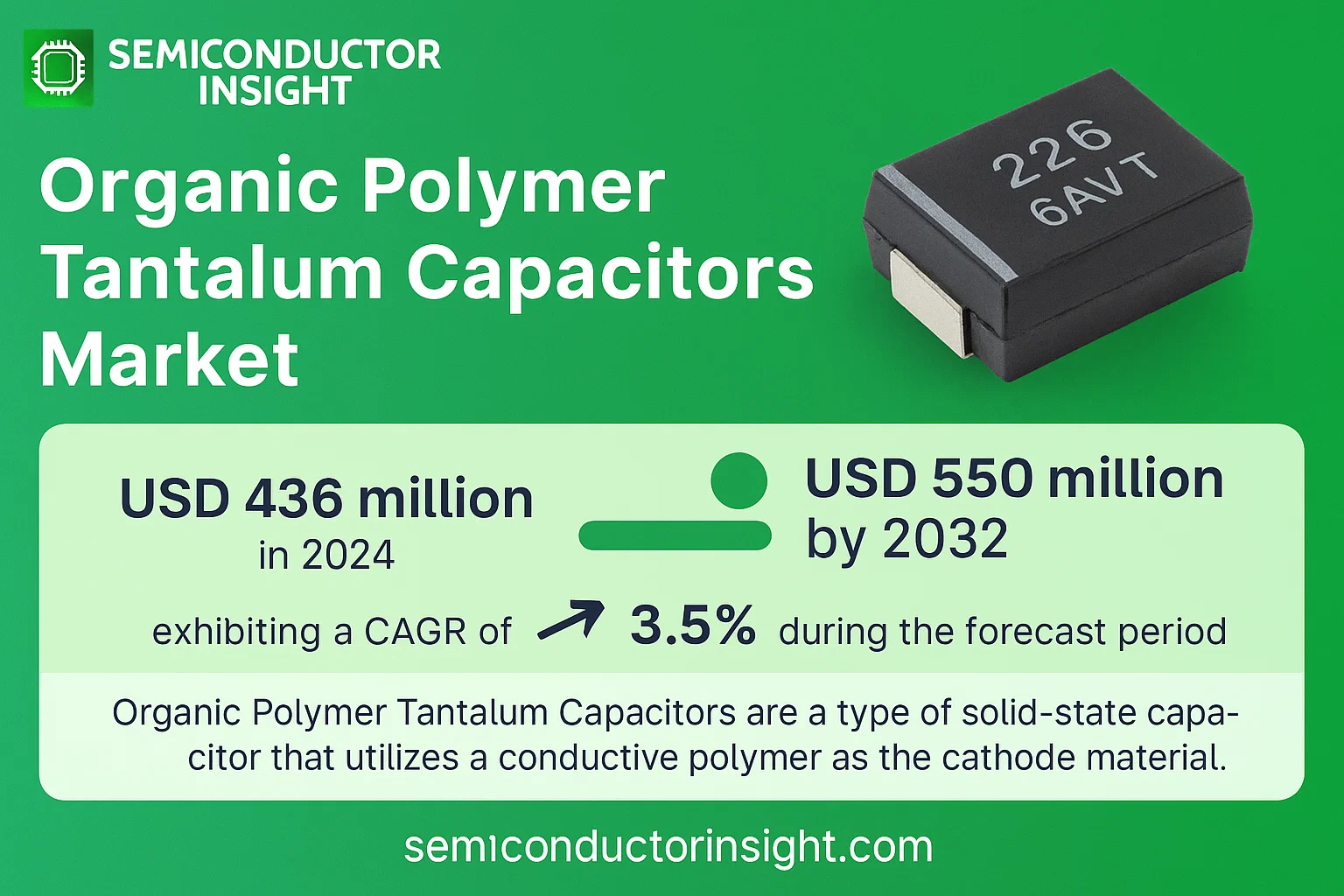
Global Organic Polymer Tantalum Capacitors Market size was valued at USD 436 million in 2024 to USD 550 million by 2032, exhibiting a CAGR of 3.5% during the forecast period.
Organic Polymer Tantalum Capacitors are a type of solid-state capacitor that utilizes a conductive polymer as the cathode material. This construction provides an extremely low equivalent series resistance (ESR), which enables superior performance in reducing ripple voltage and allows for the passage of larger ripple currents. Furthermore, these capacitors maintain very stable capacitance values even with fluctuations in frequency, making them highly reliable for demanding applications. They are primarily used across various sectors including Automotive, Military, Portable Consumer Electronics, Medical devices, and other fields.
The market growth is driven by increasing demand for miniaturized and high-performance electronic components in consumer electronics and the expanding electric vehicle (EV) sector, which requires robust and efficient capacitors for power management systems. However, the market faces challenges such as price volatility of raw tantalum and competition from alternative capacitor technologies like Multi-Layer Ceramic Capacitors (MLCCs). The competitive landscape is concentrated, with key players continuously innovating to enhance product performance and cater to specific application needs. Kemet, AVX, Vishay, Panasonic, and ROHM Semiconductor are some of the prominent companies operating in this market with extensive product portfolios.
MARKET DRIVERS
Rising Demand for Miniaturized and High-Performance Electronics
Global push towards smaller, more powerful electronic devices is a primary driver for the Organic Polymer Tantalum Capacitor market. These components offer superior volumetric efficiency, high capacitance, and excellent frequency characteristics compared to traditional capacitors, making them ideal for smartphones, wearables, and other compact electronics. The increasing complexity and power requirements of these devices necessitate components that can operate reliably in constrained spaces.
Expansion of 5G Infrastructure and Automotive Electronics
The rapid deployment of 5G networks and the proliferation of advanced driver-assistance systems (ADAS) and electric vehicles (EVs) are creating substantial demand. Organic Polymer Tantalum Capacitors are critical for power management and signal filtering in base stations, telecommunications equipment, and automotive control units due to their low equivalent series resistance (ESR), high ripple current handling, and stability over a wide temperature range.
Furthermore, the ongoing digital transformation across industries, including industrial automation and medical devices, is fueling demand for reliable and durable passive components, solidifying the position of organic polymer tantalum capacitors as a key enabling technology.
MARKET CHALLENGES
Supply Chain Vulnerabilities and Raw Material Cost Volatility
The market is susceptible to disruptions in the supply of raw tantalum, a conflict mineral whose mining is concentrated in a few geographic regions. This concentration creates significant supply chain risks and price volatility. Additionally, the complex manufacturing process for these capacitors requires specialized equipment and expertise, posing challenges for scaling production to meet surging demand.
Other Challenges
Technical Competition from Advanced MLCCs
Multilayer Ceramic Capacitors (MLCCs) with high capacitance values are increasingly competing with polymer tantalums in some applications, particularly where cost is a more critical factor than performance under high ripple current or high-temperature conditions.
Stringent Environmental and Compliance Regulations
Adherence to regulations concerning conflict minerals (like the Dodd-Frank Act) and RoHS/REACH directives adds complexity and cost to the sourcing and manufacturing processes for market participants.
MARKET RESTRAINTS
Higher Cost Compared to Alternative Technologies
The primary restraint for the Organic Polymer Tantalum Capacitor market is its higher unit cost relative to other capacitor technologies, such as aluminum electrolytic and certain MLCCs. This cost differential can make them less attractive for price-sensitive consumer applications and high-volume, cost-driven markets, limiting their adoption in these segments.
Perceived Reliability Concerns in High-Voltage Applications
While reliability has significantly improved, a historical perception of vulnerability to sudden failures under high surge currents or voltage spikes can still deter some design engineers from specifying them in critical high-reliability applications, where solid tantalum capacitors with manganese dioxide cathodes have a longer track record.
MARKET OPPORTUNITIES
Growth in Renewable Energy and Energy Storage Systems
The transition to renewable energy presents a significant opportunity. Organic Polymer Tantalum Capacitors are well-suited for use in solar inverters, wind turbine converters, and battery management systems (BMS) for energy storage due to their long operational life, high-temperature stability, and ability to handle high ripple currents, which are essential for efficient power conversion.
Innovation in Next-Generation Electronics
Emerging technologies such as artificial intelligence (AI), the Internet of Things (IoT), and advanced aerospace and defense systems require capacitors that offer a combination of high performance, miniaturization, and reliability. This creates a fertile ground for innovation and the development of new, higher-specification organic polymer tantalum capacitors to meet these demanding requirements.
Organic Polymer Tantalum Capacitors Market Trends
Sustained Market Growth and Regional Dominance
Global Organic Polymer Tantalum Capacitors Market is on a trajectory of steady expansion, with its value projected to increase from USD 436 million in 2024 to USD 550 million by 2032, representing a Compound Annual Growth Rate (CAGR) of 3.5%. A dominant regional trend is the concentration of market demand in the Asia-Pacific region, which currently holds approximately 60% of the global market share. This is largely driven by the region’s massive electronics manufacturing base. North America follows as the second-largest market, accounting for about 20% of global demand. The market structure is also highly consolidated, with the top five manufacturers Kemet, AVX, Vishay, Panasonic, and ROHM Semiconductor collectively holding around 90% of the market share, indicating a trend toward established players dominating the supply chain.
Other Trends
Portable Consumer Electronics Driving Application Demand
The application landscape reveals a clear trend where Portable Consumer electronics are the largest end-use segment for Organic Polymer Tantalum Capacitors. These components are favored in this sector due to their extremely low Equivalent Series Resistance (ESR) and stable capacitance under frequency changes, which are critical for the performance and miniaturization of devices like smartphones and laptops. The Automotive, Military, and Medical sectors represent other significant application areas, with the stable performance of these capacitors under demanding conditions making them suitable for advanced driver-assistance systems (ADAS), avionics, and critical medical equipment.
Product Specification Preferences
In terms of product types categorized by ESR (Equivalent Series Resistance), capacitors with an ESR at 100kHz falling in the 100-200 milliOhm (mΩ) range are the most prevalent, commanding a significant segment share of approximately 35%. This indicates a market trend favoring a specific balance of performance characteristics that this ESR range offers for a wide array of common electronic applications, providing an optimal combination of low ripple voltage and current handling capabilities.
Technological Advantages Underpinning Market Position
The fundamental technological benefits of Organic Polymer Tantalum Capacitors continue to be a key trend supporting their market position. The use of a conductive polymer material distinguishes them from traditional tantalum capacitors by offering superior performance characteristics. The exceptionally low ESR is a critical factor, as it allows for the reduction of ripple voltage and enables larger ripple currents to pass through the component. This performance stability across frequency changes makes them indispensable in modern electronic circuits where reliability and efficiency are paramount, ensuring their continued adoption across all key sectors.
COMPETITIVE LANDSCAPE
Key Industry Players
An Oligopolistic Market Dominated by Five Global Giants
Global Organic Polymer Tantalum Capacitors Market exhibits a highly concentrated competitive structure, with the top five manufacturers collectively holding a commanding share of approximately 90% of the market. This dominance underscores the significant barriers to entry, including advanced material science expertise, extensive research and development requirements, and established global supply chains. Market leadership is characterized by companies with robust technological portfolios and strong relationships in key end-use sectors such as automotive, portable consumer electronics, and military applications. The competition is primarily based on product reliability, performance characteristics like extremely low Equivalent Series Resistance (ESR), and the ability to meet stringent quality standards required by these demanding industries.
Beyond the dominant players, the market includes several other significant manufacturers who compete effectively by focusing on specific regional markets, application niches, or by offering cost-competitive alternatives. These companies often serve specialized segments within the medical, industrial, or telecommunications sectors, where custom specifications or localized support provide a competitive edge. The Asia-Pacific region is the largest market, accounting for about 60% of global demand, which has fueled the growth of regional players. Innovation in polymer technologies and miniaturization continues to be a key differentiator for all competitors aiming to capture growth in next-generation electronics.
List of Key Organic Polymer Tantalum Capacitors Companies Profiled
- Kemet (a part of Yageo Corporation)
- AVX Corporation (a part of Kyocera Group)
- Vishay Intertechnology, Inc.
- Panasonic Corporation
- ROHM Semiconductor
- Hongda Electronics Corp.
- Sunlord Electronics
- Abracon LLC
- TE Connectivity Ltd.
- Murata Manufacturing Co., Ltd.
- Würth Elektronik GmbH & Co. KG
- Samwha Capacitor Group
- NCC (Nippon Chemi-Con) Corporation
- TDK Corporation
- Taiyo Yuden Co., Ltd.
Segment Analysis:
| Segment Category | Sub-Segments | Key Insights |
| By Type |
|
ESR at 100kHz [mΩ] 100-200 is the leading segment, driven by its optimal balance between performance characteristics and cost-effectiveness for a wide range of mainstream electronic applications. This specific range offers a compelling combination of low equivalent series resistance and stable capacitance, which is highly sought after for power supply filtering and decoupling functions. The consistent demand for reliable performance in applications like consumer electronics and automotive systems solidifies its dominant market position. |
| By Application |
|
Portable Consumer applications represent the leading segment, underpinned by the massive global demand for smartphones, tablets, wearables, and laptops. The intrinsic advantages of organic polymer tantalum capacitors, such as their excellent stability under varying frequencies, compact size, and ability to handle high ripple currents, make them exceptionally well-suited for power management circuits in space-constrained portable devices. This sector’s continuous innovation and high-volume production cycles ensure sustained and robust demand. |
| By End User |
|
Consumer Electronics OEMs constitute the primary end-user segment, driving the largest volume of demand for organic polymer tantalum capacitors. The relentless pace of product development and the sheer scale of global production of personal electronics necessitate a reliable and high-performance component supply. These original equipment manufacturers increasingly value the capacitors for their ability to enhance energy efficiency and device reliability, which are critical selling points in a highly competitive market. The trend towards miniaturization further cements the importance of these components. |
| By Performance Grade |
|
Standard Grade capacitors are the market leader, primarily due to their broad applicability across the vast consumer electronics and general industrial sectors. These components meet the reliability and performance requirements for most commercial applications without the stringent, and consequently more costly, specifications needed for extreme environments. The large-scale adoption in high-volume manufacturing processes ensures their continued dominance, as they offer the best value proposition for a majority of end-use cases where extreme durability is not the primary concern. |
| By Sales Channel |
|
Direct Sales to original equipment manufacturers and large contract manufacturers is the leading channel for market transactions. This model fosters strong, long-term partnerships, enables collaborative design-in processes, and ensures a stable supply chain for high-volume production runs. The direct relationship allows for better technical support, customization, and just-in-time delivery, which are critical factors for manufacturers aiming to optimize their production efficiency and maintain consistent product quality. This channel’s dominance reflects the component’s role as a critical bill-of-materials item in mass-produced electronics. |
Regional Analysis: Organic Polymer Tantalum Capacitors Market
Asia-Pacific’s dense network of electronics manufacturing, from smartphones to industrial automation systems, provides a massive, built-in customer base for Organic Polymer Tantalum Capacitors. The proximity to assembly lines fosters close collaboration between component suppliers and device makers, accelerating adoption cycles for new capacitor technologies tailored to specific application requirements, which is a significant competitive advantage.
A deeply integrated regional supply chain for electronic components and raw materials underpins market leadership. Local availability of materials and specialized manufacturing equipment reduces logistical costs and lead times, creating a highly efficient production environment. This integration allows manufacturers to quickly respond to fluctuations in demand and maintain a steady supply to global markets.
Leading Japanese and South Korean component manufacturers are at the forefront of research into next-generation Organic Polymer Tantalum Capacitors. Their continuous investment in R&D focuses on achieving higher capacitance densities, improved thermal stability, and enhanced reliability, which are critical for applications in 5G infrastructure, electric vehicles, and advanced computing.
Supportive government policies in several Asia-Pacific countries actively promote the semiconductor and advanced electronics industries. Initiatives include funding for research, tax incentives for manufacturing, and the development of specialized industrial parks. This creates a favorable environment for sustained growth and technological leadership in high-performance capacitor markets.
North America
The North American market for Organic Polymer Tantalum Capacitors is characterized by robust demand from the aerospace, defense, and medical device sectors, where component reliability and performance under stringent conditions are paramount. The region’s strong focus on innovation, particularly in the United States, drives the adoption of these capacitors in high-reliability applications within telecommunications infrastructure, data centers, and advanced industrial equipment. While manufacturing presence is smaller than in Asia-Pacific, North America remains a critical market for high-value, specialized capacitors, with supply chains deeply integrated with demanding end-users who specify rigorous quality standards. The market dynamics are heavily influenced by defense spending and technological advancements in adjacent fields like artificial intelligence and quantum computing.
Europe
Europe holds a significant position in the Organic Polymer Tantalum Capacitors Market, supported by its strong automotive industry, particularly the shift towards electric and autonomous vehicles, and a well-established industrial automation sector. German and French automotive manufacturers are major consumers, requiring capacitors that offer high stability and long life cycles for power management and safety-critical systems. The region also benefits from a stringent regulatory environment that emphasizes product quality and environmental sustainability, influencing capacitor specifications. European research institutions and companies contribute to advancements in materials science, focusing on improving the environmental footprint and recycling processes for electronic components, which shapes procurement strategies within the region.
South America
The market in South America is emerging, with growth primarily driven by the gradual modernization of industrial infrastructure and increasing investment in telecommunications networks. Brazil and Argentina are the key markets, where demand is linked to the expansion of consumer electronics assembly and the automotive sector. The market dynamics are influenced by economic fluctuations and import dependencies, as local manufacturing capabilities for advanced components are limited. Growth is often tied to foreign direct investment and technology transfer agreements, making the market more sensitive to global economic trends and regional trade policies compared to more established regions.
Middle East & Africa
The Middle East & Africa region represents a developing market for Organic Polymer Tantalum Capacitors, with potential growth anchored in infrastructure development projects, particularly in the Gulf Cooperation Council (GCC) countries and parts of North Africa. Demand is primarily generated by investments in telecommunications, smart city initiatives, and the energy sector. The market is characterized by a reliance on imports, with distribution channels playing a critical role in supply. While current volumes are modest compared to global leaders, the region’s strategic focus on economic diversification and technological adoption presents long-term growth opportunities, albeit dependent on political stability and sustained investment in industrial and digital infrastructure.
Report Scope
This market research report provides a comprehensive analysis of the Organic Polymer Tantalum Capacitors Market, covering the forecast period 2025–2032. It offers detailed insights into market dynamics, technological advancements, competitive landscape, and key trends shaping the industry.
Key focus areas of the report include:
- Market Overview: The report begins with an overview outlining its current market scenario, key growth indicators, and industry transformation drivers. It discusses macroeconomic factors, demand–supply balance, regulatory landscape, and the strategic role of semiconductors in powering advancements across industries such as automotive, telecommunications, consumer electronics, and industrial automation.
- Market Size & Forecast: Historical data and future projections for revenue, unit shipments, and market value across major regions and segments.
- Segmentation Analysis: Detailed breakdown by product type, technology, application, and end-user industry to identify high-growth segments and investment opportunities.
- Regional Insights: Insights into market performance across North America, Europe, Asia-Pacific, Latin America, and the Middle East & Africa, including country-level analysis where relevant.
- Competitive Landscape: Profiles of leading market participants, including their product offerings, R&D focus, manufacturing capacity, pricing strategies, and recent developments such as mergers, acquisitions, and partnerships.
- Technology Trends & Innovation: Assessment of emerging technologies, integration of AI/IoT, semiconductor design trends, fabrication techniques, and evolving industry standards.
- Market Drivers & Restraints: Evaluation of factors driving market growth along with challenges, supply chain constraints, regulatory issues, and market-entry barriers.
- Stakeholder Insights: Insights for component suppliers, OEMs, system integrators, investors, and policymakers regarding the evolving ecosystem and strategic opportunities.
Primary and secondary research methods are employed, including interviews with industry experts, data from verified sources, and real-time market intelligence to ensure the accuracy and reliability of the insights presented.
FREQUENTLY ASKED QUESTIONS:
What is the current market size of Organic Polymer Tantalum Capacitors Market?
-> Organic Polymer Tantalum Capacitors Market size was valued at USD 436 million in 2024 to USD 550 million by 2032, exhibiting a CAGR of 3.5% during the forecast period.
Which key companies operate in Organic Polymer Tantalum Capacitors Market?
-> Key players include Kemet, AVX, Vishay, Panasonic, ROHM Semiconductor, Hongda Electronics, and Sunlord, among others. Global top five manufacturers hold a share of about 90%.
What are the key growth drivers?
-> Key growth drivers include increasing demand from the automotive and portable consumer electronics sectors, the components’ extremely low equivalent series resistance (ESR), and stable capacitance under frequency changes.
Which region dominates the market?
-> Asia-Pacific is the largest market, with a share of about 60%, followed by North America with a share of about 20%.
What are the emerging trends?
-> Emerging trends include the adoption of conductive polymer materials for enhanced performance, expansion into medical applications, and technological advancements to support higher ripple currents.

Get Sample Report PDF for Exclusive Insights
Report Sample Includes
- Table of Contents
- List of Tables & Figures
- Charts, Research Methodology, and more...
 Download Sample Report PDF