Optical Under-Screen Fingerprint Recognition Market Insights
Global Optical Under-Screen Fingerprint Recognition market size was valued at USD 1.67 billion in 2025. The market is projected to grow from USD 1.76 billion in 2026 to USD 2.56 billion by 2034, exhibiting a CAGR of 5.6% during the forecast period.
Optical under-screen fingerprint recognition is a biometric authentication technology widely used in modern smartphones and tablets, enabling a seamless, bezel-less design. This technology integrates a micro camera and light source beneath the display; when a user places their finger on the designated screen area, the light-emitting layer illuminates the fingerprint ridges, and an optical sensor captures a high-resolution image for comparison with pre-stored data.
The market is experiencing steady growth due to several factors, including the rising consumer demand for full-screen displays and enhanced device security in mobile electronics. Furthermore, advancements in sensor accuracy and declining component costs are making this technology accessible to mid-range smartphone segments, significantly expanding its addressable market. Initiatives by key players are also expected to fuel market growth. For instance, companies like Goodix Technology and Synaptics continuously innovate with larger sensing areas and improved anti-spoofing algorithms. Goodix Technology, Egis Technology, Synaptics, and Focaltech Electronics are some of the key players that operate in the market with a wide range of portfolios.
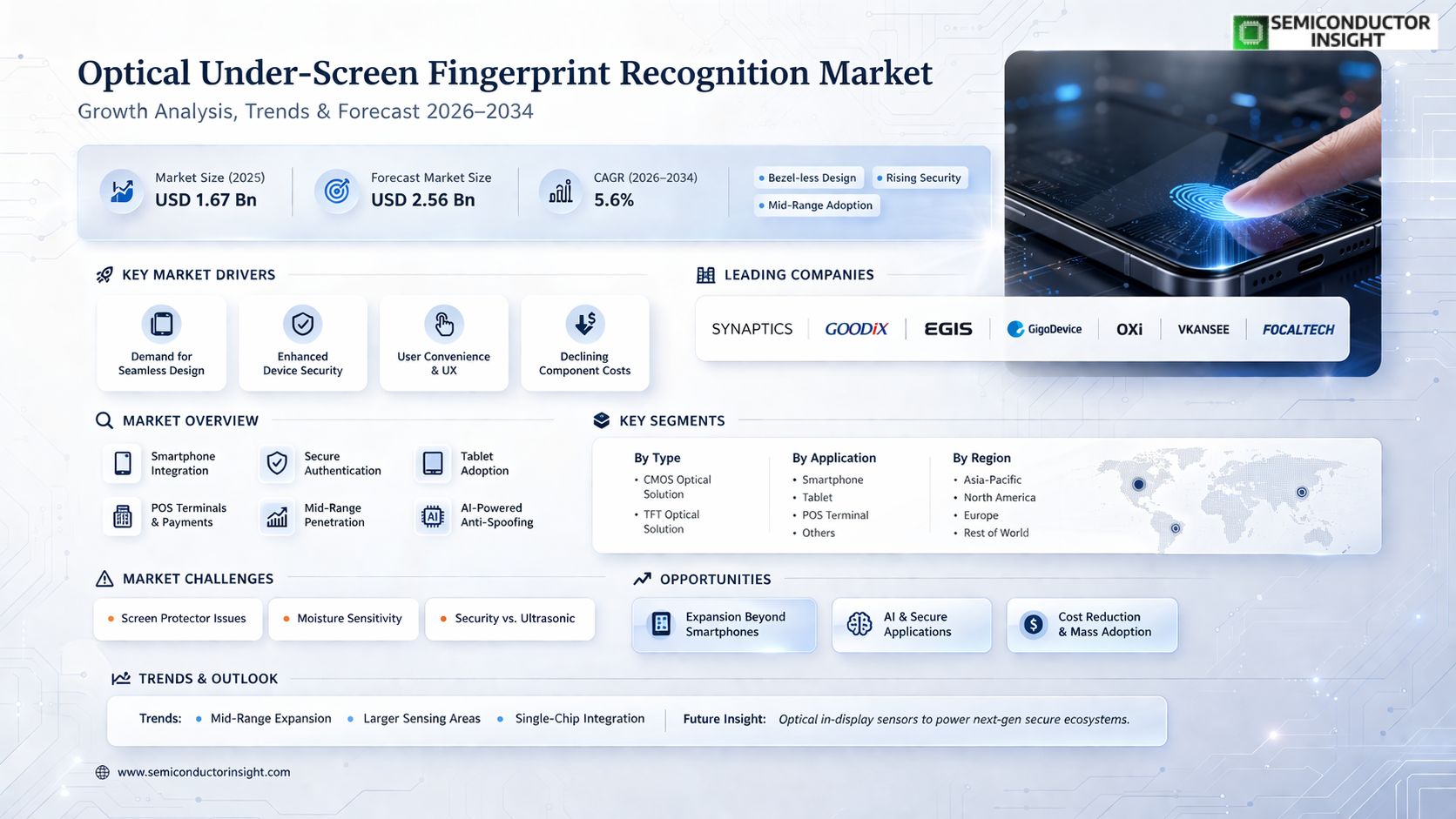
MARKET DRIVERS
Demand for Seamless Smartphone Design and Security
The relentless pursuit of full-screen, bezel-less smartphone displays represents a primary catalyst for Optical Under-Screen Fingerprint Recognition Market. As consumers favor expansive screen-to-body ratios, traditional capacitive sensors and physical buttons become obsolete. This technology embeds the authentication module directly beneath the display, preserving device aesthetics while maintaining a critical security function. Its integration has become a key differentiator in the flagship and mid-range smartphone segments, driving adoption across multiple OEMs. This alignment with design trends continues to fuel significant market growth.
Enhanced User Experience and Convenience
The convenience offered by optical under-screen sensors provides a substantial user experience advantage. The ability to authenticate anywhere on a designated area of the screen streamlines device access and digital payment authorizations. Compared to facial recognition systems, which can struggle in low-light conditions or when the user is wearing masks, this method offers consistent and reliable performance. The continued expansion of mobile banking, digital wallets, and app-specific security locks further solidifies the value proposition of this biometric solution within the broader Optical Under-Screen Fingerprint Recognition Market ecosystem.
➤ Advancements in sensor technology, particularly in module size reduction and algorithmic power, are enabling faster, more accurate, and more secure readings, directly addressing early criticisms of the technology.
Furthermore, the ongoing evolution towards larger sensing areas and even single-chip solutions is reducing manufacturing complexity and cost, making this technology accessible to a wider range of device price points and accelerating market penetration.
MARKET CHALLENGES
Technical Limitations and Environmental Factors
Despite advancements, optical under-screen fingerprint recognition faces inherent technical hurdles. The technology can be susceptible to various environmental and user conditions. Screen protectors, particularly those of lower quality or non-optimized materials, can significantly degrade sensor performance and accuracy. Moisture on the finger or screen, such as from sweat or light rain, often leads to authentication failures. Additionally, the optical method generally remains less secure than ultrasonic alternatives, as it can theoretically be fooled by high-resolution photographs in some implementations, presenting a challenge for high-security applications.
Other Challenges
Competition from Alternative Biometrics
Optical Under-Screen Fingerprint Recognition Market faces intense competition from other authentication methods. Ultrasonic under-display sensors offer superior security and performance under wet conditions, though at a higher cost. Simultaneously, advanced 3D facial recognition systems provide a completely hands-free experience. This competitive landscape forces optical sensor manufacturers to continuously innovate in speed, accuracy, and cost-efficiency to maintain their market share, particularly in premium devices.
High Development and Integration Costs
Integrating an optical under-screen module requires precise calibration with the display panel and complex software algorithms. This integration complexity leads to higher research and development expenses. For smartphone manufacturers, these costs must be carefully balanced against bill-of-materials targets, especially in price-sensitive market segments, potentially slowing adoption rates.
MARKET RESTRAINTS
Performance Gap with Traditional Sensors
A key factor restraining faster market growth is the perceived performance gap compared to traditional capacitive fingerprint sensors. Early-generation optical sensors were notably slower and less reliable, creating initial user skepticism. While newer iterations have dramatically improved, the legacy perception of inferior speed and accuracy, especially in direct sunlight or with dry fingers, can still influence purchasing decisions and OEM implementation strategies for Optical Under-Screen Fingerprint Recognition Market. This restraint is particularly relevant in regions where cost-conscious consumers prioritize proven, reliable technology.
Supply Chain and Component Complexity
The sophisticated supply chain required for optical under-screen modules presents a significant restraint. The technology relies on a tight integration of specialized image sensors, lenses, and display components. Disruptions in the supply of any key component, such as specific CMOS sensors or OLED panels, can directly impact production volumes and lead times for smartphone manufacturers. This complexity and associated vulnerability constrain the market’s ability to scale rapidly and uniformly across all geographies and device tiers.
MARKET OPPORTUNITIES
Expansion Beyond Smartphones
The most significant growth avenue for Optical Under-Screen Fingerprint Recognition Market lies in expanding into new device categories. This technology holds immense potential for integration into tablets, laptops, smart home devices (like door locks and security panels), and in-vehicle infotainment systems. As these devices increasingly adopt touchscreen interfaces and require secure, personalized access, the demand for embedded, invisible authentication will surge. This diversification reduces reliance on the smartphone sector alone and opens vast new total addressable markets.
Advancements in Secure Applications and AI
The fusion of optical sensing with advanced artificial intelligence and machine learning algorithms presents a major opportunity. AI can dramatically enhance spoof detection capabilities, differentiating live skin from sophisticated replicas, thereby closing the security gap with ultrasonic methods. Furthermore, these advancements enable new use cases such as continuous authentication, where the sensor verifies the user’s identity passively during device use, and health monitoring via subtle blood flow detection. These value-added features can command premium pricing and drive the next wave of innovation in this market.
Cost Reduction and Mid-Market Penetration
As manufacturing processes mature and economies of scale are achieved, the cost per sensor module is on a downward trajectory. This trend creates a substantial opportunity to penetrate the high-volume mid-range and budget smartphone segments globally. Making this technology a standard feature rather than a premium luxury will significantly expand its installed base and drive recurring revenue from licensing and algorithm updates, solidifying its long-term position in Global biometrics landscape.
Key Optical Under-Screen Fingerprint Recognition Market Trends
Expansion Beyond Premium Smartphones
The primary trend in Optical Under-Screen Fingerprint Recognition Market is its rapid expansion from a premium smartphone feature into mid-range devices and other electronics. This technology integrates a micro-camera and light source under a device’s display to capture high-resolution fingerprint images for secure authentication. As production costs for CMOS and TFT optical solutions continue to decrease, manufacturers are increasingly adopting this technology to enhance user experience and design aesthetics by eliminating the need for physical fingerprint sensors. This democratization is a significant driver for market growth, extending the technology’s reach to a much larger consumer base.
Other Trends
Increasing Application Portfolio
A notable trend is the exploration of this technology beyond its dominant application in smartphones. The market is witnessing growing interest from makers of premium tablets and emerging segments like modern Point-of-Sale (POS) terminals, where secure, seamless authentication is critical. While smartphones remain the primary driver, this diversification into new product categories helps mitigate market saturation risks and opens new revenue streams for key players in Optical Under-Screen Fingerprint Recognition Market.
Regional Manufacturing and Innovation Hubs
Global landscape shows a strong concentration of innovation and manufacturing in the Asia-Pacific region, particularly China. This region is a crucial hub for both the development of optical fingerprint solutions and their integration into consumer electronics. Leading companies like Goodix Technology and Egis Technology, headquartered in this region, benefit from proximity to vast smartphone manufacturing ecosystems. Meanwhile, North America remains a critical market for high-end device sales and technological R&D, contributing to the overall competitive dynamics.
Consolidation of Leading Players
The competitive landscape of Optical Under-Screen Fingerprint Recognition Market is characterized by consolidation around key technology providers. A select group of companies, including Synaptics, Goodix Technology, and Egis Technology, hold a substantial collective market share. These leaders are focused on continuous innovation to improve recognition speed, accuracy, and performance under diverse screen conditions. Their strong intellectual property portfolios and partnerships with major smartphone OEMs create significant barriers to entry and define the technological trajectory of the entire market.
COMPETITIVE LANDSCAPE
Key Industry Players
A Market Consolidating Around CMOS and TFT Optical Solutions
Optical Under-Screen Fingerprint Recognition Market is characterized by intense competition among a mix of established sensor manufacturers, specialized fabless semiconductor firms, and display supply chain leaders. Global market, valued at $1667 million in 2025 and projected to reach $2558 million by 2034, is shaped by the technological race between CMOS optical and TFT optical solutions. Leadership is concentrated, with Global top five players commanding a significant revenue share. The competitive landscape is defined by deep integration with smartphone OEMs and continuous R&D investment to improve speed, accuracy, and the ability to function under various display technologies, directly impacting the technology’s adoption in premium and mid-range devices.
Beyond the market leaders, several niche and emerging players contribute to innovation and serve specific regional or application segments. Companies specializing in TFT optical solutions are competing to capture market share in cost-sensitive segments, particularly in high-growth markets like Asia. Other significant competitors are focusing on adjacent applications such as tablets, POS terminals, and automotive authentication, driving diversification beyond the primary smartphone market. The competitive intensity is further heightened by strategic partnerships with display panel manufacturers and ongoing mergers and acquisitions aimed at securing intellectual property and expanding product portfolios.
List of Key Optical Under-Screen Fingerprint Recognition Companies Profiled
- Synaptics
- Goodix Technology
- Egis Technology Inc.
- Beijing GigaDevice
- Shanghai OXi Technology
- VKANSEE
- Focaltech Electronics Co., Ltd.
- Qualcomm Technologies, Inc.
- Fingerprint Cards AB
- IDEX Biometrics ASA
- Novatek Microelectronics Corp.
- Himax Technologies, Inc.
- Silicon Works Co., Ltd.
- Samsung System LSI
- Beyond Semiconductor
Segment Analysis:
| Segment Category | Sub-Segments | Key Insights |
| By Type |
|
CMOS Optical Solution is the established leading segment, favored for its higher commercial maturity and superior cost-performance ratio for mass-market devices. The technology benefits from a robust supply chain and continuous improvements in sensor resolution and power efficiency. In contrast, advancements in TFT (Thin-Film Transistor) solutions are gaining attention for their potential in enabling larger sensing areas and integration flexibility, particularly for future all-screen designs and foldable displays, though they currently face higher complexity in manufacturing. |
| By Application |
|
Smartphone remains the unequivocal dominant application segment, driven by its status as a standard feature in mid-range to flagship models seeking sleek, bezel-free designs. The pervasiveness of mobile transactions and device security needs underpins this demand. While tablets present a logical extension for the technology, its adoption is more selective. Emerging applications in POS terminals and other secure access devices represent a nascent but promising growth vector, leveraging the technology for both enhanced user convenience and improved hygiene over traditional contact-based sensors. |
| By End User |
|
Consumer Electronics is the primary end-user segment, characterized by extremely high-volume adoption and intense competition among smartphone OEMs to integrate advanced biometrics. This segment prioritizes speed, accuracy, and user experience. The Financial Services & Retail segment is emerging, driven by the need for secure, seamless authentication in payment systems and kiosks. The Enterprise & Access Control segment shows potential for growth as organizations look to incorporate modern, touchless biometric verification into corporate devices and secure facility entry, valuing the technology’s integration with display panels. |
| By Technology Maturity |
|
Established/Volume Production technology holds clear leadership, defined by its optimization for high-yield manufacturing and performance consistency, which is critical for smartphone integration. The supply chain for key components like sensors and micro-cameras is well-developed. The R&D/Next-Generation segment is highly active, focusing on overcoming current limitations such as recognition speed under varying conditions and power consumption, while also exploring ultra-thin and flexible sensor designs compatible with future display innovations like rollable screens. |
| By Integration Level |
|
Fully Integrated Modules represent the leading approach, offering a complete, tested solution that simplifies the design and assembly process for device manufacturers. This trend is driven by the need for reliability and faster time-to-market. The critical role of advanced Software & Algorithm Platforms cannot be understated, as they are fundamental to the system’s performance. Continuous innovation in AI-driven image processing and liveness detection algorithms is a key competitive differentiator, enhancing security against spoofing and improving accuracy with dry or wet fingers, thereby directly impacting the user adoption and trust in the technology. |
Regional Analysis: Global Optical Under-Screen Fingerprint Recognition Market
Asia-Pacific
The dense concentration of smartphone OEMs and component suppliers in China, South Korea, and Vietnam facilitates rapid iteration and integration of optical under-screen fingerprint sensors. This ecosystem drives down costs and accelerates time-to-market, making the technology accessible across price segments.
Tech-savvy consumers in markets like China, India, and Southeast Asia exhibit a strong preference for devices with seamless, bezel-less designs and advanced security. Optical under-screen fingerprint recognition aligns perfectly with this demand, driving high adoption rates in new smartphone purchases.
Government initiatives promoting digital payments, e-governance, and national digital identity programs are creating a structured demand for reliable biometric authentication, indirectly boosting Optical Under-Screen Fingerprint Recognition Market for consumer and institutional applications.
Leading sensor manufacturers and tech giants in the region are investing heavily in R&D to overcome challenges like recognition speed under different screen types and environmental conditions, ensuring the optical under-screen fingerprint technology remains competitive against ultrasonic alternatives.
North America
The North American market for Optical Under-Screen Fingerprint Recognition is characterized by high-value, premium device adoption and stringent security requirements. While smartphone shipment volumes are lower than Asia-Pacific, the region’s consumers and enterprises prioritize cutting-edge technology and robust security protocols, creating strong demand for high-performance optical modules. The market is influenced by leading technology companies based in the United States, which set global design and security standards. Integration into flagship devices from major US brands validates the technology’s viability and drives its inclusion in global product lines. Furthermore, applications are expanding beyond smartphones into premium laptops, tablets, and secure access systems for corporate and government use, supported by a mature ecosystem of cybersecurity and biometric software developers.
Europe
Europe represents a significant and quality-conscious market for Optical Under-Screen Fingerprint Recognition Market, shaped by robust data protection regulations like GDPR. This regulatory environment emphasizes secure and private authentication methods, bolstering the appeal of integrated biometric solutions. Consumer preference leans towards high-end smartphones and secure banking applications, where optical under-screen technology offers a blend of convenience and perceived security. The automotive sector in Western Europe is also emerging as a potential growth avenue, with research into integrating fingerprint recognition for vehicle access and personalized settings. However, market growth is tempered by a slower replacement cycle for consumer electronics compared to Asia and a competitive landscape that includes well-established alternative biometric technologies.
South America
The South American market for optical under-screen fingerprint recognition is in a growth phase, primarily driven by the increasing penetration of mid-range smartphones that now incorporate this feature. Economic recovery in key countries is boosting consumer electronics spending. Market dynamics are influenced by the strong presence of Asian smartphone brands, which are introducing optical under-screen fingerprint sensors as a standard feature in new models to gain competitive advantage. While adoption is growing, it faces challenges such as price sensitivity among consumers and varying levels of digital infrastructure development across the region. The potential for growth is linked to the broader expansion of digital financial services, which require reliable user authentication methods.
Middle East & Africa
The Middle East & Africa region shows a bifurcated dynamic within Optical Under-Screen Fingerprint Recognition Market. The Gulf Cooperation Council (GCC) countries, with their high disposable incomes, display a strong affinity for premium smartphones featuring the latest biometric technologies, including optical under-screen sensors. This segment drives early adoption. In contrast, broader African markets are more price-sensitive, with growth linked to the gradual trickle-down of the technology into affordable smartphone segments. The region presents unique opportunities in government-led digital transformation and national ID projects, particularly in the Middle East and North Africa, where secure biometric enrollment is a priority. However, market development is uneven and hinges on overall economic stability and telecommunications infrastructure improvement.
Report Scope
This market research report provides a comprehensive analysis of Optical Under-Screen Fingerprint Recognition Market, covering the forecast period 2026–2034. It offers detailed insights into market dynamics, technological advancements, competitive landscape, and key trends shaping the industry.
Key focus areas of the report include:
- Market Overview: The report begins with an overview outlining its current market scenario, key growth indicators, and industry transformation drivers. It discusses macroeconomic factors, demand–supply balance, regulatory landscape, and the strategic role of semiconductors in powering advancements across industries such as automotive, telecommunications, consumer electronics, and industrial automation.
- Market Size & Forecast: Historical data and future projections for revenue, unit shipments, and market value across major regions and segments.
- Segmentation Analysis: Detailed breakdown by product type, technology, application, and end-user industry to identify high-growth segments and investment opportunities.
- Regional Insights: Insights into market performance across North America, Europe, Asia-Pacific, Latin America, and the Middle East & Africa, including country-level analysis where relevant.
- Competitive Landscape: Profiles of leading market participants, including their product offerings, R&D focus, manufacturing capacity, pricing strategies, and recent developments such as mergers, acquisitions, and partnerships.
- Technology Trends & Innovation: Assessment of emerging technologies, integration of AI/IoT, semiconductor design trends, fabrication techniques, and evolving industry standards.
- Market Drivers & Restraints: Evaluation of factors driving market growth along with challenges, supply chain constraints, regulatory issues, and market-entry barriers.
- Stakeholder Insights: Insights for component suppliers, OEMs, system integrators, investors, and policymakers regarding the evolving ecosystem and strategic opportunities.
Primary and secondary research methods are employed, including interviews with industry experts, data from verified sources, and real-time market intelligence to ensure the accuracy and reliability of the insights presented.
FREQUENTLY ASKED QUESTIONS:
What is the current market size of Optical Under-Screen Fingerprint Recognition Market?
-> Global Optical Under-Screen Fingerprint Recognition Market was valued at USD 1667 million in 2025 and is projected to reach USD 2558 million by 2034, growing at a CAGR of 5.6% during the forecast period.
Which key companies operate in Optical Under-Screen Fingerprint Recognition Market?
-> Key players include Synaptics, Goodix Technology, Egis Technology, Beijing GigaDevice, Shanghai OXi Technology, VKANSEE, and Focaltech Electronics, among others.
What are the key growth drivers?
-> Key growth drivers include widespread adoption in modern smartphones and tablets, increasing demand for secure and convenient biometric authentication, and ongoing technological integration of micro cameras and optical sensors beneath device screens.
Which region dominates the market?
-> The U.S. market is estimated at a significant value in 2025, while China is also a key and rapidly growing market. Asia is a major regional market for this technology.
What are the emerging trends?
-> Emerging trends include advancements in CMOS and TFT optical solutions, expansion into applications beyond smartphones such as tablets and POS terminals, and continuous innovation for faster and more accurate under-screen recognition.

Get Sample Report PDF for Exclusive Insights
Report Sample Includes
- Table of Contents
- List of Tables & Figures
- Charts, Research Methodology, and more...
 Download Sample Report PDF