MARKET INSIGHTS
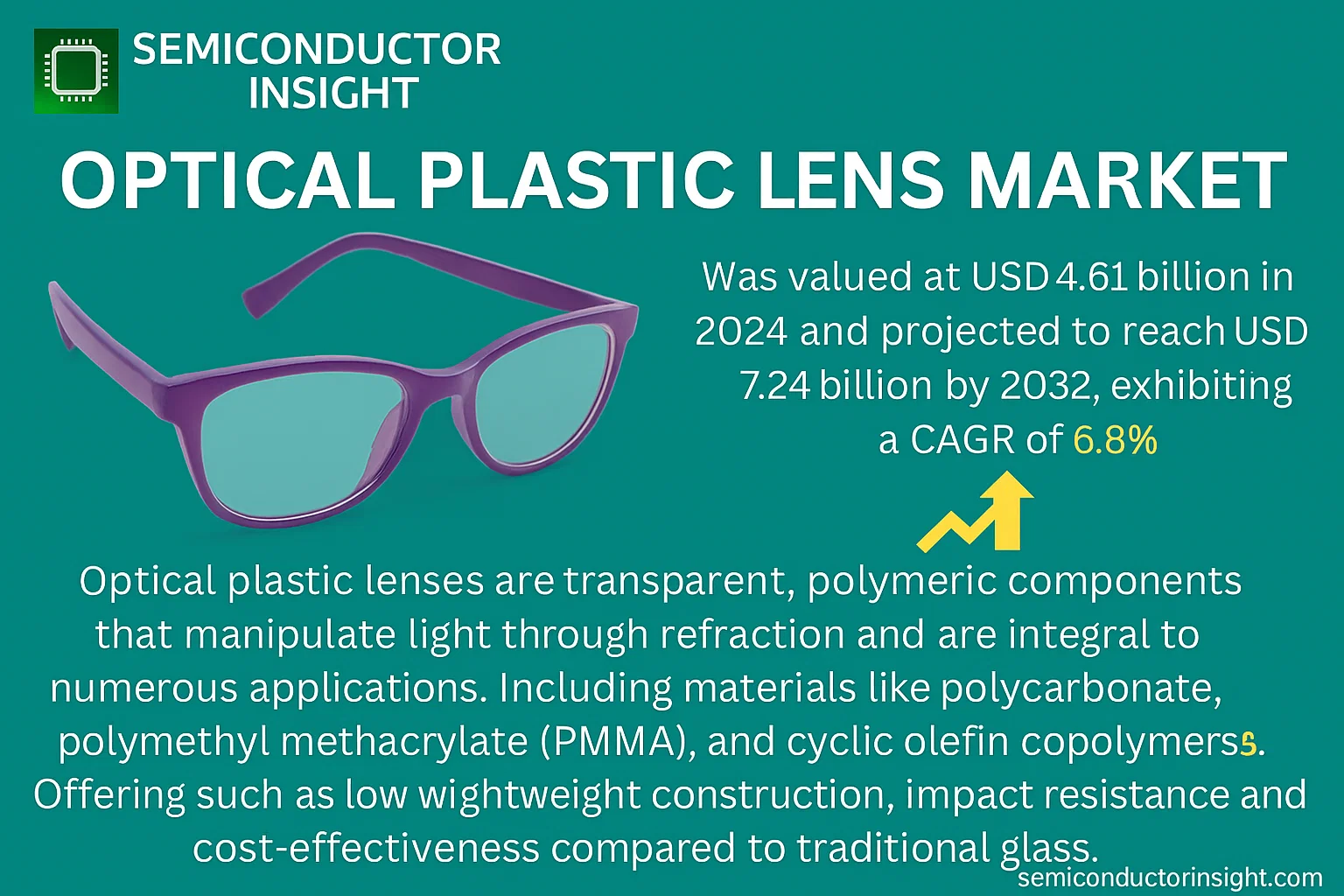
Global Optical Plastic Lens Market was valued at USD 4.61 billion in 2024 and is projected to reach USD 7.24 billion by 2032, exhibiting a CAGR of 6.8% during the forecast period.
Optical plastic lenses are transparent, polymeric components that manipulate light through refraction and are integral to numerous applications. These lenses are manufactured from materials like polycarbonate, polymethyl methacrylate (PMMA), and cyclic olefin copolymers, offering benefits such as lightweight construction, impact resistance, and cost-effectiveness compared to traditional glass. They are engineered to correct aberrations, focus light precisely, and are found in a vast array of devices.
The market’s robust growth is propelled by the expanding consumer electronics sector, particularly the high demand for high-resolution cameras in smartphones, tablets, and laptops. The rise of electric and autonomous vehicles, which utilize multiple optical plastic lenses in their Advanced Driver-Assistance Systems (ADAS), Lidar, and infotainment systems, provides significant impetus. The global push for digitalization and connectivity, including the expansion of 5G networks and the Internet of Things (IoT), drives demand for imaging sensors and optical components across various sectors. Continuous innovation in medical imaging, virtual reality (VR), and augmented reality (AR) headsets further stimulates market expansion. Strategic initiatives and product developments by key industry players, such as partnerships between smartphone manufacturers and lens producers, are also accelerating market growth.
MARKET DRIVERS
Proliferation of Consumer Electronics with Advanced Cameras
The exponential growth in the adoption of smartphones, tablets, and laptops equipped with multiple, high-resolution cameras is a primary driver for the optical plastic lens market. The demand for thinner, lighter, and more cost-effective lenses in these devices has accelerated the shift from glass to advanced plastic polymers.
Growth in Automotive Advanced Driver-Assistance Systems (ADAS)
The automotive industry’s rapid integration of ADAS, including LiDAR, surround-view cameras, and driver monitoring systems, requires durable and precision-molded optical plastic lenses. These lenses offer design flexibility and cost advantages essential for mass-market vehicle adoption.
➤ The global market for optical plastic lenses is projected to grow at a CAGR of over 7% in the next five years, largely driven by these expanding applications.
Furthermore, advancements in augmented reality (AR) and virtual reality (VR) headsets necessitate lightweight optical components, and injection-molded plastic lenses are increasingly the material of choice to meet performance and ergonomic requirements.
MARKET CHALLENGES
Intense Competition and Price Pressure
The market is characterized by a high level of competition among numerous manufacturers, particularly in Asia-Pacific. This leads to significant price pressure, shrinking profit margins, and challenges for companies to invest in research and development for next-generation products.
Other Challenges
Technical Limitations Compared to Glass
Despite improvements, optical plastic lenses can still face challenges related to lower thermal stability, susceptibility to scratching, and potential for optical aberrations when compared to high-performance glass alternatives, limiting their use in some high-precision applications.
Complex and Capital-Intensive Manufacturing
High-precision injection molding requires sophisticated machinery and stringent quality control processes. The initial capital investment for manufacturing facilities and the need for specialized expertise present significant barriers to entry and scalability.
MARKET RESTRAINTS
Raw Material Price Volatility
The cost of high-quality optical-grade plastic polymers, such as polycarbonate and cyclic olefin copolymer (COC), is subject to fluctuations based on petrochemical prices and global supply chain dynamics. This volatility can disrupt production planning and impact profitability for lens manufacturers.
Stringent Performance and Quality Standards
Applications in medical devices, automotive safety systems, and high-end instrumentation demand lenses that meet rigorous performance, reliability, and regulatory standards. Achieving and maintaining this level of quality consistently in mass production with plastic materials can be a significant restraint.
MARKET OPPORTUNITIES
Expansion into Medical and Healthcare Applications
The healthcare sector presents substantial growth opportunities for optical plastic lenses. They are increasingly used in endoscopic imaging systems, diagnostic equipment, and disposable medical devices due to their biocompatibility, lightweight nature, and suitability for complex, miniaturized designs.
Advent of Industry 4.0 and Machine Vision Systems
The rise of automation and smart manufacturing is driving demand for machine vision systems. Optical plastic lenses are essential components in cameras used for quality inspection, robotic guidance, and object recognition, creating a robust and growing market segment.
Development of Advanced Polymer Materials
Ongoing R&D in novel polymer blends and nano-composites promises to deliver plastic lenses with properties closer to glass, including higher refractive indices, better Abbe numbers, and improved thermal and environmental resistance. This will unlock new, demanding applications.
Optical Plastic Lens Market Trends
Sustained Growth Driven by Smartphone Dominance
The global Optical Plastic Lens market is on a robust growth trajectory, with a valuation of $4614 million in 2024 projected to reach $7244 million by 2032, representing a compound annual growth rate (CAGR) of 6.8%. This expansion is primarily anchored by the overwhelming demand from the mobile phone industry. Due to the large demand for mobile phone lenses and stringent cost requirements, the inherent advantages of plastic lenses in terms of process difficulty, mass production capability, and overall cost-effectiveness are decisively highlighted. As a result, mobile phone lenses are predominantly manufactured from plastic, with this single application segment commanding approximately 88% of the total market share.
Other Trends
Geographical Market Concentration
The geographical landscape of the Optical Plastic Lens market is characterized by significant concentration, with China emerging as the dominant force. The Chinese market has evolved rapidly in recent years and now accounts for about 71% of the global market. This regional dominance is tightly linked to the concentration of consumer electronics manufacturing, particularly for smartphones, within the region. The presence of major manufacturing hubs supports the entire supply chain, from raw materials to finished lens modules.
Competitive Landscape and Market Consolidation
The global market features a consolidated competitive environment. Major manufacturers such as Largan, Sunny Optical Technology, GSEO, AAC Technologies, and Kantatsu lead the industry. The top five manufacturers collectively account for more than 79% of the total global market share. This high level of consolidation underscores the significant barriers to entry, including advanced manufacturing technology, substantial R&D investment, and established relationships with major smartphone OEMs. Competition is intense, focusing on innovation in lens design, miniaturization, and improving optical performance metrics like resolution and light transmission.
Product Type and Emerging Application Segments
Within the product segment, aspheric and spherical lenses are the key types, with aspheric lenses often preferred for their superior ability to correct optical aberrations in compact devices. While mobile phones are the principal application, other segments such as computers, automotive cameras, monitors, and various other consumer and industrial applications represent areas for future growth. As advanced driver-assistance systems (ADAS) and augmented/virtual reality technologies evolve, they are expected to become increasingly significant drivers for the Optical Plastic Lens market, diversifying its application base beyond the currently smartphone-centric market structure.
COMPETITIVE LANDSCAPE
Key Industry Players
A Highly Concentrated Market Dominated by Asian Manufacturing Giants
The global optical plastic lens market is characterized by a high level of concentration, with the top five manufacturers accounting for more than 79% of the total market share. This dominance is driven by the immense scale and technical expertise required for mass production, particularly for the smartphone application segment which constitutes approximately 88% of the market. Leading this pack are companies like Largan Precision Co., Ltd. and Sunny Optical Technology (Group) Company Limited, which have established themselves as global powerhouses through advanced manufacturing capabilities, significant R&D investments, and strong relationships with major consumer electronics brands. The market structure is heavily influenced by the demand from the mobile phone industry, where the advantages of plastic lenses in terms of cost, ease of mass production, and design flexibility are paramount.
Beyond the top-tier leaders, several other significant players operate strategically within specific niches or regional markets. Companies such as AAC Technologies Holdings Inc., Kantatsu Co., Ltd., and Ofilm Group Co., Ltd. are key suppliers, leveraging their expertise to serve the high-volume demands of smartphone manufacturers, particularly in the critical Chinese market which accounts for about 71% of the global total. Other players like GSEO, Sekonix, and Newmax Technology focus on diversifying into applications such as automotive cameras, computer webcams, and monitors. These companies compete on factors including optical performance, miniaturization, cost-effectiveness, and the ability to innovate with lens types like aspheric and spherical lenses to meet evolving industry specifications.
List of Key Optical Plastic Lens Companies Profiled
- Largan Precision Co., Ltd.
- Sunny Optical Technology (Group) Company Limited
- GSEO
- AAC Technologies Holdings Inc.
- Kantatsu Co., Ltd.
- Sekonix Co., Ltd.
- Newmax Technology Co., Ltd.
- Ofilm Group Co., Ltd.
- CoAsia Optics
- Aoet
- Huaxin Optical Tech
- Kinko Optical Co., Ltd.
- Dali Light
- Sainty Optics
- Yujing Optoelectronics
- Resound Technology
Segment Analysis:
| Segment Category | Sub-Segments | Key Insights |
| By Type |
|
Aspheric Lens is the leading segment, widely recognized for its superior optical performance in correcting aberrations compared to traditional spherical lenses. This design superiority enables the creation of more compact and lightweight optical systems, which is a critical advantage in space-constrained applications like smartphones and high-performance cameras. The manufacturing complexity, while initially a barrier, has been overcome by advancements in precision molding technologies, making aspheric lenses the preferred choice for applications demanding high image quality and miniaturization. |
| By Application |
|
Mobile Phone is the unequivocally dominant application segment, driven by the massive and continuous global demand for smartphones with advanced camera systems. Plastic lenses offer significant advantages in this sector due to their lower cost, lighter weight, and greater ease of mass production compared to glass, which is essential for meeting the high-volume, cost-sensitive demands of the mobile industry. The relentless push for multi-camera setups and higher resolution in smartphones continues to be the primary engine of growth and innovation for optical plastic lenses. |
| By End User |
|
Consumer Electronics OEMs constitute the leading end-user segment, as they are the primary integrators of optical plastic lenses into flagship products like smartphones, laptops, and tablets. This dominance is attributed to the high-volume production requirements and intense cost pressure inherent in the consumer electronics industry, where the benefits of plastic lenses are most pronounced. These manufacturers drive continuous innovation, demanding lenses that support thinner devices, higher pixel counts, and advanced features such as augmented reality. |
| By Manufacturing Process |
|
Precision Molding is the leading manufacturing process for high-quality optical plastic lenses, particularly for complex shapes like aspheric lenses. This method allows for exceptional surface finish and high production repeatability, which are critical for meeting the stringent quality demands of applications in mobile phone cameras and other high-performance imaging systems. The efficiency of precision molding in large-volume production runs makes it the cornerstone of the modern optical plastic lens supply chain. |
| By Material Composition |
|
Polycarbonate (PC) is the leading material due to its outstanding combination of impact resistance, high heat deflection temperature, and good optical clarity. These properties make it exceptionally well-suited for the demanding environments of consumer electronics and automotive applications, where durability is as important as optical performance. The versatility and cost-effectiveness of polycarbonate ensure its continued dominance as the material of choice for a wide array of optical plastic lens products. |
Regional Analysis: Optical Plastic Lens Market
Asia-Pacific’s leadership is underpinned by its unparalleled manufacturing capabilities. The region is home to the world’s largest and most sophisticated network of factories specializing in high-volume, precision production of optical components. A deeply integrated local supply chain for resins and molding equipment ensures cost efficiency and rapid scalability, allowing manufacturers to quickly respond to global demand fluctuations from consumer electronics giants.
The massive consumer electronics sector in countries like China and South Korea provides the primary engine for market growth. The relentless drive for thinner smartphones with advanced multi-camera systems creates sustained, high-volume demand for compact, high-performance plastic lenses. This direct proximity to end-product manufacturers fosters close collaboration on lens design and integration, accelerating technological adoption.
Japan and South Korea are global centers for optical R&D. Japanese companies are pioneers in developing novel plastic materials with superior optical clarity and durability, while South Korean firms excel in miniaturization and integration for mobile applications. This continuous innovation cycle ensures that the region stays at the forefront of lens performance, setting global standards for quality and capability.
The market is characterized by intense competition among numerous established players and agile newcomers, which drives down costs and spurs innovation. This highly competitive environment forces companies to continuously improve production efficiencies and develop niche applications, such as lenses for automotive sensors and medical imaging devices, thereby expanding the overall market scope from its consumer electronics core.
North America
North America represents a highly advanced and innovation-driven market for optical plastic lenses, characterized by strong demand from specialized, high-value sectors. The region’s strength lies not in volume manufacturing but in cutting-edge applications within the medical, defense, and automotive industries. There is significant demand for precision plastic lenses used in advanced medical diagnostic equipment, minimally invasive surgical tools, and sophisticated laboratory instruments. The North American automotive sector’s rapid adoption of advanced driver-assistance systems (ADAS) and autonomous vehicle technologies is another major growth driver, requiring robust and reliable plastic lenses for LiDAR, cameras, and sensors. Furthermore, a strong venture capital ecosystem supports startups focusing on emerging applications like augmented and virtual reality headsets, which rely heavily on lightweight, complex plastic optics. Collaboration between leading research universities and industry players fosters a pipeline of innovation in novel polymer materials and optical designs.
Europe
The European market for optical plastic lenses is mature and technologically sophisticated, with a strong emphasis on quality, precision, and specialized industrial applications. Germany, as a manufacturing powerhouse, is a key driver, with demand stemming from its world-leading automotive industry for lenses used in interior monitoring systems, head-up displays, and external sensing applications. The region also has a robust medical technology sector that utilizes high-precision plastic lenses in diagnostic imaging and analytical instruments. A focus on sustainability and stringent regulatory standards influences material choices and manufacturing processes, pushing the development of more environmentally friendly bio-based or recyclable optical polymers. While facing competition from Asia on cost for high-volume consumer goods, European manufacturers maintain a competitive edge in high-performance, custom-engineered lenses for specialized industrial and scientific uses, supported by a strong tradition of precision engineering.
South America
The South American market for optical plastic lenses is emerging and is primarily characterized by its role as a demand center rather than a significant production hub. Market growth is largely tied to the consumption of imported finished goods, such as smartphones and automobiles, which incorporate these lenses. Brazil is the largest market in the region, with its domestic consumer electronics and automotive assembly industries driving demand. However, local manufacturing capacity for the lenses themselves remains limited, leading to a high reliance on imports from Asia and North America. The market potential is closely linked to regional economic stability and industrial development policies. There is growing interest in developing local supply chains to reduce import dependency, but this is a long-term prospect. The market is gradually evolving from pure consumption to including some downstream assembly and Value addition activities.
Middle East & Africa
The Middle East & Africa region represents a diverse but still developing market for optical plastic lenses. The market is fragmented, with significant variation between the oil-rich Gulf Cooperation Council (GCC) nations and other African countries. In the GCC, demand is primarily driven by high per capita spending on luxury consumer electronics, automotive imports, and investments in security and surveillance infrastructure. In contrast, broader African markets are characterized by demand for more affordable consumer goods and a growing mobile phone penetration rate, which stimulates need for lenses in budget to mid-range smartphones. The region has minimal local manufacturing, making it almost entirely import-dependent. Market growth is closely tied to economic diversification efforts in the Gulf and overall economic development across Africa, with potential for gradual expansion as local technological capabilities and industrial bases develop over the long term.
Report Scope
This market research report provides a comprehensive analysis of the Optical Plastic Lens Market , covering the forecast period 2025–2032. It offers detailed insights into market dynamics, technological advancements, competitive landscape, and key trends shaping the industry.
Key focus areas of the report include:
- Market Overview: The report begins with an overview outlining its current market scenario, key growth indicators, and industry transformation drivers. It discusses macroeconomic factors, demand–supply balance, regulatory landscape, and the strategic role of semiconductors in powering advancements across industries such as automotive, telecommunications, consumer electronics, and industrial automation.
- Market Size & Forecast: Historical data and future projections for revenue, unit shipments, and market value across major regions and segments.
- Segmentation Analysis: Detailed breakdown by product type, technology, application, and end-user industry to identify high-growth segments and investment opportunities.
- Regional Insights: Insights into market performance across North America, Europe, Asia-Pacific, Latin America, and the Middle East & Africa, including country-level analysis where relevant.
- Competitive Landscape: Profiles of leading market participants, including their product offerings, R&D focus, manufacturing capacity, pricing strategies, and recent developments such as mergers, acquisitions, and partnerships.
- Technology Trends & Innovation: Assessment of emerging technologies, integration of AI/IoT, semiconductor design trends, fabrication techniques, and evolving industry standards.
- Market Drivers & Restraints: Evaluation of factors driving market growth along with challenges, supply chain constraints, regulatory issues, and market-entry barriers.
- Stakeholder Insights: Insights for component suppliers, OEMs, system integrators, investors, and policymakers regarding the evolving ecosystem and strategic opportunities.
Primary and secondary research methods are employed, including interviews with industry experts, data from verified sources, and real-time market intelligence to ensure the accuracy and reliability of the insights presented.
FREQUENTLY ASKED QUESTIONS:
What is the current market size of Optical Plastic Lens Market?
-> Global Optical Plastic Lens Market was valued at USD 4614 million in 2024 and is projected to reach USD 7244 million by 2032, exhibiting a CAGR of 6.8% during the forecast period.
Which key companies operate in Optical Plastic Lens Market?
-> Key players include Dali Light, Sainty Optics, Yujing Optoelectronics, Resound Technology and Kantatsu, among others. Leading manufacturers such as Largan, Sunny Optical Technology, GSEO, and AAC Technologies also hold significant market shares.
What are the key growth drivers?
-> Key growth drivers include the large demand for mobile phone lenses, where advantages in process difficulty, mass production, and cost make plastic lenses the dominant material, with mobile phones accounting for about 88% of the market share.
Which region dominates the market?
-> The Chinese market is a dominant region, accounting for approximately 71% of the global market share and has changed rapidly in recent years.
What are the emerging trends?
-> Emerging trends include the rising adoption across applications like computers, automotive, and monitors, alongside technological advancements in product segments such as Aspheric Lenses and Spherical Lenses.

Get Sample Report PDF for Exclusive Insights
Report Sample Includes
- Table of Contents
- List of Tables & Figures
- Charts, Research Methodology, and more...
 Download Sample Report PDF