
On-Chip Integrated Micro-lens Arrays Market Insights
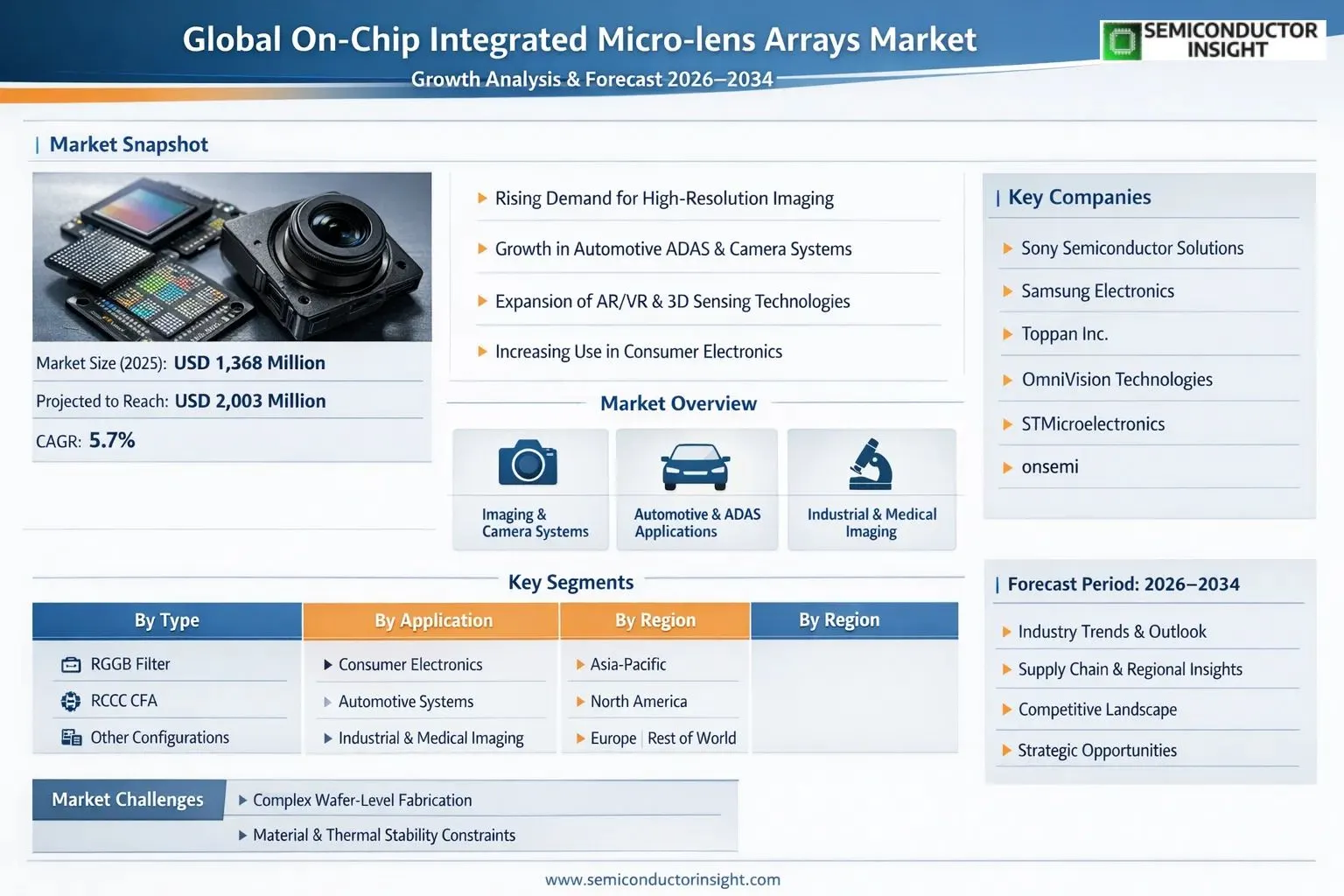
Global On-Chip Integrated Micro-lens Arrays market size was valued at USD 1,368 million in 2025. The market is projected to grow from USD 1,446 million in 2026 to USD 2,003 million by 2034, exhibiting a CAGR of 5.7% during the forecast period.
On-chip integrated micro-lens arrays are precision optical components fabricated directly onto image sensor substrates, designed to concentrate incoming light onto individual photodetectors and significantly improve overall light-collection efficiency. Each micro-lens is precisely aligned to a corresponding pixel, reducing optical crosstalk and enhancing the signal-to-noise ratio. These arrays are integral to the performance of complementary metal-oxide-semiconductor (CMOS) and charge-coupled device (CCD) image sensors, where maximizing photon capture at the pixel level is critical to image quality. The technology spans various filter configurations, including RGGB filters and RCCC color filter arrays (CFAs), with leading manufacturers such as Sony, Samsung, and Toppan recognized for their advanced fabrication capabilities and high-precision optical performance standards.
The market is gaining strong momentum driven by surging demand for high-resolution imaging in consumer electronics and the rapid expansion of automotive camera systems, particularly for advanced driver-assistance systems (ADAS) and autonomous vehicle applications. Furthermore, the proliferation of multi-camera smartphone designs and the growing adoption of machine vision in industrial settings are reinforcing demand across key application segments. Toppan’s CFAs, for instance, have earned a strong reputation for pristine color reproduction and high-quality fabrication, underscoring how manufacturer innovation continues to elevate product benchmarks. As imaging performance requirements become increasingly stringent across both consumer and mobility sectors, on-chip integrated micro-lens array technology remains a foundational enabler of next-generation optical sensor design.
MARKET DRIVERS
Rising Demand for Advanced Imaging and Sensing Technologies
On-Chip Integrated Micro-lens Arrays Market is experiencing robust growth driven by the accelerating adoption of compact, high-performance imaging systems across consumer electronics, automotive, and industrial sectors. As device miniaturization intensifies, the integration of micro-lens arrays directly onto semiconductor chips has become a critical enabler for improving light-collection efficiency, reducing optical path lengths, and enhancing overall pixel sensitivity. The proliferation of high-resolution smartphone cameras and advanced driver-assistance systems (ADAS) has significantly amplified demand for on-chip micro-lens array solutions that deliver superior optical performance within tight spatial constraints.
Expansion of LiDAR, AR/VR, and 3D Sensing Applications
Technological advancements in augmented reality, virtual reality, and three-dimensional sensing platforms have emerged as powerful catalysts for On-Chip Integrated Micro-lens Arrays Market. LiDAR systems used in autonomous vehicles and robotics increasingly rely on precisely fabricated micro-lens arrays to collimate and focus light beams with high accuracy, while AR/VR headsets leverage these optical components to achieve wide field-of-view displays with minimal aberration. The growing deployment of facial recognition and structured-light 3D sensing in consumer and security applications further underscores the strategic importance of integrated micro-lens solutions in next-generation photonic architectures.
➤ The convergence of semiconductor fabrication precision with photonic design is enabling micro-lens arrays to achieve sub-micron alignment tolerances, unlocking performance benchmarks previously unattainable with discrete optical assemblies.
Furthermore, the medical imaging and life sciences sectors are increasingly integrating on-chip micro-lens arrays into endoscopic cameras, flow cytometers, and lab-on-chip platforms, where compact form factors and high optical throughput are paramount. This cross-industry demand diversification is strengthening the market’s resilience and long-term growth trajectory, as manufacturers invest in scalable wafer-level optics manufacturing processes to meet rising volume requirements across multiple verticals.
MARKET CHALLENGES
Fabrication Complexity and Yield Management at Wafer Scale
One of the most significant challenges confronting On-Chip Integrated Micro-lens Arrays Market is the inherent complexity of fabricating micro-lens structures with nanometer-level precision at wafer scale while maintaining acceptable production yields. Achieving uniform lens geometry, surface roughness, and refractive index consistency across an entire wafer requires tightly controlled photolithographic and reflow processes, and any deviation can result in optical aberrations that render entire chip batches unusable. The integration of micro-lens arrays with underlying CMOS or photonic integrated circuits introduces additional alignment challenges, as thermal cycling during back-end processing can induce mechanical stress and dimensional drift that compromise optical registration.
Other Challenges
Material Compatibility and Thermal Stability
Polymer-based micro-lens materials, while cost-effective and amenable to high-volume fabrication, often exhibit limited thermal stability and susceptibility to UV-induced degradation, restricting their deployment in harsh-environment applications such as automotive and industrial sensing. Transitioning to glass or hybrid inorganic materials improves durability but significantly increases process complexity and unit costs, creating a persistent trade-off that constrains adoption in price-sensitive market segments within the broader On-Chip Integrated Micro-lens Arrays Market.
Standardization and Ecosystem Fragmentation
The absence of universally adopted design standards for micro-lens array geometries, fill factors, and integration protocols has resulted in a fragmented supplier ecosystem where customer switching costs are elevated and cross-platform compatibility is limited. This fragmentation complicates supply chain management for system integrators and slows the pace of broader commercialization, particularly in emerging application areas where reference designs and qualification frameworks have yet to mature.
MARKET RESTRAINTS
High Capital Investment and Barriers to Entry in Precision Optics Manufacturing
On-Chip Integrated Micro-lens Arrays Market faces a meaningful restraint in the form of substantial capital expenditure requirements associated with establishing and maintaining advanced wafer-level optics fabrication capabilities. Specialized lithography equipment, precision molding tools, and cleanroom infrastructure represent significant upfront investments that create considerable barriers to entry for smaller players and startups, effectively concentrating market supply among a limited number of established semiconductor and optics manufacturers. This capital intensity also extends product development cycles and lengthens the timeline from design conception to commercial production qualification.
Intellectual Property Constraints and Technology Licensing Complexity
A dense intellectual property landscape surrounding micro-lens array design methodologies, fabrication techniques, and integration approaches poses an additional restraint on market participants seeking to develop proprietary solutions. The cost and complexity of navigating existing patent portfolios, negotiating licensing agreements, and defending against infringement claims can divert resources away from research and development, slowing innovation cycles within On-Chip Integrated Micro-lens Arrays Market. Geopolitical tensions and export control regulations affecting advanced semiconductor and photonics technologies add a further layer of complexity for globally operating manufacturers, potentially disrupting cross-border supply chains and technology transfer arrangements.
MARKET OPPORTUNITIES
Wafer-Level Optics Integration with Advanced CMOS and Photonic Platforms
The ongoing convergence of wafer-level optics manufacturing with advanced CMOS image sensor and silicon photonics platforms presents a compelling growth opportunity for On-Chip Integrated Micro-lens Arrays Market. As foundries expand their back-end-of-line optical integration capabilities, the ability to monolithically co-fabricate micro-lens arrays with photodetectors, waveguides, and signal processing circuits is enabling a new generation of fully integrated optical subsystems with reduced assembly costs and improved alignment precision. This integration paradigm is particularly attractive for high-volume consumer and automotive applications where cost efficiency and reliability are decisive procurement criteria.
Emerging Opportunities in Quantum Sensing, Biophotonics, and Free-Space Optical Communications
Beyond established application domains, On-Chip Integrated Micro-lens Arrays Market stands to benefit substantially from nascent demand in quantum sensing, biophotonic diagnostics, and free-space optical communication systems. Quantum photonic circuits require precisely engineered micro-lens arrays to achieve efficient photon coupling between on-chip sources and detectors, while point-of-care biophotonic platforms leverage these components to miniaturize fluorescence detection and spectroscopic analysis capabilities. The expansion of optical wireless communication infrastructure for data center interconnects and last-mile broadband delivery creates additional addressable demand for high-throughput, beam-shaping micro-lens array modules that can be manufactured at scale using wafer-level processes, positioning agile market participants to capture early-mover advantages in these high-value emerging segments.
MAIN TITLE HERE () Trends
Rising Demand from Consumer Electronics Driving On-Chip Integrated Micro-lens Arrays Market
On-Chip Integrated Micro-lens Arrays Market is witnessing sustained momentum, largely propelled by the rapid proliferation of advanced imaging technologies across consumer electronics. Smartphones, tablets, and wearable devices increasingly incorporate high-resolution image sensors, creating consistent demand for micro-lens arrays that improve light capture efficiency and pixel-level optical performance. As manufacturers strive to deliver superior camera performance in compact form factors, on-chip micro-lens integration has become a critical enabler. Leading industry players such as Sony and Samsung continue to invest in refining micro-lens fabrication techniques, pushing optical precision to new thresholds and reinforcing the market’s upward trajectory.
Other Trends
Automotive Imaging Applications Expanding Market Reach
The automotive sector is emerging as a high-growth application area within On-Chip Integrated Micro-lens Arrays Market. The widespread adoption of advanced driver-assistance systems (ADAS), surround-view cameras, and in-cabin monitoring solutions requires image sensors capable of performing reliably across varied lighting conditions. On-chip micro-lens arrays address this requirement by maximizing photon collection and reducing optical crosstalk in image sensors designed for automotive-grade performance. As electric and autonomous vehicle platforms scale globally, the demand for ruggedized, high-efficiency imaging components is expected to intensify, positioning the automotive segment as a key growth driver alongside consumer electronics.
Advancements in Color Filter Array Integration
Technological convergence between color filter arrays (CFAs) and micro-lens structures is reshaping product development within On-Chip Integrated Micro-lens Arrays Market. RGGB filter configurations remain the dominant CFA type, valued for their compatibility with standard Bayer pattern image processing pipelines. Meanwhile, RCCC configurations are gaining traction in machine vision and low-light automotive imaging, where near-infrared sensitivity is prioritized. Companies such as Toppan are recognized for their high-precision CFA fabrication, which complements micro-lens array performance to deliver accurate color reproduction and reduced noise , factors increasingly valued across both consumer and industrial imaging platforms.
Regional Dynamics and Competitive Landscape Shaping Future Growth
From a regional perspective, Asia remains the dominant hub for On-Chip Integrated Micro-lens Arrays manufacturing and consumption, with China, Japan, and South Korea at the forefront of production capacity and technological advancement. North America and Europe contribute significantly through demand generated by automotive OEMs and industrial imaging sectors. The competitive landscape is characterized by a concentrated group of global manufacturers who collectively held a substantial share of market revenue in 2025. Ongoing investments in semiconductor fabrication, optical engineering, and next-generation sensor architectures are expected to sustain competitive differentiation, as On-Chip Integrated Micro-lens Arrays Market continues to evolve in response to increasingly sophisticated end-user requirements across multiple industries.
COMPETITIVE LANDSCAPE
Key Industry Players
On-Chip Integrated Micro-lens Arrays Market: Competitive Dynamics, Strategic Positioning, and Leading Innovators
Global On-Chip Integrated Micro-lens Arrays market, valued at approximately USD 1,368 million in 2025 and projected to reach USD 2,003 million by 2034 at a CAGR of 5.7%, is characterized by a moderately consolidated competitive landscape dominated by a handful of technologically advanced semiconductor and imaging solution providers. Sony and Samsung collectively command a significant portion of Global revenue share, leveraging their vertically integrated manufacturing capabilities, extensive R&D investments, and established supply chains to maintain leadership in image sensor-integrated micro-lens technologies. These companies benefit from massive economies of scale across consumer electronics and automotive imaging applications, enabling them to consistently deliver high-precision micro-lens arrays with superior light-gathering efficiency, reduced optical crosstalk, and enhanced pixel-level performance across CMOS image sensor platforms.
Beyond the dominant players, several specialized and regionally significant companies contribute meaningfully to the competitive fabric of On-Chip Integrated Micro-lens Arrays Market. Toppan Inc. holds a notable position in the color filter array (CFA) segment, particularly renowned for RGGB filter fabrication with exceptional color accuracy and photolithographic precision. Companies such as OmniVision Technologies, STMicroelectronics, and ON Semiconductor (onsemi) have carved out strong niches by targeting automotive ADAS systems, industrial machine vision, and IoT-embedded imaging. Meanwhile, firms like Himax Technologies, Largan Precision, and II-VI Incorporated (now Coherent Corp.) are expanding their micro-optics portfolios to address emerging demand in AR/VR, LiDAR, and medical imaging applications. The competitive intensity is further amplified by Asian manufacturers,particularly those based in China, Japan, South Korea, and Taiwan,that are rapidly scaling production capabilities and investing in next-generation nanofabrication techniques to challenge incumbent leaders across both price-sensitive and performance-critical market segments.
List of Key On-Chip Integrated Micro-lens Arrays Companies Profiled
- Sony Semiconductor Solutions Corporation
- Samsung Electronics Co., Ltd.
- Toppan Inc.
- OmniVision Technologies, Inc.
- STMicroelectronics N.V.
- ON Semiconductor (onsemi)
- Himax Technologies, Inc.
- Largan Precision Co., Ltd.
- Coherent Corp. (formerly II-VI Incorporated)
- Canon Inc.
- Omnivision Holding (CMOS Sensor Division)
- Hamamatsu Photonics K.K.
- SUSS MicroOptics SA
- Viavi Solutions Inc.
- Anteryon International BV
Segment Analysis:
| Segment Category | Sub-Segments | Key Insights |
| By Type |
|
RGGB Filter holds the dominant position within On-Chip Integrated Micro-lens Arrays Market by type, driven by its widespread adoption across image sensing applications.
|
| By Application |
|
Consumer Electronics represents the leading application segment for On-Chip Integrated Micro-lens Arrays, fueled by the persistent demand for superior imaging capabilities in smartphones, tablets, and wearable devices.
|
| By End User |
|
OEM Manufacturers constitute the dominant end user category in On-Chip Integrated Micro-lens Arrays Market, as original equipment manufacturers across consumer electronics and automotive sectors drive the highest volume procurement of customized micro-lens array solutions.
|
| By Technology |
|
Refractive Micro-lens Arrays lead the technology segment owing to their proven manufacturability, high optical efficiency, and compatibility with established CMOS fabrication processes utilized by major image sensor producers globally.
|
| By Fabrication Process |
|
Wafer-Level Fabrication is the dominant process in On-Chip Integrated Micro-lens Arrays Market, enabling manufacturers to achieve exceptional uniformity, throughput efficiency, and cost optimization across high-volume production runs.
|
Regional Analysis: On-Chip Integrated Micro-lens Arrays Market
Asia-Pacific
Asia-Pacific hosts the world’s most advanced semiconductor and optical component fabrication ecosystems. Taiwan’s TSMC and South Korea’s Samsung are at the forefront of integrating photonic elements at the chip level. This manufacturing depth allows for cost-efficient, high-precision production of micro-lens arrays, enabling rapid technology iteration and commercialization across imaging, sensing, and communications applications
The region’s dominant role in global smartphone and wearable electronics production creates immense demand for on-chip integrated micro-lens arrays used in multi-camera systems, under-display sensors, and AR/VR optics. The continuous push for thinner, more capable devices drives OEM partnerships with micro-optics developers, reinforcing Asia-Pacific’s central position in On-Chip Integrated Micro-lens Arrays Market value chain.
Government-funded research initiatives across China, Japan, and South Korea are channeling significant resources into photonics and micro-optics innovation. Academic institutions collaborate closely with industry players to advance wafer-level lens fabrication, polymer optics, and hybrid integration techniques. This synergy between research and commercialization accelerates the development cycle for next-generation micro-lens array technologies.
Beyond consumer electronics, Asia-Pacific is rapidly expanding micro-lens array adoption in medical imaging, LiDAR for autonomous vehicles, and industrial machine vision. China’s aggressive push into electric and autonomous vehicles, combined with Japan and South Korea’s strong medical device sectors, opens multiple high-growth verticals for on-chip optical solutions, ensuring sustained regional market expansion through the forecast period.
North America
North America represents a highly mature and innovation-intensive region within On-Chip Integrated Micro-lens Arrays Market. The United States, in particular, is home to a dense network of fabless semiconductor companies, optical system integrators, and tier-one defense contractors that rely on precision micro-optical components. Silicon Valley and the broader U.S. tech corridor continue to drive demand through advancements in LiDAR-based autonomous systems, computational imaging, and next-generation data center photonics. Leading universities and national laboratories , including MIT, Caltech, and DARPA-affiliated research programs , are actively advancing micro-lens fabrication methodologies. Canada contributes through its growing photonics cluster in Quebec and Ontario. The region also benefits from strong intellectual property frameworks and technology transfer pipelines between academia and industry. Defense and aerospace applications, including infrared imaging and satellite-based sensing, represent strategically significant demand segments unique to North America’s market profile in Global on-chip integrated micro-lens arrays industry.
Europe
Europe maintains a significant and technologically sophisticated presence in On-Chip Integrated Micro-lens Arrays Market, underpinned by its strengths in precision optics, photonics research, and medical technology. Germany, the Netherlands, and France are among the continent’s key contributors, with companies like ZEISS, Philips, and STMicroelectronics driving both component-level innovation and system-level integration. The European Union’s Horizon research programs actively fund photonics and micro-optics projects, creating a fertile environment for academic-industry collaboration. The region’s medical device sector, one of the most stringent and innovative globally, generates consistent demand for high-performance micro-lens arrays used in endoscopy, ophthalmology, and diagnostic imaging. Europe’s commitment to sustainable manufacturing and high-precision engineering further distinguishes it in Global competitive landscape. While production scale may not match Asia-Pacific, Europe’s emphasis on quality, intellectual property, and application-specific customization positions it as a vital contributor to On-Chip Integrated Micro-lens Arrays Market’s long-term evolution.
South America
South America occupies a developing but gradually expanding position in On-Chip Integrated Micro-lens Arrays Market. Brazil leads the region’s technology sector, with growing investments in telecommunications infrastructure, consumer electronics adoption, and medical device importation driving indirect demand for micro-optical components. Argentina and Chile are emerging as secondary contributors through their developing electronics assembly and photonics research communities. While the region currently depends heavily on imports of advanced optical components from Asia-Pacific and North America, increasing government focus on domestic technology manufacturing and digital transformation is expected to nurture local demand over the coming years. The expansion of 5G networks and smart city initiatives across major South American metropolitan centers is anticipated to create new application pathways for on-chip integrated micro-lens arrays, particularly in sensing and communication modules. Regional market growth is likely to remain steady but measured through the 2026–2034 forecast period, with gradual technological capability building expected.
Middle East & Africa
The Middle East and Africa region represents an emerging frontier in On-Chip Integrated Micro-lens Arrays Market, characterized by nascent but promising demand dynamics. The Gulf Cooperation Council countries , particularly the UAE, Saudi Arabia, and Qatar , are channeling substantial investment into smart infrastructure, surveillance systems, and healthcare modernization, all of which incorporate advanced optical sensing technologies. Saudi Vision 2030 and the UAE’s national innovation agenda are accelerating technology adoption across sectors where micro-lens array applications are gaining relevance. Africa, while still in early stages of technology infrastructure development, presents long-term opportunity driven by a rapidly growing population and expanding telecommunications sector. Israel stands out as a notable exception within the broader region, boasting a mature high-tech ecosystem with established expertise in optical systems, defense photonics, and imaging technologies. As digital infrastructure matures across the region, demand for on-chip integrated micro-lens arrays is expected to grow incrementally, supported by increasing foreign direct investment and technology partnerships.
Report Scope
This market research report provides a comprehensive analysis of On-Chip Integrated Micro-lens Arrays Market, covering the forecast period 2026–2034. It offers detailed insights into market dynamics, technological advancements, competitive landscape, and key trends shaping the industry.
Key focus areas of the report include:
- Market Overview: The report begins with an overview outlining its current market scenario, key growth indicators, and industry transformation drivers. It discusses macroeconomic factors, demand–supply balance, regulatory landscape, and the strategic role of semiconductors in powering advancements across industries such as automotive, telecommunications, consumer electronics, and industrial automation.
- Market Size & Forecast: Historical data and future projections for revenue, unit shipments, and market value across major regions and segments.
- Segmentation Analysis: Detailed breakdown by product type, technology, application, and end-user industry to identify high-growth segments and investment opportunities.
- Regional Insights: Insights into market performance across North America, Europe, Asia-Pacific, Latin America, and the Middle East & Africa, including country-level analysis where relevant.
- Competitive Landscape: Profiles of leading market participants, including their product offerings, R&D focus, manufacturing capacity, pricing strategies, and recent developments such as mergers, acquisitions, and partnerships.
- Technology Trends & Innovation: Assessment of emerging technologies, integration of AI/IoT, semiconductor design trends, fabrication techniques, and evolving industry standards.
- Market Drivers & Restraints: Evaluation of factors driving market growth along with challenges, supply chain constraints, regulatory issues, and market-entry barriers.
- Stakeholder Insights: Insights for component suppliers, OEMs, system integrators, investors, and policymakers regarding the evolving ecosystem and strategic opportunities.
Primary and secondary research methods are employed, including interviews with industry experts, data from verified sources, and real-time market intelligence to ensure the accuracy and reliability of the insights presented.
FREQUENTLY ASKED QUESTIONS:
What is the current market size of On-Chip Integrated Micro-lens Arrays Market?
-> Global On-Chip Integrated Micro-lens Arrays Market was valued at USD 1368 million in 2025 and is expected to reach USD 2003 million by 2034, growing at a CAGR of 5.7% during the forecast period.
Which key companies operate in On-Chip Integrated Micro-lens Arrays Market?
-> Key players include Sony, Samsung, and Toppan, among others. In 2025, Global top five players held a significant share in terms of revenue in On-Chip Integrated Micro-lens Arrays Market.
What are the key growth drivers?
-> Key growth drivers include rising demand for advanced image sensors in consumer electronics and automotive applications, growing adoption of color filter arrays (CFAs) for high-quality image reproduction, and increasing integration of micro-lens arrays in semiconductor-based imaging technologies.
Which region dominates the market?
-> Asia-Pacific is the fastest-growing region driven by strong manufacturing presence in China, Japan, South Korea, and Southeast Asia, while North America remains a significant market supported by technological innovation and demand from consumer electronics and automotive sectors.
What are the emerging trends?
-> Emerging trends include advancements in RGGB Filter and RCCC CFA technologies, increasing use of on-chip micro-lens arrays in automobile camera systems, and the growing adoption of high-precision color filter fabrication techniques such as those pioneered by Toppan for pristine color reproduction.

Get Sample Report PDF for Exclusive Insights
Report Sample Includes
- Table of Contents
- List of Tables & Figures
- Charts, Research Methodology, and more...
 Download Sample Report PDF



