Omni Directional Antennas Market Insights
Omni Directional Antennas market size was valued at USD 251 million in 2026 and is forecasted to reach USD 379 million by 2034, reflecting a CAGR of 6.8% during the forecast period.
Omnidirectional antennas are radio devices that radiate and receive electromagnetic signals uniformly across the horizontal plane, delivering 360‑degree coverage without precise alignment. This characteristic makes them ideal for wireless systems that require broad‑area connectivity, such as cellular base stations, Wi‑Fi access points, vehicle‑to‑infrastructure links, IoT networks and industrial automation.
The market’s expansion is fueled by continuous rollout of wireless infrastructure,especially 4G/5G base stations and small cells,combined with an explosion in smart‑device and IoT endpoint deployments. Enterprises seeking seamless coverage in public venues and manufacturers of connected vehicles, drones and portable communication equipment also boost demand for reliable omnidirectional connectivity.
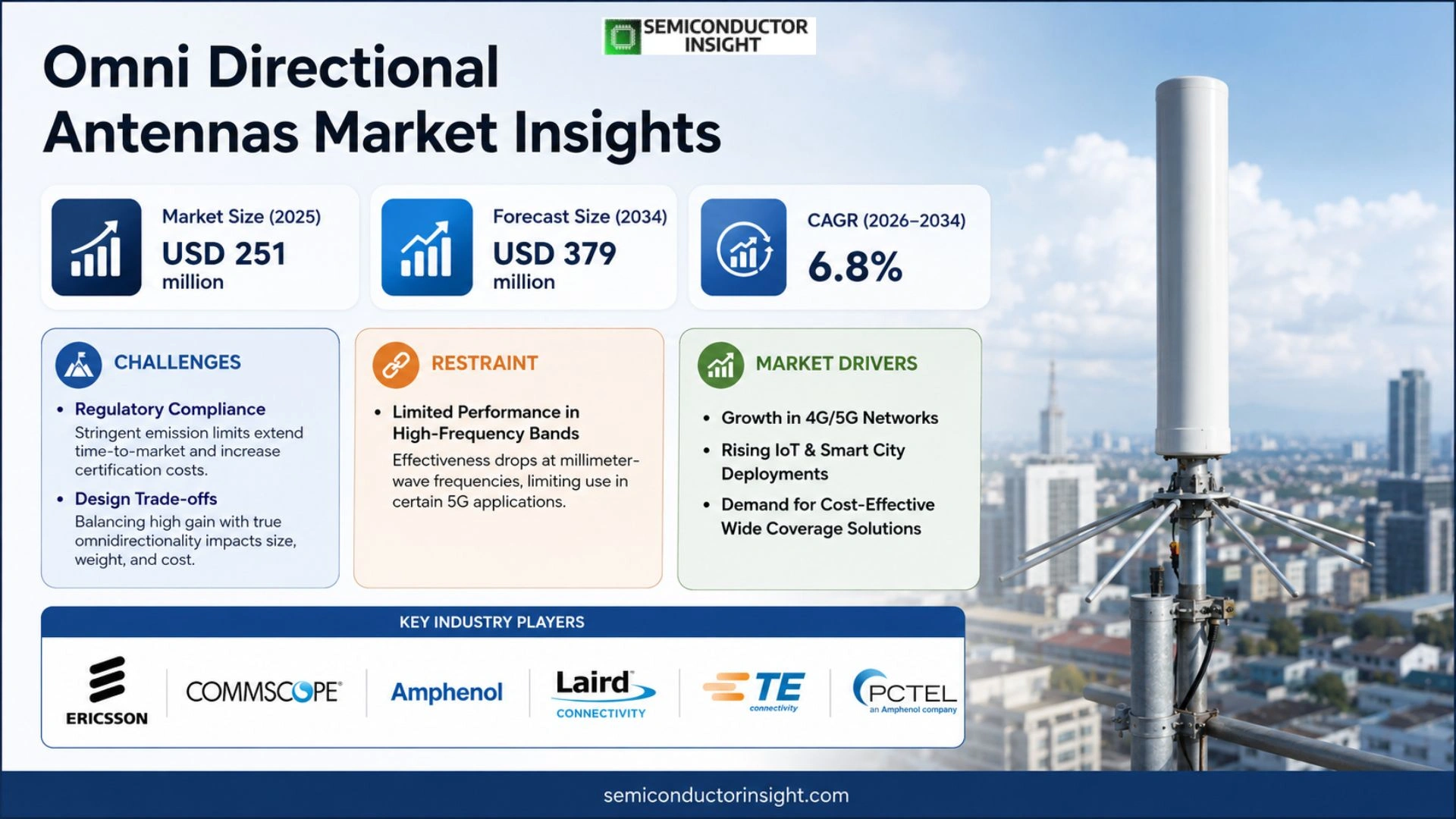
MARKET DRIVERS
Rising Demand for Seamless Connectivity
The proliferation of smart‑city initiatives and the rollout of 5G infrastructure have intensified the need for antennas that can cover wide areas without directional constraints. Omni Directional Antennas Market players are capitalising on this shift, offering products that deliver uniform signal strength across complex urban topographies, thereby reducing the number of required site installations.
Cost‑Effective Network Expansion
Operators are favouring omni‑type solutions because a single unit can replace multiple sector antennas, cutting both capital and operational expenditures. Recent deployments indicate that broadband providers can lower site‑build costs by up to 30 % when substituting traditional directional arrays with omni‑directional hardware.
➤ Manufacturers that integrate low‑loss materials and compact form factors are experiencing faster order‑to‑delivery cycles, giving them a competitive edge in fast‑moving projects.
In addition, the surge in Internet of Things (IoT) devices,especially in logistics and agriculture,requires reliable, all‑around coverage that omni antennas naturally provide, further amplifying market momentum.
MARKET CHALLENGES
Interference Management in Dense Environments
Deployments in metropolitan corridors often encounter co‑channel interference, which can erode the perceived advantages of omni‑directional patterns. Vendors are obliged to embed advanced filtering and beam‑shaping technologies, inflating product complexity and price points.
Other Challenges
Regulatory Compliance
Stringent emission limits in several regions mandate rigorous testing, extending time‑to‑market for new designs and imposing additional certification costs.
Design Trade‑offs
Achieving high gain while maintaining a truly omnidirectional footprint forces engineers to balance size, weight, and material costs, limiting the scalability of ultra‑compact solutions for certain applications.
MARKET RESTRAINTS
Limited Performance in High‑Frequency Bands
While omni antennas excel at VHF/UHF ranges, their efficacy diminishes as frequencies climb into the millimetre‑wave spectrum required for some 5G use‑cases. This technical ceiling discourages certain carriers from adopting omni solutions for flagship services.
Supply‑Chain Vulnerabilities
Recent semiconductor shortages and fluctuations in specialty ceramic prices have exposed fragilities in the component supply chain. Manufacturers relying on single‑source suppliers face production bottlenecks that can delay large‑scale rollouts.
MARKET OPPORTUNITIES
Integration with Edge Computing Platforms
Emerging edge‑compute nodes demand antennas that can provide continuous coverage for distributed processing units. Embedding omni‑directional arrays directly into edge hardware creates a bundled offering, opening new revenue streams for system integrators.
Expansion into Rural Broadband Initiatives
Government‑backed rural connectivity programs are prioritising cost‑efficient solutions that minimise the number of transmission sites. Omni antennas, with their broad footprint, align perfectly with these objectives, presenting a sizable growth avenue for vendors willing to tailor ruggedised versions for harsh environments.
Omni Directional Antennas Market Trends
Infrastructure Expansion Fuels Demand
Omni Directional Antennas Market recorded a valuation of roughly $251 million in 2026 and is on track to reach about $379 million by 2034. This upward trajectory mirrors the relentless rollout of 4G and 5G base stations, as well as the deployment of dense small‑cell networks in urban cores. Because omnidirectional elements broadcast uniformly across the horizontal plane, they eliminate the need for precision alignment while supporting seamless hand‑offs for mobile users. Consequently, network operators favor them for macro‑cell sites where broad coverage and rapid installation translate into lower capital expenditures and faster time‑to‑service.
Other Trends
IoT Proliferation Reinforces Coverage Needs
By the end of 2026, global sales of omnidirectional antennas topped 5.5 million units, with an average transaction price of $500 per unit. The surge in connected sensors, wearables, and industrial automation devices creates a persistent demand for 360‑degree signal reliability. Enterprises deploying private LTE or private 5G clouds rely on these antennas to guarantee uninterrupted link quality across factories, campuses, and logistics hubs. The resulting economies of scale have nudged unit costs downward, prompting midsize vendors to expand their product portfolios and capture niche verticals such as smart transportation and remote monitoring.
Cost Efficiency Drives Adoption in Enterprise
Beyond carrier infrastructure, corporate campuses and public venues are turning to omnidirectional solutions to simplify Wi‑Fi and Bluetooth deployments. Unlike directional arrays that demand careful site surveys, the broad‑pattern devices can be mounted in ceiling panels or wall brackets, reducing installation labor by up to 30 %. This cost advantage becomes decisive when budget constraints intersect with the need for ubiquitous connectivity in airports, stadiums, and retail complexes. As a result, manufacturers are integrating antenna‑on‑module designs that combine built‑in tuning circuits, further trimming bill‑of‑material costs while maintaining regulatory compliance.
COMPETITIVE LANDSCAPE
Key Industry Players
Omni Directional Antennas Market: Competitive Landscape Overview
The market is anchored by a handful of global integrators whose scale enables them to secure multi‑year contracts with telecom operators and large‑volume IoT platform owners. Ericsson, leveraging its extensive base‑station portfolio, commands a sizable share of the 4G/5G antenna segment and frequently bundles omnidirectional modules with its radio hardware. Amphenol’s broad component catalogue and deep supply‑chain relationships allow it to serve both carrier and industrial customers, translating into a diversified revenue base that cushions short‑term pricing pressure. Meanwhile, PCTEL and Taoglas specialize in ruggedized designs for automotive and drone applications, carving out niches where environmental resilience outweighs cost considerations. This concentration of capabilities among the top three creates a tiered structure: a dominant tier of full‑system providers, a second tier of component‑focused firms, and a long tail of regional specialists that compete on customization and service agility.
Beyond the heavyweights, a spectrum of niche innovators injects differentiation into the market. Companies such as Aaronia and HUBER+SUHNER excel in high‑frequency measurement and precision antenna engineering, attracting high‑value contracts in defense and aerospace. Smiths Interconnect and Luxun Antenna focus on compact, high‑gain solutions for IoT gateways, capitalizing on the explosion of edge devices in smart factories. Smaller Asian players,including Kenbotong Technology, Asia RF Co., Ltd., and Alpha Wireless,provide cost‑effective mass‑production options that appeal to emerging market operators and low‑end consumer equipment makers. Their ability to rapidly iterate designs in response to evolving regulatory bands keeps the overall ecosystem responsive and competitive.
List of Key Omni Directional Antennas Companies Profiled
- Ericsson
- Amphenol
- PCTEL, Inc.
- Taoglas
- Aaronia
- HUBER+SUHNER
- Smiths Interconnect
- Luxun Antenna
- Comba Telecom
- Pasternack
- Kenbotong Technology
- Asia RF Co., Ltd.
- Alpha Wireless
- BJTEK
Segment Analysis:
| Segment Category | Sub-Segments | Key Insights |
| By Type |
|
Vertical Whip/Monopole has become the preferred architecture for outdoor base‑station deployments because it offers robust omnidirectional coverage while maintaining a compact profile.
|
| By Application |
|
Mobile Communication Base Stations dominate the application landscape as network operators expand 4G and 5G coverage.
|
| By End User |
|
Telecom Operators prioritize reliability and scalability, driving demand for omnidirectional solutions.
|
| By Frequency |
|
UHF emerges as the most versatile band for omnidirectional deployment across multiple sectors.
|
| By Polarization |
|
Dual/Mixed polarization is gaining traction as manufacturers seek to address heterogeneous device ecosystems.
|
Regional Analysis: Omni Directional Antennas Market
North America
The surge in smart‑city initiatives drives municipal agencies to prioritize wide‑angle coverage, making omnidirectional antennas a logical fit for street‑level sensors and public Wi‑Fi hotspots. Simultaneously, the rise of edge‑computing nodes in remote facilities calls for robust, all‑directional links that avoid costly site surveys.
Tier‑1 manufacturers leverage extensive R&D budgets to fine‑tune feed‑network architectures, while niche players differentiate through rapid prototyping and low‑volume custom orders. Partnerships between antenna firms and chipset designers are blurring traditional market boundaries.
FCC’s clear exposure limits and streamlined certification pathways reduce time spent on compliance testing, enabling vendors to allocate resources toward performance enhancement and cost efficiency.
Autonomous freight corridors and drone delivery networks are experimenting with omnidirectional antenna arrays to maintain uninterrupted link quality during high‑speed maneuvers, a use case that is rapidly shaping product roadmaps.
Europe
European operators exhibit a cautious yet progressive stance, balancing legacy network assets with the need for homogeneous coverage in dense urban districts. Telecommunication carriers are piloting omnidirectional modules within private 5G slices for manufacturing hubs, where the ability to serve multiple machines from a single point reduces installation overhead. Sustainability mandates encourage the reuse of existing mast structures, prompting vendors to develop low‑profile designs that integrate seamlessly with historic cityscapes. Policy frameworks across the EU also incentivize cross‑border IoT projects, opening channels for standard‑compliant antenna solutions that can operate under varied spectrum allocations.
Asia‑Pacific
In Asia‑Pacific, the market is energized by massive infrastructure roll‑outs in emerging economies. Governments are prioritizing universal broadband access, and the simplicity of omnidirectional antennas makes them attractive for rural deployments where terrain variability hampers directional alignment. Simultaneously, the region’s fast‑moving consumer electronics sector integrates these antennas into wearables and smart‑home hubs, capitalizing on the need for compact, all‑around signal capture. Competitive pricing pressure forces manufacturers to adopt lean production techniques, yet innovation thrives through collaborations with local universities focusing on novel substrate materials.
South America
South American markets are characterized by uneven connectivity distribution, prompting service providers to seek cost‑effective solutions that can bridge gaps without extensive tower networks. Omnidirectional antennas, with their ability to blanket wide areas from a single installation, align with these operational constraints. Moreover, the surge in agritech platforms,ranging from precision irrigation to livestock monitoring,relies on reliable, 360‑degree radio links across sprawling farms. Companies are therefore embedding these antennas into ruggedized enclosures designed to withstand harsh climatic conditions, a trend that reinforces demand for durable yet lightweight designs.
Middle East & Africa
The Middle East & Africa region displays a dual narrative: affluent Gulf states are upgrading high‑density venues such as stadiums and oil‑field command centers with omnidirectional arrays to guarantee uniform signal strength, while many African nations are still expanding basic telecom coverage. In the former, the focus is on integrating antennas with advanced beam‑forming algorithms to enhance capacity, whereas in the latter, the emphasis lies on deploying simple, low‑maintenance units that can survive extreme temperatures. Partnerships between multinational OEMs and regional integrators are facilitating technology transfer, gradually elevating the overall sophistication of antenna deployments across the continent.
Report Scope
This market research report provides a comprehensive analysis of the Omni Directional Antennas Market , covering the forecast period 2026–2034. It offers detailed insights into market dynamics, technological advancements, competitive landscape, and key trends shaping the industry.
Key focus areas of the report include:
- Market Overview: The report begins with an overview outlining its current market scenario, key growth indicators, and industry transformation drivers. It discusses macroeconomic factors, demand–supply balance, regulatory landscape, and the strategic role of semiconductors in powering advancements across industries such as automotive, telecommunications, consumer electronics, and industrial automation.
- Market Size & Forecast: Historical data and future projections for revenue, unit shipments, and market value across major regions and segments.
- Segmentation Analysis: Detailed breakdown by product type, technology, application, and end-user industry to identify high-growth segments and investment opportunities.
- Regional Insights: Insights into market performance across North America, Europe, Asia-Pacific, Latin America, and the Middle East & Africa, including country-level analysis where relevant.
- Competitive Landscape: Profiles of leading market participants, including their product offerings, R&D focus, manufacturing capacity, pricing strategies, and recent developments such as mergers, acquisitions, and partnerships.
- Technology Trends & Innovation: Assessment of emerging technologies, integration of AI/IoT, semiconductor design trends, fabrication techniques, and evolving industry standards.
- Market Drivers & Restraints: Evaluation of factors driving market growth along with challenges, supply chain constraints, regulatory issues, and market-entry barriers.
- Stakeholder Insights: Insights for component suppliers, OEMs, system integrators, investors, and policymakers regarding the evolving ecosystem and strategic opportunities.
Primary and secondary research methods are employed, including interviews with industry experts, data from verified sources, and real-time market intelligence to ensure the accuracy and reliability of the insights presented.
FREQUENTLY ASKED QUESTIONS:
What is the current market size of Omni Directional Antennas Market?
-> Omni Directional Antennas market is forecasted to reach USD 379 million by 2034, reflecting a CAGR of 6.8% during the forecast period.
Which key companies operate in Omni Directional Antennas Market?
-> Key players include Aaronia, Ericsson, HUBER+SUHNER, Amphenol, PCTEL, Inc., Taoglas, CellMax Technologies, Smiths Interconnect, L?Com?Laird Connectivity?, Luxun Antenna, Comba Telecom, Kenbotong Technology, Asia RF Co., Ltd., BJTEK, Alpha Wireless, Pasternack.
What are the key growth drivers?
-> Key growth drivers include continuous expansion of wireless network infrastructure (4G/5G base stations and small cells), explosive growth of smart devices and IoT endpoints, rising demand for comprehensive wireless coverage in enterprise and public venues, and reliance of connected vehicles, drones and portable communication equipment on stable omnidirectional connectivity.
Which region dominates the market?
-> Asia-Pacific holds a leading position due to aggressive 5G roll‑out and extensive IoT deployments, while North America and Europe also represent significant mature markets.
What are the emerging trends?
-> Emerging trends include integration of omnidirectional antennas with 5G and private LTE networks, miniaturized designs for automotive and drone applications, and advanced materials to improve bandwidth and durability for industrial IoT environments.

Get Sample Report PDF for Exclusive Insights
Report Sample Includes
- Table of Contents
- List of Tables & Figures
- Charts, Research Methodology, and more...