Normal-temperature Adsorption Gas Purifier Market Insights
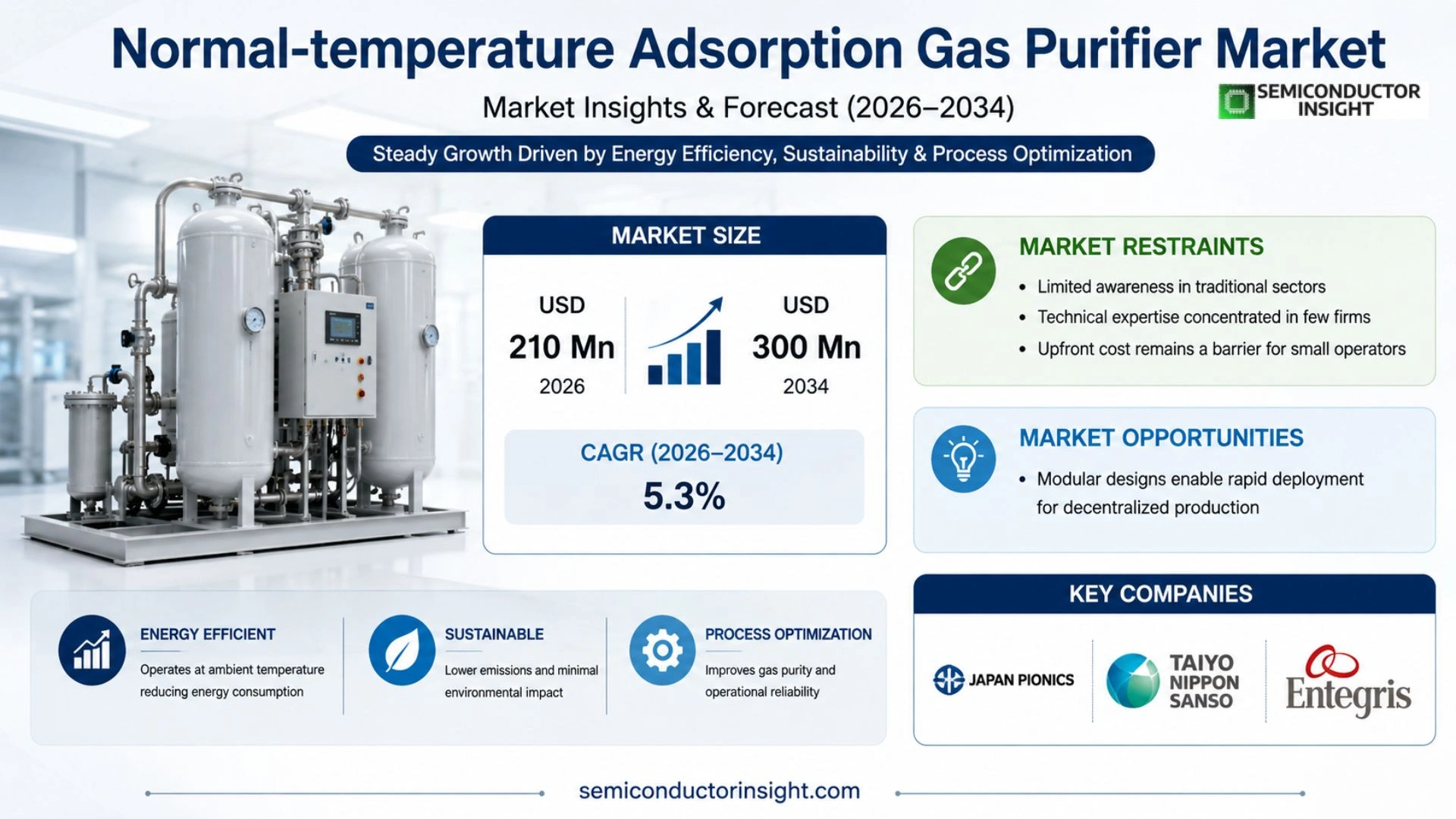
Normal-temperature Adsorption Gas Purifier market is projected to grow from USD 210 million in 2026 to USD 300 million by 2034, exhibiting a CAGR of 5.3% during the forecast period.
Normal-temperature adsorption gas purifiers are a class of equipment built around adsorption media operating at ambient temperature or hybrid catalyst‑plus‑adsorption systems to continuously remove trace moisture, oxygen, carbon monoxide, carbon dioxide, hydrocarbons and other impurities from nitrogen, hydrogen, argon, helium, air and selected process gases. Their purpose is to upgrade conventionally high‑purity gases into high‑purity or ultra‑high‑purity process gases suitable for semiconductors, displays, LEDs, photovoltaics, analytical instruments, metallurgical heat treatment and other controlled environments. Technical formats include ambient‑temperature adsorption, catalytic reaction with downstream adsorption, getter‑based purification and customized hybrid modules; product forms span point‑of‑use purifiers, inline modules, centralized bulk systems and integrated gas‑supply skids.
The market is gaining momentum because expanding semiconductor fab capacity in East Asia and policy initiatives such as CHIPS for America and the European Chips Act are driving demand for ultra‑high‑purity gases. Suppliers including Japan Pionics, Entegris and Taiyo Nippon Sanso are extending business models that bundle equipment sales with consumable regeneration contracts. Since impurity fluctuations directly affect yield and tool uptime on advanced production lines, customers prioritize sub‑ppb stability with low pressure drop. Recent product launches highlight modular designs that retrofit into existing gas skids while lowering total cost of ownership.
MARKET DRIVERS
Regulatory Incentives for Low‑Carbon Emissions
Governments across Europe and North America have tightened emissions standards for industrial plants, prompting manufacturers to adopt cleaner purification technologies. Normal-temperature Adsorption Gas Purifier Market benefits because the equipment operates without the energy penalties of high‑temperature processes, allowing firms to meet compliance while conserving power.
Cost Advantage of Ambient‑Temperature Operation
Operating at ambient temperature eliminates the need for expensive heat‑exchange infrastructure. End‑users report up to 20 % reduction in total cost of ownership, a margin that directly translates into faster payback periods and higher adoption rates among mid‑size producers.
➤ Companies that retrofit existing units with normal‑temperature adsorbers see a 15‑30 % boost in throughput without additional energy input.
In parallel, the expansion of petrochemical complexes in Asia creates a pipeline of projects seeking reliable gas cleanup. The convergence of policy pressure and clear financial upside establishes a sturdy foundation for sustained market expansion.
MARKET CHALLENGES
Material Longevity Under Variable Feed Streams
Adsorbent media can degrade when exposed to fluctuating concentrations of contaminants, especially in facilities with irregular production schedules. Early degradation forces premature media replacement, eroding the cost advantage that drives purchase decisions.
Other Challenges
Supply‑Chain Constraints
The specialty chemicals required for high‑performance adsorbents are sourced from a limited number of producers. Recent logistics bottlenecks have elongated lead times, making inventory planning more complex for end users.
MARKET RESTRAINTS
Limited Awareness in Traditional Sectors
Many established players in oil refining and fertilizer production remain accustomed to high‑temperature purification cycles. The inertia stems from decades‑long equipment lifecycles, resulting in slower acceptance of ambient‑temperature alternatives.
Technical expertise required to design and operate adsorption units is still concentrated in a few engineering firms. Companies lacking in‑house knowledge often defer adoption until they can secure external consultancy, adding another layer of hesitation.
Finally, the upfront capital outlay, while lower than high‑temperature systems, still represents a noticeable expense for small‑scale operators, who may opt for cheaper, albeit less efficient, legacy solutions.
MARKET OPPORTUNITIES
Modular Designs for Decentralized Production
Emerging modular adsorption units enable rapid deployment at remote sites, aligning with the trend toward distributed manufacturing. Their plug‑and‑play nature reduces engineering lead time, opening doors to markets that previously could not justify large‑scale installations.
Integrating digital monitoring with adsorber performance creates predictive maintenance models, extending adsorbent life and lowering operational risk. Early adopters of such smart solutions can differentiate themselves by offering higher reliability to downstream customers.
Additionally, the growing emphasis on circular economy practices places a premium on technologies that can recover valuable components from waste gases. Normal‑temperature adsorbers, with their selective capture capabilities, are well‑positioned to serve this niche, unlocking new revenue streams.
Normal-temperature Adsorption Gas Purifier Market Trends
Shift Toward Integrated Regeneration Platforms
The industry is moving from isolated adsorption beds to platforms that combine catalytic stages, regenerative media, and smart controls. Vendors such as Entegris and Japan Pionics now offer units where a catalyst reduces carbon monoxide while a downstream adsorbent captures residual oxygen, all managed by a micro‑processor that predicts cartridge life. This architecture reduces pressure drop and extends service intervals, directly lowering plant‑level downtime. Customers value the predictability of impurity levels because even sub‑ppb fluctuations can cause film defects in semiconductor fabs. By embedding regeneration cycles into the equipment, suppliers transform a consumable‑only business into an uptime‑assurance proposition. The trend is reinforced by increasing demand for ultra‑stable gas streams in LED and photovoltaic production, where process yield correlates tightly with gas purity consistency.
Other Trends
Regional Concentration and Policy Support
Demand clusters remain anchored in East Asia, where the majority of wafer fab capacity continues to expand. China’s semiconductor roadmap and Japan’s industrial gas investments create a steady pipeline of new lines that require point‑of‑use purification. At the same time, public initiatives such as CHIPS for America and the European Chips Act have attracted capital to domestic fabs, prompting local gas suppliers to establish service hubs. This policy‑driven shift is prompting North American and European manufacturers to adopt modular inline purifiers that can be retrofitted into existing gas skids, reducing the need for large‑scale bulk systems. The combined effect is a more balanced geographic distribution of orders, with a modest rise in projects that favor centralized bulk units in regions where new fabs are built from the ground up.
Business Model Evolution Toward Service‑Centric Packages
The commercial logic of Normal-temperature Adsorption Gas Purifier Market now hinges on total cost of ownership rather than upfront equipment price. Suppliers bundle hardware with scheduled cartridge replacement, on‑site regeneration, and validation testing, turning a one‑off sale into a recurring revenue stream. This service orientation benefits end users by converting unpredictable maintenance spikes into predictable operating expense, while manufacturers gain pricing leverage through long‑term contracts. As advanced‑material makers tighten yield targets, procurement teams are more willing to lock in multi‑year service agreements that guarantee sub‑ppb impurity control. The emerging package‑deal mindset is reshaping competitive dynamics, rewarding firms that can integrate engineering support with consumable logistics.
COMPETITIVE LANDSCAPE
Key Industry Players
Competitive Dynamics in Normal‑Temperature Adsorption Gas Purifiers
Japan Pionics dominates the upper tier of the market by supplying integrated point‑of‑use and inline modules that combine ambient‑temperature adsorption beds with proprietary catalyst layers. Its emphasis on sub‑ppb impurity control and a service model that bundles on‑site regeneration with consumable replacement has helped it lock in long‑term contracts with leading semiconductor fabs in East Asia. The firm’s product portfolio spans nitrogen, hydrogen and inert‑gas purification, allowing customers to standardize on a single vendor for multiple gas streams. This breadth, together with a reputation for rigorous validation support, gives Pionics pricing leverage and a defensible position against newcomers that focus on a single gas type or a narrower flow range.
Beyond the flagship tier, a constellation of specialist suppliers competes on niche performance criteria. Taiyo Nippon Sanso and Entegris differentiate through hybrid catalyst‑plus‑adsorption platforms that target high‑flow bulk systems for display and photovoltaic lines. Companies such as Naotech, WONIK HOLDINGS and Feature‑Tec focus on regenerable cartridge designs that lower operating expense for mid‑size fabs. Regional players,Suzhou Since Gas, Dalian Kaiteli, Chengdu Yiansaidi, KC Innovation and Aura Material,lever‑age local engineering talent to customise purification routes for emerging applications like advanced metrology and alloy‑heat‑treatment processes. Their agility in offering bespoke service contracts and rapid media turnover creates a competitive edge that larger incumbents find harder to replicate, especially in markets where total‑cost‑of‑ownership calculations dominate procurement decisions.
List of Key Normal‑Temperature Adsorption Gas Purifier Companies Profiled
- Japan Pionics
- Taiyo Nippon Sanso
- Entegris
- Pall Corporation
- WONIK HOLDINGS Co., Ltd.
- Naotech Co., Ltd.
- Feature‑Tec (Shanghai) New Materials Co., Ltd.
- Aura Material Ltd.
- Applied Energy Systems
- NuPure
- KC Innovation
- Dalian Kaiteli Catalytic Engineering Technology Co., Ltd.
- Suzhou Since Gas Technology Co., Ltd.
- Chengdu Yiansaidi Environmental Technology Co., Ltd.
- Samsung Advanced Gas Solutions
Segment Analysis:
| Segment Category | Sub-Segments | Key Insights |
| By Type |
|
Ambient‑Temperature Adsorption is the leading type because it aligns with the industry’s demand for low‑energy operation and continuous impurity removal.
|
| By Application |
|
Semiconductor dominates due to its extreme sensitivity to trace impurities.
|
| By End User |
|
Integrated Circuit Foundries lead because gas purity is a gate‑keeping factor for advanced node production.
|
| By Purification Mechanism |
|
Hybrid Integrated Modules are emerging as the preferred mechanism.
|
| By Deployment Model |
|
Point‑of‑Use Purifiers dominate because they align with the industry’s push for modularity and rapid change‑over.
|
Regional Analysis: Normal-temperature Adsorption Gas Purifier Market
North America
Federal agencies regularly tighten permissible limits for volatile organic compounds, prompting processors to retrofit plants with adsorption purifiers that function at ambient conditions. The regulatory cadence encourages OEMs to certify their units against evolving standards, reinforcing a market that rewards compliance‑focused engineering.
Academic collaborations in the Great Lakes corridor have yielded sorbent materials with higher affinity for nitrogen oxides while retaining low‑temperature performance. These breakthroughs translate into smaller footprint units, appealing to manufacturers seeking space‑efficient retrofits.
Proximity between raw‑material producers, component assemblers, and end‑users reduces lead times, allowing customers to align inventory cycles with project milestones. This logistical advantage shortens the adoption curve for new purifier designs.
Facility managers increasingly favour solutions that balance energy consumption with removal efficiency. Ambient‑temperature adsorbers meet this demand, offering operational simplicity while maintaining rigorous contaminant control.
Europe
European manufacturers benefit from a coordinated regulatory framework across the EU, which pushes industrial sites toward low‑energy air‑cleaning technologies. Countries such as Germany and France invest heavily in pilot projects that evaluate ambient‑temperature adsorption for power‑generation and chemical processing. The region’s strong emphasis on circular‑economy principles also stimulates interest in regenerable sorbents, positioning Europe as a hub for sustainable purifier development. Market participants are tailoring product lines to satisfy both stringent emissions directives and the continent’s growing preference for modular, easily serviced equipment.
Asia‑Pacific
Rapid urbanisation and expanding manufacturing bases in China, India, and Southeast Asia create a fertile environment for Normal-temperature Adsorption Gas Purifier adoption. Local firms are scaling production capacities to meet heightened awareness of indoor‑air quality in dense megacities. While cost considerations remain paramount, governments are rolling out incentive schemes that lower entry barriers for advanced filtration technologies. The confluence of governmental support, escalating industrial output, and rising consumer health consciousness propels the region toward intensified market activity.
South America
In Brazil and Argentina, the petrochemical and mining sectors drive demand for ambient‑temperature purification, primarily to comply with export‑oriented environmental certifications. Regional trade agreements encourage cross‑border technology transfer, enabling local players to access sorbent formulations developed abroad. Nevertheless, infrastructure constraints and fluctuating investment cycles introduce a degree of volatility, prompting companies to adopt phased deployment strategies that align capital outlays with project milestones.
Middle East & Africa
The Middle East’s oil‑refining hubs and Africa’s emerging manufacturing clusters are gradually recognising the operational savings offered by low‑temperature adsorption systems. Nations such as the United Arab Emirates are integrating purifiers into offshore processing facilities, where energy efficiency directly impacts operating margins. In sub‑Saharan markets, pilot installations in water‑treatment plants illustrate a nascent interest that could expand as utility providers seek cost‑effective solutions for gas‑phase contaminants. The region’s trajectory hinges on the ability of technology providers to demonstrate reliability under harsh climatic conditions.
Report Scope
This market research report provides a comprehensive analysis of the Normal-temperature Adsorption Gas Purifier Market , covering the forecast period 2026–2034. It offers detailed insights into market dynamics, technological advancements, competitive landscape, and key trends shaping the industry.
Key focus areas of the report include:
- Market Overview: The report begins with an overview outlining its current market scenario, key growth indicators, and industry transformation drivers. It discusses macroeconomic factors, demand–supply balance, regulatory landscape, and the strategic role of semiconductors in powering advancements across industries such as automotive, telecommunications, consumer electronics, and industrial automation.
- Market Size & Forecast: Historical data and future projections for revenue, unit shipments, and market value across major regions and segments.
- Segmentation Analysis: Detailed breakdown by product type, technology, application, and end-user industry to identify high-growth segments and investment opportunities.
- Regional Insights: Insights into market performance across North America, Europe, Asia-Pacific, Latin America, and the Middle East & Africa, including country-level analysis where relevant.
- Competitive Landscape: Profiles of leading market participants, including their product offerings, R&D focus, manufacturing capacity, pricing strategies, and recent developments such as mergers, acquisitions, and partnerships.
- Technology Trends & Innovation: Assessment of emerging technologies, integration of AI/IoT, semiconductor design trends, fabrication techniques, and evolving industry standards.
- Market Drivers & Restraints: Evaluation of factors driving market growth along with challenges, supply chain constraints, regulatory issues, and market-entry barriers.
- Stakeholder Insights: Insights for component suppliers, OEMs, system integrators, investors, and policymakers regarding the evolving ecosystem and strategic opportunities.
Primary and secondary research methods are employed, including interviews with industry experts, data from verified sources, and real-time market intelligence to ensure the accuracy and reliability of the insights presented.
FREQUENTLY ASKED QUESTIONS:
What is the current market size of Normal-temperature Adsorption Gas Purifier Market?
-> Normal-temperature Adsorption Gas Purifier market is projected to grow from USD 210 million in 2026 to USD 300 million by 2034, exhibiting a CAGR of 5.3%
Which key companies operate in Normal-temperature Adsorption Gas Purifier Market?
-> Key players include Japan Pionics, Taiyo Nippon Sanso, Entegris, WONIK HOLDINGS, Naotech, Feature‑Tec, Dalian Kaiteli, among others.
What are the key growth drivers?
-> Key growth drivers include expansion of semiconductor, display, LED, and photovoltaic fabs; increasing demand for ultra‑high‑purity gases; and the need for stable impurity control to improve yield and equipment uptime.
Which region dominates the market?
-> Asia remains the core market, driven by concentrated wafer‑fab and panel‑plant capacity, while North America and Europe are gaining traction through policy support such as CHIPS for America and the European Chips Act.
What are the emerging trends?
-> Emerging trends include integration of hybrid catalyst‑adsorption modules, regenerable media designs, sub‑ppb impurity control, and the transition toward total‑cost‑of‑ownership business models that combine equipment, consumables, and regeneration services.

Get Sample Report PDF for Exclusive Insights
Report Sample Includes
- Table of Contents
- List of Tables & Figures
- Charts, Research Methodology, and more...