Heat Wet Scrubber for LCD Market Insights
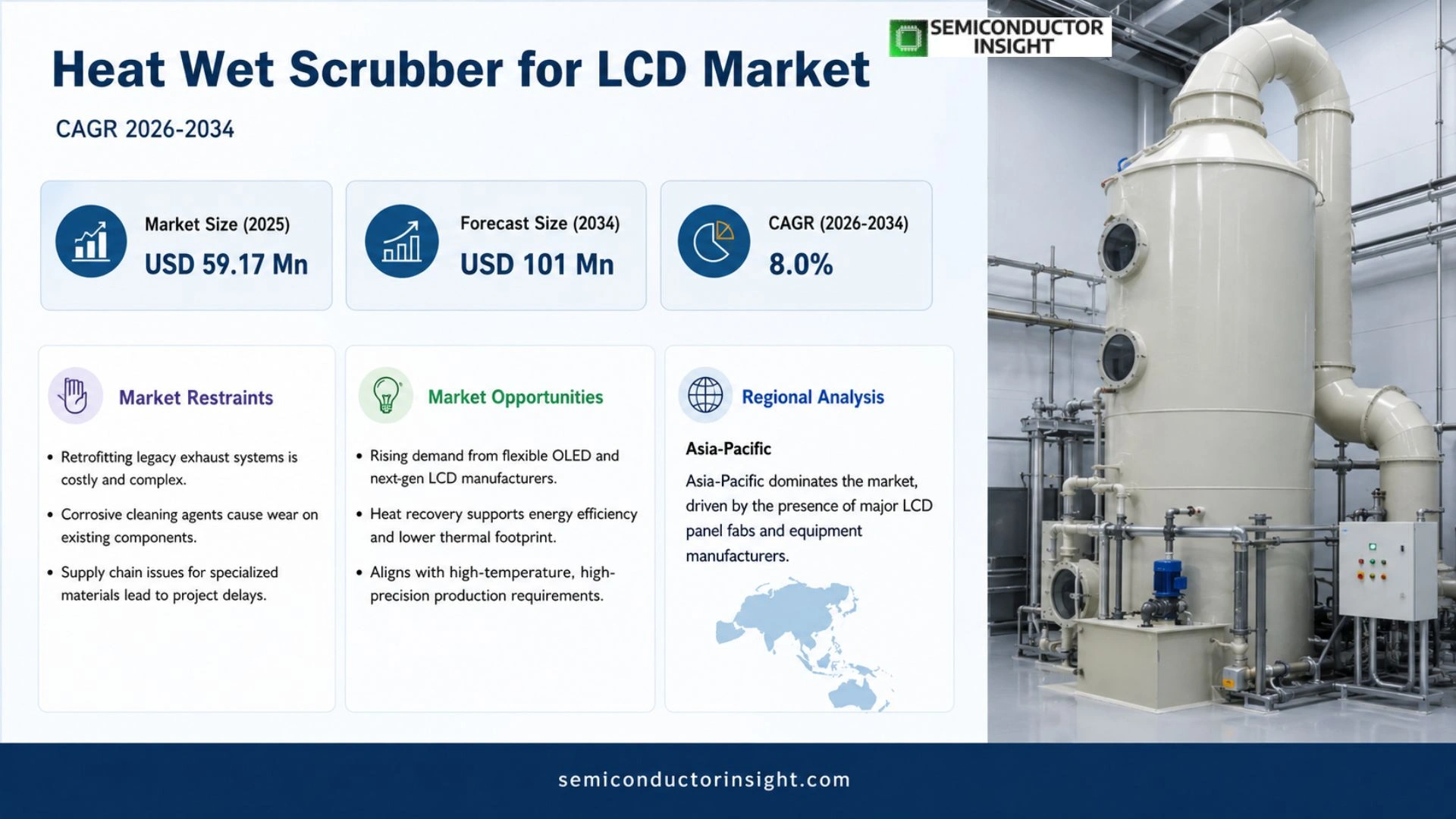
Heat Wet Scrubber for LCD market was valued at USD 59.17 million in 2025 and is forecasted to reach USD 101 million by 2034, exhibiting a CAGR of 8.0% during the forecast period.
A Heat Wet Scrubber for LCD is a point‑of‑use waste‑gas abatement system installed directly on TFT‑LCD or related equipment. It combines a reaction chamber, cooling section, wet tower and self‑cleaning powder‑removal unit, converting hazardous gases such as SiH₄, NF₃, CF₄, SF₆, NH₃ and HCl through thermal decomposition or heat‑catalytic reactions before wet absorption and discharge. Typical users include panel makers and semiconductor fabs that require rapid PFC removal, low water consumption and high uptime.
MARKET DRIVERS
Stricter Environmental Standards in LCD Manufacturing Hubs
Across Asia and Europe, regulators are tightening emission limits for volatile organic compounds and particulates released during LCD panel fabrication. Companies that adopt Heat Wet Scrubber for LCD Market solutions can demonstrate compliance while avoiding costly penalties. The technology’s ability to capture both moisture and heat makes it an attractive alternative to traditional dry scrubbers, which struggle to meet the new thresholds.
Push for Production Efficiency and Yield Improvement
Manufacturers are under pressure to shrink cycle times without sacrificing panel quality. By reclaiming heat from exhaust streams, wet scrubbers lower boiler fuel consumption and stabilize furnace temperatures, directly influencing defect rates. Operators report tighter control over humidity levels in cleanrooms, which translates into higher first‑pass yields and lower rework costs.
➤ Integrating heat recovery with contaminant capture creates a dual‑benefit platform that addresses both environmental compliance and cost competitiveness.
The convergence of regulatory pressure and the need for operational efficiency creates a fertile environment for adoption. Firms that invest early are positioning themselves to lock in lower energy bills and to differentiate their production lines as “green” to OEM partners, a factor that increasingly influences procurement decisions.
MARKET CHALLENGES
Capital Allocation Constraints in Tier‑2 Suppliers
Mid‑size component suppliers often operate on thin margins, limiting their ability to fund capital‑intensive upgrades. While the long‑term payback of a Heat Wet Scrubber system can be attractive, the upfront outlay competes with other priority projects such as automation and workforce training.
Other Challenges
Cost Sensitivity
The total cost of ownership, including maintenance chemicals and periodic filter replacement, remains a sticking point for cash‑strapped plants. Any unexpected downtime for cleaning or repairs can erode the anticipated savings, prompting some operators to defer adoption.
Further, the technical expertise required to integrate the scrubber with existing exhaust networks is not uniformly available. Companies that lack in‑house engineering resources must rely on external consultants, adding another layer of expense and schedule risk.
MARKET RESTRAINTS
Limited Compatibility with Legacy Exhaust Systems
Older facilities were designed around low‑temperature, dry‑scrubbing technologies. Retrofitting these plants to accommodate the water flow and heat exchange requirements of a wet scrubber can involve substantial ductwork redesign, which many operators deem impractical.
Moreover, the corrosive nature of certain cleaning agents necessary for the system’s upkeep can accelerate wear on existing metal components, necessitating the replacement of piping and valves,a cost that is often overlooked in initial budgeting.
Finally, supply chain disruptions for specialized stainless‑steel components have introduced lead‑time uncertainties, making project planners hesitant to commit to large‑scale installations.
MARKET OPPORTUNITIES
Emerging Demand from Flexible‑Display Producers
Manufacturers of flexible OLED and next‑generation LCD panels are scaling up production lines that operate at higher temperatures to achieve better material pliability. The heat recovery feature of wet scrubbers aligns perfectly with these processes, offering a pathway to lower thermal footprints while maintaining stringent cleanliness standards.
In parallel, a growing number of OEMs are incorporating sustainability clauses into their supplier contracts. Vendors that can demonstrate measurable reductions in energy consumption and emissions through heat‑wet scrubbing are likely to secure preferential pricing and longer‑term contracts.
Additional upside stems from modular scrubber designs that can be deployed incrementally. This flexibility reduces the initial capital barrier and allows facilities to expand capacity as market demand for high‑resolution LCDs rises.
Heat Wet Scrubber for LCD Market Trends
Tool‑Side Treatment Becomes Standard Practice
The adoption of point‑of‑use scrubbing is reshaping equipment portfolios for display manufacturers. By locating heat‑wet treatment directly on the tool, companies eliminate the need for long exhaust runs that can mix reactive gases and raise explosion hazards. This configuration also shortens the response time between gas generation and abatement, allowing tighter control of by‑product formation. As fab lines pursue larger substrates and higher throughput, the reliability of the scrubber directly influences line uptime and yield. Consequently, buyers are prioritizing systems that combine thermal decomposition with wet absorption in a compact package, because they deliver both safety compliance and a measurable reduction in process interruptions.
Other Trends
Technology Differentiation and Service Orientation
Vendors are moving beyond simple reaction chemistry to offer integrated solutions that address maintenance effort, water‑use efficiency, and remote diagnostics. Products now feature automatic powder removal, self‑cleaning cycles, and modular control software that can be updated over the air. These capabilities translate into lower total cost of ownership, a factor that procurement teams weigh heavily against raw throughput figures. Service contracts that guarantee 24‑hour on‑site support have become a decisive selling point, especially for customers operating in regions where skilled technicians are scarce. The firms that can bundle high PFC abatement performance with proactive service are securing multi‑year agreements that lock in recurring revenue streams.
Geographic Expansion Driven by Regulation
Demand is spreading from the traditional East‑Asian hub to North America and Europe, where stricter emissions standards are pushing fabs to upgrade legacy abatement equipment. Suppliers headquartered in Korea, Japan, China, Taiwan, and Germany are extending their service networks to cover the United States, Canada, and key European markets. This geographic diversification reduces reliance on a single regional customer base and opens cross‑border opportunities for spare‑part logistics and training programs. The regulatory backdrop,tightening limits on fluorinated greenhouse gases and mandatory reporting,creates a predictable market tailwind that encourages capital investment in compliant scrubber technology. Companies that align their product roadmaps with these policy trends are better positioned to capture growth in both mature and emerging fab sites.
COMPETITIVE LANDSCAPE
Key Industry Players
Heat‑Wet Scrubber Solutions for LCD Fabrication: Competitive Overview
The market is anchored by a handful of firms that have built end‑to‑end portfolios covering thermal‑wet, burn‑wet and hybrid concepts. Global Standard Technology Co., Ltd. commands the broadest product family, integrating high‑throughput reaction chambers with automated powder‑handling modules that appeal to large‑scale panel makers seeking near‑continuous operation. Their ability to bundle hardware with 24‑hour field service creates a lock‑in effect, especially in Korean and Taiwanese fabs where most LCD lines reside. DAS Environmental Expert GmbH, a German‑based specialist, leverages its compliance pedigree to win contracts in Europe and North America, where regulatory scrutiny of fluorinated greenhouse gases remains intense. Kanken Techno Co., Ltd., with a strong foothold in China’s display cluster, differentiates through compact heat‑catalyst designs that reduce water consumption while maintaining aggressive PFC abatement rates. Collectively, these leaders shape market structure by setting performance baselines that niche entrants must exceed to gain traction.
Beyond the dominant trio, a second tier of manufacturers supplies focused solutions that address specific process niches or regional cost constraints. Triple Cores Technology Corp. and UNISEM Co., Ltd. concentrate on modular scrubbers for diffusion and etch tools, emphasizing plug‑and‑play integration that minimizes installation downtime. SemiAn Technology Co., Ltd. and Integrated Plasma Inc. have introduced plasma‑assisted wet designs targeting high‑energy CVD streams, a segment where traditional thermal routes struggle with by‑product formation. EBARA CORPORATION brings its legacy of industrial water treatment to the LCD arena, offering rugged wet tanks that resonate with manufacturers prioritizing longevity over compactness. AIR WATER INC. and Greenstar (Beijing) Environmental Technology Co., Ltd. focus on cost‑effective units for emerging fab operators in Southeast Asia, relying on aggressive pricing and localized support networks. Together, these players diversify the supply base, creating competitive pressure that drives incremental innovation in reliability, energy use and service responsiveness.
List of Key Heat Wet Scrubber for LCD Companies Profiled
- Global Standard Technology Co., Ltd.
- DAS Environmental Expert GmbH
- Kanken Techno Co., Ltd.
- Greenstar (Beijing) Environmental Technology Co., Ltd.
- Triple Cores Technology Corp.
- UNISEM Co., Ltd.
- SemiAn Technology Co., Ltd.
- EBARA CORPORATION
- AIR WATER INC.
- Integrated Plasma Inc.
Segment Analysis:
| Segment Category | Sub-Segments | Key Insights |
| By Type |
|
Burn‑Wet
|
| By Application |
|
Deposition Process Exhaust Abatement
|
| By End User |
|
Panel Makers
|
| By Treatment Principle |
|
Thermal‑Wet
|
| By Service Model |
|
Full System Solutions
|
Regional Analysis: Heat Wet Scrubber for LCD Market
Asia-Pacific
Concentrated LCD fabs in South Korea and China create a dense customer base, prompting scrubber vendors to establish dedicated assembly lines nearby, reducing lead times and enabling rapid engineering tweaks responsive to fab‑specific process changes.
Tightened wastewater discharge limits across ASEAN and Greater China incentivise fab owners to adopt wet‑scrubbing solutions that can demonstrate measurable reductions in pollutant loads while satisfying audit requirements.
Recent component shortages have spurred local sourcing of critical alloy membranes, allowing suppliers to bypass bottlenecks in European ports and maintain steady fulfilment for high‑volume fab customers.
Collaborative R&D programmes between universities in Taiwan and leading equipment makers accelerate the rollout of high‑temperature resistant scrubbers, addressing the thermal demands of next‑generation LCD processes.
North America
North America’s LCD segment is anchored by a handful of legacy fabs in the United States and Canada, where equipment upgrades are driven more by reliability and compliance than sheer capacity expansion. Federal and state‑level environmental regulations emphasise trace‑metal capture, nudging plant managers toward wet‑scrubber configurations that can guarantee low‑ppm emissions. Vendors with a strong service footprint, capable of on‑site calibration and predictive maintenance, capture a disproportionate share of contracts, as downtime costs remain a decisive factor in a mature market where incremental output gains are limited.
Europe
European LCD manufacturers operate under a stringent EU directive that demands closed‑loop water treatment, a requirement that dovetails neatly with the capabilities of heat‑wet scrubbers. The market is characterised by a concentration of high‑tech players who value modular solutions that can be integrated into existing cleanrooms without extensive civil works. Partnerships between German engineering firms and specialist scrubber designers have yielded bespoke units that balance thermal efficiency with compact footprints, an essential consideration for fabs constrained by legacy infrastructure.
South America
In South America, LCD production is nascent, centred mainly in Brazil’s Sao Paulo industrial corridor. The region’s growth trajectory is shaped by governmental incentives aimed at attracting foreign fab investment, coupled with a rising demand for high‑resolution displays in the domestic market. Early‑stage entrants in Heat Wet Scrubber for LCD Market see an opening to provide turnkey packages that include design, installation, and training, thereby mitigating the skill gap that currently limits widespread adoption of advanced emissions controls.
Middle East & Africa
The Middle East & Africa region presents a mixed picture. While the Gulf Cooperation Council states boast new fab projects funded by sovereign wealth, African nations are only beginning to explore display manufacturing. The prevailing business model leans toward leasing arrangements, allowing operators to test scrubber performance under local climatic conditions before committing to capital expenditure. Service‑oriented providers that can offer remote monitoring and rapid spare‑part delivery are well positioned to win the limited but strategically important contracts emerging from this diverse landscape.
Report Scope
This market research report provides a comprehensive analysis of the Heat Wet Scrubber for LCD Market , covering the forecast period 2026–2034. It offers detailed insights into market dynamics, technological advancements, competitive landscape, and key trends shaping the industry.
Key focus areas of the report include:
- Market Overview: The report begins with an overview outlining its current market scenario, key growth indicators, and industry transformation drivers. It discusses macroeconomic factors, demand–supply balance, regulatory landscape, and the strategic role of semiconductors in powering advancements across industries such as automotive, telecommunications, consumer electronics, and industrial automation.
- Market Size & Forecast: Historical data and future projections for revenue, unit shipments, and market value across major regions and segments.
- Segmentation Analysis: Detailed breakdown by product type, technology, application, and end-user industry to identify high-growth segments and investment opportunities.
- Regional Insights: Insights into market performance across North America, Europe, Asia-Pacific, Latin America, and the Middle East & Africa, including country-level analysis where relevant.
- Competitive Landscape: Profiles of leading market participants, including their product offerings, R&D focus, manufacturing capacity, pricing strategies, and recent developments such as mergers, acquisitions, and partnerships.
- Technology Trends & Innovation: Assessment of emerging technologies, integration of AI/IoT, semiconductor design trends, fabrication techniques, and evolving industry standards.
- Market Drivers & Restraints: Evaluation of factors driving market growth along with challenges, supply chain constraints, regulatory issues, and market-entry barriers.
- Stakeholder Insights: Insights for component suppliers, OEMs, system integrators, investors, and policymakers regarding the evolving ecosystem and strategic opportunities.
Primary and secondary research methods are employed, including interviews with industry experts, data from verified sources, and real-time market intelligence to ensure the accuracy and reliability of the insights presented.
FREQUENTLY ASKED QUESTIONS:
What is the current market size of Heat Wet Scrubber for LCD Market?
-> Heat Wet Scrubber for LCD market is forecasted to reach USD 101 million by 2034, exhibiting a CAGR of 8.0% during the forecast period.
Which key companies operate in Heat Wet Scrubber for LCD Market?
-> Key players include Triple Cores Technology Corp., UNISEM Co., Ltd., Global Standard Technology Co., Ltd., SemiAn Technology Co., Ltd., EBARA CORPORATION, Kanken Techno Co., Ltd., AIR WATER INC., Integrated Plasma Inc., Greenstar (Beijing) Environmental Technology Co., Ltd., DAS Environmental Expert GmbH.
What are the key growth drivers?
-> Key growth drivers include stringent environmental regulations on fluorinated gases, increasing demand for PFC abatement in TFT‑LCD and semiconductor fabs, need for point‑of‑use safety solutions, and expanding high‑yield, large‑substrate production lines.
Which region dominates the market?
-> Asia-Pacific dominates Heat Wet Scrubber for LCD market, driven by major manufacturers in South Korea, Japan, China, and Taiwan, while Europe and North America show steady growth.
What are the emerging trends?
-> Emerging trends include integration of self‑cleaning powder‑handling, hybrid heat‑catalyst wet technologies, reduced water and power consumption designs, and modular configurable scrubbers for flexible deployment.
Get Sample Report PDF for Exclusive Insights
Report Sample Includes
- Table of Contents
- List of Tables & Figures
- Charts, Research Methodology, and more...