Non-terrestrial network (NTN) NB-IoT for asset tracking Market Insights
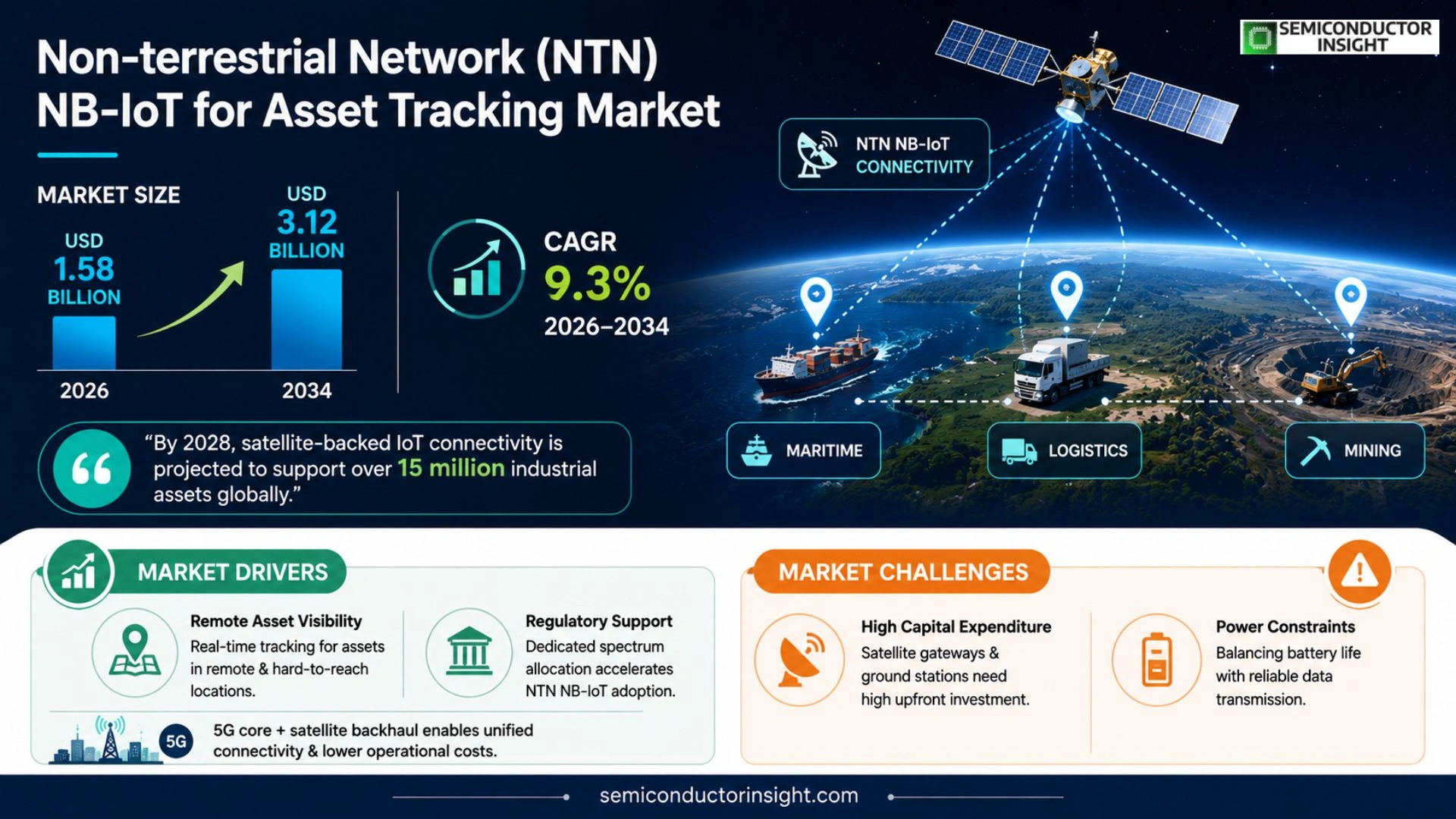
Global Non‑terrestrial network (NTN) NB‑IoT for asset tracking market size was valued at USD 1.45 billion in 2025. The market is projected to grow from USD 1.58 billion in 2026 to USD 3.12 billion by 2034, exhibiting a CAGR of 9.3% during the forecast period.
NTN NB‑IoT combines satellite‑based non‑terrestrial networks with narrowband IoT technology to deliver low‑power, wide‑area connectivity for tracking assets in remote or underserved locations where terrestrial coverage is limited or absent. This solution enables real‑time location updates, condition monitoring, and predictive maintenance for logistics chains spanning oceans, deserts, mountains, and sparsely populated regions.
The market is accelerating because enterprises are seeking resilient supply‑chain visibility and regulators are mandating traceability of high‑value goods. Moreover, the rapid deployment of low‑Earth orbit constellations,such as those operated by SpaceX Starlink, OneWeb, and LeoSat,has lowered latency and cost per device, encouraging adoption across shipping, mining, and agriculture sectors. Leading vendors including Airbus Defence & Space, Thales Alenia Space, and Qualcomm are expanding their portfolios through strategic partnerships and firmware upgrades that enhance device power efficiency and interoperability.
MARKET DRIVERS
Increasing Demand for Remote Asset Visibility
Enterprises in logistics, mining, and maritime sectors are seeking real‑time location intelligence beyond the reach of terrestrial cellular networks. The Non‑terrestrial network (NTN) NB‑IoT for asset tracking Market addresses this gap by leveraging satellite‑based low‑power wide‑area connectivity, enabling continuous monitoring of high‑value assets in remote regions.
Regulatory Support and Spectrum Allocation
Governments worldwide are allocating dedicated L‑band and S‑band spectrum for satellite IoT services, reducing interference risk and encouraging investment in NTN‑enabled NB‑IoT solutions. This regulatory momentum accelerates rollout timelines and expands the addressable market for asset‑tracking providers.
➤ “By 2028, satellite‑backed IoT connectivity is projected to support over 15 million industrial assets globally,”
In addition, the convergence of 5G core networks with satellite backhaul creates a unified architecture that simplifies device management and reduces operational costs, further driving adoption of NTN NB‑IoT asset‑tracking ecosystem.
MARKET CHALLENGES
High Initial Capital Expenditure
Deploying satellite gateways and upgrading ground stations require substantial upfront investment, which can deter small‑to‑mid‑size enterprises. While the long‑term ROI improves with scale, the payback period remains a barrier for early adopters.
Other Challenges
Power Consumption Constraints
Although NB‑IoT is designed for low power, devices operating in remote environments must balance battery longevity with the need for frequent transmission, especially in harsh weather conditions that can affect signal quality.
MARKET RESTRAINTS
Limited Coverage in Polar Regions
Current satellite constellations prioritize equatorial and mid‑latitude coverage, leaving polar and high‑latitude zones with reduced service reliability. Asset owners operating in these areas face intermittent connectivity, which can compromise tracking accuracy.
Complex Integration with Legacy Systems
Many manufacturers rely on legacy telemetry platforms that are not immediately compatible with NTN NB‑IoT protocols. Integration efforts often require custom middleware, extending project timelines and increasing costs.
Regulatory Variability Across Regions
Differences in spectrum licensing and data privacy regulations across jurisdictions can create compliance hurdles, limiting the ability to offer a uniform global service.
MARKET OPPORTUNITIES
Expansion of Low‑Earth Orbit (LEO) Constellations
The rapid deployment of LEO satellite constellations enhances latency performance and boosts bandwidth availability for NB‑IoT devices. This evolution opens new use cases such as real‑time condition monitoring of drilling equipment in offshore locations.
Growth of Integrated Smart‑City Initiatives
Smart‑city projects are incorporating asset‑tracking for public transportation fleets and waste‑management units beyond city limits, creating demand for reliable NTN‑backed NB‑IoT connectivity that transcends traditional network boundaries.
Partnerships Between Telecom Operators and Satellite Providers
Strategic collaborations enable seamless handover between terrestrial 5G and satellite links, offering end‑to‑end coverage for mobile assets. These partnerships are poised to drive market penetration and unlock new revenue streams for service providers.
Non-terrestrial network (NTN) NB-IoT for asset tracking Market Trends
Growth Enabled by Low‑Earth Orbit Constellations
The deployment of low‑Earth orbit (LEO) satellite constellations is reshaping connectivity for remote asset tracking. By providing reduced latency and lower per‑device costs, LEO networks make it feasible for logistics operators to extend real‑time monitoring to vessels crossing oceans, mining equipment in deserts, and agricultural assets in mountainous terrain. This technical shift aligns with enterprise demand for resilient, end‑to‑end supply‑chain visibility, especially where terrestrial networks are sparse or non‑existent. As a result, the Non‑terrestrial network (NTN) NB‑IoT for asset tracking Market is experiencing a steady influx of new projects that prioritize low power consumption and wide‑area coverage.
Other Trends
Regulatory and Compliance Momentum
Regulators in several regions are tightening traceability requirements for high‑value goods, prompting companies to adopt satellite‑backed NB‑IoT solutions that can certify location data across jurisdictional boundaries. Compliance frameworks now often mandate continuous condition monitoring and immutable reporting, which LEO‑enabled NB‑IoT can deliver without relying on fragmented terrestrial infrastructure. This pressure is accelerating investment in firmware upgrades that embed encryption and secure over‑the‑air updates, ensuring that asset‑tracking devices meet emerging data‑integrity standards while remaining cost‑effective.
Vertical Adoption Across Industries
Beyond logistics, sectors such as mining, agriculture, and offshore energy are integrating NTN NB‑IoT to overcome traditional connectivity gaps. Mining operators use satellite‑linked sensors to track equipment usage and predictive maintenance needs in remote pits, while farmers deploy devices that relay soil and weather metrics from fields beyond cellular reach. Offshore wind farms benefit from the ability to monitor turbine health across vast sea areas, reducing downtime through proactive alerts. Leading vendors,including Airbus Defence & Space, Thales Alenia Space, and Qualcomm,are expanding their portfolios through partnerships that streamline device certification and simplify integration for these diverse verticals.
COMPETITIVE LANDSCAPE
Key Industry Players
Competitive Landscape of NTN NB‑IoT Asset Tracking
NTN NB‑IoT market for asset tracking is currently anchored by a few vertically integrated leaders that combine satellite capacity with IoT chipset expertise. Airbus Defence & Space and Thales Alenia Space dominate the satellite‑payload side, leveraging their heritage in L‑band and S‑band constellations to provide reliable low‑power connectivity for remote sensors. Qualcomm, with its advanced NB‑IoT modem portfolio, supplies the device‑side technology that enables ultra‑low‑energy operation, a critical factor for long‑duration tracking tags. Together, these firms shape a market structure where high‑volume satellite operators partner with chipset manufacturers to offer bundled solutions, driving economies of scale and setting pricing benchmarks for enterprise customers across logistics, mining and agriculture sectors.
Beyond the core trio, a broader ecosystem of niche and emerging players enriches the competitive landscape. Low‑Earth‑orbit constellations such as SpaceX Starlink, OneWeb, and LeoSat enhance coverage density and reduce latency, while Iridium Communications offers truly global coverage through its polar orbits. European and Asian challengers including SES Networks, Huawei, Nokia and Ericsson are investing in integrated satellite‑IoT platforms to capture regional market share. North‑American entrants like Amazon’s Project Kuiper and Telesat’s LEO initiative are positioning themselves for future asset‑tracking deployments, and Alphabet’s former Loon project illustrates the potential for high‑altitude platform diversification. This mosaic of satellite operators, chipset vendors, and system integrators creates a competitive environment that incentivizes innovation, partnership, and cost‑efficiency across the value chain.
List of Key Non‑terrestrial Network (NTN) NB‑IoT for Asset Tracking Companies Profiled
- Airbus Defence & Space
- Thales Alenia Space
- Qualcomm
- SpaceX (Starlink)
- OneWeb
- LeoSat
- Iridium Communications
- SES Networks
- Huawei
- Nokia
- Ericsson
- Telesat
- Amazon Project Kuiper
- Alphabet Loon (historical)
Segment Analysis:
| Segment Category | Sub-Segments | Key Insights |
| By Type |
|
Network‑Centric NB‑IoT
|
| By Application |
|
Shipping & Maritime
|
| By End User |
|
Logistics Service Providers
|
| By Deployment Model |
|
Integrated Hybrid
|
| By Service Offering |
|
Asset Tracking + Condition Monitoring
|
Regional Analysis: North America
North America
The logistics sector in North America is grappling with challenges related to supply chain optimization and reducing asset loss. NTN NB-IoT offers solutions for tracking goods in transit, monitoring environmental conditions, and improving overall supply chain efficiency.
The utilities industry in North America utilizes NTN NB-IoT for monitoring critical infrastructure assets such as pipelines, power grids, and water systems. Real-time location tracking and condition monitoring contribute to proactive maintenance and reduced operational costs.
The transportation and fleet management segment is a key driver of the NTN NB-IoT market in North America. Tracking vehicles, monitoring driver behavior, and optimizing fleet utilization are prominent applications.
Healthcare facilities in North America are increasingly adopting NTN NB-IoT for tracking medical equipment, pharmaceuticals, and other critical assets. This enhances asset utilization and reduces the risk of loss or theft.
Europe
Europe represents another substantial market for Non-terrestrial network (NTN) NB-IoT for asset tracking. Stringent data privacy regulations and a strong emphasis on sustainability are shaping market dynamics. The focus on smart agriculture and connected infrastructure is creating new opportunities for NTN NB-IoT applications throughout the continent.
Asia-Pacific
The Asia-Pacific region, with its rapidly expanding industrial sector, presents a high-growth potential for Non-terrestrial network (NTN) NB-IoT for asset tracking market. Investments in smart cities and infrastructure development are fueling demand, particularly in countries like China and Japan.
South America
South America is witnessing increasing adoption of Non-terrestrial network (NTN) NB-IoT for asset tracking, driven by the expansion of logistics and mining industries. The need for efficient asset management in remote locations is a key factor contributing to market growth.
Middle East & Africa
The Middle East & Africa region shows promising growth prospects for Non-terrestrial network (NTN) NB-IoT for asset tracking, particularly in sectors like oil & gas, transportation, and infrastructure development. The region’s focus on digitalization and smart infrastructure is boosting market demand.
Report Scope
This market research report provides a comprehensive analysis of the Non-terrestrial network (NTN) NB-IoT for asset tracking Market , covering the forecast period 2026–2034. It offers detailed insights into market dynamics, technological advancements, competitive landscape, and key trends shaping the industry.
Key focus areas of the report include:
- Market Overview: The report begins with an overview outlining its current market scenario, key growth indicators, and industry transformation drivers. It discusses macroeconomic factors, demand–supply balance, regulatory landscape, and the strategic role of semiconductors in powering advancements across industries such as automotive, telecommunications, consumer electronics, and industrial automation.
- Market Size & Forecast: Historical data and future projections for revenue, unit shipments, and market value across major regions and segments.
- Segmentation Analysis: Detailed breakdown by product type, technology, application, and end-user industry to identify high-growth segments and investment opportunities.
- Regional Insights: Insights into market performance across North America, Europe, Asia-Pacific, Latin America, and the Middle East & Africa, including country-level analysis where relevant.
- Competitive Landscape: Profiles of leading market participants, including their product offerings, R&D focus, manufacturing capacity, pricing strategies, and recent developments such as mergers, acquisitions, and partnerships.
- Technology Trends & Innovation: Assessment of emerging technologies, integration of AI/IoT, semiconductor design trends, fabrication techniques, and evolving industry standards.
- Market Drivers & Restraints: Evaluation of factors driving market growth along with challenges, supply chain constraints, regulatory issues, and market-entry barriers.
- Stakeholder Insights: Insights for component suppliers, OEMs, system integrators, investors, and policymakers regarding the evolving ecosystem and strategic opportunities.
Primary and secondary research methods are employed, including interviews with industry experts, data from verified sources, and real-time market intelligence to ensure the accuracy and reliability of the insights presented.
FREQUENTLY ASKED QUESTIONS:
What is the current market size of Non-terrestrial network (NTN) NB-IoT for asset tracking Market?
-> Non‑terrestrial network (NTN) NB‑IoT for asset tracking market size is projected to grow from USD 1.58 billion in 2026 to USD 3.12 billion by 2034, exhibiting a CAGR of 9.3%.
Which key companies operate in Non-terrestrial network (NTN) NB-IoT for asset tracking Market?
-> Key players include Airbus Defence & Space, Thales Alenia Space, Qualcomm, among others.
What are the key growth drivers?
-> Key growth drivers include resilient supply‑chain visibility, regulatory traceability mandates, and the rapid deployment of low‑Earth‑orbit constellations that lower latency and device cost.
Which region dominates the market?
-> The source does not specify a dominant region.
What are the emerging trends?
-> Emerging trends include LEO constellation expansion, strategic partnerships, and firmware upgrades that improve power efficiency and interoperability.
Get Sample Report PDF for Exclusive Insights
Report Sample Includes
- Table of Contents
- List of Tables & Figures
- Charts, Research Methodology, and more...
 Download Sample Report PDF